
NUC-310 · Lesson 8 of 12 · 20 min
Dosimeters
Survey meters measure the radiation field at a place and a moment. Dosimeters measure what a particular person received over a period. At TVA's pressurized water reactor fleet, every worker who enters a radiological area wears at least two: a passive dosimeter that is the legal record of dose, and an electronic dosimeter that reads out in real time and alarms. Hana spends a week with the dosimetry group to see how a small badge on a lapel becomes a line in a national dose registry.
What a dosimeter must measure
Radiation protection limits are expressed in effective dose and equivalent dose, quantities that cannot be measured directly because they depend on organ doses inside the body. Dosimeters therefore measure operational quantities defined by the International Commission on Radiation Units and Measurements (ICRU). For personal monitoring, the personal dose equivalent \(H_p(d)\) is the dose equivalent in soft tissue at a depth \(d\) below a specified point on the body. \(H_p(10)\), at 10 mm, estimates effective dose from penetrating radiation. \(H_p(0.07)\), at 0.07 mm, estimates dose to the skin. \(H_p(3)\) at 3 mm is used for the lens of the eye. A dosimeter worn on the trunk and calibrated on a tissue-equivalent phantom is designed to read these quantities directly.
The limits themselves, and the reasons for them, are the subject of NUC-320. Here it is enough to know that a dosimetry service must measure doses well below the annual limits with known accuracy across the energies and types of radiation a worker meets, and that results below a reporting level are recorded consistently rather than discarded.
Thermoluminescent dosimeters
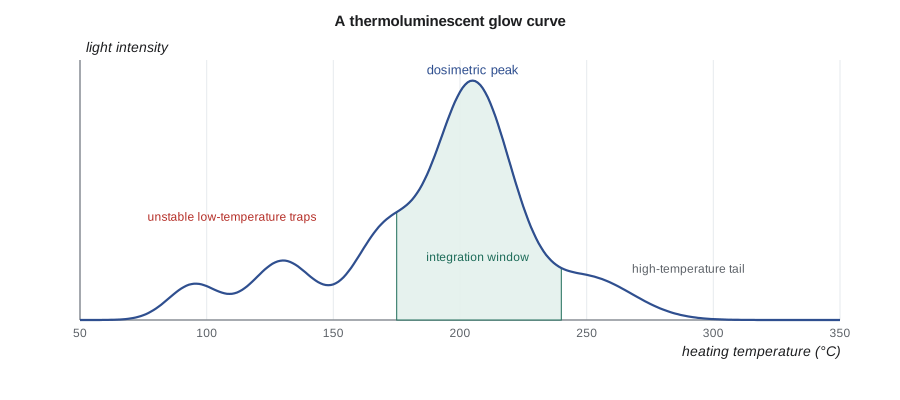
A thermoluminescent dosimeter (TLD) is a small crystal, commonly lithium fluoride doped with magnesium and titanium, LiF:Mg,Ti. Radiation frees electrons in the crystal, and some are captured in traps, defects in the lattice that hold them for months at room temperature. To read the dosimeter, it is heated in a reader. The trapped electrons are released, recombine at luminescence centers and emit light, which a photomultiplier measures. The light emitted as temperature rises, the glow curve, shows peaks for traps of different depths, and the area of the main dosimetric peaks is proportional to dose.
LiF is close to tissue in effective atomic number, so its response per unit dose varies little with photon energy, an important advantage. A badge typically holds several TLD elements behind filters of different materials and thicknesses. Comparing the readings separates penetrating photon dose from shallow beta dose and gives a rough idea of the photon energy, which is used to apply energy corrections. Lithium-6 enriched and lithium-7 enriched pairs can separate thermal neutron dose from gamma dose, since only lithium-6 responds strongly to slow neutrons.
Reading a TLD erases most of its signal, so each reading is a one-time measurement. Anneal cycles at higher temperatures reset the crystals for reuse. Low-temperature traps fade within days, so readers pre-heat to empty them or exclude them from the integration window. The main peak fades slowly, a few percent over a quarter, and the program applies a typical correction. Each element has its own sensitivity, measured by irradiating it with a known dose and stored as an element correction coefficient.
# Dosimeters: TLD readout, electronic dosimeter alarms and a monthly dose record.
# TLD: dose = (net light) x calibration factor x element correction
cal = 0.0125                # mSv per nC (illustrative reader calibration)
ecc = {'chip 1': 1.03, 'chip 2': 0.98, 'chip 3': 1.01}
reads = {'chip 1': 128.0, 'chip 2': 135.5, 'chip 3': 131.0}   # nC after background
bkg_nc = 4.0
doses = []
for c in reads:
    d = (reads[c] - bkg_nc) * cal * ecc[c]
    doses.append(d); print(f"{c}: {d:5.2f} mSv")
print(f"mean Hp(10) {sum(doses)/len(doses):4.2f} mSv")

# Fading correction: fraction remaining after storage (approx. 5 % per quarter for LiF:Mg,Ti)
for days in (30, 60, 90):
    f = 1 - 0.05 * days / 90
    print(f"read after {days} days: divide by {f:4.3f}")

# Electronic personal dosimeter: time to reach a 0.5 mSv dose alarm at several dose rates
for rate in (10, 50, 250, 1000):   # microsievert per hour
print(f"{rate:5d} uSv/h: alarm after {500/rate*60:6.1f} min")chip 1: 1.60 mSv chip 2: 1.61 mSv chip 3: 1.60 mSv mean Hp(10) 1.60 mSv read after 30 days: divide by 0.983 read after 60 days: divide by 0.967 read after 90 days: divide by 0.950 10 uSv/h: alarm after 3000.0 min 50 uSv/h: alarm after 600.0 min 250 uSv/h: alarm after 120.0 min 1000 uSv/h: alarm after 30.0 min
Optically stimulated luminescence
Optically stimulated luminescence (OSL) dosimeters store dose in the same way, as trapped charge, but read it out with light instead of heat. Aluminum oxide doped with carbon, Al₂O₃:C, is the most common material. A green light or laser stimulates the traps, and the blue luminescence is measured. Because only a small fraction of the trapped charge is released in a short stimulation, an OSL dosimeter can be read many times and re-read if a result is questioned. OSL materials are very sensitive and are widely used in commercial dosimetry services. Their higher effective atomic number than tissue means they over-respond to low-energy photons, so badges use filters to flatten and correct the energy response.
Electronic personal dosimeters
An electronic personal dosimeter (EPD) uses one or more silicon diodes, sometimes with filters to shape the energy response, to count photon and beta interactions and convert them to dose and dose rate. It displays both in real time, logs the history, and alarms when a preset dose or dose rate is exceeded. EPDs are the backbone of dose control during work: they are read at the entrance and exit of each controlled area and linked to the work permit, so the station knows how much dose each job is costing as it happens.
The program shows how alarm settings relate to dose rate. A 0.5 mSv dose alarm triggers after 50 hours at 10 µSv/h but after only 30 minutes at 1 mSv/h. Dose rate alarms give earlier indication of an unexpected field, such as a shield left off or a hot spot in a pipe. Workers are trained to stop work and leave the area on any unexpected alarm and to report it.
EPDs have limitations. Silicon diodes respond poorly to very low-energy photons and to neutrons unless specially designed, and they can be affected by strong radiofrequency fields and by pulsed radiation from some X-ray sources. Batteries fail, and a dosimeter dropped in water or crushed may stop working. For these reasons most jurisdictions treat the passive dosimeter, not the EPD, as the dose of record, although some approve EPDs for that role when the service meets the same accreditation requirements.
Neutron and extremity dosimeters
Neutron dose is harder to measure. Albedo dosimeters use pairs of lithium TLDs to detect thermal neutrons reflected from the body, which reflect the incident fast neutron field. Their response depends strongly on the neutron spectrum and must be calibrated for each workplace, using spectra measured with Bonner spheres (lesson 6). Track-etch dosimeters, such as CR-39 plastic, record fast-neutron proton recoils as tiny damage tracks that are enlarged by chemical etching and counted under a microscope. Bubble detectors, small vials of superheated droplets in a gel, form visible bubbles when neutrons deposit energy, and give a direct visual count useful for job surveys.
Extremity dosimeters, usually TLD chips mounted in rings, measure dose to hands and fingers when workers handle sources or contaminated items, where the hand dose can be many times the body dose. Lens of the eye dosimeters worn near the eyes are used for work in high beta fields or near X-ray equipment, where the lens dose may approach its limit before the whole-body dose does.
| Dosimeter | Principle | Readout | Typical role |
|---|---|---|---|
| TLD (LiF:Mg,Ti) | Trapped charge released by heat | Destructive, once | Dose of record, extremities |
| OSL (Al₂O₃:C) | Trapped charge released by light | Re-readable | Dose of record |
| Electronic dosimeter | Silicon diode counting | Real time, alarms | Dose control during work |
| Albedo TLD pair | Thermal neutrons reflected from the body | Destructive | Neutron dose of record |
| Track-etch (CR-39) | Recoil-proton damage tracks | Etching and counting | Fast neutron dose |
| Bubble detector | Superheated droplets | Count visible bubbles | Neutron job surveys |
Dosimetry services and records
In the United States, 10 CFR 20.1501 requires that personnel dosimeters used to meet the NRC's monitoring requirements be processed by a dosimetry processor holding current accreditation from the National Voluntary Laboratory Accreditation Program (NVLAP), which tests processors against national performance standards. Licensees keep individual monitoring records and report annual doses to the NRC's radiation exposure information reporting system, REIRS.
Accreditation testing irradiates sample dosimeters with known doses in several categories of radiation type and energy, and the service must report results within set tolerances. Within the station, the dosimetry group compares each worker's passive dosimeter result with the sum of EPD readings for the same period. Large discrepancies are investigated, because they can reveal a lost or damaged dosimeter, a badge left in a radiation area, or a field that one type of dosimeter does not measure well.
Dose reconstruction is needed when a dosimeter is lost or a result is clearly wrong. It uses survey records, EPD logs, time in each area and the readings of co-workers on the same job to estimate the dose, documented in the worker's record. A dosimeter that was not worn correctly, for example under a lead apron when it should have been outside, also needs correction. Hana sees how much of dosimetry is careful record keeping rather than physics.
Wearing and handling dosimeters
A dosimeter only measures the dose at the point where it is worn. The usual position is on the front of the trunk, between the waist and the neck, facing the source of radiation. When a lead apron is worn, as in some medical and industrial work, the dosimeter of record goes under the apron and a second dosimeter may be worn at the collar outside it, and the two are combined with an algorithm to estimate effective dose. When the head or hands are closer to the source than the trunk, additional dosimeters are worn there. Workers are trained never to leave dosimeters in radiation areas when they are not wearing them, never to wear another person's dosimeter, and to report a lost or damaged dosimeter at once.
Control dosimeters are kept in a low-background location and processed with each batch to measure the dose received in transit and storage, which is subtracted from the workers' results. A batch with an unusually high control result, perhaps because the package passed through an airport X-ray scanner or sat near a source, is investigated before any worker results are released.
Retrospective and emergency dosimetry
When no dosimeter was worn, or an exposure far exceeded the dosimeter's range, other methods estimate dose after the fact. Electronic devices such as mobile phones contain materials that can be read by luminescence techniques. Biological dosimetry counts chromosome aberrations in blood lymphocytes, which increase with dose above roughly 0.1 Gy. Activation of sodium in blood or of sulfur in hair can indicate neutron exposure. These methods are specialized and used only after rare events, but they show that a dose record can be reconstructed when the normal system fails, and they are part of emergency preparedness planning.
Dose records over a career
A worker's dose record follows them for life. When a technician moves from one station or employer to another, their previous dose is obtained from the national registry or from previous employers before they are allowed to work in radiation areas, so that annual and multi-year limits apply across employers. Records include the type of radiation, the dosimeter type and any assigned or reconstructed doses. Workers have the right to see their own records, and dosimetry services must protect the privacy of personal information while making doses available to those entitled to them.
Dosimetry services also test their own systems continuously. Each batch of dosimeters read includes quality control dosimeters irradiated to known doses, and the reader's calibration is confirmed before worker results are processed. A result that falls outside the expected range for the control dosimeters stops the batch until the cause is found, in the same way that a failed check source stops a counter in the counting room.
Hana's summary
Hana's notes for the week describe a two-layer system. Passive TLD or OSL badges, read by an accredited service, provide the legal dose of record, with corrections for energy, fading and background. Electronic dosimeters give real-time control and alarms. Neutron and extremity dosimeters fill specific gaps. And a reconciliation between them, done every period, is what makes the records trustworthy. She adds a note for NUC-320: the dose quantities and limits behind the readings deserve a course of their own.
Summary and key terms
- Dosimeters measure personal dose equivalent H_p(10), H_p(0.07) and H_p(3) defined by ICRU.
- TLDs store dose as trapped charge read out by heating; glow curves show trap depths.
- OSL dosimeters are read with light and can be re-read; they need energy-response filters.
- Electronic dosimeters give real-time dose, dose rate and alarms for dose control.
- Albedo, track-etch and bubble detectors handle neutrons; ring dosimeters measure extremity dose.
- Dosimetry services are licensed or accredited, and doses of record go to national registries.
- Personal dose equivalent
- Dose equivalent in soft tissue at a specified depth below a point on the body.
- Thermoluminescence
- Light emitted on heating as trapped charge recombines.
- Glow curve
- Light output against temperature during TLD readout.
- Optically stimulated luminescence
- Light emitted when trapped charge is released by optical stimulation.
- Electronic personal dosimeter
- A real-time dosimeter using semiconductor detectors with alarms.
- Albedo dosimeter
- A neutron dosimeter that detects thermal neutrons reflected from the body.
- Dose of record
- The dose officially recorded for a worker for regulatory purposes.
Practice problems
Work each problem on paper first, then reveal the answer to check.
What does H_p(10) estimate?
Show answer
Effective dose from penetrating radiation.
A TLD reads 104 nC net with a calibration of 0.0125 mSv/nC and an element factor of 1.02. Dose?
Show answer
104 × 0.0125 × 1.02 ≈ 1.33 mSv.
Why can an OSL badge be re-read?
Show answer
Brief stimulation releases only a small fraction of the trapped charge.
How long until a 0.2 mSv alarm at 400 µSv/h?
Show answer
0.2/0.4 h = 30 min.
Why are albedo dosimeters calibrated for each workplace?
Show answer
Their response depends strongly on the neutron spectrum.
Why compare passive dosimeter results with EPD totals?
Show answer
To detect lost, damaged or misused dosimeters and unmeasured fields.
Lesson quiz · 5 questions
Score 60% or more to complete this lesson.
Create a free account to save your progress, take quizzes and earn a certificate.