
NUC-310 · Lesson 6 of 12 · 20 min
Neutron detection
Neutrons are the reason a reactor works, and measuring them is the reason reactor instrumentation exists. Yet a neutron has no charge, so it passes through a gas or a crystal without ionizing anything. Every neutron detector therefore relies on a nuclear reaction that turns the neutron into charged particles. This week Dr. Vasquez borrows Hana back from the counting room to help with the start-up neutron instrumentation for TVA's pressurized water reactor fleet, and Marcel lends her a neutron survey meter for the area surveys she must do on the way.
Converting neutrons into charged particles
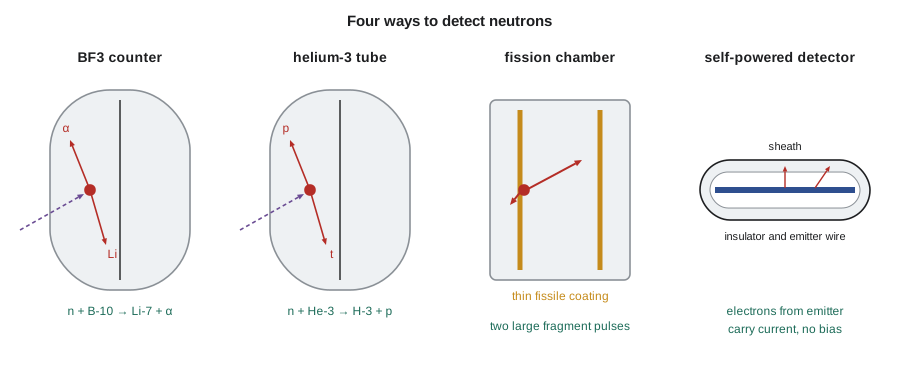
For slow neutrons, the useful reactions are those with very large thermal cross sections that release energetic charged particles. Three dominate practice:
The fourth is fission. In a fission chamber, a thin coating of fissile or fissionable material lines the electrodes, and each fission sends two heavy fragments carrying about 160 MeV between them into the gas. The pulses are enormous compared with gamma-ray pulses, which makes fission chambers excellent for separating neutrons from an intense gamma background.
The Q-value matters because it sets the pulse size. The reaction products carry the Q-value as kinetic energy, much more than the energy of a slow neutron, so the pulse height is almost independent of neutron energy. That is good for counting and bad for spectroscopy. A slow-neutron detector tells you how many neutrons arrived, not how fast they were moving.
# Neutron detection: reaction Q-values, detector efficiency and SPND signals.
import math
reactions = {'B-10(n,alpha)': (2.31, 3840), 'He-3(n,p)': (0.764, 5330), 'Li-6(n,t)': (4.78, 940), 'U-235 fission': (200.0, 585)}
for r, (Q, sig) in reactions.items():
    print(f"{r:15s}: Q about {Q:6.2f} MeV, thermal cross section {sig:5d} b")

# Efficiency of a 2.5 cm diameter He-3 tube at 4 atm for thermal neutrons (path ~ 2 cm average)
N = 4 * 2.69e19          # atoms per cm3 (ideal gas at 0 C, approx.)
sigma = 5330e-24
for L in (1.0, 2.0, 2.5):
    eff = 1 - math.exp(-N * sigma * L)
    print(f"path {L:3.1f} cm: thermal efficiency {100*eff:5.1f} %")

# Rhodium self-powered detector: prompt fraction small, signal follows Rh-104 decay (T1/2 42 s)
lam = math.log(2) / 42.3
I_eq = 1.0                  # normalized equilibrium current
print("\nresponse of a rhodium detector to a step increase in flux")
for t in (0, 20, 42, 84, 126, 210):
print(f"t = {t:4d} s: signal {I_eq*(0.07 + 0.93*(1-math.exp(-lam*t))):5.2f} of final value")B-10(n,alpha) : Q about 2.31 MeV, thermal cross section 3840 b He-3(n,p) : Q about 0.76 MeV, thermal cross section 5330 b Li-6(n,t) : Q about 4.78 MeV, thermal cross section 940 b U-235 fission : Q about 200.00 MeV, thermal cross section 585 b path 1.0 cm: thermal efficiency 43.6 % path 2.0 cm: thermal efficiency 68.2 % path 2.5 cm: thermal efficiency 76.2 % response of a rhodium detector to a step increase in flux t = 0 s: signal 0.07 of final value t = 20 s: signal 0.33 of final value t = 42 s: signal 0.53 of final value t = 84 s: signal 0.77 of final value t = 126 s: signal 0.88 of final value t = 210 s: signal 0.97 of final value
Boron trifluoride and boron-lined counters
A BF₃ proportional counter is filled with boron trifluoride gas enriched in boron-10. A neutron absorbed in the gas produces an alpha particle and a lithium-7 nucleus that together deposit 2.3 or 2.8 MeV, giving pulses far larger than those from gamma-ray electrons. A pulse height discriminator set below the neutron peak and above the gamma pulses gives a clean neutron count even in moderate gamma fields. The wall effect, in which one product hits the wall before depositing all its energy, produces a continuum below the main peaks that the discriminator must allow for.
BF₃ is toxic and corrosive, which has led to restrictions on its use and transport. Boron-lined proportional counters avoid the gas by coating the walls with boron, at the cost of lower efficiency, since only one product enters the gas. Both types are used as start-up and source-range detectors, because they count individual neutrons with high sensitivity and reject gamma rays well.
Helium-3 counters
Helium-3 has a thermal cross section of about 5330 barns, the largest of the common converters, and it is an inert gas that can be used at several atmospheres of pressure. He-3 proportional counters have high efficiency, good gamma rejection and long life. The program estimates that a tube with a 2.5 cm path through 4 atm of helium-3 absorbs about three-quarters of the thermal neutrons that cross it.
Helium-3 is produced almost entirely from the decay of tritium, and its supply has been limited for years. That has driven development of alternatives, including boron-coated straw detectors, lithium-6 glass and lithium-6 doped scintillators, for applications such as portal monitors, while He-3 is reserved for uses where its properties are hard to match.
Fission chambers
Fission chambers are the most versatile reactor neutron detectors. Coated with highly enriched uranium-235 for sensitivity to thermal neutrons, or with uranium-238 or thorium-232 for a fast-neutron threshold response, they can be operated in pulse mode at low power, in a fluctuation (Campbell) mode in the intermediate range, and in current mode at high power. Their large fragment pulses let them count neutrons in gamma fields that would swamp a BF₃ counter. Their main drawbacks are fuel depletion of the coating at high fluence and the need for licensing and control of the fissile material they contain.
Ionization chambers for neutron flux
At power, the neutron flux is high enough that the current from an ion chamber lined with boron-10 is easily measured. The trouble is that gamma rays also ionize the gas, and near a reactor core the gamma current can be large. A compensated ion chamber (CIC) solves this with two volumes: one boron-lined and sensitive to neutrons plus gamma rays, the other unlined and sensitive to gamma rays only. Subtracting the two currents electrically leaves a current proportional to neutron flux. Compensation is needed in the intermediate range, where gamma currents from decaying fission products can still be comparable to the neutron signal after shutdown. At high power, the neutron current dominates and uncompensated ion chambers are adequate.
Self-powered neutron detectors
A self-powered neutron detector (SPND) is a coaxial cable a few millimeters thick with a central emitter wire, a mineral insulator and a metal sheath. Neutrons are captured in the emitter, which then emits electrons, either directly in prompt capture reactions or after a beta decay. Some electrons cross the insulator and reach the sheath, producing a tiny current with no external voltage needed. SPNDs are small, rugged and inexpensive enough to install in large numbers inside the core, and they map the flux distribution in real time.
The choice of emitter sets the response. Rhodium and vanadium emitters respond through beta decay of the activated nucleus: rhodium-104 with a half-life of about 42 seconds and vanadium-52 with about 3.7 minutes. Their signals are large and proportional to flux but lag a step change, as the program shows for rhodium, which takes several minutes to reach its new value. Cobalt, platinum and inconel emitters respond promptly through capture gamma rays and Compton electrons, giving signals fast enough for reactor protection systems at the cost of smaller current and some gamma sensitivity. Emitters also burn up with fluence, so their sensitivity falls slowly over years and is corrected in the core monitoring software.
PWRs typically use movable miniature fission chambers or fixed rhodium SPND strings inserted into instrument thimbles in selected fuel assemblies to map the core, and ex-core ion chambers and fission chambers for protection. BWRs use local power range monitors, small fission chambers in strings between fuel bundles.
Fast neutrons and moderated detectors
Slow-neutron detectors are nearly blind to fast neutrons, because the converter cross sections fall roughly as \(1/v\) and are tiny at MeV energies. The simplest solution is to surround a thermal detector with a moderator, usually polyethylene. Fast neutrons slow down in the moderator and some reach the detector at thermal energy. The thickness of moderator shapes the response: a sphere of about 25 to 30 cm diameter around a small thermal detector has a response roughly proportional to neutron dose equivalent over a wide energy range.
That principle is behind the moderated neutron survey meters Hana carries, often called rem meters or remmeters for historical reasons even though modern instruments read in microsieverts per hour. Their large spheres or cylinders are heavy, but they give a dose reading without needing to know the spectrum. Bonner sphere sets, a series of spheres of different diameters measured in turn, unfold a rough neutron spectrum and are used to calibrate instruments for a particular workplace.
Fast neutrons can also be detected directly. Organic scintillators record proton recoils from elastic scattering on hydrogen, and with pulse shape discrimination (lesson 3) they separate neutron and gamma events. Threshold activation foils, such as sulfur, nickel and aluminum, become radioactive only above certain neutron energies and, counted afterwards, give information on the fast spectrum. These are tools for specialists, used in reactor dosimetry for pressure vessel surveillance and in calibration facilities.
Practical considerations
| Detector | Neutron range | Mode | Typical use |
|---|---|---|---|
| BF₃ or boron-lined counter | Thermal | Pulse | Start-up and source range |
| He-3 counter | Thermal (moderated for fast) | Pulse | Survey meters, research |
| Fission chamber | Thermal or fast threshold | Pulse, Campbell or current | Wide-range reactor instrumentation |
| Compensated ion chamber | Thermal | Current | Intermediate range |
| Self-powered detector | Thermal | Current, no bias | In-core flux mapping and protection |
| Moderated sphere survey meter | Thermal to about 10 MeV | Pulse | Neutron dose equivalent rate |
Neutron measurements are more uncertain than gamma measurements. Survey meter response varies with the neutron spectrum, which changes behind shielding and near different sources, so instruments are calibrated in a known spectrum and sometimes given workplace correction factors. Albedo and track-etch personal dosimeters (lesson 8) have similar limits. When Hana reports a neutron dose rate near the reactor's shielding penetrations, Marcel asks her to record which instrument and calibration she used, because a factor of two difference between meters is not unusual.
Gamma discrimination in practice
Every neutron detector near a reactor sits in a gamma field, often far stronger than the neutron field in terms of energy deposited. Pulse-mode counters handle it with a discriminator, but in very high gamma fields gamma pulses pile up into large pulses that can exceed the threshold. Setting the discriminator therefore uses a measured pulse height spectrum: the threshold sits in the valley between the gamma pile-up region and the neutron peak, and it is checked whenever the detector or its surroundings change. Fission chambers have the largest margin, which is why they are favored for source-range use in high gamma fields after shutdown.
In current mode, gamma rays add a current that cannot be separated by pulse height. Compensation, described above, is one answer. Another is the Campbell or mean-square-voltage technique, which measures the variance of the signal rather than its mean. The variance is proportional to the rate of events times the square of the charge per event, so the large charge from fission fragments dominates the small charges from gamma rays even when the gamma rate is high. Wide-range fission chamber channels use counting, Campbell and current modes in turn to cover about ten decades with a single detector.
Neutron instruments in the field
Hana's area surveys around shielding penetrations teach her the practical side. Neutron survey meters are heavy, have a slow response at low rates, and can be confused by intense gamma fields if the gamma rejection is poor. They are checked daily with a neutron check source, often americium-beryllium or californium-252 in a shielded holder. Because neutron fields can change sharply over short distances near penetrations and gaps in shielding, surveys use small step sizes and record the meter's position as well as its reading.
Hana's start-up checklist
The start-up group's checklist that Hana helps prepare follows from the physics. Before approach to critical, the source-range counters must show a count rate well above their noise from the installed neutron source, and their discriminator settings must be confirmed with a pulse height spectrum. Intermediate-range chambers must show overlap with the source range over at least one decade. And the in-core detectors' readings must be compared with predicted flux shapes once power rises. Lesson 9 follows the instruments through that approach to power.
Summary and key terms
- Neutrons are detected through reactions that produce charged particles: ¹⁰B(n,α), ³He(n,p), ⁶Li(n,t) and fission.
- Large Q-values give large pulses, good gamma rejection and little energy information.
- BF₃ and boron-lined counters serve the source range; He-3 counters are efficient but scarce.
- Fission chambers work from pulse to current mode; compensated ion chambers remove gamma current.
- Self-powered detectors map in-core flux; rhodium and vanadium respond with a decay delay, cobalt and platinum promptly.
- Moderated detectors and Bonner spheres measure fast neutrons and dose equivalent.
- Converter
- A nuclide that absorbs neutrons and emits charged particles a detector can see.
- Q-value
- The energy released in a nuclear reaction.
- Fission chamber
- An ionization chamber coated with fissile or fissionable material.
- Compensated ion chamber
- A two-volume chamber that subtracts gamma current from neutron-plus-gamma current.
- Self-powered neutron detector
- An in-core detector whose current comes from electrons emitted after neutron capture.
- Moderated detector
- A thermal neutron detector inside a moderator that makes it sensitive to fast neutrons.
- Bonner spheres
- A set of moderating spheres of different sizes used to estimate a neutron spectrum.
Practice problems
Work each problem on paper first, then reveal the answer to check.
Why is a BF₃ counter's pulse height nearly independent of neutron energy?
Show answer
The 2.3–2.8 MeV reaction energy far exceeds a slow neutron's energy.
Using the program, about what fraction of thermal neutrons does a 1 cm path in 4 atm He-3 absorb?
Show answer
About 44 %.
How long does a rhodium SPND take to reach about 90 % of a new flux level?
Show answer
Roughly two to two and a half minutes (about three half-lives of 42 s).
What does a compensated ion chamber compensate for?
Show answer
The gamma-ray contribution to the chamber current.
Why are neutron survey meters large and heavy?
Show answer
They need a thick moderator to slow fast neutrons for a thermal detector.
Name one alternative to helium-3 for neutron detection.
Show answer
Boron-coated straws, lithium-6 glass or lithium-6 doped scintillator.
Lesson quiz · 5 questions
Score 60% or more to complete this lesson.
Create a free account to save your progress, take quizzes and earn a certificate.