
NUC-310 · Lesson 2 of 12 · 22 min
Gas-filled detectors
The oldest radiation detectors are still the most common. Every survey meter on Marcel's shelf, the area monitors on the walls of TVA's pressurized water reactor fleet, the contamination monitors at the exits and the ion chambers that measure reactor power all rely on the same principle: radiation ionizes a gas, and an electric field collects the charge. Hana's second assignment is to work out why the team keeps three different kinds of gas detector, and when each one gives the right answer.
Ionization in a gas
A charged particle passing through a gas loses energy in collisions that knock electrons from atoms, leaving positive ions behind. The average energy spent per ion pair formed is called the W-value. It is larger than the ionization energy of the gas because part of the energy goes into excitation, not ionization. Typical W-values are about 34 eV in air, 26 eV in argon and 30 eV in methane, and they are nearly independent of the type and energy of the radiation. That near constancy is what makes gas detectors useful for measuring energy deposited and therefore dose.
Photons do not ionize directly. They first transfer energy to electrons through the photoelectric effect, Compton scattering or pair production, either in the gas or, more often, in the detector wall. The electrons then ionize the gas. Neutrons need a converter, such as boron-10 or helium-3, and are the subject of lesson 6.
Worked problem
Charge from a single alpha particle
A 5.0 MeV alpha particle stops completely in air. How many ion pairs does it form, and how much charge is that?
Show solution
- \(N = 5.0 \times 10^{6} / 33.97 = 1.47 \times 10^{5}\) ion pairs.
- \(Q = 1.47 \times 10^{5} \times 1.602 \times 10^{-19} = 2.4 \times 10^{-14}\) C.
Answer: About 24 fC. Collected in a few microseconds, that is a tiny but measurable pulse, which is why alpha particles can be counted one at a time in a simple ion chamber with a sensitive amplifier.
The six regions of a gas detector
Imagine a gas-filled cylinder with a thin wire along its axis, the wire held positive with respect to the wall. Put the same radiation source near it and raise the voltage step by step while recording the charge collected per event. The curve that results is the classic map of gas detector behavior.
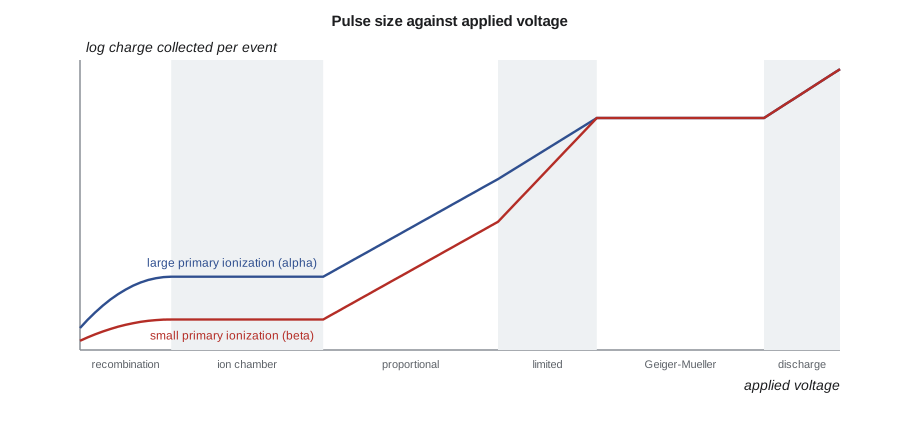
At very low voltage, many ions and electrons recombine before they reach the electrodes, and the signal rises with voltage. In the ion chamber region, the field is strong enough to collect essentially every primary ion pair, but not strong enough to make more. The signal is flat with voltage and equal to the primary ionization. Raise the voltage further and electrons near the thin wire gain enough energy between collisions to ionize gas themselves. Each primary electron starts a small avalanche, multiplying the charge by a gas gain \(M\) that can range from tens to tens of thousands. Because every avalanche is independent and local, the collected charge stays proportional to the primary ionization. This is the proportional region.
At still higher voltage the avalanches interact through space charge and proportionality is lost (the limited proportional region). Finally, in the Geiger-Mueller region, ultraviolet photons from each avalanche start new avalanches along the whole wire until the discharge is limited by the positive ion sheath. Every event, large or small, now gives the same large pulse. Beyond that region the gas breaks down into continuous discharge, which damages the detector.
Ion chambers
An ion chamber collects the primary ionization without multiplication. It is usually operated in current mode: the steady current from many events is measured, rather than individual pulses. Since the current is proportional to the energy deposited in the gas per unit time, an air-filled chamber with air-equivalent walls measures exposure rate or air kerma rate directly, and with a suitable wall it approximates tissue dose. That is why the ion chamber is the reference instrument for dose rate surveys and for calibration laboratories.
Exposure is defined as charge liberated per unit mass of air, and one roentgen is \(2.58 \times 10^{-4}\) C/kg. The current from a chamber of volume \(V\) is therefore
# Gas-filled detectors: ion pairs, ion chamber current, proportional gain and GM dead-time losses.
W_air = 33.97        # eV per ion pair in air (approx.)
E = 5.0e6            # alpha particle energy, eV
n = E / W_air
print(f"ion pairs from a 5 MeV alpha in air: {n:.3e}")
q = 1.602e-19
print(f"charge collected: {n*q*1e15:.1f} fC")

# Ion chamber current from an exposure rate: 1 R = 2.58e-4 C/kg of air
rho_air = 1.205e-3   # g/cm3 at 20 C, 101.3 kPa
V = 500.0            # cm3 chamber volume
for mR_h in (0.02, 2.0, 200.0):
    I = mR_h * 1e-3 * 2.58e-4 * (rho_air * V * 1e-3) / 3600
    print(f"{mR_h:7.2f} mR/h -> chamber current {I:.2e} A")

# Proportional counter: same primary charge, different gas gain
for M in (1, 100, 1000, 10000):
    print(f"gas gain {M:6d}: charge per 5.9 keV X-ray {5900/26.4*M*q*1e15:.3f} fC")

# GM counter losses with a 100 microsecond dead time (non-paralyzable)
tau = 100e-6
for m in (100, 1000, 5000):
    true = m / (1 - m * tau)
print(f"measured {m:5d} cps -> true {true:7.0f} cps ({100*(true-m)/true:4.1f} % lost)")ion pairs from a 5 MeV alpha in air: 1.472e+05 charge collected: 23.6 fC 0.02 mR/h -> chamber current 8.64e-16 A 2.00 mR/h -> chamber current 8.64e-14 A 200.00 mR/h -> chamber current 8.64e-12 A gas gain 1: charge per 5.9 keV X-ray 0.036 fC gas gain 100: charge per 5.9 keV X-ray 3.580 fC gas gain 1000: charge per 5.9 keV X-ray 35.802 fC gas gain 10000: charge per 5.9 keV X-ray 358.023 fC measured 100 cps -> true 101 cps ( 1.0 % lost) measured 1000 cps -> true 1111 cps (10.0 % lost) measured 5000 cps -> true 10000 cps (50.0 % lost)
The program shows the challenge. A 500 cm³ chamber in a field of 2 mR/h produces less than \(10^{-13}\) A, a fraction of a picoampere. Measuring such currents needs electrometers with very high input resistance, guard rings to stop leakage currents across insulators, and careful attention to humidity and cable movement. Large-volume and pressurized chambers help at low dose rates. Above a few sieverts per hour the opposite problem appears, and recombination in the gas can reduce the reading unless the collecting voltage is high enough.
Hand-held ion chamber survey meters are the standard instrument for measuring gamma dose rates around reactor systems, shielded sources and radiography work. They have a flat energy response over a wide range, respond slowly at low dose rates because of the time constants needed to average the tiny current, and are usually fitted with a thin window or removable beta shield so the user can estimate beta dose separately from gamma dose.
Proportional counters
A proportional counter combines pulse counting with energy information. Each event gives a pulse whose size is proportional to the energy deposited, so the counter can separate alpha particles, which deposit a great deal of energy, from beta particles and gamma rays, which deposit far less. That property is the basis of the gas-flow proportional counter used in counting rooms for smears and air filters, and of the large-area contamination monitors at site exits.
Common fill gases are P-10, a mixture of 90 % argon and 10 % methane, and pure methane. The methane acts as a quench gas, absorbing ultraviolet photons that would otherwise spread the discharge along the wire. In gas-flow counters the gas flows continuously through the chamber, so the sample can be placed inside with no window at all, or behind a very thin window. That gives high efficiency for low-energy beta emitters and alpha particles that a sealed detector could never see.
By choosing the operating voltage, a technician can set the counter to an alpha plateau, where only the large alpha pulses exceed the discriminator, or an alpha-plus-beta plateau, where both are counted. Subtracting gives the beta count. Some crosstalk always occurs: a few beta pulses are counted as alpha particles and some alpha pulses fall into the beta channel. The spillover fractions are measured with pure sources and corrected for in the calculation.
The gas gain depends steeply on voltage, typically doubling for every few tens of volts, and also on gas density. A proportional counter's high voltage supply must be stable, and its calibration is checked when the gas bottle is changed, because small differences in composition shift the gain.
Geiger-Mueller counters
The Geiger-Mueller (GM) counter gives a large pulse, often a volt or more, for every event that produces even one ion pair in the gas. It needs very little electronics, which makes it cheap, rugged and very sensitive for detecting the presence of radiation. A pancake GM probe with a thin mica window is the first instrument most radiation workers learn to use for contamination surveys of hands, feet and equipment.
The same feature limits it. Because every pulse is the same size, a GM counter carries no information about energy and cannot tell an alpha particle from a beta particle or a photon. Its response to gamma rays depends strongly on energy, because photons interact mainly in the wall, and an uncompensated GM tube can over-respond to low-energy photons by a factor of several. Energy-compensated GM detectors use metal filters to flatten the response, at some cost in sensitivity.
After each discharge, the positive ions take a hundred microseconds or so to drift away from the wire. During that time the field is too weak for another discharge, and the counter is dead. The dead time limits GM counters to a few thousand counts per second before losses become large, as the program shows: with a 100 µs dead time, 10 % of events are lost at 1000 counts per second and half at 5000. In a very high field, some GM instruments can saturate and read low or even zero. Modern survey meters detect this and display an over-range indication, but older ones may not, which is why high-range work uses ion chambers.
A GM tube also needs quenching to stop the discharge from repeating. Organic quench gases are consumed with each pulse and limit tube life; halogen quench gases such as chlorine or bromine recombine and give a much longer life, which is why halogen-quenched tubes dominate today.
Practical problems in the field
Gas detectors fail in predictable ways, and a technician who knows them can spot a bad reading before it becomes a bad decision. Thin windows are the weak point of pancake probes and proportional counters. A punctured mica window lets air into a sealed GM tube, and the probe either stops counting or begins to count erratically. A torn aluminized Mylar window on a gas-flow counter lets light in, which some detectors register as noise. Windows are checked visually before use and protected with screens.
Humidity and dirt cause leakage currents across insulators. In an ion chamber those currents are indistinguishable from signal and show up as a reading with no source present, or as a slow drift. Moving a cable can also produce a burst of charge, so ion chamber readings are taken with the instrument held still. Temperature and pressure change the mass of gas in an open-air chamber, and precise measurements correct the reading to reference conditions with a simple density ratio.
Gas supply matters for flow counters. If the bottle runs low or the flow rate is set wrong, air diffuses into the chamber, the gas gain falls and the count rate drops without any obvious alarm. Daily source checks catch this, and good laboratories log the gas flow rate and bottle pressure with every batch of samples. Finally, every gas detector has a plateau that shifts slowly with age, so the operating voltage is re-checked at each calibration.
Choosing the right gas detector
| Task | Usual choice | Reason |
|---|---|---|
| Gamma dose rate survey | Ion chamber | Flat energy response; measures energy deposited |
| Finding contamination quickly | Pancake GM probe | High sensitivity, simple, rugged |
| Counting smears and air filters | Gas-flow proportional counter | High efficiency; separates alpha and beta |
| Personnel exit monitoring | Large-area proportional detectors | Sensitive to beta over large areas |
| Reactor power measurement | Ion chambers in current mode | Wide range; long life in high fields |
| Very low dose rates | Pressurized ion chamber | Larger signal; stable response |
At the TVA sites Hana visits, every portable instrument is checked against a calibrated source before use and returned for full calibration at a fixed interval. Under 10 CFR Part 20, instruments used for required surveys must be calibrated periodically for the radiation measured, and many US laboratories follow ANSI N323 for portable instrument calibration.
Hana's summary
Hana's note to Marcel lists the three detector types by what they measure. The ion chamber measures energy deposited and therefore dose, at the cost of tiny currents. The proportional counter counts events and measures their energy, which lets it tell alpha from beta. The GM counter counts events with very high sensitivity but no energy information, and it saturates at high rates. Each instrument on the shelf is the right tool for one job and the wrong tool for others, and the most common errors in the field come from using a GM probe where an ion chamber reading is needed.
Summary and key terms
- Gas detectors collect ion pairs formed by radiation; the W-value is about 34 eV in air.
- Raising voltage takes a detector through recombination, ion chamber, proportional and Geiger-Mueller regions.
- Ion chambers measure current proportional to energy deposited and are the reference dose rate instrument.
- Proportional counters multiply charge while keeping pulse size proportional to energy, so they separate alpha and beta.
- GM counters give equal large pulses, are very sensitive, have no energy information and suffer dead-time losses.
- Quench gas, gas composition and high voltage stability control detector performance.
- W-value
- The average energy spent per ion pair formed in a gas.
- Ion chamber
- A gas detector that collects primary ionization without multiplication.
- Gas gain
- The multiplication of charge by avalanches near the anode wire.
- Proportional counter
- A gas detector with gas gain whose pulse size stays proportional to deposited energy.
- Geiger-Mueller counter
- A gas detector in which every event triggers a full discharge of equal size.
- Quench gas
- A gas component that stops the discharge from spreading or repeating.
- Plateau
- A range of voltage over which a counter's count rate changes little.
Practice problems
Work each problem on paper first, then reveal the answer to check.
How many ion pairs does a 1 MeV electron form if all its energy is deposited in argon?
Show answer
10⁶/26 ≈ 3.8 × 10⁴.
Why is an ion chamber preferred for gamma dose rate measurement?
Show answer
Its signal is proportional to energy deposited and its energy response is flat.
What does the methane in P-10 gas do?
Show answer
It quenches the avalanche by absorbing ultraviolet photons.
A GM counter with 100 µs dead time reads 2000 cps. Estimate the true rate.
Show answer
2000/(1 − 0.2) = 2500 cps.
Why can't a GM counter separate alpha and beta particles?
Show answer
Every event gives the same full discharge pulse.
What happens to an ion chamber reading at very high dose rate if the voltage is too low?
Show answer
Recombination reduces the collected charge, so it reads low.
Lesson quiz · 5 questions
Score 60% or more to complete this lesson.
Create a free account to save your progress, take quizzes and earn a certificate.