
NUC-310 · Lesson 3 of 12 · 20 min
Scintillation detectors
Gas detectors are excellent for dose rate and for counting charged particles, but they are poor at stopping gamma rays. A gas has too few atoms per cubic centimeter to absorb a 662 keV photon in a reasonable volume. When Marcel's team needs to identify which gamma emitters are present in a waste drum, or count very low levels of activity in a water sample, they turn to solid detectors. The oldest and still the most widely used of these is the scintillator, a material that turns the energy of radiation into a flash of light.
How scintillation works
When a charged particle, or an electron set in motion by a photon, deposits energy in a scintillator, part of that energy excites the material. As it de-excites, it emits photons of visible or near-ultraviolet light, a few nanoseconds to a few microseconds later. The total light in each flash is close to proportional to the energy deposited. A light sensor then converts the flash into an electrical pulse whose size measures the energy.
A good scintillator needs several properties at once. It should convert a large fraction of deposited energy into light (high light yield). It should be transparent to its own light so that the light can escape to the sensor. The light should be emitted quickly, so that pulses are short and high count rates can be handled. Its emission wavelength should match the sensor's sensitivity. And for gamma rays, it should be dense and contain high atomic number elements to stop photons efficiently, especially by the photoelectric effect.
Inorganic scintillators
Inorganic scintillators are crystals of alkali halides and other compounds doped with small amounts of an activator. The activator creates energy levels in the band gap of the crystal, where electrons and holes recombine and emit light at a wavelength the crystal does not absorb. Thallium-doped sodium iodide, NaI(Tl), introduced in 1948, remains the workhorse: its light yield is about 38 000 photons per MeV, its emission near 415 nm matches photomultiplier tubes well, and large crystals are affordable. It is hygroscopic and must be sealed in an aluminum can with a glass window, and it is sensitive to mechanical and thermal shock.
Other crystals trade properties. Cesium iodide doped with thallium has even higher light yield but slower, longer-wavelength light, which suits photodiodes better than photomultipliers. Bismuth germanate (BGO) is very dense and stops high-energy gamma rays efficiently, but gives only about a fifth of the light of NaI, so its energy resolution is poorer; it is widely used in medical imaging and in Compton suppression shields. Newer materials such as lanthanum bromide and cerium bromide give better resolution than NaI at higher cost, and are now found in some field spectrometers.
Organic scintillators
Organic scintillators are aromatic hydrocarbons, used as crystals, as solutions in a liquid solvent, or dissolved in a plastic. Their light comes from transitions of electrons in molecular orbitals and is emitted within a few nanoseconds, so they are very fast. They are made of low atomic number elements, carbon and hydrogen, which makes them poor at photoelectric absorption of gamma rays but good for detecting beta particles and, because of the hydrogen, fast neutrons through proton recoil. Plastic scintillators can be made in very large sheets and are used in portal monitors, vehicle monitors and whole-body contamination monitors.
Liquid scintillation counting is the standard method for tritium and carbon-14, which emit low-energy beta particles that cannot penetrate any detector window. The sample is dissolved or suspended directly in a scintillation cocktail, so every beta particle deposits its energy in the scintillator. That geometry gives efficiencies of 20 to 60 % even for tritium, whose maximum beta energy is only 18.6 keV. It is the method used to measure tritium in moderator, in station drains and in environmental water samples.
Liquid scintillation has its own complication, called quenching. Chemicals and colors in the sample absorb energy or light before it reaches the photomultiplier, reducing the pulse height and the counting efficiency. Each sample's quench is measured, often with an external gamma source that produces a Compton spectrum in the vial, and the efficiency is corrected from a calibration curve made with quenched standards.
Tritium in light water reactors comes mainly from boron and lithium in the reactor coolant and from ternary fission, at lower concentrations than in heavy water reactors, but it is still measured routinely in liquid effluents and groundwater at TVA sites by liquid scintillation counting.
Photomultiplier tubes and photodiodes
The flash from a scintillator contains only a few thousand photons, far too few to measure directly. A photomultiplier tube (PMT) amplifies it. Light enters through a glass window and strikes a photocathode, a thin layer that emits photoelectrons with a quantum efficiency of about 25 % in the blue. The photoelectrons are accelerated onto a chain of electrodes called dynodes, each held about 100 V more positive than the last. Each electron striking a dynode knocks out several secondary electrons, so after ten or twelve dynodes the original few thousand photoelectrons have become \(10^{9}\) or more electrons, a pulse large enough for ordinary electronics.
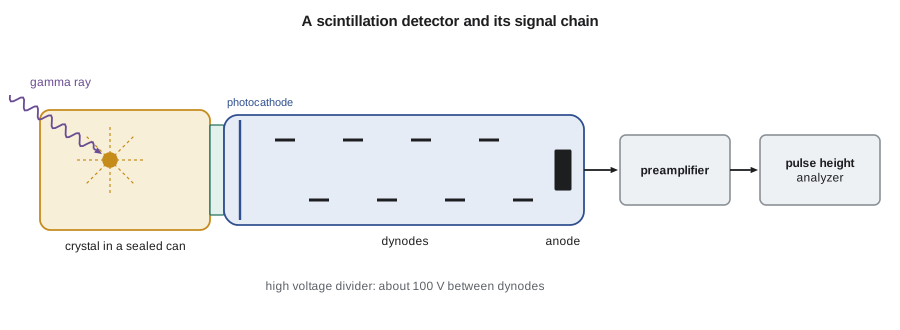
The gain of a PMT depends very steeply on the high voltage, often as the seventh or eighth power, so a 1 % change in voltage changes gain by 7 or 8 %. Stable supplies and periodic gain checks are essential. PMTs are also sensitive to magnetic fields, which deflect the electrons between dynodes, and they are shielded with high-permeability metal near motors or magnets.
Solid-state alternatives are replacing PMTs in some instruments. Silicon photodiodes have high quantum efficiency but no internal gain, so their signals are noisy for small flashes. Silicon photomultipliers (SiPMs), arrays of tiny avalanche photodiodes, provide high gain at low voltage, are compact and immune to magnetic fields, and are now common in hand-held spectrometers and medical imaging.
Energy resolution
If the same gamma ray deposits the same energy in a scintillator many times, the pulse heights still vary. The spread is described by the energy resolution, the full width of the peak at half its maximum (FWHM) divided by the peak position. For NaI(Tl) at 662 keV, a typical value is 6.5 to 7.5 %, or about 46 keV.
The largest contribution is statistical. The number of photoelectrons \(N_{pe}\) produced in the photocathode is small, and it follows Poisson statistics, so its relative standard deviation is \(1/\sqrt{N_{pe}}\). For a Gaussian peak, FWHM is 2.355 standard deviations, so the statistical limit on resolution is
# Scintillation detectors: light yield, photoelectrons and the statistical limit on resolution.
import math
crystals = {               # light yield photons/MeV, light collection, PMT quantum efficiency (approx.)
    'NaI(Tl)': (38000, 0.6, 0.25),
    'CsI(Tl)': (54000, 0.6, 0.12),
    'BGO': (8200, 0.6, 0.25),
    'plastic': (10000, 0.5, 0.25),
}
E = 0.662                  # MeV, Cs-137 gamma
for name, (Y, coll, qe) in crystals.items():
    npe = Y * E * coll * qe
    stat = 2.355 / math.sqrt(npe)           # statistical FWHM, fraction
    print(f"{name:8s}: {npe:6.0f} photoelectrons, statistical FWHM {100*stat:4.1f} %")

# Measured NaI resolution ~ 7 % at 662 keV, scaling roughly as 1/sqrt(E)
for e in (0.122, 0.364, 0.662, 1.332):
print(f"NaI FWHM at {1000*e:6.0f} keV about {7.0*math.sqrt(0.662/e):4.1f} %")NaI(Tl) : 3773 photoelectrons, statistical FWHM 3.8 % CsI(Tl) : 2574 photoelectrons, statistical FWHM 4.6 % BGO : 814 photoelectrons, statistical FWHM 8.3 % plastic : 828 photoelectrons, statistical FWHM 8.2 % NaI FWHM at 122 keV about 16.3 % NaI FWHM at 364 keV about 9.4 % NaI FWHM at 662 keV about 7.0 % NaI FWHM at 1332 keV about 4.9 %
The program estimates about 3800 photoelectrons per 662 keV event in NaI, giving a statistical limit near 3.8 %. The measured 7 % is larger because of non-proportionality of the light yield with electron energy, variations in light collection across the crystal and noise in the PMT. Because the statistical term scales as \(1/\sqrt{E}\), resolution improves with energy, roughly from 16 % at 122 keV to 5 % at 1332 keV. BGO and plastic, with fewer photoelectrons, have worse limits, which is why plastic scintillators are used for counting rather than for identifying nuclides.
Resolution decides how well two gamma lines close in energy can be separated. NaI can separate the 1173 and 1332 keV lines of cobalt-60 easily, but it cannot separate the 662 keV line of cesium-137 from the 658 keV line of silver-110m, or many of the close lines in fission and activation product mixtures. For that, the much better resolution of germanium detectors, the subject of lesson 4, is needed.
Efficiency and the detector's response
A scintillation detector's efficiency for gamma rays depends on the crystal size, the photon energy and the geometry between source and crystal. A 3 inch by 3 inch NaI crystal, long the standard size for spectroscopy, absorbs a large fraction of 662 keV photons that strike it, but only some of those deposit all their energy. Photons that Compton scatter and then escape leave only part of their energy and appear in the continuum below the peak. Lesson 5 develops the full spectrum and the distinction between total and full-energy peak efficiency.
Scintillators are also temperature sensitive. NaI light yield and decay time change with temperature, so a portable instrument carried from a heated building into a cold yard will see its peaks shift. Field instruments stabilize gain automatically, often by tracking a weak reference source or the natural potassium-40 peak at 1461 keV, and laboratory detectors are kept at stable room temperature.
Timing and pulse shape
The speed of a scintillator matters as much as its light yield in some jobs. NaI(Tl) light decays with a time constant of about 230 ns, so pulses are a few microseconds long after shaping, and count rates above a few tens of thousands per second begin to pile up. Plastic scintillators decay in about 2 ns and can handle far higher rates, which is one reason they are used in portal monitors that must react to a vehicle passing at speed.
Some scintillators emit light with more than one decay component, and the share of slow light depends on the type of particle. Heavier, more densely ionizing particles produce relatively more slow light. Pulse shape discrimination exploits this: electronics compare the tail of each pulse with its total, and sort events into, for example, gamma rays and fast-neutron proton recoils in a liquid scintillator, or alpha and beta events in a liquid scintillation cocktail. The same idea lets one detector do the work of two, and it is now usually done digitally by sampling each pulse.
Background in scintillation counting
A large NaI crystal is a sensitive detector, and much of what it sees in a laboratory is background: potassium-40 in concrete and in the glass of the PMT, uranium and thorium decay products in building materials, radon progeny in the air and cosmic-ray muons. Low-background counting uses several defenses. The detector sits inside 10 cm or more of lead lined with thin layers of cadmium and copper to absorb lead X-rays. Low-activity PMT glass and crystal housings reduce internal background. Nitrogen boil-off gas or sealed shields keep radon out of the counting cavity. For the lowest levels, a plastic scintillator surrounding the main detector vetoes coincident cosmic-ray events.
Background is measured regularly with an empty or blank sample in the same geometry, and changes are tracked. A sudden rise usually means contamination of the shield or sample holder, which in a reactor laboratory is a common and avoidable problem. Marcel insists that sample containers are bagged before they enter the shield and that hot samples are counted on a different detector from environmental ones.
Where scintillators are used at the station
| Application | Scintillator | Why |
|---|---|---|
| Gamma spectrometry of waste and samples (screening) | NaI(Tl) | High efficiency, low cost, room temperature |
| Tritium and carbon-14 in water and urine | Liquid scintillation cocktail | Sample mixed in detector; sees low-energy beta |
| Portal and vehicle monitors | Large plastic sheets | Large area, fast, inexpensive |
| Whole-body counting | NaI or plastic arrays | Efficient detection of internal gamma emitters |
| Alpha contamination probes | ZnS(Ag) on a thin window | Bright flashes for alpha, blind to most beta and gamma |
| Hand-held nuclide identifiers | NaI, CsI, LaBr₃ or CeBr₃ | Compact spectroscopy in the field |
Zinc sulfide activated with silver, ZnS(Ag), deserves a note. It is available only as a polycrystalline powder, which is opaque, so it is used in very thin layers. Alpha particles deposit their energy in such a layer and give bright flashes, while beta particles and gamma rays deposit little. That makes ZnS(Ag) probes simple and nearly background-free alpha detectors for surveys of hands, floors and tools.
Hana's comparison
Hana's notes compare scintillators with the gas detectors of lesson 2. A scintillator is hundreds of times denser than a gas, so it stops gamma rays and gives useful energy spectra. In exchange, its signal passes through an inefficient light-collection and photoelectron step that limits resolution, and its photomultiplier needs stable high voltage and care with temperature and magnetic fields. For the job of identifying exactly which radionuclides are present in a mixture, Marcel tells her, the counting room uses germanium, and that is where she goes next.
Summary and key terms
- Scintillators convert deposited energy into light roughly in proportion to energy.
- NaI(Tl) is the standard inorganic scintillator; BGO, CsI, LaBr₃ and CeBr₃ trade yield, density, speed and cost.
- Organic plastic and liquid scintillators are fast and used for beta, tritium, portals and fast neutrons.
- Photomultiplier tubes amplify a few thousand photoelectrons to measurable pulses; their gain depends steeply on voltage.
- Statistical resolution is 2.355/√N_pe; NaI gives about 7 % FWHM at 662 keV.
- Liquid scintillation counting needs quench correction for each sample.
- Scintillator
- A material that emits light when radiation deposits energy in it.
- Activator
- A dopant that creates luminescence centers in an inorganic crystal.
- Photomultiplier tube
- A vacuum tube that converts light to photoelectrons and multiplies them on dynodes.
- Energy resolution
- The FWHM of a peak divided by its energy, usually in percent.
- Light yield
- Scintillation photons produced per unit energy deposited.
- Quenching
- Loss of light or energy transfer in a liquid scintillation sample that lowers efficiency.
- Silicon photomultiplier
- A compact array of avalanche photodiodes used in place of a photomultiplier tube.
Practice problems
Work each problem on paper first, then reveal the answer to check.
A scintillator gives 1000 photoelectrons per event. What is the statistical resolution?
Show answer
2.355/√1000 = 7.4 %.
Why is liquid scintillation used for tritium?
Show answer
The sample is mixed with the scintillator, so the weak beta particles deposit their energy without crossing a window.
A PMT gain varies as V⁷. What gain change follows a 2 % voltage drift?
Show answer
About 1.02⁷ − 1 ≈ 15 %.
If NaI resolution is 7 % at 662 keV, estimate it at 1332 keV.
Show answer
7 × √(662/1332) ≈ 4.9 %.
Why is ZnS(Ag) a good alpha detector?
Show answer
Thin layers give bright alpha flashes but little response to beta and gamma.
Name one advantage of a SiPM over a PMT.
Show answer
Low voltage, compact size or immunity to magnetic fields.
Lesson quiz · 5 questions
Score 60% or more to complete this lesson.
Create a free account to save your progress, take quizzes and earn a certificate.