
MSBA-204 · Lesson 10 of 12 · 20 min
Compliance Manager and assessments
▶ Video coming soon A video version of this lesson is on the way.
When the privacy officer presented the readiness plan to Corvallin's board in October, one director asked a fair question: "How would we know we are compliant?" Nobody can answer that with a single number, but Compliance Manager in the Microsoft Purview portal gives an organization a structured way to track what a regulation expects, what has been done, who did it and what evidence shows it. This lesson covers how Compliance Manager works and how Corvallin used it. It is not in AB-650's skill list, but it is where much of an administrator's Purview configuration ends up being reported.
Compliance score
The compliance score measures progress on recommended actions that reduce data protection and regulatory risk. Microsoft is explicit that it is not an absolute measure of compliance with any standard or regulation and not a guarantee of compliance. It is a progress indicator: points are awarded as improvement actions are implemented and tested. Actions carry different point values according to their type, so a mandatory preventative control, such as enforcing MFA, counts for more than a discretionary documentation task.
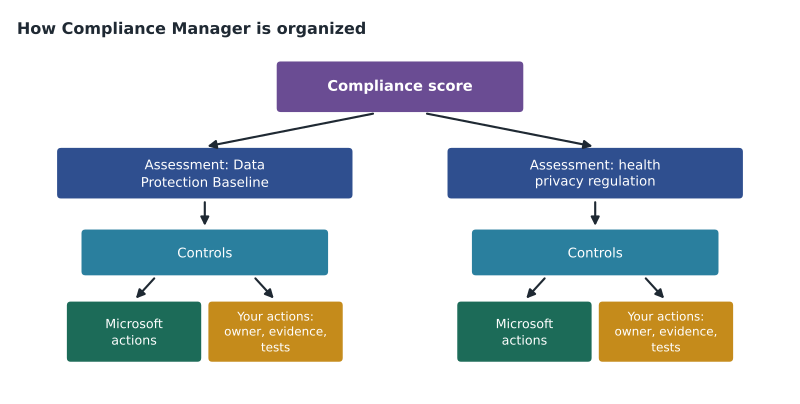
Regulations, assessments and the Data Protection Baseline
Compliance Manager has a library of regulations, previously called templates, covering privacy, security, industry and AI frameworks. An assessment is created from a regulation and scoped to the services it covers, such as Microsoft 365. Every subscription includes the Microsoft Data Protection Baseline assessment by default, a broad set of controls drawn from common standards that gives a starting score.
Access to more regulations depends on licensing. E5, A5 and G5 customers can choose up to three premium regulations at no extra cost; others are bought separately. Regulations in the same family count as one, so the levels and versions of one framework are covered by one choice. Corvallin's twelve E5 Compliance licenses gave it that entitlement, and the privacy officer chose carefully.
| Choice | Why | Notes |
|---|---|---|
| Data Protection Baseline | Included by default; broad starting point | Kept as the overview for the board |
| HIPAA and HITECH | Corvallin is a covered entity, and the Security Rule safeguards map closely to Microsoft 365 controls | Premium regulation choice one |
| An AI governance framework | The Copilot pilot in 2027 needs documented AI controls | Premium regulation choice two; Compliance Manager offers AI-related regulations |
| Unused | Kept in reserve | Choice three left open for a future need |
Custom assessments
When the library has no matching regulation, Compliance Manager supports custom regulations: an organization can modify an existing regulation or import its own controls from a spreadsheet template. The privacy officer built a small custom regulation of fourteen controls for the duties she cared most about under HIPAA that were not well covered: an accurate inventory of personal health information, breach assessment and notification, access logging, staff confidentiality agreements and limits on use for training. Several controls mapped to actions that already existed in the premium regulation, so evidence uploaded once counted in both places.
Improvement actions
Each control maps to one or more improvement actions. They come in two kinds:
| Microsoft actions | Your actions | |
|---|---|---|
| Who implements | Microsoft, as the cloud provider | The organization |
| Examples | Physical security of datacenters, service encryption | Enforcing MFA, publishing labels, training staff, writing a breach procedure |
| Testing | Tested by Microsoft; details in audit reports on the Service Trust Portal | Tested by the organization, manually or automatically |
| Points | Count toward the score | Count once implemented and tested |
Your actions can be technical, such as configuring a DLP policy, or non-technical, such as a documented procedure. Some technical actions are tested automatically: Compliance Manager reads signals from Microsoft Secure Score and from Purview configurations and updates the status itself. Non-technical actions are tested manually: an assessor reviews evidence and records the result.
Each action has an owner, an implementation status, a test status and evidence. Teodor's first week in Compliance Manager was mostly assignment: 112 actions in the baseline assessment, of which 41 were already passing through automatic testing because of the identity and DLP work. He assigned identity actions to himself, device actions to Ama, records actions to Ansel and procedural actions to the privacy officer, with due dates aligned to the readiness plan.
Worked problem
Evidence for a non-technical action
An improvement action asks Corvallin to "establish a process for responding to privacy breaches, including notification". It is a non-technical action. What evidence should the privacy officer attach, and how is it tested?
Show solution
- Attach the written breach response procedure, dated and approved by Ines.
- Attach the record of the most recent tabletop exercise or real incident handled under it, with personal details removed.
- Set implementation status to implemented.
- Ask an assessor, here Ines, to review the evidence and set the test status to passed.
- Set a reminder to review the procedure when the law or the procedure changes.
Answer: The approved procedure plus a record of it being used, reviewed by an assessor who records the test result.
Roles in Compliance Manager
Compliance Manager has its own role groups: Compliance Manager Administrators manage assessments, regulations and settings; Contributors edit actions and upload evidence; Assessors record test results; and Readers view. The Microsoft Entra AI Administrator role maps to the Compliance Manager Administrators group, which is one more reason Teodor reviewed Entra role assignments alongside Purview ones. At Corvallin, Teodor and the privacy officer were administrators, Ama and Ansel were contributors and Ines was the assessor, so the person who implemented an action was not the person who passed it.
Beyond Microsoft 365
Assessments can include services beyond Microsoft 365 through multicloud and connector support, so an organization can track controls for other cloud services in the same place. Corvallin did not need this yet, but Teodor noted that the scheduling vendor's system could be represented later as a custom service with manually tested actions.
Reporting to the board
Compliance Manager can export assessments and action lists, which made the board report simple: the Data Protection Baseline score, the health privacy assessment's progress, the number of actions overdue and the three most important open items. The privacy officer always presented the score with the caveat Microsoft itself gives: progress, not proof.
| Board report item | November 2026 value | Comment |
|---|---|---|
| Data Protection Baseline score | Rising since the identity project | Driven by MFA, Conditional Access and DLP actions |
| Health privacy assessment | About half of actions passed | Procedural actions next: breach procedure, inventory |
| Overdue actions | 6 | Mostly device actions waiting for the 2027 device phase |
| Top open item | Personal health information inventory | Owner: privacy officer, with data explorer results from Teodor |
Building the inventory action
The most important open action in Corvallin's health privacy assessment was "maintain an inventory of personal health information and where it is stored". It is a non-technical action, but Purview supplied much of the evidence. Teodor exported data explorer results showing where items matching the client ID and health card types were stored, by site, and the privacy officer combined that with a list of systems outside Microsoft 365: the scheduling vendor's system, the pharmacy portal and paper records at branches. The resulting inventory listed each location, its owner, the types of information it held, who could access it and the protections in place. It was attached as evidence and became the starting point for the case study in lesson 12.
| Location | Information | Owner | Protection |
|---|---|---|---|
| Client record libraries in clinical sites | Care plans, visit notes, consent forms | Clinical director | Confidential / Clinical label, client record retention, restricted membership |
| Branch operations sites | Schedules, some exports | Branch managers | Oversharing remediation in progress; auto-labeling; DLP |
| Email and Teams | Referrals, coordination messages | All staff | DLP health card policy; retention policies |
| Scheduling vendor system | Client demographics, visit times | Operations director | Vendor contract and access controls; outside Purview |
| Paper records at branches | Signed forms awaiting scanning | Branch managers | Locked cabinets; scanning within five days |
Keeping assessments current
Regulations change, and Microsoft updates regulations in Compliance Manager when they do. When a regulation is updated, assessments based on it can be updated to the new version, which may add or change actions. Corvallin's policy was to review update notices monthly and accept updates after the privacy officer checked what changed, so the assessment never silently drifted from the law it represented. For the US site's HIPAA work this mattered in particular: amendments to the HIPAA Security Rule proposed in January 2025 were still pending in 2026, with a final rule projected for July 2027, so the privacy officer expected a regulation update and planned to review the assessment when it came.
Using Compliance Manager with other teams
Compliance Manager became a shared workspace, not an IT tool. Ama owned the device actions and uploaded Intune compliance reports as evidence. Ansel owned records actions and uploaded the file plan export. HR owned training actions and uploaded the attendance list for the annual privacy training. The privacy officer reviewed overdue actions in a short meeting each fortnight, which kept the assessment honest. When an action no longer applied, for example an action about on-premises servers that Corvallin no longer had, it was marked as not applicable with a written reason rather than left to look like a gap.
Worked problem
An automatically tested action fails
A technical action about blocking legacy authentication, which had been passing automatically, suddenly shows as failed. What should Teodor check?
Show solution
- Open the action and read which signal it tests, such as a Secure Score recommendation or a Conditional Access setting.
- Check recent changes in the audit log and the decision log; a Conditional Access policy may have been edited or excluded a new group.
- Fix the configuration if it is wrong, or record why the change was intentional.
- Wait for the next automatic test to update the status, and add a note to the action.
Answer: Trace the signal the action tests back to a configuration change, correct it or document it, and let the automatic test update.
Compliance Manager and AI governance
The AI governance regulation Corvallin chose added actions that the Copilot readiness plan already addressed in practice, such as documenting the purpose of AI use, assessing risks before rollout, informing users and monitoring AI interactions. Mapping the readiness plan to those actions turned scattered work into a coherent record. DSPM findings, the Copilot DLP policy, the communication compliance policy for Copilot interactions and the acceptable use policy section on reviewing AI summaries all became evidence attached to specific actions. When the board asked in November whether the pilot was being managed responsibly, the privacy officer could show the assessment rather than describe it.
Limits of Compliance Manager
Compliance Manager tracks controls; it does not perform them, and it cannot see systems it is not told about. A passing action means the control was implemented and tested at the time, not that it still works today, which is why automatically tested actions are valuable and why manually tested ones need review dates. It also cannot judge whether a control is adequate for a particular organization; that remains the privacy officer's responsibility. Used with those limits in mind, it is an excellent way to organize evidence and keep work moving. Used as a scoreboard, it can create false comfort.
A quarterly rhythm
By late November the privacy officer had settled on a quarterly rhythm for Compliance Manager. In the first month of each quarter, owners updated their actions and evidence. In the second, Ines tested actions as assessor and the privacy officer reviewed regulation updates. In the third, the board report was produced from the exported assessment. The rhythm kept Compliance Manager from becoming a project that peaked before an audit and then decayed, and it gave every owner a predictable date when their work would be looked at.
Common mistakes
MistakePresenting the compliance score as proof of compliance.
InsteadPresent it as progress on recommended actions, with Microsoft's own caveat.
MistakeUsing all three free premium regulations immediately.
InsteadChoose the regulations that match real obligations and keep a choice in reserve.
MistakeLetting the person who implemented an action also pass its test.
InsteadSeparate contributors from assessors.
MistakeLeaving non-technical actions without evidence.
InsteadAttach procedures and records of their use, and set review reminders.
Summary and key terms
- Compliance score measures progress on recommended actions and is not a guarantee of compliance.
- Assessments are created from regulations; the Data Protection Baseline is included by default.
- E5-level customers can choose up to three premium regulations at no extra cost; families count as one.
- Improvement actions are Microsoft actions or your actions, technical or non-technical, tested automatically or manually with evidence.
- Compliance Manager role groups separate administration, contribution, assessment and reading.
- Compliance score
- A progress measure based on implemented and tested improvement actions.
- Regulation
- A set of controls in Compliance Manager used to create assessments.
- Assessment
- A grouping of controls from a regulation, scoped to services, used to track compliance work.
- Improvement action
- A task that implements a control, owned and tested by the organization or by Microsoft.
- Data Protection Baseline
- The default assessment included with every subscription.
- Custom regulation
- A regulation an organization modifies or imports to track its own controls.
Practice problems
Work each problem on paper first, then reveal the answer to check.
How many premium regulations can E5 customers choose at no extra cost?
Show answer
Up to three.
Which assessment is included by default?
Show answer
The Microsoft Data Protection Baseline.
Where can you find details of how Microsoft tests its own actions?
Show answer
In audit reports on the Service Trust Portal.
Lesson quiz · 5 questions
Score 60% or more to complete this lesson.
Create a free account to save your progress, take quizzes and earn a certificate.