
MSBA-121 · Lesson 12 of 12 · 18 min
Case study: choosing tools for a manufacturer
▶ Video coming soon A video version of this lesson is on the way.
For her last briefing, Celestine did something different. Instead of another Quillfield decision, she brought a case from a peer network of operations leaders she belonged to, with the company's details changed. "We have spent eleven weeks applying this to an insurance brokerage," she said. "Let's see whether the method works for a business that looks nothing like ours." This lesson works through the case as the leadership team did, from the company profile to a recommendation. Ironsedge Fittings is fictional, and all of its figures are invented for the exercise.
The company
Ironsedge Fittings makes industrial valves and pipe fittings for water utilities, oil and gas producers and building contractors. It has about 650 employees: two plants near Rockford, Illinois, a distribution center and a head office. Its chief operating officer, Margit Oduya, had been asked by the board for an AI plan for the coming year with a budget of about 350,000 dollars, covering licenses, consumption and implementation partners, but not internal staff time.
| Area | People | Current tools | Pain points |
|---|---|---|---|
| Office staff (sales, finance, HR, purchasing) | 200 | Microsoft 365 E3 | Long email threads, slow month-end reporting, many meetings |
| Customer service | 18 | Shared mailbox, Dynamics 365 Supply Chain Management for orders | About 1,200 distributor emails a week asking order status, lead times and certificates |
| Engineering | 25 | Design software, SharePoint for drawings and specifications | Engineers spend hours finding old specifications and test reports |
| Quality | 12 | Inspection photos in folders, paper checklists | Defect photos reviewed by hand; slow root-cause analysis |
| Plant and warehouse workers | 380 | Microsoft 365 F3, shared terminals | Hard to find safety procedures and work instructions on the floor |
| IT | 9, including 3 developers | GitHub for integrations | Backlog of integration and reporting requests |
| Security | 1 analyst plus a managed provider | Microsoft Defender in E3, managed detection | Alert overload; no time for improvement |
Margit's team had already done the business value work covered in MSBA-120: they had a list of candidate use cases with rough benefit estimates. What they needed was a product map, a cost picture, a governance plan and a sequence. Celestine split the leadership team into pairs to work on each.
Step 1: Map the use cases
Using the decision path from lesson 10, the team mapped Ironsedge's main ideas.
| Use case | Where the work happens | Recommended product | Reasoning |
|---|---|---|---|
| Meeting recaps, email summaries and drafting for managers | Teams, Outlook, Word | Microsoft 365 Copilot for about 60 heavy users | Daily work in Microsoft 365 apps on their own content |
| General drafting and research for other office staff | Microsoft 365 apps and browser | Copilot Chat | Included with eligible plans; light use |
| Answer distributor order-status and lead-time emails | Shared mailbox and Supply Chain Management | Autonomous agent in Copilot Studio, drafting replies for approval | Needs order data, a trigger on new email and human review |
| Find engineering specifications and test reports | SharePoint and drawing archives | Foundry with Azure AI Search, surfaced as an agent in Teams | Large document collection, technical language, citations needed |
| Analyze defect photos | Quality inspection | Foundry with Azure Vision in Foundry Tools, piloted first | Image analysis; specialized judgment |
| Safety procedures and work instructions on the floor | Shared terminals and phones | Agent built with Agent Builder over the approved procedures library, used through Copilot Chat | Focused knowledge for many unlicensed users |
| Month-end variance analysis | Finance spreadsheets and Dynamics 365 Finance | Analyst in Microsoft 365 Copilot for finance analysts; Copilot in Finance | Reasoning over structured data |
| Integration backlog | Developers' editors | GitHub Copilot Business for 3 developers | Code context, small team |
| Alert triage | Security operations | Defer: Security Copilot requires E5 or a separate purchase | Revisit with the E5 decision next year |
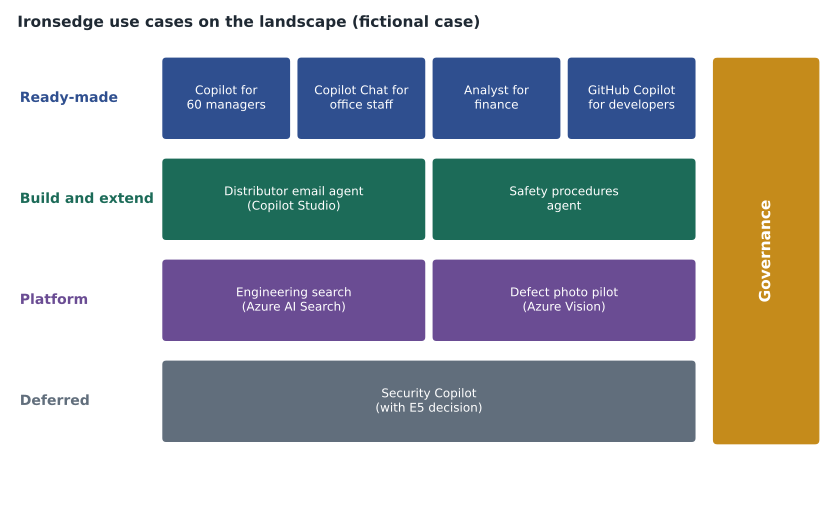
Two choices caused debate. Some of the team wanted to give all 200 office staff Microsoft 365 Copilot licenses "so nobody feels left out". The pair working on costs showed that usage data from other organizations, and Quillfield's own experience, suggested that light users got most of their value from Copilot Chat, and that a smaller licensed group, expanded as evidence came in, was the better investment. The second debate was whether the distributor email agent should send replies on its own. The team decided it should draft replies for customer service staff to approve for the first three months, because a wrong lead time promised to a distributor could cost a contract.
Step 2: Build the cost picture
The cost pair built a first-year estimate using list prices and illustrative consumption assumptions, with every assumption written down so it could be checked.
| Item | Assumption | First-year cost (US dollars) |
|---|---|---|
| Microsoft 365 Copilot licenses | 60 users at 30 US dollars per month for 12 months | 21,600 |
| Copilot Chat | Included with eligible plans | 0 |
| Distributor email agent (Copilot Credits) | 4,800 emails a month at an assumed 10 credits each, one US cent per credit | 5,760 |
| Safety procedures agent (Copilot Credits) | 3,000 questions a month at an assumed 2 credits each | 720 |
| Engineering search (Foundry, Azure AI Search, models) | Search service plus model tokens, estimated with Bram-style testing | 24,000 |
| Defect photo pilot (Foundry Tools) | Three-month pilot, pay-as-you-go | 6,000 |
| GitHub Copilot Business | 3 developers at 19 US dollars per month | 684 |
| Implementation partner | Engineering search and email agent build, oversharing review | 180,000 |
| Training and change management | Champions program and role-based training | 40,000 |
| Contingency | About 15 percent of the above | 42,000 |
Worked problem
Checking the total and the largest line
Add up the first-year costs in the table. Which line is largest, and what does that say about where Ironsedge should focus its scrutiny?
Show solution
- Licenses and consumption: 21,600 plus 0 plus 5,760 plus 720 plus 24,000 plus 6,000 plus 684 = 58,764 US dollars.
- Services and change: 180,000 plus 40,000 = 220,000 US dollars.
- Contingency: 42,000 US dollars. Total: 58,764 plus 220,000 plus 42,000 = 320,764 US dollars.
- The largest line is the implementation partner at 180,000 US dollars, more than three times all licenses and consumption combined.
Answer: About 320,800 US dollars, within the 350,000 dollar budget. Product prices are not the main cost; building, integrating and changing how people work are. Margit's scrutiny should go to the partner's scope and to adoption.
The cost pair also noted three uncertainties for the board: the credits per email were an assumption until a pilot measured them; Microsoft had changed Copilot and agent pricing several times in two years; and the budget was in US dollars while Ironsedge reported in US dollars, so exchange rates could move the Canadian total.
Step 3: Plan governance
The governance pair used the four questions from lesson 11.
| Question | Ironsedge controls before launch |
|---|---|
| Who and what can access AI? | Copilot licenses for the named 60; Agent Builder sharing limited to champions; Copilot Studio in a managed environment with data policies; agent identities for the email agent |
| What data can AI see and produce? | Oversharing review of SharePoint, starting with HR and engineering; sensitivity labels for pricing, contracts and export-controlled drawings; data loss prevention for customer pricing |
| What is AI doing? | Monthly usage and cost report; agent inventory reviewed quarterly; budgets and alerts on credits and Azure |
| Is AI behaving responsibly? | Evaluation sets for each agent; human approval for distributor replies; weekly sampling of answers; a two-page AI policy with named owners |
One item was specific to manufacturing. Some of Ironsedge's engineering drawings were subject to export controls. The governance pair recommended labeling those drawings and excluding them from the engineering search index until legal advice confirmed how they could be used, a reminder that the data each industry must protect differs, but the controls are the same.
Step 4: Sequence the work
The sequencing pair combined value, feasibility and reuse into a four-quarter roadmap.
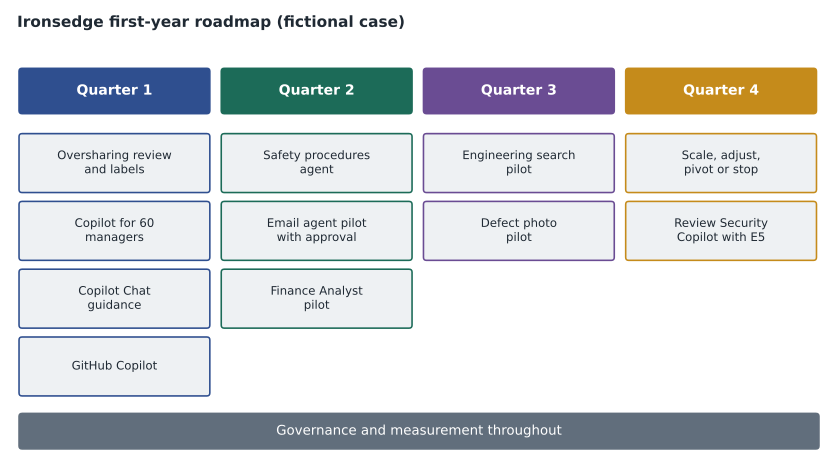
The logic was the same as Quillfield's. Foundations that every later use case depends on, clean permissions and labels, came first. Quick, low-risk wins built confidence. Harder platform work started once the foundations were in place. And every pilot ended with an evidence-based decision to scale, adjust, pivot or stop.
Step 5: Write the recommendation
Celestine asked each group to write the recommendation as a one-page memo to the board. The version the leadership team agreed on is summarized below.
| Section | Content |
|---|---|
| Recommendation | Approve a first-year AI program of about 321,000 US dollars, within the 350,000 dollar budget |
| What we will buy | Microsoft 365 Copilot for 60 managers; Copilot Chat for all office staff; GitHub Copilot Business for developers |
| What we will extend or build | A distributor email agent and a safety procedures agent in Copilot Studio and Agent Builder; an engineering search in Microsoft Foundry; a defect photo pilot |
| What we will not do yet | Security Copilot, pending the E5 decision; autonomous sending of distributor replies |
| Expected benefits | Faster distributor responses, engineering time recovered from searching, quicker month-end analysis; measured against baselines |
| Key risks and controls | Oversharing (review and labels), wrong answers to distributors (approval and sampling), export-controlled drawings (excluded), cost growth (budgets and alerts) |
| Decisions and dates | Pilot reviews at the end of quarters 2 and 3; full review of products and prices in month 6 and month 12 |
What the case shows
At the end of the session, Lorne said the case had convinced him of something the earlier briefings had only suggested: the method mattered more than the products. Ironsedge and Quillfield chose different combinations of Microsoft's AI apps and services because their work was different, but they followed the same steps: map the work to the landscape, cost it honestly with written assumptions, put governance in place before launch, sequence by value, feasibility and reuse, and decide at each gate with evidence.
That is also what the AB-731 exam's scenario questions test. They describe an organization and its needs and ask which Microsoft capability fits, how it is licensed, what risks it raises and how to adopt it. A candidate who can work through a case like Ironsedge's, layer by layer, is well prepared for them.
How the board responded
In the version of the case Celestine presented, Ironsedge's board approved the plan with two changes. It asked for the distributor email agent to report weekly on how many drafts staff accepted without changes, a simple measure of quality that would show when the agent might safely be allowed to send routine replies on its own. And it asked Margit to bring the E5 and Security Copilot decision forward by a quarter, because the single security analyst was already stretched and the new agents would add to the systems she had to watch.
Both changes reflect themes from this course. The first is that autonomy should be earned with evidence: an agent moves from drafting to acting only when measured quality justifies it. The second is that AI adoption and security capacity have to grow together. Leaders who keep those two ideas in mind, alongside the four layers and the method of mapping, costing, governing and sequencing, will make sound choices about Microsoft's AI apps and services even as the products themselves keep changing.
| Course theme | Where it appeared in the Ironsedge case |
|---|---|
| Start with the work | Use cases described by people, place and information before products |
| Match the version to the user | 60 licenses, Copilot Chat for the rest |
| Buy, extend, then build | Ready-made tools first, agents next, Foundry for distinctive needs |
| Cost honestly | Written assumptions; services larger than licenses |
| Govern before launch | Oversharing review, labels, approval for distributor replies |
| Decide with evidence | Pilot reviews with scale, adjust, pivot or stop |
Celestine closed the series by asking each member of the leadership team to name one decision from the eleven weeks they would make differently with hindsight. Most named the same one: they would have started the oversharing review sooner, because almost every use case depended on it.
Common mistakes
MistakeLicensing everyone so nobody feels left out.
InsteadLicense heavy users, give others Copilot Chat, and expand with evidence.
MistakeTreating product prices as the main cost.
InsteadBudget for implementation, integration, training and change, which are often larger.
MistakeIndexing every document for AI search.
InsteadExclude restricted content, such as export-controlled drawings, until its use is confirmed.
MistakePresenting a plan without decision points.
InsteadGive each pilot a review date and four possible outcomes: scale, adjust, pivot or stop.
Summary and key terms
- The method from this course applies to any organization: map work to the landscape, cost it, govern it, sequence it and decide with evidence.
- Ironsedge combined Microsoft 365 Copilot, Copilot Chat, Copilot Studio agents, Foundry with Azure AI Search and Vision, Analyst and GitHub Copilot.
- Implementation, integration and change were the largest costs, far above licenses and consumption.
- Governance covered access, data, visibility and responsible behavior, plus industry-specific data such as export-controlled drawings.
- A one-page recommendation states what to buy, extend, build and defer, with risks, controls and decision dates.
- Roadmap
- A sequenced plan of initiatives over time with dependencies and decision points.
- Assumption register
- A written list of the estimates behind a cost or benefit figure, so they can be checked.
- Foundation work
- Work, such as permission clean-up and labeling, that later use cases depend on.
- Contingency
- An amount added to a budget for costs that are uncertain or unforeseen.
- Export controls
- Laws restricting the sharing of certain technical information or products across borders.
Practice problems
Work each problem on paper first, then reveal the answer to check.
Why did Ironsedge choose to license 60 users rather than all 200 office staff?
Show answer
Light users get most value from Copilot Chat; licensing heavy users first and expanding with evidence is better value.
An agent handles 4,800 emails a month at 10 credits each and one US cent per credit. What is the annual cost?
Show answer
48,000 credits a month, 480 US dollars a month, 5,760 US dollars a year.
What were the five steps Ironsedge followed?
Show answer
Map the use cases, build the cost picture, plan governance, sequence the work and write the recommendation.
Lesson quiz · 5 questions
Score 60% or more to complete this lesson.
Create a free account to save your progress, take quizzes and earn a certificate.