
MSBA-110 · Lesson 7 of 12 · 18 min
Responsible AI principles
▶ Video coming soon A video version of this lesson is on the way.
Celestine opened the seventh session herself. The executive team had agreed to expand the pilot in the new year, but only after Quillfield adopted a written responsible AI policy. "Insurance runs on trust," she said. "Clients trust us to give honest advice and protect their information. If AI helps us do that faster, good. If it makes us careless, we have lost the thing we sell." She asked Hamish to walk everyone through the principles the policy would be built on.
This lesson explains responsible AI: the practice of designing, building and using AI in ways that are safe, fair and trustworthy. It covers Microsoft's six responsible AI principles, how Microsoft puts them into practice, how an organization turns principles into governance, and what each principle means for an everyday user. Both AB-730 and AB-731 test this material, and AB-731 adds the leader's role in setting up governance.
Microsoft's six principles
Microsoft has published six principles that guide how it builds and deploys AI: fairness, reliability and safety, privacy and security, inclusiveness, transparency and accountability. Microsoft describes transparency and accountability as the foundation that supports the other four. The AB-731 study guide lists exactly these values when it asks leaders to ensure that AI solutions meet responsible AI standards.
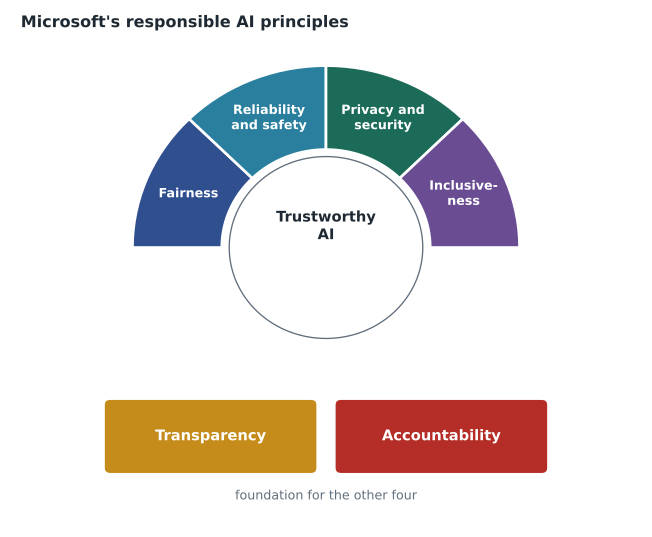
| Principle | What it means | A Quillfield example |
|---|---|---|
| Fairness | AI systems should treat all people fairly and avoid unjust differences between groups | Checking that an AI-drafted service priority list does not disadvantage clients of one branch |
| Reliability and safety | AI systems should perform reliably and safely, including in unexpected conditions | Testing an agent on real questions before staff rely on it |
| Privacy and security | AI systems should be secure and respect privacy | Using only work-account Copilot for client information |
| Inclusiveness | AI systems should empower everyone and engage people of all abilities | Making sure AI-drafted client letters are in plain language and accessible formats |
| Transparency | People should understand how AI systems work and when they are being used | Telling clients when a chat on the website is with an AI agent |
| Accountability | People should be accountable for AI systems and their outcomes | The broker who sends advice owns it, however it was drafted |
How Microsoft puts the principles into practice
Principles are easy to write and hard to apply, so Microsoft built a program around them. Its Responsible AI Standard, whose second version was published in 2022, turns the principles into concrete requirements for teams that build AI products, such as impact assessments, testing for harmful outputs and documentation of intended uses. An Office of Responsible AI sets policy and governance, and Microsoft publishes an annual Responsible AI Transparency Report describing its practices. For customers, Microsoft provides transparency notes that explain what a product such as Microsoft 365 Copilot is designed to do, its limits and how to use it responsibly.
Some protections are built directly into the products. Copilot includes content filters that screen prompts and responses for harmful content, defenses against attempts to manipulate the model, citations so users can check sources, and labels or notices that content was generated by AI. Microsoft also offers a Customer Copyright Commitment, under which it defends eligible commercial customers who are sued for copyright infringement over output from covered Copilot services, provided they use the products as intended with the built-in protections on. Quillfield's lawyers read the details; for staff the lesson was that the protections exist and that using the products as designed matters.
From principles to governance
A company does not adopt responsible AI by agreeing with six words on a slide. It needs governance: policies, roles, processes and checks. The AB-731 study guide asks leaders to establish governance principles for AI use, set up an AI council to guide strategy, oversight and cross-functional alignment, and ensure solutions meet responsible AI standards. MSBA-122 covers this in depth; here is the outline.
An AI policy states what AI may and may not be used for, which tools are approved, what data may be used with them, and what review is required. An AI council or steering group, typically including business leaders, IT, security, legal or compliance, privacy and human resources, approves new uses, reviews risks and tracks results. A use-case review process sorts proposed uses by risk: drafting internal notes is low risk; using AI to decide which claims get investigated is high risk and needs much more scrutiny. Training makes sure people know the policy and the skills. Monitoring checks that what happens matches what was approved.
| Risk level | Example use | Typical controls |
|---|---|---|
| Low | Summarizing your own meeting notes | Approved tool, user review |
| Medium | Drafting client renewal letters | Approved tool, user review, spot checks by a team lead |
| High | AI that recommends which claims to investigate | Council approval, impact assessment, bias testing, human decision, ongoing monitoring |
Worked problem
Sorting proposals by risk
Quillfield's new AI council receives 12 proposed uses. Seven only affect internal drafts, three produce content that goes to clients after review, and two would influence decisions about individual clients. If low-risk uses take 1 hour of review each, medium 3 hours and high 12 hours, how many hours of review does the council need?
Show solution
- Low: 7 x 1 = 7 hours.
- Medium: 3 x 3 = 9 hours.
- High: 2 x 12 = 24 hours.
- Total: 7 + 9 + 24 = 40 hours.
Answer: About 40 hours, more than half of it on the two high-risk uses. Sorting by risk lets the council spend its time where it matters.
The principles in everyday use
Most employees will never write a policy or run an impact assessment, but each principle translates into habits. Fairness means reading AI output about people for assumptions and stereotypes, and never letting an AI draft decide how a client is treated. Reliability and safety means checking facts, numbers and citations, and not using AI for tasks it has not been tested on. Privacy and security means using approved tools with a work account, sharing only the data the task needs, and keeping passwords and secrets out of prompts.
Inclusiveness means using AI to make communication clearer and more accessible, for example generating plain-language explanations, alternative text for images or translations, while checking that the result still says what you meant. Transparency means being honest about AI involvement where it matters, such as telling a client that a chat is with an agent or noting that a summary was AI-assisted. Accountability means owning what you send. "Copilot wrote it" is not an excuse that any client, insurer or regulator will accept.
| Principle | Habit for every user |
|---|---|
| Fairness | Check AI text about people for assumptions; keep decisions human |
| Reliability and safety | Verify facts, numbers and citations; use AI only for suitable tasks |
| Privacy and security | Approved tools, work account, minimum necessary data, no secrets |
| Inclusiveness | Use AI to make content clearer and accessible, and check the meaning |
| Transparency | Disclose AI involvement where people would expect to know |
| Accountability | Own everything you send, however it was drafted |
Laws and standards are catching up
Responsible AI is not only voluntary. Governments are adding rules. The European Union's AI Act entered into force in 2024, with obligations phased in over several years according to the risk level of each use. In the United States there is no single federal AI law, but existing privacy, consumer protection and anti-discrimination laws apply to AI uses, and several states have passed AI-specific laws. Insurance regulators in particular have issued guidance on AI in underwriting and claims. International standards such as ISO/IEC 42001 describe management systems for AI. For a business user, the takeaway is that the principles in this lesson increasingly line up with legal expectations.
Wendell finished the session by reading the first line of Quillfield's draft policy: "We use AI to help our people serve clients better, never to replace the judgment and accountability our clients rely on." Dolores, who had started the course with folded arms, suggested one addition: "and we check its work." It went into the final version.
Three cases from Quillfield's pilot
Principles become clearer when applied to real decisions. Wendell shared three cases from the first weeks of the pilot, each handled by asking which principles were at stake.
In the first case, the marketing coordinator wanted to use AI-generated images of "typical clients" for a brochure. The draft images showed a narrow range of people. Fairness and inclusiveness were at stake. The coordinator rewrote the prompts to describe the actual range of Quillfield's clients, reviewed the results with two colleagues, and used real client photos, with permission, where possible. The brochure also avoided presenting generated images as real customers, which touched on transparency.
In the second case, a team lead proposed letting an agent send routine certificate confirmations to clients automatically, without human review. Reliability and safety and accountability were at stake. The AI council approved a pilot in which the agent drafted confirmations and a service representative approved each one for the first month, with error rates tracked. Only after the error rate stayed very low would the council consider automatic sending for the simplest cases, and even then with spot checks.
In the third case, an account manager asked whether she could use Copilot to analyze a client's employee list to suggest benefits options. Privacy and security was at stake. The answer was yes, but only through approved tools, with the list stored in the client's secure folder, using only the fields needed, and with the client's agreement that Quillfield could process the data for that purpose.
| Case | Principles at stake | Outcome |
|---|---|---|
| AI images of clients for a brochure | Fairness, inclusiveness, transparency | Prompts revised, reviewed by colleagues, real photos where possible |
| Automatic certificate confirmations | Reliability and safety, accountability | Human approval for a month, error tracking, then reconsider |
| Analyzing a client's employee list | Privacy and security | Approved tools, minimum fields, client agreement |
Inclusiveness and accessibility
Inclusiveness is often the principle people think about least, yet generative AI offers real gains here. It can turn dense policy language into plain language for clients who find insurance jargon confusing, draft alternative text for images so that people using screen readers understand them, translate letters for clients more comfortable in another language, and summarize long documents for colleagues who process information differently. Microsoft builds accessibility features into Copilot and its apps, and many people with disabilities report that AI assistants help them work more independently.
The responsible part is checking that simplification does not change meaning. A plain-language version of an exclusion that drops a key condition is not more inclusive; it is wrong. Quillfield's rule was that any simplified or translated client communication about coverage had to be compared with the original by the person sending it.
Writing a personal AI code
Hamish ended the session with an exercise: each participant wrote three sentences describing how they personally would use AI responsibly in their role. The point was not to copy the policy but to translate it into their own work. Tobias wrote: "I will never send a claim letter I have not read in full. I will tell clients when an agent is involved. I will flag any draft that treats a claimant unfairly." Dolores wrote: "I check every number. I keep client data in our tools. I give the advice; Copilot gives me drafts."
The exercise took ten minutes and turned an abstract topic into something personal. Several participants pinned their three sentences above their desks. When the AI council later reviewed early results from the pilot, it found that the teams whose members had done the exercise reported fewer errors reaching clients, although, as Hamish noted, those teams also had more experienced staff, so the comparison was not conclusive.
| Question to ask | Principle it reflects |
|---|---|
| Would I be comfortable if the client knew how this was made? | Transparency |
| Have I checked the facts, numbers and sources? | Reliability and safety |
| Does this treat everyone fairly, without assumptions? | Fairness |
| Did I use only the data the task needed, in approved tools? | Privacy and security |
| Is this clear and usable for everyone who will read it? | Inclusiveness |
| Am I willing to sign my name to it? | Accountability |
Common mistakes
MistakeTreating responsible AI as the IT department's job.
InsteadEvery user applies the principles in daily habits; leaders set governance.
MistakeApplying the same controls to every use.
InsteadMatch controls to risk: light for internal drafts, heavy for decisions about people.
MistakeAssuming built-in filters make any output safe.
InsteadFilters reduce harmful content; they do not check facts or fairness for you.
MistakeHiding AI involvement from clients when they would expect to know.
InsteadBe transparent where it matters, for example with AI agents that talk to clients.
Summary and key terms
- Microsoft's six principles are fairness, reliability and safety, privacy and security, inclusiveness, transparency and accountability.
- Microsoft applies them through its Responsible AI Standard, an Office of Responsible AI, transparency notes, product safeguards and an annual transparency report.
- Organizations need governance: a policy, an AI council, risk-based use-case review, training and monitoring.
- Each principle becomes a daily habit for users, from checking facts to owning what they send.
- Laws and standards increasingly reflect these principles.
- Responsible AI
- Designing, building and using AI in ways that are safe, fair and trustworthy.
- AI council
- A cross-functional group that guides AI strategy, approves uses and oversees risk.
- Transparency note
- Microsoft documentation explaining an AI product's intended uses, capabilities and limits.
- Impact assessment
- A structured review of who an AI use could affect and how, done before deployment.
- Customer Copyright Commitment
- Microsoft's commitment to defend eligible customers sued over copyright in output from covered Copilot services used as intended.
Practice problems
Work each problem on paper first, then reveal the answer to check.
List Microsoft's six responsible AI principles.
Show answer
Fairness, reliability and safety, privacy and security, inclusiveness, transparency, accountability.
Which two principles does Microsoft describe as the foundation?
Show answer
Transparency and accountability.
Give one high-risk and one low-risk AI use at a brokerage.
Show answer
High: recommending which claims to investigate. Low: summarizing your own meeting notes.
Lesson quiz · 5 questions
Score 60% or more to complete this lesson.
Create a free account to save your progress, take quizzes and earn a certificate.