
MSBA-110 · Lesson 2 of 12 · 19 min
Large language models in plain language
▶ Video coming soon A video version of this lesson is on the way.
At the second session Hamish brought a deck of index cards. On each card he had written the start of a sentence that anyone at Quillfield would recognize: "Please find attached your renewal…", "The policy excludes damage caused by…", "Thank you for your call today regarding…". He handed them out and asked people to write the most likely next word. Almost everyone wrote "documents", "flood" and "your" respectively. "Congratulations," he said. "You have just done what a large language model does, billions of times over."
This lesson explains in plain language what a large language model, or LLM, is, how it is trained, why it can write so fluently, and why fluency is not the same as being correct. No mathematics is needed. The goal is a mental model good enough to predict when the tool will help and when it will mislead.
Predicting the next piece of text
At its core, an LLM is a system that, given some text, predicts what text is likely to come next. It does not predict whole sentences at once. It predicts one small piece, called a token, then adds that token to the text and predicts the next one, and so on until it decides the reply is finished. A token is often a whole short word, part of a longer word or a punctuation mark; lesson 3 looks at tokens in detail.
For each step the model produces a list of possible next tokens with a likelihood for each. After "Please find attached your renewal", the token "documents" might be very likely, "package" fairly likely and "banana" almost impossible. The product then picks a token from the likely ones. Repeating this hundreds of times produces a paragraph that reads as if someone wrote it on purpose.
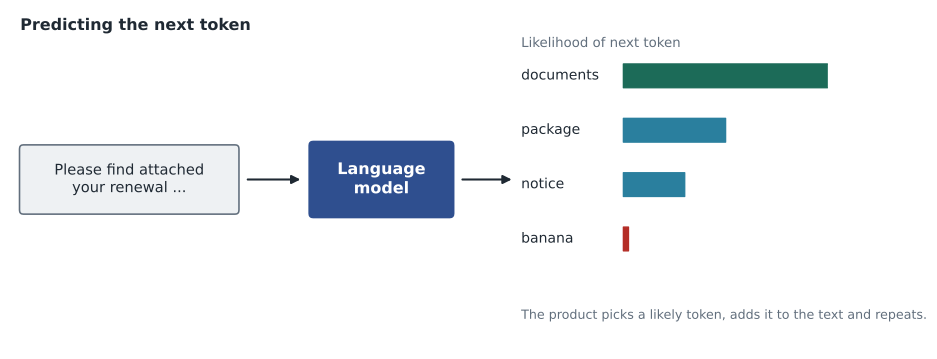
This explains two things people notice at once. First, replies stream onto the screen a word or two at a time, because that is how they are produced. Second, asking the same question twice can give different wording, because the product does not always pick the single most likely token. A setting often called temperature controls how adventurous the choice is. Low temperature gives predictable, repetitive text; higher temperature gives more varied, sometimes more creative and sometimes less accurate text. Business assistants such as Copilot choose these settings for you.
Where the knowledge comes from
How does a model know that renewal letters come with documents, or that property policies often exclude flood? It learned patterns from a vast amount of text during training. Training starts with a model whose internal settings are random. It is shown text with the next token hidden, makes a prediction, and its settings are nudged slightly to make the right token more likely next time. Repeated over trillions of tokens, this process tunes billions of internal numbers, called parameters, until the model is very good at predicting text in general.
Nothing in that process stores documents the way a filing cabinet does. The model does not keep a copy of each web page it saw. It keeps patterns: which words tend to follow which, how arguments are usually structured, what a polite email sounds like, which facts are often stated together. That is why an LLM can write about topics it was never explicitly taught, and also why it can blend patterns into a statement that sounds right but is not true.
| Term | Plain-language meaning |
|---|---|
| Training data | The very large collection of text, and sometimes images and code, the model learned from |
| Parameters | The internal numbers tuned during training; large models have billions |
| Training cutoff | The date after which the model saw no new training data |
| Inference | Using a trained model to produce output for a new prompt |
| Temperature | A setting that controls how varied the model's word choices are |
From text predictor to helpful assistant
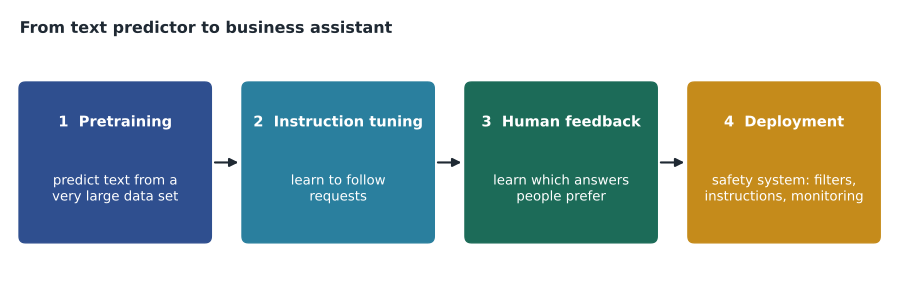
A model trained only to predict text is called a pretrained or base model. It is knowledgeable but awkward. Ask it a question and it may continue with three more questions, because on the web questions often come in lists. To turn it into an assistant, developers apply further training steps.
In instruction tuning, the model is trained on many examples of instructions paired with good responses, so it learns to answer the request rather than continue it. In learning from human feedback, people compare pairs of responses and say which is better, and the model is tuned to prefer the kind of answer people rated higher: helpful, honest and harmless. Finally, the deployed product wraps the model in a safety system: filters that screen prompts and responses for harmful content, instructions that tell the model how to behave, and monitoring.
Pretrained and fine-tuned models
The AB-731 study guide asks candidates to describe the difference between kinds of AI models, including pretrained and fine-tuned models. A pretrained model, in the business sense, is a general model used as it comes: it was trained by the provider on broad data and can handle many tasks. A fine-tuned model starts from a pretrained model and is trained further on a smaller, specialized data set, so that it becomes better at a narrow task or style, for example classifying insurance emails into service categories or writing in a company's house style.
Fine-tuning costs time and money, needs good example data and must be repeated when the base model changes. For most business needs there is a cheaper first step: give a general model better instructions and the right information at the moment of the request, a technique called grounding that lesson 3 explains. Bram Oosterhuis, Quillfield's solutions architect, put it simply at the session: "Ground first. Fine-tune only when grounding and good prompts are not enough."
| Approach | What changes | Good for | Trade-offs |
|---|---|---|---|
| Use a pretrained model with good prompts | Nothing in the model; you change the request | Most everyday drafting and summarizing | Limited to what the model already knows |
| Ground the model in your data | The information supplied with each request | Answers about your policies, clients and documents | Depends on data quality and permissions |
| Fine-tune a model | The model's parameters, using your examples | A narrow, repeated task or a specific style | Cost, data preparation and upkeep |
Large and small language models
Not every language model is huge. Small language models have far fewer parameters, run faster and more cheaply, and can even run on a laptop or phone. Microsoft's Phi family is an example. They are often good enough for focused tasks such as classifying text, extracting fields or summarizing short passages. Large models are better at broad knowledge, long and complex documents and multi-step reasoning. Some newer models are tuned to "think" through a problem in steps before answering; they are slower and use more computing but do better on complex analysis. Business products increasingly choose a model for you based on the task.
For a business user, the practical lesson is that model choice is a trade-off among quality, speed and cost. A quick rewrite of a two-line email does not need the most powerful model; a comparison of two 80-page policy wordings benefits from a capable one. Lesson 9 turns this into a way of choosing tools.
Why fluent is not the same as correct
Because an LLM produces whatever text is most plausible given its training and the prompt, it is excellent at sounding right. Usually sounding right and being right go together, because true statements are common in good training text. But when the prompt asks about something the model has little information on, such as a specific client, a recent event or an unusual clause, the most plausible continuation may be an invented detail stated with full confidence. Microsoft calls these invented details fabrications; many people call them hallucinations.
Hamish demonstrated with a harmless example. He asked a model with no web access for "the three most-cited court decisions about hail damage to grain bins in 2025". It returned three neat case names with years and courts. Not one existed. "It is not lying," he said. "It is doing what it was trained to do, producing what an answer to that question usually looks like." Lesson 4 covers how to spot and prevent this, and lesson 3 explains why grounding a request in real sources reduces it.
Worked problem
Estimating how long a reply takes
A model produces about 40 tokens a second. A typical English word is about 1.3 tokens. How long will a 300-word summary take to appear?
Show solution
- Convert words to tokens: 300 x 1.3 = 390 tokens.
- Divide by the speed: 390 / 40 = 9.75 seconds.
- So the summary appears in roughly ten seconds, a few words at a time.
Answer: About ten seconds. Real speeds vary with the model, the length of the input and how busy the service is.
What the model does not do
It helps to list what is not happening when you send a prompt. The model is not looking up the answer in a database, unless the product adds a retrieval step. It is not learning from your conversation in a way that changes the model for other people; in Microsoft's business services, prompts and responses are not used to train the foundation models. It is not checking its answer against reality unless the product adds a check. And it has no goals or opinions of its own; when it sounds certain, that is a feature of the text style, not a sign of evidence.
Yusra Kamaludin, who coordinated Quillfield's commercial lines service team, asked the question several people were thinking: "If it is just predicting words, why does it seem to understand my questions so well?" Hamish answered that predicting text extremely well requires the model to capture a great deal about how language and ideas connect. Whether that counts as understanding is a debate for philosophers. For daily work, the safer stance is to treat the model as a powerful pattern engine whose output you verify.
An analogy: the well-read new hire
Hamish offered an analogy that the group found useful for the rest of the course. Imagine Quillfield hires an assistant who has read an enormous library: insurance textbooks, millions of business emails, legal commentary, news and novels. The assistant writes beautifully and can explain almost any general concept. But the assistant has never worked at Quillfield, has not read any client file, does not know what was said in yesterday's meeting, and stopped reading the news on a certain date. When asked something it does not know, it tends to answer anyway rather than say "I am not sure".
You would not let such an assistant send advice to clients unsupervised. You would give it the right files, ask it to show where each fact came from, check its work, and gradually learn which tasks it handles well. That is exactly how to treat a language model. The analogy also explains grounding: handing the new hire the client's policy schedule before asking about the deductible changes the quality of the answer completely.
Model choice in Microsoft's products
Business users rarely pick a model directly. Microsoft 365 Copilot routes requests to the models Microsoft has chosen for each experience, and it updates them over time, sometimes offering a choice between a faster mode and a deeper "thinking" mode for complex questions. Copilot Studio lets agent makers choose among available models for some tasks, and Microsoft Foundry gives developers a catalog of models from Microsoft, OpenAI and other providers. The AB-731 study guide asks leaders to match an AI model to a business need; the practical criteria are the task's complexity, the need for speed, the volume of requests and the cost per request.
| Need | Model characteristic that matters |
|---|---|
| Quick rewrites and short summaries at high volume | Speed and low cost; a small or fast model is often enough |
| Long documents and detailed comparisons | A large context window and strong comprehension |
| Multi-step analysis or planning | A reasoning model that works through steps, accepting slower replies |
| Images or scanned documents | Multimodal input |
| A narrow, repeated classification task | A small model, possibly fine-tuned |
The model is only one part of the result. The same model can give a poor answer to a vague prompt with no grounding and an excellent answer to a clear prompt with the right documents. For most Quillfield users, improving prompts and grounding did far more than any change of model, which is why MSBA-111 spends a whole course on prompting.
Common mistakes
MistakeBelieving the model stores and retrieves documents.
InsteadIt stores patterns in its parameters; products add retrieval to bring in real documents.
MistakeExpecting identical answers every time.
InsteadWord choice varies; the substance should be similar, but always check.
MistakeFine-tuning before trying better prompts and grounding.
InsteadStart with instructions and grounding; fine-tune only for narrow, repeated tasks.
MistakeReading confidence as evidence.
InsteadConfident wording is a style; ask for sources and check them.
Summary and key terms
- An LLM predicts the next token again and again to build a reply.
- Training tunes billions of parameters on very large amounts of text; the model keeps patterns, not copies of documents.
- Instruction tuning, human feedback and a safety system turn a base model into an assistant.
- A pretrained model is general; a fine-tuned model is trained further for a narrow task; grounding is usually the cheaper first step.
- Fluent output can contain fabrications, especially about specific or recent facts.
- Large language model (LLM)
- A model trained on very large amounts of text that generates text by predicting likely next tokens.
- Parameters
- The internal numbers a model tunes during training.
- Pretrained model
- A general model trained by a provider on broad data and used as it comes.
- Fine-tuned model
- A pretrained model trained further on specialized examples for a narrow task.
- Fabrication
- Microsoft's term for invented content that a model presents as fact.
- Temperature
- A setting that makes word choice more predictable or more varied.
Practice problems
Work each problem on paper first, then reveal the answer to check.
Why does the same prompt sometimes give different wording?
Show answer
Because the product picks among several likely tokens rather than always the single most likely one.
What is the difference between a pretrained and a fine-tuned model?
Show answer
A pretrained model is general; a fine-tuned model has been trained further on specialized examples for a narrow task.
Why did the model invent court decisions about hail damage?
Show answer
It had no real information and produced what such an answer usually looks like.
Lesson quiz · 5 questions
Score 60% or more to complete this lesson.
Create a free account to save your progress, take quizzes and earn a certificate.