
MSBA-110 · Lesson 1 of 12 · 19 min
What generative AI is
▶ Video coming soon A video version of this lesson is on the way.
Quillfield Insurance Brokers is a mid-size brokerage with about 380 employees in five offices, led from its head office in Omaha. Its account executives place commercial and personal insurance with dozens of insurers, and its service teams handle renewals, certificates, endorsements and claims questions all year. In September 2026 the company gave every employee access to Microsoft 365 Copilot Chat and bought Microsoft 365 Copilot licenses for a pilot group of 60 people. Celestine Nwachukwu-Hale, the chief operating officer, agreed to sponsor the program on one condition: nobody would use the tools without first understanding what they were.
So Hamish Quarrington, an operations analyst who had spent the summer reading everything he could find, started a Thursday lunch series called AI Fundamentals. The first session filled the boardroom. Dolores Ventimiglia, a senior account executive with 25 years in the business, sat at the back with her arms folded. "I have heard that this thing makes things up," she said before Hamish had opened his laptop. "Why would a broker trust it with anything?" Hamish wrote her question on the whiteboard and said it was exactly where the course would end up. First, though, everyone needed a shared picture of what generative AI is.
This course, MSBA-110, gives that picture. It explains in plain language how generative AI works, what it is good and bad at, how Microsoft 365 Copilot, Copilot Chat and agents differ, what happens to company data, which principles guide responsible use, and how to choose the right tool and measure whether it helps. It is the starting course for three certification programs: AB-730 (AI Business Professional), AB-731 (AI Transformation Leader) and AB-620 (AI Agent Builder). Later courses build on the vocabulary introduced here.
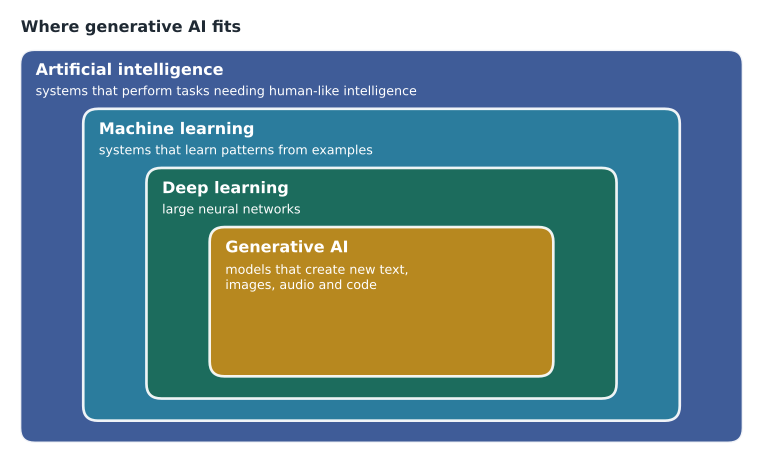
Artificial intelligence, machine learning and generative AI
Artificial intelligence, or AI, is a broad label for computer systems that perform tasks we would normally say need human intelligence: recognizing speech, spotting patterns, making predictions, translating, planning or holding a conversation. The label is old. Researchers used it in the 1950s, and for decades most AI systems followed hand-written rules: if the claim amount is over a threshold and the policy is less than 30 days old, flag it for review.
Machine learning is the part of AI in which a system learns patterns from examples instead of following rules a person wrote. Show a machine learning model thousands of past claims labeled as legitimate or suspicious, and it learns which combinations of features tend to go with each label. Machine learning is behind fraud scoring, demand forecasting, spam filters and product recommendations. These systems usually produce a number or a category: a probability, a score, a yes or no.
Deep learning is a family of machine learning methods that use large neural networks, layers of simple mathematical units whose connections are tuned during training. Deep learning made big advances in image recognition and speech in the 2010s, because it could learn useful features directly from raw pixels or sound instead of needing people to design them.
Generative AI is deep learning used to create new content: text, images, audio, video or code. Instead of answering "which category is this?", a generative model answers "what would a plausible continuation, picture or reply look like?" Given the request "draft a renewal reminder for a bakery whose commercial property policy expires on 30 November", a generative model writes an email that did not exist before. That ability to produce fluent new content is what makes the technology feel so different from the AI people met before.
| Kind of system | What it learns or follows | Typical output | Example at a brokerage |
|---|---|---|---|
| Rule-based system | Rules written by people | A decision that follows the rules | A rule that routes any claim over a set amount to a senior adjuster |
| Predictive machine learning | Patterns in labeled examples | A score, probability or category | A model that scores how likely a client is to leave at renewal |
| Generative AI | Patterns in very large amounts of text, images or code | New content | A draft email, a meeting summary, a comparison table of two quotes |
Why generative AI arrived when it did
Three things came together in the late 2010s and early 2020s. First, researchers published the transformer architecture in 2017, a design for neural networks that is very good at handling long sequences such as sentences and documents, because it lets every word in a passage "pay attention" to every other word. Second, cloud data centers made it possible to train models on enormous collections of text drawn from books, websites, code and other sources. Third, companies learned to tune these models so that they follow instructions and hold a conversation instead of simply continuing text. The public release of chat assistants in late 2022 put this into the hands of millions of people almost overnight.
Microsoft built its Copilot products on these models. It has a long partnership with OpenAI, whose GPT models power many Copilot experiences, and it also offers models from other providers and its own models in its cloud services. For a business user, the important point is not which lab trained the model but what the product around the model adds: access to your work data, security and compliance controls, and integration into the apps you already use. Lesson 5 returns to that idea.
What generative AI can produce
Generative models are often grouped by the kind of content they create. Text models draft, summarize, translate, rewrite and answer questions. Image models create pictures from a description or edit existing images. Audio models transcribe and generate speech and music. Video models create short clips. Code models write and explain software. Many current models are multimodal, meaning they can take in more than one kind of input, for example a photo of a damaged roof plus a question about it, and respond in text.
Most business use today is text: emails, summaries, reports, proposals, policies and answers to questions. That is why this course concentrates on text, and why Microsoft 365 Copilot sits inside Word, Outlook, Teams, Excel and PowerPoint. But it helps to know the other kinds exist. At Quillfield, the marketing coordinator already used an image tool to draft social media graphics, and the claims team had asked whether AI could read photographs submitted with claims. Each use raises its own questions, which later lessons cover.
How generative AI differs from search
A common first mistake is to treat a chat assistant like a search engine. A search engine finds existing pages that match your words and shows you links; you decide which sources to trust. A generative model produces a new answer by predicting plausible words. It may draw on sources, and good business tools show citations, but the sentences are newly generated. That is a strength, because the answer is tailored to your question, and a weakness, because a fluent answer can be wrong.
| Search engine | Generative AI assistant | |
|---|---|---|
| What it returns | Links to existing pages | A newly written answer, often with citations |
| Who combines the information | You | The model |
| Main risk | Choosing an unreliable page | A confident answer that contains errors |
| Best for | Finding a specific source | Drafting, summarizing, explaining and transforming content |
Hamish showed the difference with a live example. He asked Copilot Chat, "What does a commercial general liability policy usually cover?" The answer was a tidy, accurate overview with links to the sources it had used. Then he asked, "What is the deductible on the Pemberton Bakery policy?" Copilot Chat, working from the web, could not know; it said so and suggested checking the policy documents. With a Microsoft 365 Copilot license and the right file permissions, the same question could be answered from the bakery's policy schedule in SharePoint, with a citation to the file. "The tool is only as good as what it can see," Hamish said, writing that sentence under Dolores's question.
The business case in one minute
Why are companies such as Quillfield paying attention? Generative AI is good at the parts of knowledge work that are about language: reading, writing, summarizing and reorganizing information. Brokers spend much of their day on exactly that: reading policy wordings, writing to clients and insurers, summarizing meetings and comparing quotes. If an assistant can produce a solid first draft in seconds, people spend more of their time on judgment, relationships and advice. Lesson 11 shows how to measure whether that actually happens.
Worked problem
Estimating time spent on language tasks
A Quillfield account manager estimates that in a 37.5-hour week she spends 6 hours writing emails, 3 hours summarizing calls and meetings, and 4 hours comparing quotes and policy wordings. What share of her week is spent on these language-heavy tasks?
Show solution
- Add the hours: 6 + 3 + 4 = 13 hours.
- Divide by the week: 13 / 37.5 = 0.347, or about 35 parts in 100.
- So roughly a third of her week is spent on the kind of work generative AI can help draft.
Answer: About 35 percent of her week. That does not mean AI saves 35 percent of her time: the AI drafts, and she still checks, edits and decides.
Celestine added the caution that framed the whole program. "We are not buying a robot broker," she said. "We are buying a drafting assistant for people who stay responsible for the advice." That idea, that a person stays accountable for anything the AI helps produce, appears in Microsoft's responsible AI principles and runs through every lesson that follows.
Four myths to drop on day one
By the end of the first session, Hamish had collected a list of beliefs that people brought with them. Most came from news headlines or from trying a consumer chatbot at home. He grouped them into four myths that the course would test against evidence.
The first myth is that the AI understands like a person. A language model represents patterns in language extremely well, and it can appear to reason, but it has no lived experience of Quillfield's clients, no memory of last year's renewal meeting unless it is given that information, and no stake in being right. Treat its output as a capable draft from a well-read assistant who has never met the client.
The second myth is that the AI is always up to date. A model learns from data collected up to a training cutoff. Anything after that date it knows only if the product feeds it current information, for example through a web search or your files. Ask a model with no web access about an insurer's rate change announced last month and it may answer from older patterns.
The third myth is that the AI is either magic or useless. Both extremes miss the point. The same tool that writes a strong first draft of a coverage summary in ten seconds can also misread a table of limits. The useful question is not "is it good?" but "for which tasks is it good enough, with what checks?" Lessons 4 and 9 build that judgment.
The fourth myth is that using AI means giving away company data. Consumer tools and business tools handle data very differently. Microsoft 365 Copilot and Copilot Chat signed in with a work account operate under the organization's agreement with Microsoft, and prompts and responses are not used to train the underlying models. That does not remove every risk, but it changes the conversation from "never" to "which tool, with which data, under which rules". Lessons 6 and 8 explain the details.
Dolores unfolded her arms at the last myth. Her worry had been that client information would leak into some public system. Knowing that there was a difference between a free consumer chatbot and the company's licensed tools did not make her a convert, but it made her willing to try.
Where this course fits in the certifications
Microsoft introduced a set of AI business certifications that do not require technical skills. Exam AB-730: AI Business Professional tests whether someone can use generative AI well in everyday work. Microsoft Learn lists three skill areas: understanding generative AI fundamentals, managing prompts and conversations by using AI, and drafting and analyzing business content by using AI. It is a 45-minute proctored exam offered in English. Exam AB-731: AI Transformation Leader is aimed at leaders who decide where and how to adopt AI; its study guide covers the business value of generative AI, Microsoft's AI apps and services, and implementation and adoption strategy. Exam AB-620: AI Agent Builder is for people who build agents in Copilot Studio.
This course covers the shared foundation for all three. MSBA-111 and MSBA-112 continue the AB-730 path with prompting and business content; MSBA-120 to MSBA-122 continue the AB-731 path; MSBA-240 onward covers agent building. Exam details change, so always check the current study guide on Microsoft Learn before you book.
Common mistakes
MistakeThinking generative AI looks up stored answers.
InsteadIt generates new text by predicting likely words; it can be fluent and wrong.
MistakeTreating "AI" as one thing.
InsteadRule-based systems, predictive models and generative models do different jobs.
MistakeAssuming a chat assistant can see your company files.
InsteadIt sees only what the product connects it to and what you have permission to open.
MistakeExpecting the AI to take responsibility.
InsteadThe person who uses the output stays accountable for it.
Summary and key terms
- AI is the broad field; machine learning learns from examples; deep learning uses large neural networks; generative AI creates new content.
- Generative models can produce text, images, audio, video and code, and many are multimodal.
- A search engine finds existing pages; a generative assistant writes a new answer, which may include errors.
- Business value comes mostly from language-heavy work: reading, writing, summarizing and comparing.
- People remain accountable for anything AI helps produce.
- Artificial intelligence (AI)
- Computer systems that perform tasks normally thought to need human intelligence.
- Machine learning
- AI that learns patterns from examples rather than following hand-written rules.
- Generative AI
- AI that creates new content such as text, images, audio or code.
- Transformer
- A neural network design, published in 2017, that underlies most modern language models.
- Multimodal
- Able to take in or produce more than one kind of content, such as text and images.
Practice problems
Work each problem on paper first, then reveal the answer to check.
Give one example each of a rule-based system, a predictive model and a generative AI tool at an insurance brokerage.
Show answer
Rule-based: routing large claims to a senior adjuster. Predictive: scoring the chance a client leaves at renewal. Generative: drafting a renewal email.
Why could Copilot Chat not answer the question about the bakery's deductible?
Show answer
It was working from the web and could not see Quillfield's policy files.
State the difference between search and generative AI in one sentence.
Show answer
Search finds existing sources; generative AI writes a new answer that may cite sources but can contain errors.
Lesson quiz · 5 questions
Score 60% or more to complete this lesson.
Create a free account to save your progress, take quizzes and earn a certificate.