
MSBA-110 · Lesson 4 of 12 · 19 min
Strengths and limits: hallucinations and bias
▶ Video coming soon A video version of this lesson is on the way.
Dolores came to the fourth session with evidence. Over the weekend she had asked a free chatbot to explain the difference between "actual cash value" and "replacement cost" settlement on a homeowner's policy. The explanation was clear and correct. Then she asked it for the replacement cost limit on one of her client's policies. It gave a precise figure, formatted beautifully. The figure was invented. "So which is it," she asked, "brilliant or dangerous?" Hamish answered: "Both, and today we learn to tell them apart."
This lesson sets out what generative AI does well, where it fails, and why. It focuses on the two failures that matter most in business: fabrications, often called hallucinations, and bias. It also covers a quieter risk, over-reliance, and finishes with a practical set of checks that turn a risky tool into a reliable assistant.
What generative AI does well
Generative AI is strongest when the task is about transforming language that you supply or that the tool can retrieve. Drafting is the obvious one: a first version of an email, a letter, a proposal or a procedure. Summarizing comes close behind: turning a long thread, a meeting transcript or a report into key points and actions. Rewriting changes tone, length or reading level, for example making a coverage explanation suitable for a client who is not an insurance expert. Extracting pulls structured details from unstructured text, such as names, dates and amounts from a broker-of-record letter. Brainstorming produces options to react to, such as ten subject lines or five ways to explain a deductible.
It is also good at explaining general concepts that are well covered in its training data, like Dolores's question about settlement methods, and at translating between languages and between formats, for example turning bullet notes into a table. In each case a person can check the output against something they know or something in front of them.
| Task | Why AI does it well | What you still check |
|---|---|---|
| Drafting an email | Fluent writing in a requested tone | Facts, names, amounts and promises |
| Summarizing a meeting | Picks out themes and actions from a transcript | That nothing important was dropped or misattributed |
| Rewriting for a client | Changes reading level and tone | That the meaning did not change |
| Extracting details | Finds fields in messy text | Each value against the source |
| Brainstorming | Produces many options quickly | Which options make sense for this client |
Fabrications: when plausible is not true
A fabrication is content that the model presents as fact but that is not supported by its sources or by reality. Microsoft uses the term fabrication in its documentation; you will also hear hallucination and confabulation. Fabrications happen because a language model generates the most plausible continuation of the text. When it has solid information, plausible and true usually coincide. When it does not, it can still produce something that looks exactly like a correct answer.
Fabrications cluster in predictable places. Specific facts the model cannot know, such as a client's policy limit, a colleague's phone extension or the result of yesterday's meeting, are high risk unless the tool is grounded in the right source. Citations and references are a classic case: invented article titles, court decisions or regulation numbers. Numbers are another: models can misadd, misread a table or confidently state a statistic. Recent events after the training cutoff are unknown unless the product searches the web. Niche topics with little training data, such as an unusual endorsement used by one insurer, are risky too.
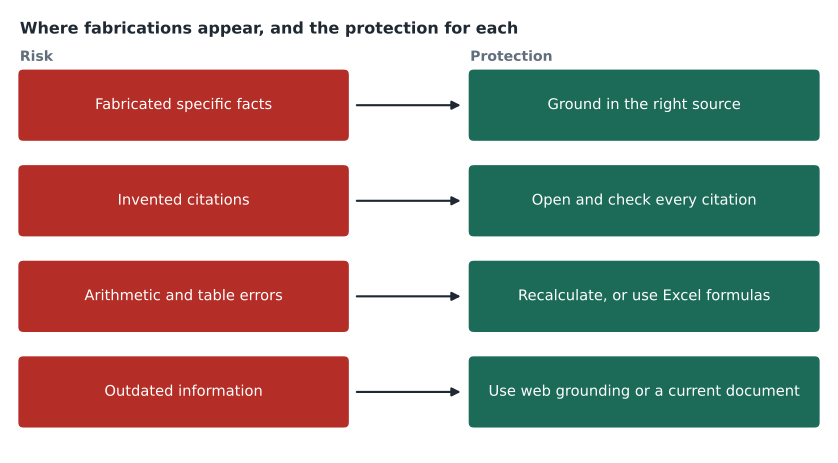
Grounding reduces fabrications but does not eliminate them. A model given the right policy schedule can still misread a column, mix up two locations or summarize an exclusion too broadly. That is why Microsoft 365 Copilot shows citations linking each statement to its source: the citation is your invitation to check. Dolores's invented figure would have been caught at once if she had asked the grounded tool and clicked the citation to the schedule.
Reliability and consistency
Generative AI is not deterministic. The same prompt can produce somewhat different answers, and small changes in wording can change the result. Models can also be inconsistent across a long task, following an instruction in the first half of a document and forgetting it in the second. For business use, reliability means designing work so that variation does not matter: using clear instructions, checking outputs, and keeping a person responsible for anything that goes to a client or an insurer.
The AB-731 study guide lists the main challenges of generative AI as fabrications, reliability and bias. Leaders need to understand these because they shape where AI can be used safely. A tool that drafts internal meeting notes can tolerate occasional slips that a person fixes; a tool that sends quotes to clients automatically cannot.
Bias: patterns we did not intend
Bias in AI means outputs that systematically favor or disadvantage some people or groups, or that reflect stereotypes. Generative models learn from enormous amounts of human-written text, and human text contains historical and social biases. A model asked to write a story about "a CEO and her assistant" might switch the genders unless told otherwise. A model asked to describe "a typical small business owner" might default to one picture of who that is.
Bias can also come from the data used to ground or fine-tune a system. If Quillfield trained a model to prioritize service requests using last year's records, and last year one branch's clients waited longer because that branch was short-staffed, the model might learn to give that branch's clients lower priority. Nobody intended it; the pattern was in the data.
| Source of bias | Example | Mitigation |
|---|---|---|
| Training data | Stereotyped assumptions about occupations or groups | Review outputs for assumptions; set neutral instructions |
| Grounding or fine-tuning data | Historical service delays repeated by a model | Check that example data is representative |
| Prompt wording | A leading question that invites a one-sided answer | Ask neutral questions and request balanced views |
| How output is used | Using AI scores for decisions about people without review | Keep a human decision-maker and document the criteria |
In insurance, decisions about people carry legal and ethical weight. Pricing, underwriting and claims decisions are regulated, and using AI in them requires governance that Quillfield's compliance team owns. For everyday users, the lesson is narrower but important: read AI-drafted text about people with an eye for assumptions, and never let an AI draft be the basis for treating a client differently without a human decision based on legitimate criteria.
Over-reliance and automation bias
The quietest risk is not in the model but in us. Automation bias is the tendency to trust a system's output and stop checking, especially when it has been right many times before. After the tenth good meeting summary, it is tempting not to read the eleventh. Research on human-AI teamwork has repeatedly found that people accept wrong AI suggestions more often than they should, particularly under time pressure.
Microsoft's guidance on Copilot, as the product name suggests, puts the person in control: Copilot suggests, and the person reviews, edits and decides. Practical habits keep that true: read the whole output before sending it, check every number and name, click citations for anything important, and be most careful when you are busy, because that is when automation bias is strongest.
Worked problem
How much checking is enough?
Hamish tests Copilot on 40 renewal summaries and finds that 3 contain an error that would matter if sent to a client. If an account manager produces 25 such summaries a month without checking, how many errors would reach clients on average?
Show solution
- Error rate in the test: 3 / 40 = 0.075.
- Expected errors a month: 25 x 0.075 = 1.875.
- That is roughly two client-facing errors every month.
Answer: About 2 errors a month, which is why every client-facing summary gets a human check. Testing on real examples is how you find the rate in the first place.
A checklist for trustworthy output
Hamish ended the session with a short checklist that Quillfield later printed on a card for every pilot user. Source: is the answer grounded in the right document, and can I see the citation? Specifics: are every name, number, date and amount checked against the source? Scope: did the AI answer the question I asked, or a slightly different one? Slant: are there assumptions about people, or a one-sided view? Sign-off: am I comfortable putting my name on this? If any answer is no, the draft is not finished.
Dolores read the card twice. "That is just what I would tell a junior broker about a draft from a new assistant," she said. "Exactly," Hamish replied. That was the point: the skills for managing AI output are mostly the skills of a good reviewer.
Testing a tool before you rely on it
The best way to learn where an AI tool is reliable is to test it on real examples where you already know the right answer. Quillfield called this a test set. Before rolling out Copilot summaries of renewal files, Hamish collected 40 past files for which experienced account managers had written summaries. He ran Copilot on each file and compared the results with the human versions, noting every omission, error and improvement. The exercise took two days and gave the team a realistic picture: Copilot was excellent at listing locations and coverage parts, weaker at noticing unusual endorsements, and occasionally wrong about dates in scanned documents.
A test set does not need to be large to be useful. Twenty to fifty real examples usually reveal the main patterns. What matters is that the examples are representative, including the awkward cases, and that someone who knows the work judges the results. The same idea, at a larger scale, is how organizations evaluate agents before deployment, which the AB-620 courses cover.
| Test step | What Quillfield did |
|---|---|
| Choose real examples | Forty renewal files, including unusual and scanned ones |
| Define what good looks like | Experienced account managers' summaries and a checklist of required items |
| Run the tool the way users will | Same prompt and sources the pilot users would use |
| Compare and record | Every omission, error and improvement noted in a spreadsheet |
| Decide and communicate | Where to use the tool, what to check, and what to avoid |
Red flags in AI output
Some signs should make you slow down. Unusual precision without a source, such as an exact percentage or a specific clause number that you did not supply, is a common sign of fabrication. Generic answers to specific questions suggest the tool did not find the relevant source. Missing citations on a statement that should have one deserve suspicion. Inconsistencies between parts of the same answer, such as two different dates for one event, show that something went wrong. And answers that are exactly what you hoped to hear deserve a second look, because models can drift toward agreeing with the framing of a question.
Hamish asked each participant to bring one example of a red flag to the next session. Tobias brought a summary that described a claim as "approved in full" when the insurer's letter had approved it "in part". Yusra brought a draft that cited a procedure page that existed but did not say what the draft claimed. Both had been caught by people who opened the source. The collection became part of the training material for the next group of pilot users.
Asking the AI to help you check
AI can also help with its own verification, as long as you remember that the final check is yours. After a draft, you can ask Copilot to list every number, date and name it used and where each came from, which turns a long draft into a short checklist. You can ask it to identify statements it is less certain about, or to compare its summary with the source and list anything it left out. These prompts do not make the output trustworthy on their own, because the same model is checking itself, but they make your review faster and more systematic.
Hamish showed the technique on a renewal summary. Asked to list every figure with its source, Copilot produced a table of eleven values with citations. Ten matched the schedule; one, a business interruption limit, cited last year's schedule rather than this year's. The table took thirty seconds to produce and two minutes to check, and it found the one error that mattered.
Common mistakes
MistakeAsking an ungrounded chatbot for client-specific facts.
InsteadUse a tool grounded in the right source and check the citation.
MistakeTrusting references because they look properly formatted.
InsteadOpen every citation; invented references look real.
MistakeLetting AI do arithmetic that matters without checking.
InsteadRecalculate, or use Excel formulas for the numbers.
MistakeSkipping review because the last ten outputs were fine.
InsteadReview every client-facing output; automation bias grows with success.
Summary and key terms
- Generative AI is strongest at drafting, summarizing, rewriting, extracting and brainstorming with content you can check.
- Fabrications are plausible but unsupported statements; they cluster around specific facts, citations, numbers, recent events and niche topics.
- Grounding and citations reduce fabrications; human review catches what remains.
- Bias can come from training data, grounding data, prompts and how outputs are used.
- Automation bias leads people to stop checking; a consistent review checklist counters it.
- Fabrication
- Content a model presents as fact that its sources or reality do not support.
- Hallucination
- A common informal term for a fabrication.
- Bias
- Outputs that systematically favor or disadvantage people or groups, or reflect stereotypes.
- Automation bias
- The tendency to trust automated output and stop checking it.
- Citation
- A link from a statement in an AI answer to the source it was based on.
Practice problems
Work each problem on paper first, then reveal the answer to check.
Name three places where fabrications tend to appear.
Show answer
Any three of: specific facts the model cannot know, citations, numbers, recent events and niche topics.
How can historical data introduce bias into an AI system?
Show answer
If past records reflect unfair patterns, such as slower service for one branch, a model can learn and repeat them.
What are the five points on Quillfield's checklist?
Show answer
Source, specifics, scope, slant and sign-off.
Lesson quiz · 5 questions
Score 60% or more to complete this lesson.
Create a free account to save your progress, take quizzes and earn a certificate.