
MSBA-110 · Lesson 10 of 12 · 18 min
AI and roles at work
▶ Video coming soon A video version of this lesson is on the way.
The question nobody had asked out loud came up in the tenth session. Tobias Okafor-Rains, a claims advocate who had joined Quillfield two years earlier, asked it: "If Copilot writes the letters and summarizes the files, what happens to the people who used to do that?" The room went quiet. Celestine, who had come to listen, answered first. "That is the right question, and you deserve a straight answer rather than a slogan." The rest of the session was spent on that answer.
This lesson looks at how generative AI changes work: which tasks it takes on, which it supports and which stay firmly human; what new skills people need; how roles shift; and what good employers do to make the change fair. It matters for AB-730 candidates, who need to use AI well in their own roles, and for AB-731 candidates, who must plan adoption that people will actually accept.
Jobs are bundles of tasks
A useful way to think about AI and work is that jobs are made of tasks, and AI changes tasks before it changes jobs. Tobias's job includes reading claim files, writing to insurers, explaining outcomes to clients, negotiating when a claim is disputed, spotting when a claim needs a specialist and keeping records. Generative AI can help a great deal with some of those tasks, such as drafting letters and summarizing files. It can help a little with others, such as preparing for a negotiation. And some it should not do at all, such as deciding to push back on an insurer's denial or comforting a client whose business has just flooded.
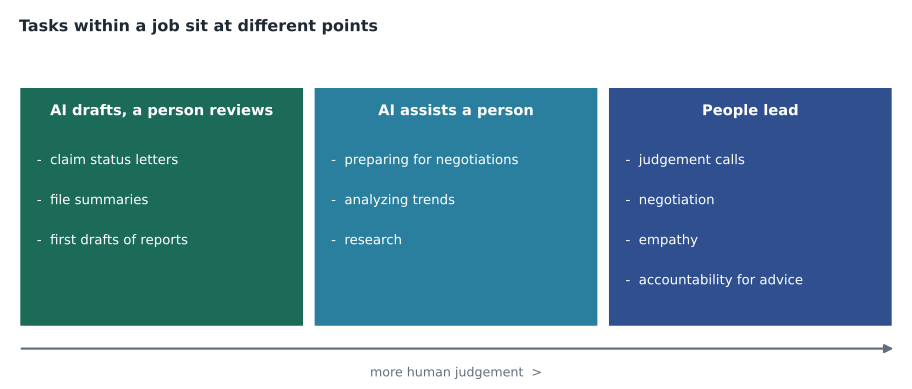
Economists distinguish automation, where a technology performs a task instead of a person, from augmentation, where it helps a person do the task better or faster. Most current uses of generative AI in knowledge work are augmentation: the AI drafts, the person decides. Some routine tasks, such as sorting a shared mailbox or producing standard confirmations, can be largely automated by agents, with people handling exceptions.
What changes in a role
When AI takes on the first draft of routine writing, three things tend to happen to a role. Time shifts toward the parts that need judgment and relationships. The skill mix changes: reviewing, editing and verifying become as important as writing. And expectations rise: if a renewal summary that took 40 minutes now takes 15, managers may expect more summaries, faster responses or more time spent with clients. Whether those changes feel like an improvement depends heavily on how the organization handles them.
| Task | Before AI | With AI |
|---|---|---|
| Claim status letter | Write from scratch, about 20 minutes | Review and personalize a draft, about 7 minutes |
| File summary for a new adjuster | Read and summarize, about 45 minutes | Check a Copilot summary against the file, about 15 minutes |
| Explaining a denial to a client | Phone call and follow-up email | Phone call stays human; AI drafts the follow-up |
| Deciding whether to dispute a denial | Human judgment with a senior advocate | Unchanged, with AI-assisted research on similar cases |
Worked problem
Where does the time go?
Tobias handles about 25 claim letters and 10 file summaries a week. Using the illustrative times above, how many hours a week does AI assistance free up, and what might he do with them?
Show solution
- Letters: 25 x (20 - 7) = 325 minutes.
- Summaries: 10 x (45 - 15) = 300 minutes.
- Total: 625 minutes, about 10.4 hours a week.
Answer: About 10 hours a week. Quillfield agreed with its claims team that part of that time would go to proactive client check-ins on open claims, which clients had asked for in surveys.
New skills for everyone
Using AI well is a skill, and like any skill it improves with practice and teaching. The core capabilities are the ones this course and its successors cover. Framing: describing a task clearly enough for AI to help, which MSBA-111 develops as prompting. Grounding: knowing what information the AI needs and pointing it there. Evaluating: reading output critically and checking facts, numbers and tone. Editing: turning a draft into something you are willing to sign. Choosing: matching tasks to tools, as lesson 9 showed. Judging: knowing when AI should not be used at all.
There are also human skills that become more valuable, not less, because AI cannot supply them: understanding a client's situation, building trust, negotiating, exercising professional judgment and taking responsibility. Dolores, who had resisted the tool, became one of its most effective users precisely because she knew what good advice looked like and could spot when a draft fell short.
Working with agents
As agents take on multi-step tasks, some roles begin to include directing and supervising them. Microsoft's 2025 Work Trend Index described this as people increasingly working alongside agents, with employees taking on something like a manager's role for the agents that handle parts of their work. In practice that means setting clear goals and limits for an agent, checking its work, handling the exceptions it escalates and improving its instructions over time. Yusra, whose procedures agent now answered dozens of questions a week, spent an hour every Friday reading the questions it could not answer and adding the missing procedures.
| When you direct an agent, you… | Because… |
|---|---|
| Define the goal and the limits | An agent works only as well as its instructions |
| Check samples of its output | Errors can repeat at scale |
| Handle the exceptions it escalates | Unusual cases need human judgment |
| Improve its knowledge and instructions | Gaps show up in real use |
| Stay accountable for the outcome | The agent acts on the organization's behalf |
Concerns that deserve answers
People have reasonable concerns about AI at work, and adoption goes better when leaders address them honestly. Job security is the most common: if tasks shrink, will roles disappear? Skill loss worries some people: if AI drafts everything, will junior staff ever learn to write a strong coverage letter? Monitoring is another: will AI usage data be used to judge individual performance? And fairness matters: will the benefits of AI go only to some teams or some people?
Celestine answered Tobias directly. Quillfield would not cut roles because of the pilot; it expected growth to absorb any time saved, and it would review that commitment openly each year. New staff would still learn to write key documents themselves before relying on AI drafts. Copilot usage reports would be used to plan training, not to rank individuals. And every employee, not just the pilot group, would get training. She did not promise that work would never change. She promised that people would be told the truth about how it was changing and would have a say.
What good employers do
Organizations that adopt AI well tend to follow a similar pattern, which MSBA-122 covers for the AB-731 exam. They involve employees early, inviting people who do the work to suggest and test uses. They train broadly, not just early adopters. They set up AI champions, respected colleagues who help others get started. They are clear about how time savings will be used. They protect learning, so that junior staff still build expertise. And they measure and share results, including problems, so that trust grows with evidence.
Quillfield's champions program began that month with eight volunteers, one from each team, including Dolores. Each champion would hold short drop-in sessions and collect examples of what worked and what did not. Hamish noticed that colleagues listened to Dolores's examples more than to his, because she had been the skeptic.
Role snapshots at Quillfield
To make the discussion concrete, Hamish asked five colleagues to describe how their work had changed in the first two months. Their answers showed that the same tools affect different roles in different ways.
| Role | What AI took on | What grew in importance |
|---|---|---|
| Account executive (Dolores) | First drafts of proposals, email catch-up, meeting preparation | Client conversations, checking figures, advice |
| Claims advocate (Tobias) | Status letters, file summaries | Negotiation, client support after a loss |
| Service coordinator (Yusra) | Answering routine procedure questions through an agent | Maintaining procedures, building and improving agents |
| Compliance officer (Wendell) | Summaries of regulatory updates, first drafts of policies | Judgment on new uses, governance, training |
| Operations analyst (Hamish) | Data preparation and charting | Measurement design, training, change support |
In each case the AI took on part of the routine work, and the person's time moved toward the parts of the job that depend on experience, relationships and responsibility. None of the five roles disappeared; several became more interesting. Hamish was careful to add that two months is a short time, and that the organization would keep watching how roles evolved.
Building a career alongside AI
For individuals, the practical question is how to stay valuable as tools change. Three habits help. Keep the craft: understand your field well enough to judge AI output, because the person who can spot the carried-over limit or the misread exclusion is more valuable than ever. Learn the tools deliberately: set aside time to try new features on real tasks and keep notes on what works, rather than waiting for formal training. Move toward judgment and relationships: volunteer for the work that AI cannot do, such as difficult conversations, complex placements and mentoring, because that is where careers grow.
Certifications can help too. AB-730 shows that someone can use AI effectively in business work; AB-731 shows that a leader understands how to adopt it responsibly; AB-620 shows that someone can build agents. Several Quillfield staff, including Dolores, decided to sit AB-730 in the new year.
What leaders owe their teams
Celestine summed up the leader's side in four commitments that she later wrote into Quillfield's AI strategy: be honest about what is changing and why; invest in everyone's skills, not only those of early adopters; share the benefits, so that time saved improves people's work and not only the company's numbers; and listen, through champions, surveys and open sessions, so that problems surface early. MSBA-122 develops these into an adoption plan for AB-731 candidates.
Teams change as well as roles
AI changes how teams work together, not only what individuals do. Shared meeting recaps mean fewer people need to attend every meeting. Agents that answer routine questions change who people go to for help; Yusra's team found that new staff asked the procedures agent first and came to colleagues with harder questions, which made those conversations more valuable. Handoffs improve when a summary of the client's history travels with the file. And new team roles appear: someone needs to own each agent, keep its knowledge current and watch its answers.
There are risks too. If everyone relies on AI summaries, fewer people read the full documents, and the team's shared understanding can thin out. Quillfield's claims team agreed that for complex claims at least one person would always read the full file and brief the others, using the AI summary only as a starting point. Small agreements like this, made by the team itself, protected the depth of knowledge that clients depend on.
| Team effect | Benefit | Risk to manage |
|---|---|---|
| Shared AI meeting recaps | Fewer people need to attend every meeting | Recaps can miss nuance; key people still attend important meetings |
| Agents for routine questions | Colleagues spend time on harder questions | Agent knowledge must be kept current |
| Summaries travel with files | Smoother handoffs | People may stop reading the full file |
| New ownership roles | Someone is accountable for each agent | Ownership must be assigned, not assumed |
Tobias, who had asked the opening question, said at the end of the session that he felt better informed, if not entirely reassured. Celestine said that was the honest outcome she had hoped for. The conversation about AI and roles, she said, was not a single meeting but something Quillfield would keep having every quarter, with real data about how work was changing and a genuine chance for staff to shape the next steps. The champions would collect questions in advance so that nobody had to raise a worry in front of the whole room.
Hamish added a practical suggestion for anyone unsure how AI would affect their own job: list your tasks, mark which ones AI could draft, which it could assist with and which must stay human, and estimate the hours in each group. The exercise takes half an hour and usually shows that the human-led tasks are the ones people value most in their work.
Common mistakes
MistakeThinking of AI as replacing whole jobs at once.
InsteadAI changes tasks first; roles shift as task mixes change.
MistakeAssuming reviewing AI output needs no skill.
InsteadEvaluating and editing are core skills that need practice.
MistakeUsing usage data to rank individuals without saying so.
InsteadBe transparent about how data is used; use it mainly to plan support.
MistakeLetting junior staff rely on AI before they learn the craft.
InsteadProtect learning so expertise still develops.
Summary and key terms
- Jobs are bundles of tasks; generative AI changes tasks before it changes jobs.
- Most current knowledge-work uses are augmentation: AI drafts, people decide.
- Roles shift toward judgment and relationships, and reviewing and editing become core skills.
- Working with agents adds supervision: setting goals, checking work, handling exceptions and improving instructions.
- Fair adoption involves employees, trains broadly, is honest about time savings and protects learning.
- Automation
- A technology performing a task instead of a person.
- Augmentation
- A technology helping a person do a task better or faster.
- AI champion
- A colleague who helps others adopt AI and shares practical examples.
- Exception
- A case an automated process or agent cannot handle and passes to a person.
Practice problems
Work each problem on paper first, then reveal the answer to check.
Give one claims task AI can draft, one it can assist with and one that stays human.
Show answer
Draft: a claim status letter. Assist: preparing for a negotiation. Human: deciding whether to dispute a denial.
Name three skills for using AI well.
Show answer
Any three of: framing, grounding, evaluating, editing, choosing and judging.
What did Celestine commit to about usage reports?
Show answer
They would be used to plan training, not to rank individuals.
Lesson quiz · 5 questions
Score 60% or more to complete this lesson.
Create a free account to save your progress, take quizzes and earn a certificate.