
MSAZ-102 · Lesson 7 of 12 · 18 min
The Service Trust Portal and compliance offerings
▶ Video coming soon A video version of this lesson is on the way.
Harrow & Finch takes payment cards in every store and online, so it is assessed every year against the Payment Card Industry Data Security Standard. Its board also has an audit committee that asks hard questions about any new supplier of critical services. On November 6, 2026, Sunil Rao had two requests on his desk. The audit committee wanted evidence that Microsoft's data centers and cloud services are independently audited before more of StockLine moved to Azure. The company's payment card assessor wanted to know which parts of the card environment Microsoft is responsible for and which remain with Harrow & Finch. Sunil did not need to email Microsoft or wait for a salesperson. He signed in to the Service Trust Portal and downloaded what he needed in about twenty minutes.
Trust, and why customers need evidence
When an organization moves workloads to a cloud provider, it hands over part of its security and compliance to that provider. The physical security of the data center, the hardware, the hypervisor and much of the network are now Microsoft's responsibility, as MSAZ-101's shared responsibility model explained. But regulators, auditors and boards still hold the customer accountable for its data. The customer therefore needs evidence that the provider's part is done properly, and it needs to understand exactly where the provider's responsibility ends and its own begins.
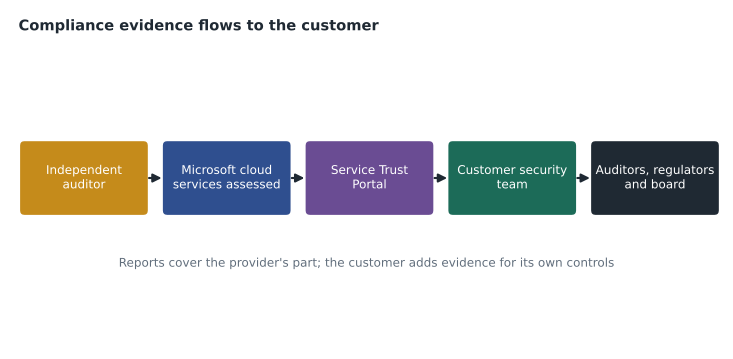
Cloud providers cannot let every customer send its own auditors into their data centers. Instead, they hire independent audit firms to assess their services against widely recognized standards, and publish the resulting reports and certificates for customers to use in their own audits. Microsoft publishes these through the Service Trust Portal and describes its approach through the Microsoft Trust Center.
The Microsoft Trust Center
The Microsoft Trust Center is a public website that explains how Microsoft approaches security, privacy, compliance and transparency across its cloud services. It describes the company's principles, how it handles customer data, how it responds to requests from governments, and which compliance standards and regulations its services support. It is written for decision-makers and is a good starting point for anyone who needs to understand Microsoft's commitments before reading detailed audit reports. The legal commitments themselves are in Microsoft's contractual documents, such as the product terms and the data protection addendum that form part of a customer's agreement.
The Service Trust Portal
The Service Trust Portal is Microsoft's site for publishing the detailed documents behind those commitments. Its main contents are audit reports from independent auditors, certificates, assessment summaries and other compliance documents for Microsoft's cloud services, including Azure, Microsoft 365 and Dynamics 365. Much of the material can be read only after signing in with a work account from an organization that uses Microsoft cloud services, because audit reports often contain details that are not published openly. Some documents are available to anyone.
Documents in the portal are organized by service and by standard, and many are grouped by industry and region, so a user can find, for example, the reports relevant to financial services or to a particular country. Users can save documents to a personal library and be notified when a new version is published, which matters because audit reports are renewed every year or so. Sunil saved the reports his auditors need so that he would be told when the next versions arrive.
The current AZ-900 skills outline no longer names the Service Trust Portal as a separate skill, though older versions did and many study guides still cover it. It remains a practical tool that cloud administrators and security teams use, and knowing what it holds saves a great deal of time when an audit arrives.
Common compliance offerings
Microsoft describes the standards and regulations its services support as compliance offerings. They fall into several groups: global standards that apply in any country, offerings for particular governments and regions, and offerings for particular industries. Which offerings cover which services, and in which regions, changes over time, so the Service Trust Portal and Microsoft's compliance documentation are the places to check current scope.
| Offering | What it is | Why a customer might need it |
|---|---|---|
| ISO/IEC 27001 | An international standard for information security management systems | Shows that the provider runs security as a managed, audited system |
| ISO/IEC 27017 and 27018 | Codes of practice for cloud security and for protecting personal information in public clouds | Supports privacy and cloud-specific security reviews |
| SOC 1, SOC 2 and SOC 3 | Independent reports on controls, from the AICPA attestation framework | SOC 1 for financial reporting audits; SOC 2 for security and availability; SOC 3 is a public summary |
| PCI DSS | The payment card industry's security standard | Needed by any business that stores, processes or transmits card data |
| CSA STAR | The Cloud Security Alliance's assurance program for cloud providers | A cloud-specific security assessment |
| FedRAMP | The US federal program for authorizing cloud services for federal agencies | Federal agencies and their suppliers |
| HIPAA business associate agreement | A contract under which Microsoft supports customers handling US health information | Health care providers, insurers and their suppliers |
A SOC 2 Type 2 report is often the most useful single document for a security review. It describes the provider's controls for security and related principles such as availability and confidentiality, and the auditor's tests of whether those controls operated effectively over a period of time, usually several months. A Type 1 report only describes the controls at a point in time. Sunil gave the audit committee the latest SOC 2 Type 2 report for Azure and the ISO 27001 certificate, together with a one-page summary in plain language.
Compliance is shared
A compliance offering covers Microsoft's part of the responsibility, not the customer's. Azure being assessed against PCI DSS means that the Azure infrastructure and services in scope meet the standard's requirements for the parts Microsoft controls. It does not mean that StockLine, running in Azure, is PCI DSS compliant. Harrow & Finch must still configure its own systems correctly: segment the card environment, control access, encrypt data, keep systems patched, log activity and train staff. The payment card assessor will check those things, using Microsoft's documents as evidence only for the layers Microsoft manages.
For that reason, Microsoft publishes responsibility matrices for several standards, showing which requirements are met by Microsoft, which by the customer, and which are shared. Sunil's second task on November 6 was to download the PCI DSS responsibility guidance and annotate it for Harrow & Finch's design. That annotated document became part of the evidence package for the next assessment, planned for the spring.
| Requirement area (simplified) | Microsoft | Harrow & Finch |
|---|---|---|
| Physical security of data centers | Responsible | Not responsible |
| Host hardware and hypervisor | Responsible | Not responsible |
| Network segmentation of the card environment in Azure | Provides the tools | Designs and configures it |
| Guest operating system patching on VMs | Not responsible | Responsible |
| Access control for StockLine users | Provides Microsoft Entra ID | Configures roles, MFA and reviews |
| Logging and monitoring of the application | Provides Azure Monitor | Configures, reviews and responds |
Tools that connect offerings to your own configuration
Two tools from earlier lessons help bridge the gap between Microsoft's compliance and the customer's. In Azure, Microsoft Defender for Cloud includes a regulatory compliance dashboard that uses Azure Policy initiatives, such as the ones lesson 5 described, to show which technical settings in your subscriptions support or break the controls of a chosen standard. In Microsoft Purview, Compliance Manager, from lesson 4, tracks assessments against regulations, lists improvement actions and keeps evidence. Neither tool makes an organization compliant on its own, but both turn a long standard into a list of concrete settings and tasks.
Privacy obligations deserve a separate mention. In the United States there is no general federal law requiring data to stay in the country, but sector laws such as HIPAA and state privacy laws, including Iowa's consumer data protection law, place duties on businesses that handle personal information and on their service providers. Contracts with Microsoft, including the data protection addendum, describe how Microsoft handles customer data on the business's behalf. Microsoft publishes information on where data is stored for each service and region, which helps answer residency questions.
Theo wrote a short script to summarize the simplified responsibility table for the audit committee, counting which side owns each area.
areas = {
    "Physical security": "Microsoft",
    "Host hardware and hypervisor": "Microsoft",
    "Network segmentation": "Shared",
    "Guest OS patching": "Customer",
    "Access control": "Shared",
    "Application logging": "Shared",
    "Staff training": "Customer",
}
from collections import Counter
counts = Counter(areas.values())
for owner in ("Microsoft", "Shared", "Customer"):
    names = [a for a, o in areas.items() if o == owner]
print(f"{owner:9s} {counts[owner]}: {', '.join(names)}")Microsoft 2: Physical security, Host hardware and hypervisor Shared 3: Network segmentation, Access control, Application logging Customer 2: Guest OS patching, Staff training
What this code does
Lists who is responsible for each security area in the cloud under the shared responsibility model: Microsoft, the customer, or both. It groups and counts the areas under each party. The result shows that physical and host security belong to Microsoft while patching and staff training stay with the customer.
Building an evidence package
Sunil built the evidence package for the audit committee in layers, a practice worth copying. The first layer is the provider's assurance: the current SOC 2 Type 2 report, the ISO 27001 certificate, the payment card attestation for the services in scope and a short note on the dates they cover. The second layer is the shared responsibility statement: the annotated responsibility matrix showing what Microsoft does and what Harrow & Finch does for each requirement. The third layer is the company's own controls: the Azure Policy compliance results, the Defender for Cloud recommendations, the access reviews and the incident records, showing that Harrow & Finch is doing its part.
Each layer answers a different question. The first says the platform is trustworthy; the second says who is responsible for what; the third says the company is meeting its responsibilities. Auditors tend to spend the most time on the third layer, because it is where most problems are found. Sunil set a calendar reminder to refresh the first layer every year, when new reports appear in the Service Trust Portal, and the third every quarter.
He also kept a short glossary at the front of the package for board members who are not security specialists, explaining terms such as attestation, certification and shared responsibility in a sentence each. The audit committee chair said afterwards that it was the first cloud security briefing she had understood without asking for a second meeting.
Finally, Sunil checked the scope section of each report before using it. Audit reports list exactly which services and which regions were tested, and a service that was released recently may not yet appear. Using a report for a service outside its scope is a common mistake that auditors notice quickly, so the evidence package lists, next to each report, the Azure services Harrow & Finch uses that the report covers.
Worked problem
Answering an auditor
The audit committee asks three questions: (1) Has an independent auditor checked Microsoft's security controls? (2) Does that mean StockLine in Azure meets the payment card standard? (3) Where can we see what Microsoft commits to doing with our data?
Show solution
- (1) Yes. Download the latest SOC 2 Type 2 report and ISO 27001 certificate from the Service Trust Portal.
- (2) No. Microsoft's PCI DSS assessment covers its part; Harrow & Finch must configure and operate StockLine to meet its own requirements, using the responsibility matrix.
- (3) The Microsoft Trust Center explains the approach, and the contractual commitments are in the product terms and data protection addendum.
Answer: Audit reports from the Service Trust Portal, a clear statement of shared responsibility, and Microsoft's contractual documents.
Common mistakes
MistakeAssuming a Microsoft certification makes your workload compliant.
InsteadIt covers Microsoft's part; you must configure and operate your own systems to meet the standard.
MistakeEmailing Microsoft for audit reports.
InsteadDownload them from the Service Trust Portal after signing in.
MistakeUsing an audit report from several years ago.
InsteadReports are renewed regularly; use the current version and subscribe to updates.
MistakeConfusing the Trust Center with the Service Trust Portal.
InsteadThe Trust Center explains principles; the Service Trust Portal holds the detailed documents.
Summary and key terms
- Customers need evidence that a cloud provider's part of security and compliance is done properly.
- The Microsoft Trust Center explains Microsoft's approach to security, privacy and compliance, while the Service Trust Portal publishes independent audit reports, certificates and compliance documents, many available after signing in with a work account.
- Compliance offerings include global standards such as ISO 27001 and SOC reports, government and regional programs, and industry standards such as PCI DSS.
- These cover Microsoft's responsibilities only; customers remain responsible for their own configurations, helped by responsibility matrices, Defender for Cloud's compliance dashboard and Purview Compliance Manager.
- Service Trust Portal
- Microsoft's site for audit reports, certificates and compliance documents about its cloud services.
- Microsoft Trust Center
- A public site describing Microsoft's approach to security, privacy and compliance.
- Compliance offering
- A standard or regulation that Microsoft's services have been assessed against or support.
- SOC 2 Type 2
- An independent report on how effectively a provider's controls operated over a period.
- Responsibility matrix
- A document showing which requirements are met by the provider, the customer or both.
Practice problems
Work each problem on paper first, then reveal the answer to check.
Where would you download Microsoft's latest ISO 27001 certificate for Azure?
Show answer
From the Service Trust Portal.
Does Azure's PCI DSS assessment make a customer's application compliant?
Show answer
No. It covers Microsoft's responsibilities; the customer must meet its own.
What is the difference between a SOC 2 Type 1 and Type 2 report?
Show answer
Type 1 describes controls at a point in time; Type 2 also tests how they operated over a period.
Lesson quiz · 5 questions
Score 60% or more to complete this lesson.
Create a free account to save your progress, take quizzes and earn a certificate.