
MBA-512 · Lesson 9 of 12 · 21 min
Integrated marketing communications and digital advertising
Cedarline spends about 26 million dollars a year on marketing communications, roughly 5.5 percent of revenue. When the cohort asks where it goes, Cedarline's marketing director produces a breakdown: about 70 percent on digital performance advertising, mostly paid search, paid social and retargeting, measured by the revenue each platform reports it generated; about 15 percent on email and the loyalty program, mostly promotional offers; about 10 percent on catalogs and in-store materials; and about 5 percent on what the director calls brand, a few sponsorships of trail races and some online video. Every channel, by its own reporting, earns several dollars of revenue for each dollar spent. Yet total revenue has grown only when promotions were deepened. Dr. Lindqvist says the cohort is looking at one of the most common problems in modern marketing, and that the rest of the day will explain it.
Marketing communications are all the ways a firm informs, persuades and reminds customers about its brands and offers: advertising in every medium, public relations, sponsorship, events, sales promotion, personal selling, direct and email marketing, social media, content and the packaging and stores themselves. Integrated marketing communications is the discipline of coordinating them so that they deliver a consistent message, reinforce one another and serve the brand's positioning, rather than each pursuing its own metrics.
What communications are meant to do
Communications work through effects on what people know, feel and do. Early models such as AIDA, attention, interest, desire and action, described a hierarchy through which customers move. Russell Colley's 1961 report Defining Advertising Goals for Measured Advertising Results, known as DAGMAR, argued that advertising should be set specific, measurable communication objectives, such as raising awareness of a product among a target group from 20 to 40 percent within a year, rather than vague sales goals. Modern practice recognizes that people do not always move neatly through stages, but the discipline remains: every campaign should state whom it is trying to reach, what it wants them to know, feel or do, and how success will be measured.
A useful distinction is between brand building and sales activation. Activation, such as a search advertisement or a promotional email, prompts people who are already in the market to buy now, and its effects are immediate and easy to measure. Brand building, such as memorable video advertising or sponsorship, creates and refreshes associations in the minds of many people who are not yet in the market, so that the brand comes to mind and is preferred when they are. Its effects are slower, smaller per week and harder to measure, but they last longer and make activation more effective. In analyses of hundreds of advertising effectiveness cases published from 2013, Les Binet and Peter Field found that campaigns balancing the two, with roughly 60 percent of effort on brand building in many categories, tended to produce the strongest long-term business results, although the right balance varies by category and by the brand's stage.
Byron Sharp's How Brands Grow, published in 2010, drew on decades of research at the Ehrenberg-Bass Institute to argue that brands grow mainly by increasing their penetration, the number of people who buy them, rather than by making existing buyers more loyal. Because most of any brand's buyers are light buyers who purchase it occasionally, communications should reach broadly and build mental availability, the likelihood that the brand comes to mind in buying situations, using distinctive brand assets such as consistent logos, shapes and characters, while distribution builds physical availability. Sharp's work is contested in some details, especially its skepticism about targeting and loyalty programs, but its evidence about penetration and light buyers is widely accepted.
Cedarline's budget shows what happens when every channel is managed for immediate, attributable sales. Most of its spending goes to people who were already about to buy, many of them existing customers searching for Cedarline by name or being shown ads for a product they had just viewed. Very little reaches the many weekend trail families and expedition enthusiasts who do not yet think of Cedarline when they plan a trip. The promotional emails train loyalty members to wait for the next offer. In Sharp's terms, Cedarline is spending heavily to harvest a field it is not replanting.
Message and creative strategy
An effective campaign starts with a creative brief, a short document that states the business objective, the target audience and what is known about them, the single most important thing the communication should convey, the reasons to believe it, the tone and the mandatory elements. The single-minded proposition is the hardest part, because marketers want to say everything. Cedarline's positioning from lesson 4, built to last for years of hard use, gives a natural proposition, and the lifetime repair service and trail testing give reasons to believe.
Messages can appeal to reason, with facts and demonstrations, or to emotion, with stories, humor, warmth or aspiration. Analyses of advertising effectiveness databases, including Binet and Field's, have found that emotional campaigns tend to produce larger long-term effects than purely rational ones, especially for brand building, while rational messages work well for activation and for complex, high-involvement purchases. The best campaigns often combine both: an emotional story with a clear, believable fact at its core. The credibility of the source matters too, which is why testimonials from expert users and real customers can be powerful, provided they are genuine and properly disclosed.
Media planning
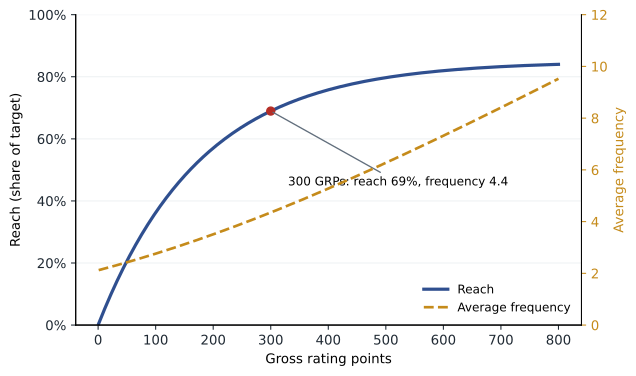
Media planning decides where, when and how often messages appear. Reach is the share of the target audience exposed at least once in a period. Frequency is the average number of exposures among those reached. Gross rating points, the product of reach in percentage points and average frequency, measure total weight. Cost per thousand impressions, CPM, compares the price of different media. Reach rises quickly at first and then flattens, because additional weight is increasingly delivered to people who have already been reached, so extra spending in one medium buys mainly frequency. Herbert Krugman suggested in 1972 that about three exposures are needed for a message to register, and media planners long used minimum effective frequency rules, though later research by John Philip Jones and others found that a single exposure close to purchase can be effective, which supports spreading weight to reach more people more continuously.
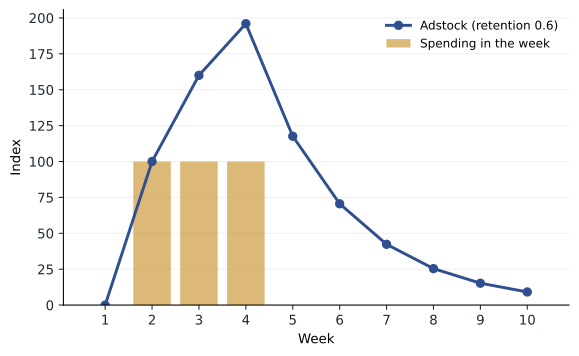
Advertising effects also carry over. Simon Broadbent introduced the idea of adstock in the 1970s: the effect of a week's advertising persists, decaying gradually, so that sales in any week reflect a weighted sum of current and past advertising. A retention rate of 0.6 a week, for example, implies a half-life of about 1.4 weeks. Brand-building media often show longer carryover than activation media, and there is evidence of even slower effects on base sales that build over years. Ignoring carryover makes short bursts of advertising look more effective than continuous presence and makes brand building look less effective than it is.
import math
# 1. Reach and frequency from gross rating points (simple saturation curve)
R_MAX, C = 0.85, 180.0
print("GRPs  reach  avg frequency")
for grp in (100, 200, 300, 500, 800):
    reach = R_MAX * (1 - math.exp(-grp / C))
    print(f"{grp:4}  {reach:5.0%}  {grp / 100 / reach:5.1f}")

# 2. Adstock: advertising's effect carries over with weekly retention lam
lam = 0.6
spend = [0, 100, 100, 100, 0, 0, 0, 0, 0, 0]
a, stock = 0.0, []
for x in spend:
    a = x + lam * a
    stock.append(a)
print("Adstock by week:", " ".join(f"{s:5.1f}" for s in stock))
print(f"Half-life of the effect: {math.log(0.5) / math.log(lam):.1f} weeks")

# 3. Platform-reported ROAS versus incremental ROAS from a geo experiment
spend_test = 400_000            # paid social spend in test regions over 8 weeks (dollars)
attributed = 2_400_000          # revenue the platform attributes to the ads
test_rev, control_rev = 9_150_000, 8_430_000    # revenue in test vs matched control regions (scaled)
incremental = test_rev - control_rev
print(f"Platform ROAS: {attributed / spend_test:.1f}; incremental ROAS: {incremental / spend_test:.1f}")
margin = 0.50
print(f"Incremental gross margin per ad dollar: {incremental * margin / spend_test:.2f}")GRPs reach avg frequency 100 36% 2.8 200 57% 3.5 300 69% 4.4 500 80% 6.3 800 84% 9.5 Adstock by week: 0.0 100.0 160.0 196.0 117.6 70.6 42.3 25.4 15.2 9.1 Half-life of the effect: 1.4 weeks Platform ROAS: 6.0; incremental ROAS: 1.8 Incremental gross margin per ad dollar: 0.90
Digital advertising
Digital advertising now accounts for most advertising spending worldwide. WPP Media's mid-2026 forecast put global advertising revenue at about 1.3 trillion US dollars for 2026, growing about 8.9 percent, with social media the largest single channel and search, including the new forms of search built on generative AI, accounting for about a fifth. The main formats are search advertising, bought by keyword in auctions and shown to people actively looking; social advertising, targeted by interests, behavior and lookalike audiences; display and video, increasingly bought programmatically, by software in real-time auctions; connected television, streaming services that sell targeted video advertising; and retail media, advertising sold by retailers and marketplaces on their own sites, which lets brands reach shoppers at the point of purchase.
Targeting has depended heavily on tracking people across websites, traditionally with third-party cookies. After years of planning to remove third-party cookies from its Chrome browser, Google announced in 2024 that it would not do so, said in 2025 that it would not introduce a separate prompt asking users to choose, and later that year retired most of the Privacy Sandbox technologies it had developed as replacements. Other browsers block third-party cookies by default, and mobile operating systems require apps to ask permission to track users, so advertisers increasingly rely on first-party data, the information customers share directly with a brand, and on contextual targeting.
The deepest problem in digital advertising is measurement. Platforms report the revenue from customers who saw or clicked an ad and later bought, often called return on ad spend, or ROAS. But many of those customers would have bought anyway: they were already searching for the brand, already in the store's loyalty program, or already in the market. What matters is incremental revenue, the sales that would not have happened without the advertising. It can be measured only by comparison with a control group, through holdout experiments in which some people or regions are randomly not shown ads.
The third part of the code shows what Cedarline found when it ran such a test. For eight weeks, it ran paid social advertising in a set of randomly chosen regions and withheld it from matched control regions. The platform reported 2.4 million dollars of revenue from 400,000 dollars of spending, a ROAS of 6. The difference in revenue between test and control regions was 720,000 dollars, an incremental ROAS of 1.8. At a gross margin of about 50 percent, each advertising dollar generated about 90 cents of gross margin, so the campaign lost money. Most of the attributed revenue came from customers who would have bought anyway. Lesson 10 returns to attribution and testing in more detail.
Influencers, reviews and email
Much brand communication now happens through other people: influencers paid to feature products, customers posting reviews and employees speaking for the firm on social media. These can be credible and effective, precisely because they do not look like advertising, and that is why the law requires material connections to be disclosed and prohibits fake or manipulated reviews.
In the United States, the FTC's Endorsement Guides, revised in 2023, require influencers and brands to disclose any material connection clearly and conspicuously, and make brands responsible for monitoring their influencers. The FTC's rule on consumer reviews and testimonials, in force since October 2024, prohibits fake reviews, buying positive reviews and suppressing negative ones, with civil penalties for violations. Commercial email is governed by the CAN-SPAM Act of 2003, which allows email without prior consent but requires accurate headers and subject lines, identification as an advertisement, a physical address and a working opt-out honored within ten business days. Text messages are more tightly restricted under the Telephone Consumer Protection Act.
Worked problem
Hana's campaign for the weekend clinics
Lakeview has 150,000 dollars to promote its evening and weekend clinics over the next year. The journey analysis in lesson 2 showed that the clinics must be in families' consideration set at the moment of need, a weekend evening, and that most parents search on a phone. How should Hana allocate the budget and measure results?
Show solution
- Fix owned and earned touchpoints first, at little cost: correct map listings with evening hours, a clear page on what the clinics treat, a wait-time display and cards handed out by emergency triage nurses.
- Build mental availability among parents of young children in the catchment area with continuous, low-weight communication rather than a single burst: local radio, community newsletters, pharmacies and schools, around 60 percent of the budget, spread across the year because adstock decays.
- Activate at the moment of need with search advertising on terms such as urgent care near me and walk-in clinic open now, limited to evenings and weekends and to the local area, around 30 percent of the budget.
- Measure incrementality: phase the campaign in by neighborhood and compare clinic visits and low-acuity emergency visits in phased and not-yet-phased areas, keeping about 10 percent of the budget for measurement.
Answer: The plan combines brand building for mental availability with activation at the moment of need, and measures what matters, the shift of minor cases from the emergency department to the clinics, rather than clicks. Because the communications concern health services, Hana's team uses only aggregate, non-identifying targeting and no data about individual patients.
Common mistakes
MistakeThe channel with the highest reported ROAS deserves more budget.
InsteadReported ROAS includes sales that would have happened anyway; allocate on incremental returns from controlled tests.
MistakeBrand advertising is a luxury when budgets are tight.
InsteadBrand building creates mental availability that makes activation work and builds long-term sales.
MistakeReach the most loyal customers, because they buy the most.
InsteadGrowth comes mainly from penetration among light buyers; reach broadly.
MistakeInfluencer posts are not advertising.
InsteadPaid or gifted endorsements must clearly disclose the material connection.
Summary and key terms
- Integrated marketing communications coordinate all touchpoints around one positioning.
- Brand building creates lasting mental availability; activation converts people already in the market; both are needed.
- Reach flattens as weight increases; adstock spreads the effect of advertising over time.
- Digital advertising dominates spending, and first-party data and contextual targeting are growing in importance.
- Platform-reported ROAS overstates effects; incremental returns require control groups.
- Endorsements must disclose material connections, reviews must be genuine, and commercial email must follow the law.
- Integrated marketing communications
- Coordinating all communications to deliver a consistent message that supports the brand's positioning.
- Mental availability
- The likelihood that a brand comes to mind in buying situations.
- Gross rating points
- Reach in percentage points multiplied by average frequency.
- Adstock
- The carryover of advertising's effect into later periods, decaying at a retention rate.
- Incremental ROAS
- Revenue caused by advertising, measured against a control group, divided by spending.
- CAN-SPAM Act
- The federal law setting requirements for commercial email, including a working opt-out.
Practice problems
Work each problem on paper first, then reveal the answer to check.
A campaign reaches 60 percent of its target an average of 4 times. How many GRPs is that?
Show answer
240.
With weekly retention of 0.7, what is the half-life of advertising's effect?
Show answer
ln(0.5) / ln(0.7), about 1.9 weeks.
A platform reports a ROAS of 5 on 100,000 dollars of spending; a holdout test shows incremental revenue of 150,000 dollars. What is the incremental ROAS?
Show answer
1.5.
Why might a brand with mostly light buyers favor broad reach over heavy frequency?
Show answer
Growth comes from penetration, and light buyers need reminding to keep the brand mentally available.
Lesson quiz · 5 questions
Score 60% or more to complete this lesson.
Create a free account to save your progress, take quizzes and earn a certificate.