
MBA-512 · Lesson 7 of 12 · 22 min
Pricing strategy and value-based pricing
Daniel Osei has a quote to defend. Northfield has bid to supply a welded bracket for the farm equipment maker it has been courting since lesson 2. The incumbent supplier charges 6.80 dollars a bracket. Northfield's bracket is designed so that it can be bolted on without a separate alignment fixture, and its defect rate in testing has been a third of the incumbent's. Northfield's cost to make it is 5.40 dollars, and its usual practice is to add a 20 percent markup, which gives 6.48 dollars. The equipment maker's buyer, pleased, has asked whether Northfield can do 6.20. Dr. Lindqvist asks Daniel a question he has never been asked about a quote: how much is the bracket worth to the customer?
Pricing is the only element of marketing that produces revenue directly; the others produce costs. It is also the decision with the most immediate effect on profit. In a 1992 article, Michael Marn and Robert Rosiello of McKinsey reported that for the average company in a large sample of firms, a 1 percent improvement in price, with volume unchanged, would raise operating profit by about 11 percent, far more than the same improvement in volume or in variable or fixed costs. The reason is arithmetic: a price increase falls straight to the bottom line, so with operating margins around 8 to 10 percent, a small change in price is a large change in profit. Yet many firms set prices with less analysis than they devote to a modest capital project.
Three ways to set a price
Prices are bounded by three Cs. Costs set a floor below which, in the long run, the firm should not sell. Customers' willingness to pay sets a ceiling above which they will not buy. Competitors' prices and offers shape where, between floor and ceiling, a price can be sustained, because they determine customers' next best alternative. Firms differ in which C they start from.
Cost-plus pricing adds a markup to unit cost. It is simple, seems fair and is easy to defend, which is why Northfield uses it. But it ignores customers entirely: if the product is worth far more than its cost, cost-plus leaves money on the table; if it is worth less, no markup will make it sell. It is also circular, since unit cost depends on volume, which depends on price. Competition-based pricing sets prices relative to rivals', at parity, at a premium or at a discount. It respects the market but assumes that the firm's offer is comparable to its rivals', and it can lead to price wars in which everyone follows everyone else down. Value-based pricing starts from what the offer is worth to the target customer relative to the alternatives, and sets a price that shares that value between customer and firm. It is the approach this lesson develops.
Economic value to the customer
Thomas Nagle and his colleagues, in The Strategy and Tactics of Pricing, describe a method for business markets called economic value estimation. The economic value of a product to a customer is the price of the customer's best alternative, the reference value, plus the value of everything that makes the product better than that alternative, minus the value of anything that makes it worse. The differences together are the differentiation value. The economic value is the most a fully informed, rational customer would pay. The firm then chooses a price below it, leaving the customer an incentive to switch, and above its own cost.
For Daniel's bracket, the reference value is the incumbent's price of 6.80 dollars. The positive differentiation value comes from two sources. Assembly without an alignment fixture saves about two minutes of line time per bracket, and the equipment maker's fully loaded labor cost is about 0.95 dollars a minute, a saving of 1.90 dollars. The lower defect rate, 0.4 percent rather than 1.2, avoids field repairs that cost the equipment maker about 85 dollars each, worth 0.68 dollars a bracket. Against that, Northfield ships from further away, adding about 20 cents of freight for the customer. The bracket's economic value is therefore about 9.18 dollars.
# 1. Economic value to the customer (EVC) for Northfield's welded bracket
ref_price = 6.80                       # incumbent supplier's bracket price (dollars)
assembly_saving = 2.0 * 0.95           # 2.0 minutes saved x 0.95 dollars per worker minute
defect_saving = (0.012 - 0.004) * 85   # lower defect rate x cost of a field repair
extra_freight = -0.20                  # Northfield ships from further away
evc = ref_price + assembly_saving + defect_saving + extra_freight
print(f"Differentiation value: assembly {assembly_saving:.2f}, defects {defect_saving:.2f}, freight {extra_freight:.2f}")
print(f"EVC per bracket: {evc:.2f} dollars against a reference price of {ref_price:.2f}")

# 2. Profit-maximizing price for the Ridgeline with constant elasticity
e, mc = -2.4, 147.0
p_star = mc * e / (1 + e)
k = 90000 * 249 ** (-e)                # calibrated so that 90,000 jackets sell at 249
def profit(p): return (p - mc) * k * p ** e
print(f"Optimal price: {p_star:.0f} dollars; contribution at 249: {profit(249) / 1e6:.2f}m; "
      f"at optimum: {profit(p_star) / 1e6:.2f}m; at 199: {profit(199) / 1e6:.2f}m")

# 3. Break-even sales lift for a price promotion
for margin in (0.41, 0.50, 0.60):
    row = [f"{d / (margin - d):>6.0%}" for d in (0.10, 0.20, 0.30)]
print(f"Gross margin {margin:.0%}: lift needed for 10/20/30 off:", *row)Differentiation value: assembly 1.90, defects 0.68, freight -0.20 EVC per bracket: 9.18 dollars against a reference price of 6.80 Optimal price: 252 dollars; contribution at 249: 9.18m; at optimum: 9.18m; at 199: 8.01m Gross margin 41%: lift needed for 10/20/30 off: 32% 95% 273% Gross margin 50%: lift needed for 10/20/30 off: 25% 67% 150% Gross margin 60%: lift needed for 10/20/30 off: 20% 50% 100%
Between Northfield's cost of 5.40 dollars and the economic value of 9.18 dollars lies 3.78 dollars of value created. At 6.20 dollars, the price the buyer requested, Northfield would capture 80 cents of it and the customer nearly 3. Daniel decides to propose 7.40 dollars, a little above the incumbent's price, which still leaves the equipment maker 1.78 dollars of savings per bracket, more than enough to justify a change of supplier, and gives Northfield a margin of 2 dollars. The hard part, Dr. Lindqvist warns, is not the arithmetic but the evidence: the buyer will pay for the savings only if engineers and plant managers believe them, so Northfield's proposal includes the test data, a time study of assembly and an offer to share the cost of a trial run.
Elasticity and the profit-maximizing price
For consumer products sold to many customers, value-based pricing works through the demand curve. The cohort learned in MBA-502 that when the price elasticity of demand is constant, the profit-maximizing price is marginal cost multiplied by e divided by one plus e, where e is the (negative) elasticity. For the Ridgeline, with marginal cost of 147 dollars and an elasticity of about minus 2.4, that gives about 252 dollars, which is why the cohort's launch price of 249 was close to optimal. The second part of the code shows that contribution is almost flat near the optimum: pricing a few dollars above or below it changes contribution very little. But a promotional price of 199 dollars cuts contribution by about 13 percent even after the extra jackets it sells, because demand, though elastic, is not elastic enough.
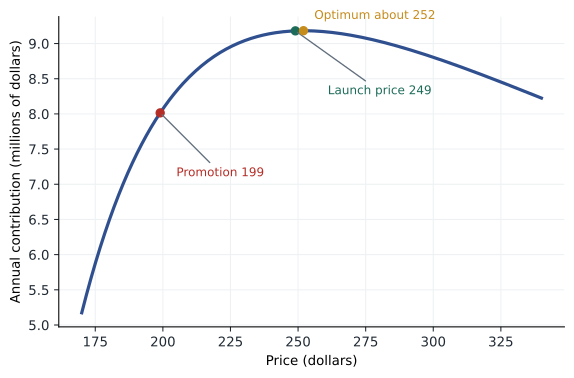
Two lessons follow. First, near the optimum, small pricing errors are cheap, so firms need not agonize over the last dollar; large errors, especially deep and frequent discounts, are expensive. Second, the elasticity itself depends on marketing. A strong brand, a clear point of difference and good availability make demand less elastic and raise the optimal price; frequent promotions teach customers to look at price first and make demand more elastic over time.
Price structure
Value-based pricing is not only about the level of price but its structure: what the customer pays for and how. Because customers differ in willingness to pay, a single price either excludes customers who value the product less or leaves surplus with those who value it more. Price structures let firms serve both.
Versioning offers products of different quality or features at different prices, so customers sort themselves. The Ridgeline line of 199, 249 and 329 dollars is a classic good, better, best structure. The best version expands the market at the top and makes the middle version look reasonable by comparison, an anchoring effect, while the basic version serves price-sensitive customers without forcing a cut on the main product. Bundling sells products together for less than the sum of their prices, which can raise profit when customers' valuations of the components vary inversely; mixed bundling offers both the bundle and the parts. Two-part tariffs combine a fixed fee with a per-unit price, as with memberships and many utilities. Subscriptions convert a purchase into a recurring relationship, smoothing revenue and raising retention, but also raising customers' sensitivity to the ongoing charge.
For software and services like Kestrel's, the key choice is the value metric, the unit on which price is charged. Kestrel charges per store. Alternatives include per user, per forecast, a share of the inventory saved or a flat fee by tier. A good value metric grows with the value the customer receives, is easy to understand and predict, and is hard to game. Per-store pricing has served Kestrel well with small retailers, but mid-sized chains find it expensive for low-volume stores. Leo's team designs three tiers: a starter tier for independents, a growth tier for chains without data teams, priced per store with volume bands, and a premium tier with integration and analyst support. They place the growth tier, their target, in the middle, where the decoy effect of lesson 2 and the anchoring of a visible premium tier both work in its favor.
Promotions and the price waterfall
Temporary price reductions are the most heavily used and least understood tool in many consumer businesses. They do increase sales in the short run, through brand switching, stockpiling by existing customers and some genuinely new consumption. But much of the lift is borrowed from future periods or from the firm's own full-price sales, and frequent promotions lower the reference price customers carry in their heads. The arithmetic of a promotion is unforgiving. If the gross margin is m and the discount d, both as fractions of the regular price, unit sales must rise by d divided by m minus d just to keep gross margin unchanged.
The third part of the code tabulates the formula. At the Ridgeline's gross margin of about 41 percent, a 20 percent discount must nearly double unit sales just to break even, and a 30 percent discount must almost quadruple them. Even at Cedarline's average gross margin of about 50 percent, a 30 percent promotion needs sales to rise 150 percent. Cedarline's own promotion data, which the cohort analyzed in MBA-504, show lifts of 40 to 70 percent for most promotions. Most of them lost money before counting the damage to reference prices.
In business-to-business and wholesale markets, the gap between list price and what the firm actually earns is often wide and poorly tracked. Marn and Rosiello called the series of deductions the price waterfall. From the list price, on-invoice discounts such as order-size and competitive discounts produce the invoice price. Off-invoice items, such as payment terms, cooperative advertising allowances, volume rebates, freight absorbed by the seller and markdown support, reduce it further to the pocket price, what the firm actually keeps. Because many of these items are recorded in different accounts by different departments, managers often do not know the pocket price for each customer, and the variation among customers is frequently far larger than anyone intended.
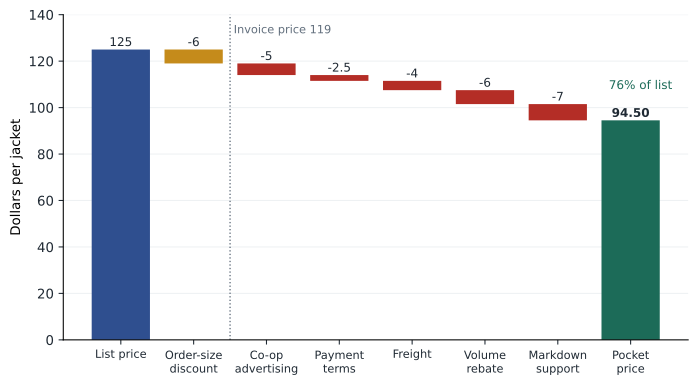
Cedarline's wholesale business, 30 percent of revenue, shows the pattern. The list wholesale price of a jacket is 125 dollars, but after an order-size discount, cooperative advertising, extended payment terms, freight, a volume rebate and markdown support, the pocket price is 94.50 dollars, about 76 percent of list. Across the chains, pocket prices range from about 68 to 88 percent of list, and the chain with the lowest pocket price is not the largest but the one that negotiates hardest. Managing the waterfall, by measuring pocket prices by customer and tying allowances to performance, is often the quickest pricing gain available.
Dynamic and personalized pricing
Digital channels let firms change prices frequently and, in principle, charge different customers different prices. Dynamic pricing, adjusting prices to demand and supply in real time, is long established in airlines and hotels and is spreading to retail, events and ride services. Personalized pricing, using data on an individual to set their price, raises sharper concerns. Customers often regard it as unfair, especially when the basis is opaque, and research on price fairness finds that perceived unfairness can provoke anger, complaints and defection even when the price is economically justified. Prices set by algorithms also raise competition concerns if competitors' algorithms learn to avoid undercutting one another. Dr. Lindqvist's advice is to price by observable segments and versions that customers can understand and choose among, rather than by hidden individual profiles.
US law constrains pricing in several ways. Agreements among competitors to fix prices are illegal per se under section 1 of the Sherman Act and can be prosecuted criminally. Since the Supreme Court's 2007 Leegin decision, minimum resale price agreements between a manufacturer and its retailers are judged under the rule of reason under federal law, although some states still treat them as illegal, which matters for Cedarline's relations with sporting goods chains. The Robinson-Patman Act restricts price discrimination between competing business buyers that harms competition. The FTC's Guides Against Deceptive Pricing hold that a former price comparison, such as was 349, now 249, is deceptive unless the former price was genuinely offered for a reasonably substantial period, and the FTC's 2025 fees rule requires the total price including mandatory fees to be shown for live-event tickets and short-term lodging.
Worked problem
A promotion proposal at Cedarline
Cedarline's merchandising team proposes a two-week 25 percent off promotion on its mid-weight fleece, which normally sells 4,000 units a fortnight at 89 dollars with a gross margin of 52 percent. Past promotions of this size lifted fleece sales by about 60 percent during the promotion, and sales in the two weeks after a promotion have typically been 15 percent below normal. Should Cedarline run it?
Show solution
- Break-even lift: 0.25 / (0.52 - 0.25) = 93 percent, so a 60 percent lift falls well short.
- Gross margin at full price: 4,000 × 89 × 0.52, about 185,100 dollars per fortnight.
- During the promotion: price 66.75, unit cost 42.72, margin 24.03 a unit on 6,400 units, about 153,800 dollars; afterwards the post-promotion dip costs 600 units × 46.28, about 27,800 dollars.
- Net effect: about 185,100 × 2 - (153,800 + 185,100 - 27,800), a loss of about 59,000 dollars of gross margin over the four weeks, before any effect on reference prices.
Answer: The promotion would lose money unless it achieved something the numbers omit, such as clearing obsolete stock that would otherwise be written down. The cohort recommends using markdowns only for end-of-season clearance of specific excess inventory, and investing instead in the measures that make demand less price-sensitive.
Common mistakes
MistakePrices should be set at cost plus a fair markup.
InsteadCost sets the floor; value to the customer, relative to alternatives, should guide the price.
MistakePromotions pay for themselves through higher volume.
InsteadUnit sales must rise by d / (m - d) to break even, often far more than promotions achieve.
MistakeThe invoice price is what we earn.
InsteadOff-invoice items can cut the pocket price far below invoice; measure pocket prices by customer.
MistakeCharging each customer their maximum is the ideal.
InsteadOpaque personalized prices are often seen as unfair; use versions and segments customers understand.
Summary and key terms
- A small price improvement has a large effect on profit because it falls straight to operating income.
- Costs set the floor, customers' willingness to pay the ceiling, and competitors' offers the reference point.
- Economic value to the customer equals the reference value plus net differentiation value; price below it and above cost.
- With constant elasticity, the optimal price is marginal cost times e / (1 + e); profit is flat near the optimum and falls steeply with deep discounts.
- Versioning, bundling, two-part tariffs and value metrics structure prices to match varied willingness to pay.
- Promotions need a lift of d / (m - d) to break even; the price waterfall shows how much list price leaks before the pocket price.
- Value-based pricing
- Setting price according to the value of the offer to target customers relative to their alternatives.
- Economic value to the customer
- The reference value of the best alternative plus the net value of differences from it.
- Versioning
- Offering versions of a product at different quality and price levels so customers sort themselves.
- Value metric
- The unit on which a price is charged, such as per user, per store or per transaction.
- Pocket price
- The price a firm actually keeps after all on-invoice and off-invoice deductions.
- Resale price maintenance
- An agreement setting the price at which a reseller sells; judged under the rule of reason federally since Leegin (2007).
Practice problems
Work each problem on paper first, then reveal the answer to check.
A product has a reference value of 50 dollars, positive differentiation worth 12 and negative differentiation worth 4. What is its economic value?
Show answer
50 + 12 - 4 = 58 dollars.
With marginal cost 30 and elasticity minus 3, what is the profit-maximizing price?
Show answer
30 × (-3) / (-2) = 45.
A product has a 35 percent gross margin. What lift does a 15 percent discount need to break even?
Show answer
0.15 / 0.20 = 75 percent.
Name three off-invoice items that reduce the pocket price.
Show answer
Payment terms, cooperative advertising allowances, volume rebates, absorbed freight or markdown support.
Lesson quiz · 5 questions
Score 60% or more to complete this lesson.
Create a free account to save your progress, take quizzes and earn a certificate.