
MBA-512 · Lesson 11 of 12 · 20 min
Go-to-market planning and launch
Leo Brandt has his targeting decision from lesson 4, his pricing tiers from lesson 7 and a growth tier ready to sell to regional chains without data teams. His board meets in six weeks and wants a launch plan. Leo's first draft is a list of activities: a new website section, a webinar series, two trade shows, a hiring plan for sales staff and a press release. Dr. Lindqvist reads it and asks what the plan is for. What must be true in twelve months for the launch to have succeeded, what has to happen in what order to get there, and how will Kestrel know early whether it is on track?
A go-to-market plan, often shortened to GTM, describes how a firm will bring a product or service to its target customers and win them: who the customers are, what value the offer gives them, how they will learn about it, buy it and receive it, what resources are needed, in what sequence, and how progress will be measured. It is where the decisions of the previous lessons become a plan of action. Launches fail more often from poor execution and sequencing than from a bad idea: the product is not quite ready, the sales team cannot explain it, the supply chain is not stocked, or nobody notices the launch at all.
The elements of a go-to-market plan
Dr. Lindqvist gives the cohort a one-page template. It begins with the objective, stated as measurable outcomes and a date. It defines the target customer precisely; in business markets this is often called the ideal customer profile, a description of the firms that get the most value from the offer and are cheapest to win and serve. It states the value proposition and positioning, the offer and pricing, the route to market, the communication plan, the launch sequence, the resources and budget, the metrics that will show progress and the risks with their responses. Each element should follow from the analysis already done; a GTM plan that introduces a new target or a new positioning is a sign that the strategy was not settled.
| Element | Kestrel growth tier | Prairie Ridge community solar relaunch |
|---|---|---|
| Objective | 40 new regional chains in 12 months; 90-day onboarding success above 85 % | 6,000 new subscribers in 12 months; fewer than 8 % of subscribers canceling in year one |
| Target | Chains of 50 to 120 stores without a data team | Homeowners and renters in the service area paying their own power bills |
| Value proposition | Better stock levels within weeks, no technical work | Lower bills and local clean power, nothing to install |
| Offer | Per-store price with volume bands; 60-day pilot | Cancel any time in year one; bill credit guarantee |
| Route to market | Inside sales and account executives; retail associations | Online sign-up; partnerships with community groups |
| Communication | Case studies, association events, targeted outreach | Local launch campaign, referral reward, window signs |
| Key metrics | Qualified leads, pilots started, pilot conversion, time to value | Awareness, site visits, sign-ups, referrals, early exits |
Choosing the route to market
In business markets, the most important GTM choice is the sales motion, how customers move from first interest to signed contract. In a sales-led motion, account executives find, qualify and close customers, which suits large, complex purchases with several decision makers. In a product-led motion, customers discover, try and often buy the product themselves, through free trials or freemium tiers, and sales staff help larger accounts expand, which suits simple products with fast time to value. Partner-led motions sell through resellers, consultants or associations that already have relationships with the target customers. Many firms combine them. Kestrel's small-retailer business has been largely product-led; its growth tier needs a lighter sales-led motion, because chains of 100 stores involve finance, operations and merchandising managers in the decision.
Whatever the motion, the plan must reconcile three quantities that are often planned separately: the number of customers the objective requires, the funnel of prospects needed to produce them, and the capacity of the people who must convert them. The cohort works the numbers backwards for Kestrel.
import math
# Kestrel growth tier: working the funnel backwards from the year-one target
target_wins = 40
rates = {'Marketing-qualified lead -> sales-qualified': 0.30,
         'Sales-qualified -> opportunity': 0.50,
         'Opportunity -> win': 0.25}
need = target_wins
for stage, r in reversed(list(rates.items())):
    need /= r
    print(f"{stage:45} rate {r:.0%}  needed at stage start: {math.ceil(need):5,}")
print(f"Marketing-qualified leads needed: {math.ceil(need):,} (about {math.ceil(need / 12)} a month)")

# Sales capacity: a fully ramped account executive closes 10 chains a year; new hires take 6 months to ramp
def wins_per_rep(start_month):
    months = 12 - start_month
    ramp = min(months, 6)
    return 10 / 12 * (0.5 * ramp + (months - ramp))
existing = 2 * 10                          # two ramped executives
plan = [(0, 1), (0, 1), (3, 1), (6, 1)]   # (hire month, count)
total = existing + sum(c * wins_per_rep(m) for m, c in plan)
print(f"Wins from 2 ramped and 4 new executives: {total:.1f}")

# Launch economics: monthly contribution from new chains against launch investment
launch_cost = 1_400_000                    # enablement, campaign, onboarding team
margin_per_chain_month = 54000 * 0.78 / 12
cum, month, active = -launch_cost, 0, 0.0
while cum < 0 and month < 48:
    month += 1
    active += target_wins / 12 if month <= 12 else 3.0
    active *= 0.88 ** (1 / 12)             # monthly survival from 88% annual retention
    cum += active * margin_per_chain_month
print(f"Launch investment recovered in month {month}, with about {active:.0f} chains active")Opportunity -> win rate 25% needed at stage start: 160 Sales-qualified -> opportunity rate 50% needed at stage start: 320 Marketing-qualified lead -> sales-qualified rate 30% needed at stage start: 1,067 Marketing-qualified leads needed: 1,067 (about 89 a month) Wins from 2 ramped and 4 new executives: 42.5 Launch investment recovered in month 16, with about 47 chains active
To win 40 chains at a 25 percent win rate, Kestrel needs 160 opportunities; at its conversion rates, those require about 320 sales-qualified and about 1,067 marketing-qualified leads, roughly 89 a month. Leo's marketing team has never produced more than 30 qualified leads a month from chains, which reveals the plan's first gap. On capacity, two existing account executives and four new hires, two at the start of the year and one each in months three and six, can close about 42 chains if each new hire takes six months to reach full productivity. The last part of the code shows that the launch investment of 1.4 million dollars, for sales training, the campaign and an onboarding team, is recovered in about month 16 if the targets are met. Leo now has a plan whose assumptions can be tested month by month.
Sequencing the launch
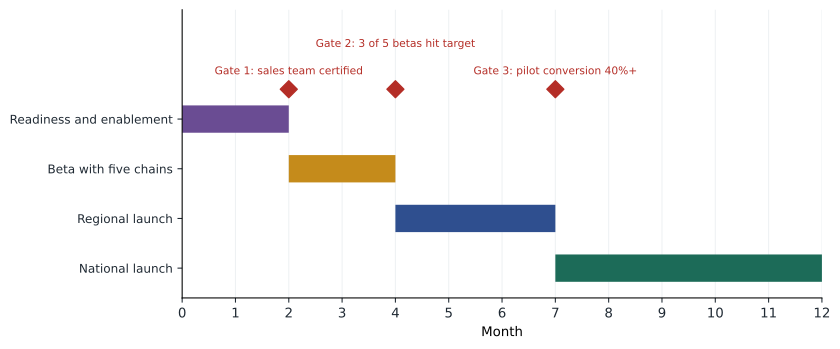
Launches benefit from stages. An internal launch comes first: the sales, service and operations teams must understand the offer, know how to explain and support it, and have the tools, prices and materials they need, often called enablement. A soft launch or beta with a few friendly customers tests the product, onboarding and support under real conditions and produces the case studies and references that later buyers will ask for. A limited launch, in one region or segment, tests the marketing and sales process at modest scale. The full launch follows when the earlier stages have met defined criteria. Each step is a gate in the sense of lesson 6: continue, adjust or stop.
Firms selling internationally choose between launching in all markets at once, sometimes called a sprinkler strategy, and launching market by market, a waterfall strategy. Simultaneous launch suits products in fast-moving categories where competitors could copy the idea in markets left unserved, and benefits from global media and word of mouth. Sequential launch lets the firm learn and adapt and spreads the investment, but gives competitors time. For Cedarline's lifetime repair service, the cohort favors launching in all stores and online at once, because the service is simple, the brand message must be consistent everywhere, and partial availability would confuse customers.
Timing also involves announcements. Announcing a product early can build anticipation and discourage customers from committing to a competitor, but it can also lead customers to stop buying the firm's current products while they wait. The danger is often called the Osborne effect, after a 1980s computer maker whose early announcement of a new model is widely said to have hurt sales of its existing one. Early announcements also give competitors notice. Dr. Lindqvist's advice is to announce when the product can actually be bought, unless there is a specific reason to do otherwise.
Anticipating competitors
A launch is a move in a game, as the cohort learned in MBA-502. Competitors may respond by cutting prices, matching features, increasing advertising or locking up channels. A useful exercise is to role-play the response of each major competitor: what will they see, how will they interpret it, what can they do quickly, and what is in their interest? A competitor whose core business the launch threatens will respond harder than one for whom it is a sideshow. Responses can sometimes be discouraged by launching where competitors are weak, by building switching costs such as integration and data history, and by making the offer hard to compare directly.
Measuring a launch
A launch needs leading indicators, which move before the final outcome and show whether the plan is working, as well as the lagging outcomes the objective names. For Kestrel, leading indicators include qualified leads per month, the number of pilots started, the share of pilots that reach a defined improvement in stock levels within 60 days, and the time it takes a new chain to see its first useful forecast, its time to value. For Prairie Ridge, they include awareness in the target area, the share of website visitors who start sign-up and complete it, referrals per subscriber and the share who cancel in the first 90 days.
The plan should also state its kill or pivot criteria in advance: the evidence that would lead the firm to stop, slow down or change course. Without them, launches acquire momentum, sunk costs and defenders, and the firm keeps investing long after the evidence has turned. Kestrel's board agrees that if fewer than three of the five beta chains reach the target improvement, the regional launch will be postponed until the product is fixed, and that if pilot conversion is below 40 percent after six months, the sales motion will be reviewed.
Legal and operational readiness
A launch must also be ready for the rules that apply to the product, its labels and its claims. In the United States, apparel must carry fiber content, country of origin and manufacturer identification under the Textile Fiber Products Identification Act and FTC rules, and a claim that a product is Made in USA must meet the FTC's all or virtually all standard, which the FTC's 2021 labeling rule made enforceable with civil penalties. Consumer products are subject to the Consumer Product Safety Commission, which can require recalls, and products sold in particular states may face additional rules, such as California's Proposition 65 warning requirements. Performance and environmental claims made at launch must meet the FTC substantiation standards of lessons 1 and 5.
Worked problem
Launching Cedarline's lifetime repair service
Cedarline plans to add lifetime repairs to its technical jackets and packs from the autumn season, with a price increase of 20 dollars on those products. The service partner can handle 1,500 repairs a month at launch and 4,000 after six months. Cedarline sells about 280,000 eligible products a year, and in the first year it expects repair requests from about 2 percent of all eligible products ever sold, including older products whose owners will be offered repairs as a goodwill gesture, roughly 30,000 requests. What must the launch plan address?
Show solution
- Capacity: 30,000 requests a year is about 2,500 a month on average, more than launch capacity, and requests from older products will peak in the first months. Cedarline should either phase eligibility for older products or expand capacity before launch.
- Promise: the turnaround promise is the service's reliability, the most important quality dimension; it should be set at what the partner can reliably meet, such as four weeks at launch, and shortened later.
- Enablement: store staff must be able to explain the service, accept items for repair and answer questions about what is covered, which requires training before launch and a clear policy on wear and tear.
- Claims and measurement: describe the service specifically, as free repairs of seams, zips and fabric for the life of the product, and track requests, turnaround, satisfaction and the effect on repeat purchase and price realization.
Answer: The biggest risk is not demand but capacity: a service launched as a promise of durability would damage the brand if customers wait months for repairs. The plan phases goodwill repairs for older products over the first six months, sets an achievable turnaround promise and makes the service part of every store's opening routine.
Common mistakes
MistakeA launch plan is a list of marketing activities.
InsteadIt links objectives, target, offer, route to market, sequence, resources and metrics, with assumptions that can be tested.
MistakeLead targets can be set independently of sales capacity.
InsteadFunnel, conversion rates and capacity must be reconciled working backwards from the objective.
MistakeLaunch everywhere at once to maximize impact.
InsteadStage the launch with gates unless speed or consistency requires simultaneous launch.
MistakeDecide later whether the launch is working.
InsteadSet leading indicators and kill or pivot criteria in advance.
Summary and key terms
- A go-to-market plan turns strategy into an executable sequence with measurable objectives.
- The ideal customer profile and the sales motion are central choices in business markets.
- Work backwards from targets through funnel conversion rates to the leads and capacity required.
- Stage launches: internal enablement, beta, limited launch and full launch, with gates between them.
- Anticipate competitors' responses and manage announcements carefully.
- Measure leading indicators and define kill or pivot criteria before launch.
- Go-to-market plan
- A plan for bringing an offer to target customers and winning them.
- Ideal customer profile
- A description of the customers who gain most from an offer and are cheapest to win and serve.
- Sales motion
- The way customers move from interest to purchase, such as sales-led, product-led or partner-led.
- Enablement
- Preparing sales, service and operations staff with the knowledge and tools to sell and support a product.
- Time to value
- How long it takes a new customer to receive the first meaningful benefit.
- Made in USA standard
- The FTC requirement that all or virtually all of a product be made in the United States for an unqualified claim.
Practice problems
Work each problem on paper first, then reveal the answer to check.
A firm wants 60 new customers. Its win rate is 20 percent and 40 percent of qualified leads become opportunities. How many qualified leads does it need?
Show answer
60 / 0.2 = 300 opportunities; 300 / 0.4 = 750 qualified leads.
Give two leading indicators for the launch of a subscription meal kit.
Show answer
Trial sign-ups per week, share of trial customers who order a second box, or the share who cancel in the first month.
When might a sprinkler (simultaneous) launch be better than a waterfall?
Show answer
When competitors could quickly copy the product in unserved markets, or when global media and word of mouth make consistency valuable.
Why should kill criteria be set before a launch?
Show answer
Afterwards, sunk costs and momentum make it hard to stop a failing launch.
Lesson quiz · 5 questions
Score 60% or more to complete this lesson.
Create a free account to save your progress, take quizzes and earn a certificate.