
MBA-512 · Lesson 5 of 12 · 21 min
Brand strategy and brand equity
Grace Mwangi's private-label problem is the subject of the fourth weekend. Fairway Grocers sells about 2,800 products under its own Fairway name, from canned tomatoes to dish soap. They are cheaper than national brands, their quality is usually comparable, and they earn Fairway a higher margin per unit. Yet shoppers in Fairway's research describe them as the store brand, the safe cheap choice, and buy them mainly for products they consider basic. Fairway's new premium range of sauces, cheeses and baked goods, developed with real care, sells poorly under the same name. Grace wants to know whether the problem is the products, the name or the way Fairway has managed both.
Dr. Lindqvist begins with a definition. The American Marketing Association defines a brand as a name, term, design, symbol or any other feature that identifies one seller's goods or services as distinct from those of other sellers. That is the legal and visual core. But the value of a brand lies in what customers know, feel and believe about it, which determines how they respond to everything the firm does. A brand, in Dr. Lindqvist's phrase, is a promise that customers have learned to believe.
What brands do
For customers, brands reduce the cost of choosing. A familiar name tells a shopper what to expect without having to read the label, test the product or research the seller. Brands also reduce risk: a customer buying a tent for a first winter camping trip trusts a brand with a reputation for reliability. And brands carry meaning, letting people express identity and values through what they buy, which is why the second T-shirt in lesson 1 could sell for twenty times the price of the first.
For firms, a strong brand produces several kinds of value. Customers will pay a price premium for it and are less likely to switch when a rival cuts its price. Retailers are more willing to stock and promote it. New products launched under it gain trial faster and at lower cost. Its name and symbols are legally protected as trademarks. And it is a durable asset: many of the leading consumer brands of today were leading brands half a century ago. The value of all these effects, net of what it costs to build and maintain the brand, is called brand equity.
Models of brand equity
David Aaker's 1991 model describes brand equity as a set of assets linked to a brand's name: brand loyalty, name awareness, perceived quality, brand associations and other proprietary assets such as patents and trademarks. Kevin Lane Keller's customer-based brand equity model, developed in the 1990s, defines brand equity as the differential effect that knowledge of the brand has on customers' response to its marketing, and arranges brand building as a pyramid of four steps. At the base is salience, how easily and often customers think of the brand in buying situations. Above it are two parallel blocks: performance, how well the product meets functional needs, and imagery, the social and psychological associations it carries. Above those are judgments, customers' opinions of the brand's quality, credibility and superiority, and feelings, their emotional responses. At the top is resonance, the intensity of the relationship: loyalty, attachment, a sense of community and active engagement.
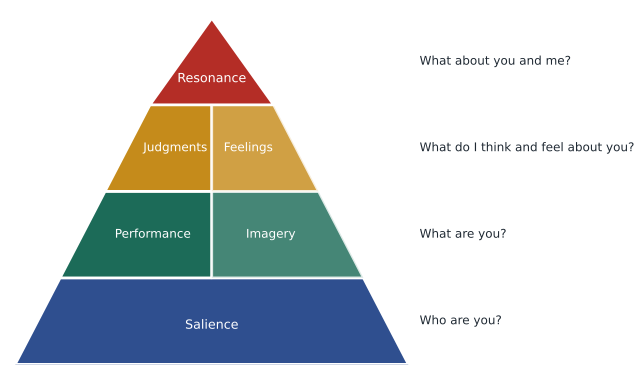
The pyramid explains Fairway's difficulty. Its private label has high salience, since every shopper sees it on every aisle, and decent performance, but its imagery is weak and its judgments are of adequacy, not superiority. Customers' feelings are neutral. A premium range needs strong judgments of quality and positive feelings, and it cannot borrow them from a name whose associations are cheapness and safety. As Grace puts it, Fairway has spent twenty years teaching shoppers that its name means a good price.
Measuring brand equity
Brand equity can be measured at three levels. Customer mindset measures track what customers know and feel: unaided and aided awareness, consideration, perceived quality, associations and loyalty intentions, usually through a regular brand tracking survey. Product-market measures capture the brand's effect on what customers do. The price premium is how much more customers pay for the brand than for a comparable product without it. The revenue premium, proposed by Kusum Ailawadi, Donald Lehmann and Scott Neslin in 2003, is the difference in revenue between the brand and a comparable private label, combining the price premium with any difference in volume; the authors found it a robust and practical measure. Financial measures estimate the value of the brand as an asset.
The most common financial method is relief from royalty. It asks how much the firm would have to pay to license its brand from someone else if it did not own it. Royalty rates for comparable brands, observed in real licensing agreements, are applied to the revenue the brand is expected to support, the after-tax royalties saved are projected, and their present value at a suitable discount rate is the value of the brand. The method is used in accounting for acquisitions, in tax planning and in published brand rankings. It depends heavily on the choice of royalty rate, growth and discount rate, so results should be presented as a range.
# Cedarline brand equity: price premium, revenue premium and a royalty-relief valuation
# 1. Price and revenue premium against a comparable unbranded jacket (store test)
branded = {'price': 249, 'units': 1180}
generic = {'price': 179, 'units': 1450}
pp = branded['price'] / generic['price'] - 1
rp = branded['price'] * branded['units'] - generic['price'] * generic['units']
print(f"Price premium: {pp:.0%}")
print(f"Revenue premium per test period: {rp:,} dollars "
      f"({branded['price'] * branded['units'] / (generic['price'] * generic['units']) - 1:.0%})")

# 2. Royalty relief: what Cedarline would pay to license its own name (millions of dollars)
TAX = 0.25
revenue, growth, royalty, r, g_term = 468.0, 0.04, 0.06, 0.10, 0.02
pv = 0.0
for t in range(1, 6):
    revenue *= 1 + growth
    after_tax = revenue * royalty * (1 - TAX)
    pv += after_tax / (1 + r) ** t
    print(f"Year {t}: revenue {revenue:6.1f}  after-tax royalty saved {after_tax:5.2f}")
terminal = after_tax * (1 + g_term) / (r - g_term) / (1 + r) ** 5
print(f"PV of years 1-5: {pv:.1f}; terminal value: {terminal:.1f}; "
f"brand value about {pv + terminal:.0f} million dollars")Price premium: 39% Revenue premium per test period: 34,270 dollars (13%) Year 1: revenue 486.7 after-tax royalty saved 21.90 Year 2: revenue 506.2 after-tax royalty saved 22.78 Year 3: revenue 526.4 after-tax royalty saved 23.69 Year 4: revenue 547.5 after-tax royalty saved 24.64 Year 5: revenue 569.4 after-tax royalty saved 25.62 PV of years 1-5: 89.3; terminal value: 202.8; brand value about 292 million dollars
In Cedarline's store test, the branded jacket sells for 39 percent more than a comparable unbranded jacket, and although it sells fewer units, it earns about 13 percent more revenue, the revenue premium. The royalty-relief valuation assumes a royalty of 6 percent of revenue, typical for apparel brands in licensing deals, revenue growth of 4 percent a year for five years and 2 percent afterwards, a combined federal and state tax rate of 25 percent and a discount rate of 10 percent, a little above Cedarline's 9 percent cost of capital because brand cash flows are riskier than the business as a whole. The result is a brand value of about 292 million dollars. Dr. Lindqvist points out a striking comparison: in MBA-511 the cohort valued the whole of Cedarline under the status quo at about 103 million dollars of equity plus 191 million of net debt, an enterprise value of about 294 million. Either the royalty rate is generous, or Cedarline is earning very poorly on a valuable brand. The cohort concludes that it is mostly the latter.
Brand architecture
Most firms own more than one product, and brand architecture is the set of decisions about how their brands relate to one another. At one extreme is the branded house, in which a single master brand covers everything, as with many technology and industrial firms; investment in the master brand benefits every product, but a failure in one product can damage all of them. At the other is the house of brands, in which each product has its own brand and the corporate name is hardly visible, as with many packaged goods companies; each brand can be precisely positioned for its segment, at the cost of building and supporting many brands. In between are endorsed brands, which carry their own names with the parent's endorsement, and sub-brands, which combine a master brand with a product name, as Cedarline does with the Ridgeline jacket.
Brand extensions use an existing brand to launch a product in a new category. They gain trial faster and cost less to launch, because the parent brand already has awareness and associations. Research since the late 1980s, beginning with work by David Aaker and Kevin Keller, has found that extensions succeed when customers see a fit between the parent and the extension, whether in product features, use or image, and when the parent's associations are relevant to the new category. Poorly fitting extensions can fail and, worse, dilute the parent: a technical outdoor brand that puts its name on fashion sneakers and scented candles risks teaching customers that its name means less than it did. Cedarline's fashion collections did something similar. Extensions into tents and packs, which share the parent's promise of performance outdoors, fit well; lifestyle accessories fit poorly.
Private labels and premium tiers
Retailer brands have grown into a substantial share of grocery and general merchandise sales in both Canada and the United States, and many retailers now manage them in tiers. An economy tier competes on price with the cheapest alternatives. A standard tier, the traditional store brand, matches mainstream national brands at a lower price. A premium tier competes on quality and distinctiveness, often with its own name and packaging rather than the store's. Some of the most successful premium private labels in North America have been built in exactly this way, with a separate brand name that signals quality rather than price, consistent design and products that customers cannot buy elsewhere.
Worked problem
Fairway's premium range
Fairway's premium range sells 3.1 million dollars a year under the Fairway name, against a plan of 8 million. In a test of 20 stores, Grace's team repackaged the same products under a separate name, Fairway Harvest Table, with distinct design and a small Fairway endorsement on the back. Sales in the test stores rose 85 percent compared with matched control stores. The repackaging would cost about 600,000 dollars, and supporting the new brand about 900,000 dollars a year. The range earns a contribution margin of 38 percent. Should Fairway proceed?
Show solution
- Estimate the incremental sales if the test result holds at scale: 3.1 million × 0.85, about 2.6 million dollars a year.
- Contribution from that increase at 38 percent: about 1.0 million dollars a year, roughly matching the 0.9 million of brand support, so the first year barely breaks even before the one-time cost.
- Consider growth: the test measured only the first months. If the separate brand lets Fairway extend the range and reach its plan of 8 million dollars, contribution from the extra 4.9 million would be about 1.9 million a year, comfortably covering support and the one-time cost.
- Consider risks: the test lift may shrink at scale, and an endorsed brand must deliver on quality consistently, since a failure would hurt both names.
Answer: The case rests on growth, not the test alone. Grace recommends an endorsed brand with a staged rollout: launch in the regions where the test was run, expand the range only if sales in the first two quarters reach a set level, and track brand judgments in Fairway's tracking survey. The architecture decision, an endorsed rather than a master brand, lets the premium range build its own associations while borrowing the trust customers have in Fairway's reliability.
Brand meaning, purpose and the law
Many brands now make claims about their environmental and social impact. Done honestly, this can strengthen associations and judgments, especially among customers who care about such issues. Done carelessly, it exposes the firm to accusations of greenwashing, claims of environmental benefit that are vague, exaggerated or unsupported, which can damage trust quickly and bring legal action. Cedarline's repair program and its use of recycled fill are real and can support honest claims, provided they are specific: this jacket's fill is made from 80 percent recycled polyester, rather than this jacket is sustainable.
In the United States, the FTC's Green Guides set out how the FTC applies the prohibition of deceptive practices to environmental claims, such as recyclable, compostable and carbon-neutral. They are guidance rather than binding rules, last revised in 2012, and the FTC began reviewing them in 2022. Several states have their own requirements; California, for example, restricts the use of the recycling symbol to products that are actually recyclable in most of the state. Unsupported claims can also be challenged by competitors under the Lanham Act or before the National Advertising Division.
Brand names and symbols are protected by registering them as trademarks with the US Patent and Trademark Office under the Lanham Act, which also allows owners to act against confusingly similar marks and false advertising. Firms that sell nationally often protect their marks in each foreign market as well, since trademark rights are territorial.
Common mistakes
MistakeA brand is a logo and a name.
InsteadA brand is what customers know, feel and believe about the offer, which shapes how they respond to marketing.
MistakeA strong parent brand can be extended to anything.
InsteadExtensions need perceived fit and relevant associations, or they fail and dilute the parent.
MistakeA private label is always the cheap option.
InsteadRetailers can build premium tiers with separate names, design and quality.
MistakeA brand valuation gives a precise number.
InsteadRoyalty-relief values depend heavily on royalty, growth and discount assumptions and should be shown as ranges.
Summary and key terms
- Brands reduce customers' search costs and risk and carry meaning; for firms they yield price premiums, loyalty and a platform for growth.
- Aaker describes brand equity as assets such as awareness, perceived quality, associations and loyalty; Keller's pyramid builds from salience to resonance.
- Brand equity can be measured in customers' minds, in price and revenue premiums, and financially by relief from royalty.
- Brand architecture ranges from a branded house to a house of brands; extensions need fit.
- Environmental and social claims must be specific and substantiated.
- Brand equity
- The value added to a product by its brand, reflected in customers' responses to its marketing.
- Revenue premium
- The extra revenue a brand earns over a comparable private label, combining price and volume effects.
- Relief from royalty
- A valuation method that values a brand as the present value of the royalties its owner avoids paying.
- Brand architecture
- How a firm's brands relate to one another, from a branded house to a house of brands.
- Greenwashing
- Making environmental claims that are vague, exaggerated or unsupported.
- Green Guides
- FTC guidance on how the prohibition of deceptive practices applies to environmental marketing claims.
Practice problems
Work each problem on paper first, then reveal the answer to check.
A branded cereal sells 10,000 boxes a month at 6 dollars and a private label sells 14,000 at 4 dollars. What are the price premium and revenue premium?
Show answer
Price premium 50 percent; revenue premium 60,000 - 56,000 = 4,000 dollars a month, about 7 percent.
Which tier of Keller's pyramid describes customers' emotional responses to a brand?
Show answer
Feelings.
A luxury car brand launches a line of budget scooters under its name. What risk does this create?
Show answer
Poor fit could make the extension fail and dilute the parent's premium associations.
Rewrite the claim: Our packaging is eco-friendly.
Show answer
Make it specific and verifiable, such as: This box is made from 100 percent recycled cardboard.
Lesson quiz · 5 questions
Score 60% or more to complete this lesson.
Create a free account to save your progress, take quizzes and earn a certificate.