
MBA-512 · Lesson 12 of 12 · 22 min
Capstone: a marketing plan for Cedarline Outdoor
The final weekend of Marketing Management takes place at Cedarline Outdoor's head office in Chicago. Cedarline's new chief executive, appointed after the board accepted the cohort's recommendations in MBA-511 to release working capital and stage its store expansion, has asked the Lakeshore cohort for a three-year marketing plan. Her brief is short. Cedarline has grown by discounting, she says; it needs to grow by being worth more to the right customers. She wants a plan that the board can approve, that the finance team can track and that the stores, the website and the wholesale team can carry out. Dr. Lindqvist will chair the presentation, with Cedarline's chief financial officer and the heads of merchandising, e-commerce and wholesale on the panel.
The five managers divide the work along the lines of the course. Hana takes customers and research, Leo segmentation and analytics, Grace brand and pricing, Daniel channels and wholesale, and Owen innovation and the launch plan. They agree on one rule from the first lesson: every recommendation must say how it creates value, how much of it Cedarline can capture, and how the company will know whether it is working.
Step 1: The situation
The team's situation analysis brings together what the cohort has learned about Cedarline across five courses. Revenue grew from 312 million dollars in fiscal 2022 to 468 million in fiscal 2026, with 45 percent from Cedarline's own stores, 25 percent online and 30 percent wholesale to sporting goods chains. Gross margin fell from 54.0 to 49.8 percent as promotions deepened, inventory rose from 58 to 128 million dollars as the assortment grew to more than 3,400 styles and variants, and return on invested capital fell to about 8 percent, below the 9 percent cost of capital. Communications spending of about 26 million dollars a year went mostly to performance advertising measured by platform-reported returns, and to promotional email.
The team adds the findings of this course. Customers' perceptions have drifted from technical and durable toward the crowded middle of the perceptual map (lesson 4). The brand is still valuable, worth roughly as much as the whole business under the status quo on a royalty-relief basis, which means it is being badly used rather than being weak (lesson 5). Promotions have mostly failed to break even and have lowered reference prices (lesson 7). Wholesale contributes more per dollar of revenue than online, and the largest chain is threatening to cut space (lesson 8). Platform-reported returns on paid social overstate incremental returns roughly threefold (lesson 9). And customers acquired through promotions and paid social are worth far less than those who come through referrals and search (lesson 10).
| Area | Finding | Implication |
|---|---|---|
| Customers | Two segments value durability and performance; promotions attract value basics who do not stay | Target expedition enthusiasts and weekend trail families |
| Brand | Strong latent equity, eroding perceptions | Rebuild the durability position with proof |
| Offer | Assortment too broad; repair service valued at about twice its cost | Prune styles; launch lifetime repairs |
| Price | Most promotions lose money; wholesale pocket prices vary widely | Cut promotional weeks; manage the waterfall |
| Channels | Wholesale is profitable but under strain; online carries hidden costs | Partner with chains on performance; reduce returns |
| Communications | Spending concentrated on activation; little brand building | Shift to brand building; measure incrementally |
Step 2: Objectives
The team sets objectives for fiscal 2029, three years out, that tie marketing to value. Gross margin should recover from 49.8 to about 53 percent, through fewer promotions and the price support of the repair service. Revenue should reach about the level the status quo would have produced, roughly 518 million dollars, but with higher quality: the team accepts that revenue will barely grow in the first year as promotions are withdrawn. The share of customers active in one year who buy again in the next should rise from 48 to 56 percent. Brand tracking should show Cedarline's ratings for durability and technical performance back at their fiscal 2022 levels. And every acquisition channel should have a lifetime value of at least three times its acquisition cost, measured from controlled tests.
Step 3: Target and positioning
Leo presents the segmentation from lesson 4. Cedarline will target expedition enthusiasts and weekend trail families, about half of its customers today and a larger share of its margin, and stop competing on price for value basics. It will continue to serve urban style buyers who choose its technical products for their look, without designing collections for them. The positioning statement is the one developed in lesson 4: for people who spend their weekends and holidays outdoors and depend on their gear, Cedarline is the outdoor outfitter whose clothing and equipment are built to last for years of hard use, because every product is tested on long trails and backed by lifetime repairs. The points of parity are warmth, weather protection and fit; the point of difference is durability; the reasons to believe are testing and repair.
Step 4: The offer
Owen presents the product decisions. Cedarline will cut its assortment from about 3,400 to about 2,400 styles and variants over two seasons, removing the slowest-selling tail, which the merchandising team estimates accounts for under 10 percent of sales but over a quarter of inventory. Fashion-led collections will be discontinued. The Ridgeline line of three versions will be the model for core categories: a clear good, better, best structure with technical differences customers can see. The lifetime repair service will launch on technical jackets and packs in the autumn season, as planned in lesson 11, with phased goodwill repairs for older products. Cedarline will also pilot a resale program for repaired and returned products in two stores, which can give durable products a second life and reach price-sensitive customers without discounting new goods.
Step 5: Price
Grace presents the pricing plan. Promotional weeks will fall by half in the first year and by two thirds by the third, with markdowns limited to end-of-season clearance of specific excess stock and set by the model-based process the cohort recommended in MBA-504. Products covered by lifetime repair will rise in price by about 20 dollars, well below the 37 dollars of willingness to pay the conjoint study suggested. Regular prices will be set so that they are genuinely the prices at which most sales occur, which also keeps Cedarline's regular-price claims within the law. In wholesale, the team will measure pocket prices for each chain and replace volume rebates and unconditional markdown support with allowances tied to sell-through and in-store presentation.
Step 6: Channels
Daniel presents the channel plan. The largest chain's letter will be answered with a partnership proposal rather than a concession: chain-exclusive versions of two best-selling jackets, allowances tied to performance, joint planning of inventory to reduce the chain's markdowns, and an end to Cedarline's website undercutting chain prices, since promotional weeks are falling anyway. Any policy on advertised prices will be designed with legal advice and applied unilaterally. Online, the fit guide tested in lesson 10 will roll out to all apparel, with a goal of cutting the return rate from 14 to 11 percent, and the free-shipping threshold of 100 dollars will stay, with contribution per visitor tracked. New stores will follow the staged plan from MBA-511: the first tranche of six will open only in markets where brand tracking and online sales show strong demand among the target segments.
Step 7: Communications
Hana presents the communications plan, built on lessons 9 and 10. The communications budget stays at about 5.5 percent of revenue, but its mix changes radically. Brand building rises from 5 to about 35 percent of the budget, with a continuous campaign showing Cedarline products on long trails, the repair service in action and real customers' gear after years of use, carried by online video, connected television, outdoor media near trailheads and partnerships with trail organizations. Performance digital advertising falls from 70 to under 40 percent, cutting bids on searches for Cedarline's own name and retargeting of people who would have bought anyway, while keeping prospecting and non-branded search where incremental tests show positive returns. Email moves from discounts to content, repair reminders and new products. Every major medium will be measured with geographic holdouts, and a marketing mix model will be built within the first year to guide the budget.
# Cedarline marketing plan: status quo versus plan, fiscal 2026 to 2029 (millions of dollars)
years = [2026, 2027, 2028, 2029]
def project(growth, gm, mkt_share, inventory):
    rows = []
    rev = 468.0
    for k, y in enumerate(years):
        if k: rev *= 1 + growth[k - 1]
        rows.append((y, rev, gm[k], rev * gm[k], rev * mkt_share[k], inventory[k]))
    return rows
status_quo = project([0.035, 0.035, 0.035], [0.498, 0.493, 0.488, 0.483], [0.055] * 4, [128, 134, 140, 146])
plan = project([0.005, 0.045, 0.055], [0.498, 0.512, 0.524, 0.532], [0.055, 0.057, 0.056, 0.055], [128, 116, 106, 100])
WACC = 0.09
print(f"{'':6}{'Revenue':>16}{'Gross margin':>16}{'GP - marketing':>18}{'Capital charge':>17}")
print(f"{'Year':6}{'SQ':>8}{'Plan':>8}{'SQ':>8}{'Plan':>8}{'SQ':>9}{'Plan':>9}{'SQ':>8}{'Plan':>9}")
for a, b in zip(status_quo, plan):
    print(f"{a[0]:<6}{a[1]:8.1f}{b[1]:8.1f}{a[2]:8.1%}{b[2]:8.1%}{a[3] - a[4]:9.1f}{b[3] - b[4]:9.1f}"
          f"{a[5] * WACC:8.1f}{b[5] * WACC:9.1f}")
gain = sum((b[3] - b[4] - b[5] * WACC) - (a[3] - a[4] - a[5] * WACC) for a, b in zip(status_quo[1:], plan[1:]))
print(f"Cumulative gain over fiscal 2027-2029, after the inventory capital charge: {gain:.1f} million")
y29 = (plan[-1][3] - plan[-1][4] - plan[-1][5] * WACC) - (status_quo[-1][3] - status_quo[-1][4] - status_quo[-1][5] * WACC)
print(f"Annual gain by fiscal 2029: {y29:.1f} million")

# Marketing budget mix (share of the communications budget)
mix_2026 = {'Brand building': 0.05, 'Performance digital': 0.70, 'Email and loyalty offers': 0.15, 'Print and in-store': 0.10}
mix_2029 = {'Brand building': 0.35, 'Performance digital': 0.38, 'Email and loyalty offers': 0.12, 'Print and in-store': 0.07,
            'Repair service and community': 0.08}
budget_26, budget_29 = plan[0][4], plan[-1][4]
for name in mix_2029:
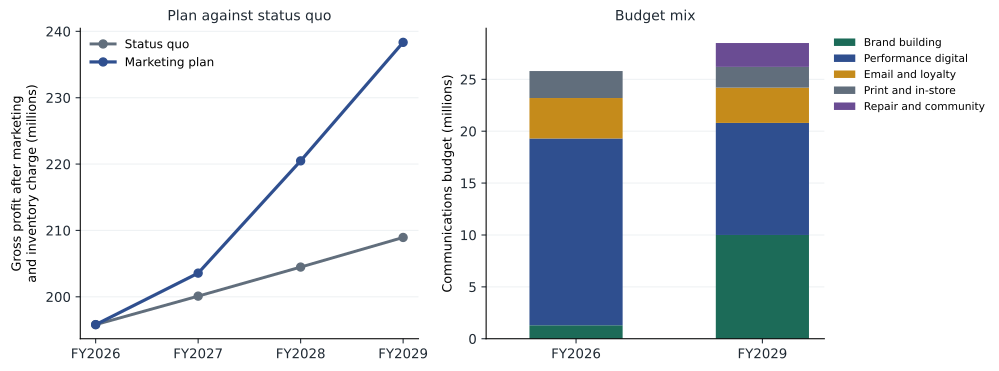
print(f"{name:30}{mix_2026.get(name, 0) * budget_26:6.1f} -> {mix_2029[name] * budget_29:5.1f}")Revenue Gross margin GP - marketing Capital charge Year SQ Plan SQ Plan SQ Plan SQ Plan 2026 468.0 468.0 49.8% 49.8% 207.3 207.3 11.5 11.5 2027 484.4 470.3 49.3% 51.2% 212.2 214.0 12.1 10.4 2028 501.3 491.5 48.8% 52.4% 217.1 230.0 12.6 9.5 2029 518.9 518.5 48.3% 53.2% 222.1 247.3 13.1 9.0 Cumulative gain over fiscal 2027-2029, after the inventory capital charge: 48.9 million Annual gain by fiscal 2029: 29.4 million Brand building 1.3 -> 10.0 Performance digital 18.0 -> 10.8 Email and loyalty offers 3.9 -> 3.4 Print and in-store 2.6 -> 2.0 Repair service and community 0.0 -> 2.3
The code compares the plan with a status quo in which revenue grows 3.5 percent a year through continued promotions, gross margin keeps slipping by half a point a year and inventory keeps rising. Under the plan, revenue is flat in fiscal 2027 as promotions are withdrawn, then grows 4.5 and 5.5 percent as the brand recovers and new stores open, reaching about the same revenue as the status quo by fiscal 2029. But gross margin recovers to 53.2 percent, so gross profit after marketing is about 25 million dollars higher in fiscal 2029, and the smaller assortment brings inventory down to about 100 million dollars, cutting the capital charge at Cedarline's 9 percent cost of capital. The total gain over three years is about 49 million dollars, and about 29 million a year by fiscal 2029. The second part of the code shows the budget mix: brand building rises from about 1.3 to 10 million dollars, performance digital falls from 18 to under 11 million, and a new line funds the repair service and community programs.
Step 8: Launch sequence, metrics and risks
Owen presents the timeline as a staged plan with gates. In the first six months, Cedarline cuts promotional weeks, launches the repair service, rolls out the fit guide, starts the brand campaign in two test regions with holdout regions for comparison, and opens negotiations with the chains. In months seven to twelve, the brand campaign expands nationally if the test regions show a lift in brand ratings and full-price sales, and assortment pruning takes effect for the spring season. In the second year, the first tranche of new stores opens and the marketing mix model guides budget shifts. Each stage has leading indicators: the share of sales at full price, brand ratings for durability, repeat purchase among active customers, repair requests and turnaround, return rates, pocket prices by chain and incremental returns by medium.
The team is candid about the risks. Withdrawing promotions may cost more revenue than planned in the first year, because some customers have learned to buy only on discount; the plan's financial case does not depend on keeping them, but the board must be prepared for a flat year. The largest chain may cut space anyway, which would reduce revenue by several million dollars in the short run. The repair service may be overwhelmed. The brand campaign may take longer than a year to show results. For each, the plan states a response and a trigger: if full-price sales in the test regions do not rise within two quarters, the creative approach will be revisited before national rollout; if the chain cuts space, the exclusive versions will be offered to its main competitor; if repair turnaround exceeds the promise, goodwill repairs will be paused.
The presentation
The panel's questions are sharp. The chief financial officer asks why the board should accept a flat year. Grace answers with the arithmetic of lesson 7: the promotions being withdrawn mostly lost money, so the revenue they produced was not worth having, and the gain in margin outweighs the lost volume within the first year after the capital charge. The head of e-commerce asks why her budget is being cut when her channels report the highest returns. Hana shows the holdout test from lesson 9 and offers to run the same test on every channel, so that budgets follow incremental returns wherever they occur. The head of wholesale asks whether the chains will accept performance-based allowances. Daniel replies that they will if the allowances are generous for real performance and if Cedarline stops competing with them on price online, which the plan does.
Dr. Lindqvist's closing comments return to the first lesson. A good marketing plan, she says, is a theory about value: what customers need, how the firm can meet that need better than others, how much of the value it can capture, and how it will find out quickly if the theory is wrong. Cedarline's plan is a theory that durability, honestly delivered and clearly communicated, will make the brand worth more to the people who use it most. The plan is credible because it is specific, because its numbers tie to the firm's value, and because it builds in the tests that will show whether it is working. She reminds the cohort that the decisions they made for Cedarline will reappear in Operations and Supply Chain Management, where the assortment and inventory choices meet the supply chain, and in Business Strategy, where the question of how Cedarline sustains its advantage becomes central.
Worked problem
The chief financial officer's challenge
The chief financial officer asks the team to show the fiscal 2027 effect of the pricing decisions alone. In fiscal 2026, about 38 percent of Cedarline's revenue, roughly 178 million dollars, was sold on promotion at an average discount of 27 percent. The plan halves promotional weeks. Suppose this moves 80 million dollars of promoted revenue, measured at promotional prices, back to full price, but 30 percent of the associated units are lost because those customers buy only on discount. Cedarline's gross margin at full price is about 56 percent. What happens to gross profit?
Show solution
- The 80 million of promoted revenue at a 27 percent discount corresponds to 80 / 0.73, about 109.6 million at full price.
- Gross profit on it at promotional prices: unit cost is 44 percent of full price, so gross profit is 80 - 0.44 × 109.6, about 31.8 million.
- At full price, 70 percent of the units still sell: revenue 0.70 × 109.6, about 76.7 million, with gross profit of 0.56 × 76.7, about 43.0 million.
- Revenue falls by about 3.3 million dollars, but gross profit rises by about 11.2 million dollars, before counting the inventory and reference-price benefits.
Answer: Even with substantial lost volume, moving sales back to full price raises gross profit, because the promotions were giving away margin that customers would largely have paid. The CFO accepts the logic but asks the team to report the share of sales at full price and the lost-customer rate every month, which becomes one of the plan's leading indicators.
Common mistakes
MistakeA marketing plan should maximize revenue growth.
InsteadIt should maximize the value created and captured, which may mean accepting slower revenue growth for higher margins.
MistakeEach department's plan can be written separately.
InsteadPositioning, offer, price, channels and communications must reinforce one another.
MistakePlatform-reported results are good enough to allocate budgets.
InsteadBudgets should follow incremental returns measured with control groups.
MistakeA plan is finished when it is approved.
InsteadA plan needs leading indicators, triggers and responses so that it can be adjusted as evidence arrives.
Summary and key terms
- The capstone integrates customer analysis, segmentation, positioning, brand, offer, price, channels, communications, analytics and launch into one plan.
- Cedarline's plan targets two segments with a durability positioning supported by testing and lifetime repairs.
- It cuts promotions, prunes the assortment, manages the price waterfall and partners with wholesale chains on performance.
- It shifts communications toward brand building and measures every medium incrementally.
- Its financial case rests on margin recovery and lower inventory, with revenue flat in the first year.
- Leading indicators, triggers and responses make the plan testable.
- Marketing plan
- A document that sets objectives, strategy, programs, budgets, metrics and responses to risks for a market.
- Situation analysis
- An assessment of customers, the company, competitors, collaborators and context that grounds a plan.
- Leading indicator
- A measure that moves before the final outcome and shows whether a plan is on track.
- Full-price sell-through
- The share of units or revenue sold at regular price rather than on promotion.
- Trigger
- A pre-agreed threshold in a leading indicator that prompts a planned response.
- Capital charge
- The cost of capital tied up in assets such as inventory, at the firm's cost of capital.
Practice problems
Work each problem on paper first, then reveal the answer to check.
Why does the team accept flat revenue in the first year of the plan?
Show answer
Withdrawn promotions mostly lost money; margin and inventory gains outweigh the lost volume.
Name three leading indicators for Cedarline's plan.
Show answer
Share of sales at full price, brand ratings for durability, repeat purchase, repair turnaround, return rate, pocket prices by chain or incremental returns by medium.
How does the plan respond if the largest chain cuts Cedarline's space?
Show answer
It offers the chain-exclusive versions to a competing chain and continues building demand that makes Cedarline valuable to retailers.
How does lowering inventory from 146 to 100 million dollars affect value at a 9 percent cost of capital?
Show answer
It cuts the annual capital charge by about 4.1 million dollars.
Lesson quiz · 5 questions
Score 60% or more to complete this lesson.
Create a free account to save your progress, take quizzes and earn a certificate.