
LES-217 · Lesson 9 of 12 · 21 min
Impact munitions and crowd settings
▶ Video coming soon A video version of this lesson is on the way.
On Saturday, September 26, 2026, about six hundred people marched from Harbor Park to City Hall to protest the planned closure of the maternity unit at Port Ardent General Hospital. Students who took the emergency management course studied that day as a public order event. What they did not see in that course was a white van parked on a side street two blocks from City Hall. Inside were eight members of the service's public order unit with batons, helmets and two launchers for impact munitions, along with a sergeant who had the authority to deploy them if the duty captain ordered it.
They never left the van. At 14:20, a few demonstrators and counter-demonstrators shoved each other for less than a minute near the steps; the liaison officers in soft caps who had walked with the march separated them, and no one complained of injury. At 15:20, a man who had climbed the City Hall flagpole for reasons unrelated to the march came down after forty minutes of talking with a negotiator. 'That van is one of the best things that happened that day,' Haddad says. 'It was ready, and it stayed shut. If you ever end up in a public order unit, remember that your success is measured by how rarely you get out of the van.'
What impact munitions are
Impact munitions are projectiles fired from a launcher, designed to strike a person from a distance with enough force to stop them without penetrating the body. Police in both countries use several types, including sponge-tipped or foam rounds, often fired from a dedicated launcher, and fabric bags filled with small pellets, often called bean bag rounds, fired from a modified shotgun. Some rounds also carry OC powder or marking dye. These weapons are sometimes grouped under the name kinetic impact projectiles, and older names, such as rubber bullets or plastic bullets, are still used for some types used in other countries.
The main reason police carry impact munitions is distance. A person armed with a knife, a bottle or another weapon who is a threat to themselves or others may need to be stopped from further away than a conducted energy weapon can reach and well beyond arm's length, without using a firearm. In those situations, an impact munition can give officers a less-lethal option at a distance that keeps everyone safer. Like the other weapons in this course, impact munitions are used only by officers who have completed specific certified training, and nothing in this lesson teaches how to use them.
Injury risk
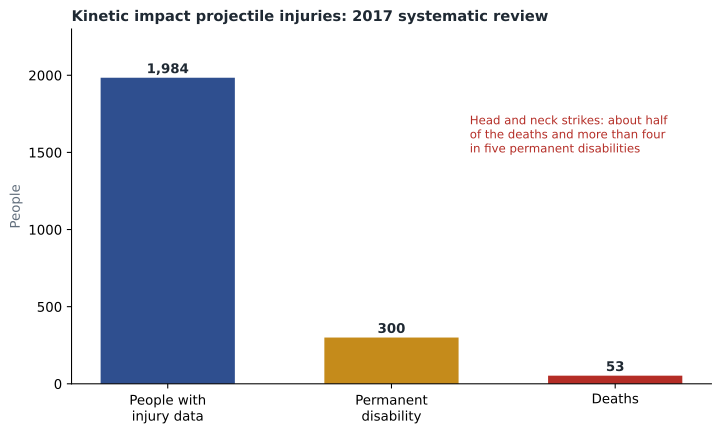
Impact munitions can cause serious injury and death, especially at close range or when they strike the head, neck or chest. In 2017, researchers published a systematic review in the medical journal BMJ Open of studies from around the world on injuries from these projectiles in crowd-control settings. Across 1,984 people with injury data, 53 died and 300 were left with permanent disabilities. Strikes to the head and neck accounted for about half of the deaths and more than four in five of the permanent disabilities, many of them eye injuries leading to blindness. The researchers concluded that these weapons were not appropriate for crowd control. Much of the data came from countries and periods in which harder and more dangerous projectiles were used than many Canadian and U.S. services carry today, but the review is still one of the most cited sources on the risk.
Worked problem
Proportions in the 2017 BMJ Open review
The review covered 1,984 people injured by impact projectiles, of whom 53 died and 300 were permanently disabled. Express these as rates.
Show solution
- \[\frac{53}{1\,984}\times 1\,000\approx 27 \text{ deaths per 1,000 injured}\]
- \[\frac{300}{1\,984}\times 1\,000\approx 151 \text{ permanent disabilities per 1,000 injured}\]
- \[\frac{53+300}{1\,984}\times 100=\frac{353}{1\,984}\times 100\approx 17.8 \text{ per 100}\]
- Turned around, 1,984 ÷ 53 ≈ 37, so about one injured person in 37 died.
Answer: About 27 deaths and 151 permanent disabilities per 1,000 people injured, or about 17.8 in every 100 killed or permanently disabled.
The numbers show why these weapons are treated as a serious use of force. About one in every 37 people in the studies who were injured died, and nearly one in five was either killed or permanently disabled. Joan Ivey tells the class she has never been to a call where an impact munition was used, but she has read the trauma reports. 'Distance makes these safer than a firearm,' she says. 'Distance that is too short, or a strike in the wrong place, makes them deadly.'
Policy for impact munitions
Policies generally restrict impact munitions to specially trained officers, require a supervisor's approval or presence where practical, and allow their use only against a specific person whose behavior presents a threat of serious harm, not against a crowd as a whole. Officers must give a warning where safe, avoid areas of the body where strikes are most likely to cause death or permanent injury, consider the distance and the risk to bystanders, and have medical help available. Firing into a crowd, firing at people who are simply present at a demonstration, or using these weapons to disperse a crowd that is not violent are prohibited by most modern policies.
U.S. agencies set their own rules, and after the protests of 2020, when large numbers of people were injured by impact munitions in several cities, many agencies tightened them. Federal courts in several cities issued orders restricting their use against protesters, and in 2022 a federal jury in Denver awarded 14 million dollars to a group of protesters who had been injured. International guidance points the same way. The United Nations Human Rights Office's 2020 guidance on less-lethal weapons in law enforcement says that kinetic impact projectiles should be used only against a specific person engaged in violence, never fired indiscriminately into a crowd, and should not be aimed at the head or face.
Crowds, rights and less-lethal weapons
Demonstrations raise special issues for less-lethal weapons because they involve the rights to free speech and peaceful assembly under the First Amendment. The great majority of people at most demonstrations are peaceful, even when a few people commit offenses. Weapons that affect an area, such as OC mists or chemical irritants, or projectiles fired into a crowd, will inevitably hit peaceful people, journalists, medics and bystanders. That is why policies and international standards distinguish so sharply between dealing with a violent individual and dealing with a crowd.
After 2020, many U.S. agencies and cities reviewed their protest policing and adopted policies that emphasize facilitation and communication, require a clear dispersal order with a way for people to leave before any force is used, and restrict area weapons and impact munitions to specific violent individuals. Port Ardent's plan for September 26 followed that model. Liaison officers in soft caps walked with the march, the organizers had the liaison sergeant's phone number, the route had been agreed in advance, and the public order unit stayed out of sight unless needed.
| Principle | What it means at a demonstration |
|---|---|
| Facilitate peaceful assembly | Agree routes, liaise with organizers, keep traffic safe |
| Target individuals, not crowds | Less-lethal force only against a specific person engaged in violence |
| Avoid area weapons where peaceful people are present | Mists and gases affect everyone, including bystanders and journalists |
| Warn and give a way out | Clear dispersal orders, time and an open route before any force |
| Medical care and accountability | Medics available; every use reported, recorded and reviewed |
A distance scenario
Haddad describes a training scenario the public order and tactical units practice. A man is standing in an empty schoolyard on a weekend holding a large kitchen knife to his own throat and refusing to talk. Officers have formed a perimeter about fifteen meters away. A negotiator is on the way. The man suddenly starts walking quickly toward the fence, beyond which a group of children are playing in a park. In that situation, she says, an impact munition fired by a trained officer might be the option that stops him before he reaches the children, without a firearm and without anyone having to close the distance to a man with a knife. 'That is what these weapons are for,' she says. 'Not for crowds. For a specific person, at a distance, when the alternative is worse.'
She also points out what the scenario does not include: an instruction about where or how to fire. 'That is for the certified course, with the instructor watching every step,' she says. 'In this room, what you need to understand is the purpose, the limits, the risk and the accountability.'
Planning before the event
The September 26 plan was written two weeks before the march. Haddad, who helped draft it, describes how less-lethal weapons appeared in it. The plan named who could authorize their use, which was the duty captain only, and in what circumstances: a specific person committing violence that put others at risk of serious injury, where lesser options would not work. It required that any deployment be filmed, that a paramedic team be staged nearby, and that every officer in the public order unit be current in training for the weapons they carried. It also said plainly that no less-lethal weapon would be used to disperse the march or to remove people who were simply refusing to move.
'Writing those limits into the plan does two things,' Haddad says. 'It tells the officers in the van what is expected, so nobody improvises. And it gives the public, and any review afterwards, a clear standard to judge us against.' Desjardins adds that some services now publish their public order plans, or summaries of them, before large events, as part of building trust with organizers.
| Plan element | September 26 approach |
|---|---|
| Who may authorize less-lethal weapons | Duty commander only |
| When | Specific person committing violence risking serious injury; lesser options not working |
| Never | To disperse the march or move people who are passively refusing |
| Medical | Paramedic team staged nearby |
| Recording | Any deployment filmed; every use reported |
Haddad adds that impact munitions also appear in calls that have nothing to do with demonstrations. Tactical teams carry them to situations involving a barricaded person, a person in crisis with a weapon, or a person threatening to harm themselves, where they give officers an option at a distance that is safer than closing in. In those situations, the same rules apply: a specific person, a threat of serious harm, a warning where safe, attention to distance and the areas of the body most at risk, medical help ready, and full reporting afterwards. 'The setting changes,' she says. 'The principles do not.'
Desjardins reminds the class that every one of these decisions, on September 26 and in any tactical call, would have been reviewed afterwards in exactly the way lesson 11 describes.
Worked problem
Using impact munitions at a protest
At a demonstration of about two hundred people, three people begin throwing bottles at police from inside the crowd. A commander suggests firing impact munitions in their general direction to make the crowd move back. Is that within modern policy and guidance?
Show solution
- Most of the crowd is peaceful; firing in a general direction will hit people who are not throwing anything.
- Policies and the UN guidance allow impact munitions only against a specific person engaged in violence, not to move a crowd.
- Options include separating the peaceful crowd from the throwers, liaison with organizers, arrest teams for identified individuals, and recording evidence for later arrests.
- If any less-lethal force is needed, it must be directed at a specific individual, with a warning where possible and medical help ready.
Answer: Firing in the general direction of the crowd would be outside modern policy and could injure many peaceful people. Commanders should focus on the specific people throwing bottles and on protecting everyone else.
Common mistakes
MistakeImpact munitions are safe because they do not penetrate.
InsteadThey can cause death and permanent disability, especially at close range or with head and neck strikes.
MistakeLess-lethal weapons are the right tools for moving crowds.
InsteadArea weapons and projectiles fired into crowds injure peaceful people; modern policy restricts force to specific violent individuals.
MistakeA public order unit that is not deployed has failed.
InsteadA well-planned event where the unit stays in reserve is a success.
MistakeAnyone with a launcher may use it.
InsteadOnly specially trained officers may use impact munitions, usually with supervisory approval.
Summary and key terms
- Impact munitions are projectiles fired from launchers to stop a person at a distance without penetrating the body.
- They can cause serious injury and death; a 2017 review found 53 deaths and 300 permanent disabilities among 1,984 people injured.
- Policies restrict them to trained officers and to specific individuals presenting a threat of serious harm, with warnings where safe.
- Firing into crowds or at peaceful demonstrators is prohibited by modern policy and international guidance.
- The First Amendment protects peaceful assembly and speech; 2020 reshaped many U.S. protest policies.
- Planning, liaison and keeping public order units in reserve are the main tools for demonstrations.
- Impact munition
- A projectile fired from a launcher to strike a person without penetrating.
- Kinetic impact projectile
- A research and international term for impact munitions, including rubber and plastic bullets.
- Area weapon
- A weapon whose effect spreads over an area, such as an OC mist or chemical irritant.
- Liaison officer
- An officer who communicates with demonstrators and organizers during an event.
Practice problems
Work each problem on paper first, then reveal the answer to check.
Why does Haddad call the closed van on September 26 a success?
Show answer
Because the event was managed through planning and liaison, and the public order unit never needed to deploy force.
What did the 2017 BMJ Open review find?
Show answer
Among 1,984 people injured, 53 died and 300 were permanently disabled; head and neck strikes caused about half of the deaths.
What does the UN guidance say about impact projectiles and crowds?
Show answer
Use them only against a specific person engaged in violence, never indiscriminately into a crowd, and not aimed at the head or face.
What is the main reason police carry impact munitions?
Show answer
To stop a dangerous person at a distance without using a firearm or closing to arm's length.
Lesson quiz · 5 questions
Score 60% or more to complete this lesson.
Create a free account to save your progress, take quizzes and earn a certificate.