
LES-217 · Lesson 12 of 12 · 19 min
Capstone: reviewing a less-lethal incident
▶ Video coming soon A video version of this lesson is on the way.
For the final class, Desjardins sets up the room the way Port Ardent's training unit sets up an after-action review. The body-worn camera videos from Coutu and Ruiz are queued on the screen. Copies of the dispatch log, the officers' use-of-force reports, Haddad's supervisor report, the weapon download, Joan Ivey's paramedic report and the professional standards findings and the civilian review board's letter are on each table, with personal details removed. Ruiz and Coutu have both agreed to attend. 'This is not a trial,' Desjardins says. 'The legal questions have been answered. This is about learning. The question is not whether they did well or badly. It is what we can learn so that the next call goes even better.'
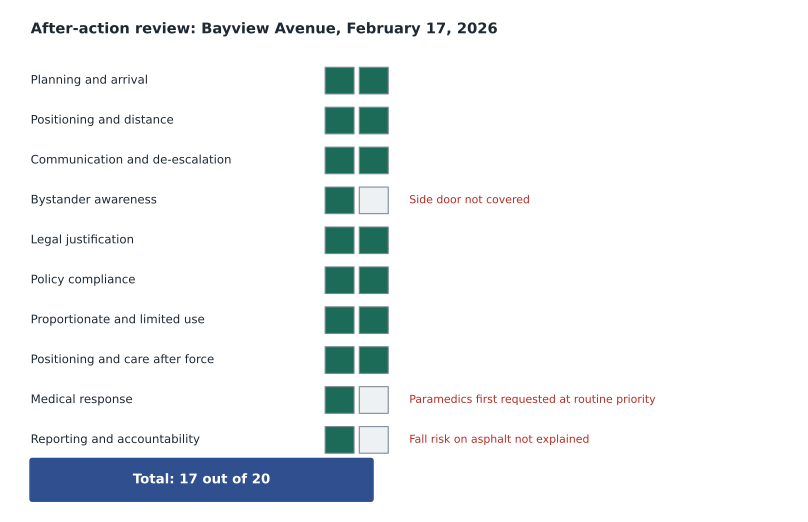
The students work in four groups, each taking part of the incident, and then score the whole call together using the training unit's ten-point review form, which awards up to two points for each area. Haddad explains that the form is deliberately strict. 'A perfect score is rare. If we give everyone twenty out of twenty, nobody learns anything.'
The incident, minute by minute
The groups first rebuild the timeline. At 19:38 on February 17, a laundromat employee called 911 to report a man shouting and waving a broken bottle in the parking lot. Coutu and Ruiz, in separate cars, were dispatched at 19:39 and arrived together at 19:40. They parked about twelve meters from Ostrowski, got out and stood behind the open doors of Coutu's car. Coutu, as the contact officer, introduced herself and began talking. Ruiz, as cover officer, radioed for paramedics and told dispatch that the man appeared to be in crisis. At about 19:43, they moved forward to about seven meters to hear him better over the traffic, then moved back to about nine meters when he swung the bottle in the air.
For the next four minutes, Coutu talked to Ostrowski about who he thought was following him, offered him water, and asked him several times to put the bottle on the ground. He alternated between shouting and crying. At 19:47, a side door of the laundromat that neither officer had noticed opened, and Hana Bekele walked out carrying a basket of laundry. Ostrowski turned toward her, raised the bottle and stepped toward her, shouting that she was one of them. She was about four meters from him. Ruiz shouted a warning, and when Ostrowski took another step, used his weapon for one five-second cycle at 19:47:12. Ostrowski fell forward onto the asphalt. Coutu handcuffed him during the cycle and the officers sat him up within about thirty seconds. Paramedics arrived at 19:51 and Haddad at 19:58.
What went well
The groups agree on what went well. The officers arrived together and took positions behind cover at a good distance. They assigned clear roles, with Coutu speaking and Ruiz covering and handling the radio. Coutu's communication was calm, patient and personal: she used Ostrowski's first name once he gave it, listened to his fears and offered him choices. They called for paramedics early. When Ostrowski moved toward Bekele, the threat changed in a second, and Ruiz responded with a proportionate option, a single cycle with a warning, rather than a firearm. The force stopped as soon as the threat stopped. Ostrowski was sat up quickly, his injured wrist was noticed and he was cuffed in front, and his condition was monitored until paramedics arrived. The reports were written that night and matched the weapon log and the video.
Amara's group focuses on the decision point. Under Graham v. Connor and Barnes v. Felix, they write, the use of force had a lawful purpose, protecting Bekele from an imminent attack with a weapon capable of causing serious injury. Lesser options had been tried for seven minutes and would not have stopped him in the second or two available. A single cycle was proportionate, and the force ended when the threat ended. The professional standards unit and the civilian review board reached the same conclusion.
What could have gone better
The groups find three areas where the call could have gone better. The first is bystander awareness. Neither officer knew about the laundromat's side door, and nobody had gone inside to tell the people there to stay put. Bekele walked straight into danger. Jesse's group suggests that the cover officer, or a third officer if one had been available, should have been assigned to watch for bystanders and that someone should have called the laundromat through dispatch. Coutu agrees. 'I've thought about that door every day since,' she says. 'If she'd stayed inside, I think we'd have talked him down.'
The second is the medical response. Ruiz requested paramedics at 19:40, which was good, but the request went out as routine priority, because he described Ostrowski as 'a man in crisis' rather than describing his physical signs. At 19:45, when Ruiz saw that Ostrowski was sweating heavily and was very agitated, he upgraded the request. Ivey says the earlier priority might have put her ambulance on scene before the weapon was used. Priya's group suggests that officers describe physical signs, such as extreme agitation, sweating and confusion, when requesting paramedics, because those signs change the priority.
The third is reporting. Ruiz's report was accurate and detailed, but it did not mention that he had considered the risk of Ostrowski falling on the asphalt and why he decided that the risk to Bekele outweighed it. Haddad explains that policy requires officers to explain the risks they weighed, especially fall risk, and that the reviewer had to ask Ruiz about it afterwards. Ruiz says he had thought about it, but in the moment the only thing in his head was the distance between the bottle and Bekele. 'That's honest,' Haddad says. 'And it's exactly why we train on it, so that next time the fall risk is already part of how you see the scene before you need to decide.'
| Area | Score | Note |
|---|---|---|
| Planning and arrival | 2 | |
| Positioning and distance | 2 | |
| Communication and de-escalation | 2 | |
| Bystander awareness | 1 | Side door not covered; laundromat not called |
| Legal justification | 2 | |
| Policy compliance | 2 | |
| Proportionate and limited use | 2 | |
| Positioning and care after force | 2 | |
| Medical response | 1 | Paramedics first requested at routine priority |
| Reporting and accountability | 1 | Fall risk not explained in report |
| Total | 17 of 20 |
The three areas that scored 1 have something in common: none of them was about the decision to use the weapon. The legal justification, the policy compliance and the proportionate use all scored 2. What cost points were the things around that decision, which is the usual finding in reviews of incidents that went reasonably well. Improvements are therefore aimed at habits, such as covering every exit and describing the person's condition when calling paramedics.
Lessons from the other incidents
Desjardins asks each group to compare Bayview Avenue with one of the other 2026 incidents. The comparison shows patterns that no single incident could. In every case where force was avoided, the officers had time and distance and used them. In both cases where force was used, the person was actively attacking or about to attack someone else, the officer gave a warning, the force was brief and limited, and aftercare began within minutes. And in every case, the people who came out best were the ones the officers treated as people first: Haines with his photographs, Fane with his job, Petrie with water and an explanation of what would happen.
| Incident | Weapon | Key decision | Lesson |
|---|---|---|---|
| Bayview Avenue, Feb 17 | Conducted energy weapon, one cycle | Stop an attack on a bystander | Watch for bystanders; describe physical signs to dispatch |
| Dockside Social, May 9 | OC spray, one burst | Stop an assault on a man on the ground | Check everyone nearby for drift; decontaminate fast |
| Maple Court, Jul 14 | None | Recognize a frail person and use time and trust | Policy limits and de-escalation work together |
| City Hall, Sep 26 | None; impact munitions held in reserve | Facilitate a peaceful demonstration | Success is staying in the van |
| Market Street, Oct 1 | Baton displayed only | Use distance and cover and keep talking | A display can be enough when combined with communication |
What happened afterwards
Port Ardent made three changes after the Bayview Avenue review. Cover officers on calls involving a person with a weapon are now expected to identify and watch for bystanders, and dispatch calls the premises where possible. Dispatchers now ask officers about physical signs of severe agitation when paramedics are requested, and upgrade the priority when those signs are present. And the annual requalification for conducted energy weapons now includes a scenario on assessing fall risk, and the report template asks officers to describe the environmental risks they considered.
Tyler Ostrowski was discharged from hospital after several days of treatment. He was charged with aggravated menacing, and his case was referred to the mental health docket. After he completed a treatment program, the charge was dismissed in September 2026. Through his lawyer, he sent a short letter to the service, which Coutu has kept. He wrote that he did not remember much of that night, but he remembered a woman's voice telling him he was going to be okay.
Hana Bekele was not hurt. She told the investigators that she was angry at first that nobody had warned her, and then grateful. She now volunteers with the local chapter of the National Alliance on Mental Illness.
Closing
Haddad finishes the course where she began, with the four objects on the table: the conducted energy weapon, the OC canister, the baton and the body-worn camera. 'You now know the law that governs every one of these, the policies that limit them, the ways they can hurt people and the ways we hold ourselves accountable for using them,' she says. 'What you do not yet know is how to use them, and you should not want to until you are in a certified course with an instructor beside you. When you get there, remember Bayview Avenue, Dockside, Maple Court, City Hall and Market Street. In three of those five calls, the right answer was to leave the weapon where it was.'
Running a fair review
Before scoring, Desjardins sets out the ground rules the training unit uses. The review looks only at what the officers knew or could reasonably have known at the time, not at what everyone learned later. It separates the decision to use force from everything else, so that a justified decision does not hide a weak aftercare, and an unjustified decision is not excused by good reporting. It invites the officers involved to explain their thinking, and it ends with specific changes rather than general advice. 'If a review ends with be more careful, it has failed,' he says. 'It should end with something we will do differently on Monday.'
Ruiz speaks last in the review. 'I used to think the weapon was the big decision,' he says. 'Now I think the big decisions were made in the first minute, where we parked, who talked, whether we called the laundromat. The weapon was the last half-second of a seven-minute call.'
Worked problem
Running your own review
A student reviewing a different incident finds that an officer used OC spray on a man who was shouting and pointing at the officer but had not moved toward anyone, after giving one warning. The man was decontaminated within two minutes and the report is detailed and accurate. How should the review score the legal justification and the aftercare?
Show solution
- Legal justification: shouting and pointing is not assaultive behavior or active resistance likely to cause injury; the force was probably not proportionate. Score low.
- Policy compliance: using OC below the policy threshold is a policy breach, whatever the warning. Score low.
- Aftercare: fast decontamination and monitoring meet the duty of care. Score high.
- Reporting: an accurate, detailed report is good practice even when the force was not justified. Score high.
Answer: The review should separate the areas: the decision to use force was likely unjustified, while the aftercare and reporting were good. Each area teaches something different.
Common mistakes
MistakeA review is a disciplinary hearing.
InsteadAn after-action review is about learning; legal and disciplinary questions are decided elsewhere.
MistakeIf force was justified, there is nothing to learn.
InsteadEven justified incidents have lessons, such as bystander awareness and medical priority.
MistakeA perfect score means a perfect call.
InsteadStrict scoring identifies areas to improve; perfect scores are rare.
MistakeThe weapon decision is the only thing that matters.
InsteadPlanning, communication, aftercare and reporting matter as much as the moment of force.
Summary and key terms
- The Bayview Avenue review scored 17 out of 20.
- Strengths were positioning, communication, early paramedic request, a proportionate single cycle, quick aftercare and accurate reports.
- Areas to improve were bystander awareness, medical priority and explaining fall risk in the report.
- Port Ardent changed its cover officer expectations, dispatch questions and requalification scenarios.
- Across the 2026 incidents, time, distance and treating people as people prevented or limited force.
- Less-lethal weapons are governed by law, policy, medical care and accountability, and are best left unused whenever possible.
- Mental health docket
- A court program that links people with mental illness charged with offenses to treatment.
- After-action review
- A structured review of an incident to identify lessons, separate from discipline.
- Contact officer
- The officer who communicates with the person.
- Cover officer
- The officer who watches for threats, handles the radio and supports the contact officer.
Practice problems
Work each problem on paper first, then reveal the answer to check.
What three areas did the review score below two?
Show answer
Bystander awareness, medical response and reporting.
Why was the paramedic request initially routine?
Show answer
Ruiz described Ostrowski as a man in crisis rather than describing his physical signs.
What three changes did Port Ardent make?
Show answer
Cover officers watch for bystanders and dispatch calls premises; dispatch asks about physical signs and upgrades priority; requalification and report templates address fall risk.
What pattern appears across the five incidents?
Show answer
Time and distance prevented force; where force was used it was brief, warned and followed by fast aftercare; people treated as people did best.
Lesson quiz · 5 questions
Score 60% or more to complete this lesson.
Create a free account to save your progress, take quizzes and earn a certificate.