
LES-217 · Lesson 4 of 12 · 20 min
De-escalation first: time, distance and communication
▶ Video coming soon A video version of this lesson is on the way.
At 10:12 on Tuesday, July 14, 2026, a care aide at the Maple Court seniors' residence called 911. Walter Haines, 84, who lives with dementia, was standing in his room holding a kitchen knife he had taken from the residents' kitchenette. He believed the staff were intruders who had come to steal from him, and he had shouted that he would 'cut anyone who comes in.' A nurse had tried to approach him and backed away when he raised the knife. No one was hurt.
Officer Femi Okeke and Probationary Officer Sofia Reyes arrived at 10:21. Both carried OC spray and batons, and Okeke carried a conducted energy weapon. They used none of them. At 10:43, Haines put the knife on his dresser, sat down in his armchair and let his care aide, Rosa Mendes, hold his hand. Paramedics took him to hospital for assessment. Desjardins plays the body-worn camera video in class without comment, then asks the students one question: 'What did they do instead?'
Why de-escalation comes first
De-escalation means using communication, time, distance and other tactics to reduce the intensity of a situation so that force becomes unnecessary or less force is needed. It is not a single technique and it is not the absence of action. It is a deliberate approach in which officers slow things down, gather information, reduce the person's sense of threat and give them a way to cooperate. Many U.S. agency policies, and the U.S. Department of Justice's own use-of-force policy for federal agents, require officers to use de-escalation techniques when it is safe and feasible to do so, and the Ohio Collaborative's standards encourage agencies to train officers in it.
There is growing evidence that de-escalation training works when it is done well. A study of the Police Executive Research Forum's de-escalation training program in Louisville, Kentucky, published in 2022, found that after officers were trained, use-of-force incidents fell, and injuries to members of the public and to officers fell as well, with reductions in the range of about a quarter to a third. Other studies have found smaller or mixed effects, and researchers agree that training alone is not enough: it works best when supervisors reinforce it, policies require it and officers practice it regularly. But no study has found that de-escalation makes officers less safe.
The connection to less-lethal weapons is direct. Most of the controversies in this course, from the Braidwood Inquiry to the federal court cases, involve situations where a weapon was used early, against a person who was confused, frightened or ill, when more time and distance might have ended the situation without force. 'The best less-lethal option,' Haddad says, 'is the one you never have to use because you bought yourself enough time to solve the problem another way.'
Time, distance and cover
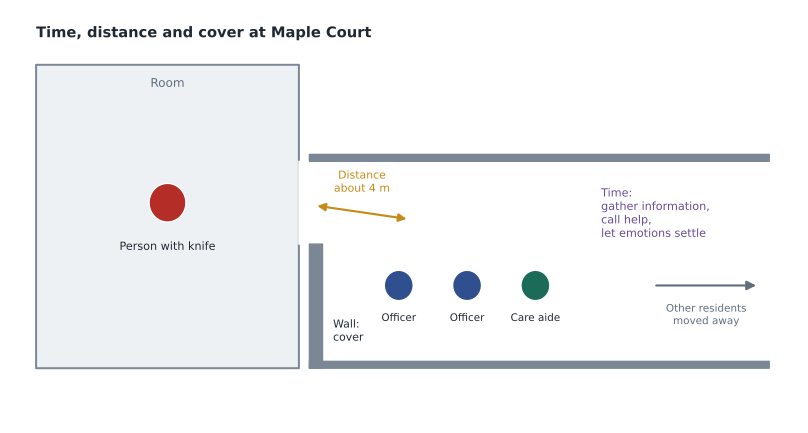
Time, distance and cover are the foundation of de-escalation. Distance reduces the immediate danger, because a person with a knife or a bottle cannot reach an officer who is far enough away and behind something solid. Cover, meaning a physical barrier such as a doorframe, a vehicle or a wall, adds protection and lets officers stay longer without having to act. Distance and cover together create time. Time lets officers gather information, call for help, let the person's emotions settle, and let the effects of drugs or a panic attack ease.
At Maple Court, Okeke and Reyes stood in the hallway, about four meters from Haines's doorway, with the corridor wall partly between them and the room. They asked staff to move other residents to the dining room at the far end of the hall. Okeke asked the nurse for information: Haines's name, what he liked to be called, his diagnosis, whether he had ever been violent before, who he trusted, and whether he had family. He learned that Haines was a retired machinist, liked to be called Walt, had never hurt anyone, and trusted Rosa more than anyone else on staff. His daughter, Linda, was reachable by phone.
Communication
Good crisis communication is calm, simple and patient. One officer speaks, so the person is not dealing with several voices. The officer introduces themselves, uses the person's preferred name, speaks slowly, and asks open questions. They listen more than they talk, and they reflect back what the person is feeling: 'You're worried someone is taking your things.' They avoid arguing with what the person believes, especially when the person is confused or experiencing delusions. They offer choices that do not compromise safety, such as 'Would you like to put that on the dresser or on the chair?' And they avoid sudden movements, raised voices and commands repeated over and over, which can make a frightened person feel more threatened.
Okeke spoke to Haines for the first six minutes without asking him to do anything. He told him who he was, said he was there to make sure Walt was safe, and asked about the photographs on the wall, which showed Haines at a lathe in a machine shop. Haines told him about his old job. When Okeke asked whether the staff had been bothering him, Haines said they kept coming into his room and taking his things. Okeke said that sounded frustrating, and asked whether it would help if Rosa came to talk to him. Haines said Rosa could come, but 'not those others.'
Reyes, meanwhile, phoned Haines's daughter. Linda told her that her father had been agitated for several days since his medication was changed, and that he often calmed down when someone talked to him about his work or his late wife. Reyes passed this to Okeke in a quiet voice. At 10:38, Rosa stood beside Okeke in the hallway, said hello to Haines and asked how his morning had been. At 10:43 he put the knife down.
| Do | Avoid |
|---|---|
| One officer speaks; others support | Several officers shouting commands at once |
| Use the person's name and introduce yourself | Impersonal commands like "drop it" repeated over and over |
| Listen and reflect feelings | Arguing with delusions or beliefs |
| Offer safe choices | Ultimatums that leave the person no way out |
| Slow down and use silence | Rushing toward a resolution |
| Bring in people the person trusts | Excluding family or carers who can help |
People who cannot comply
Some people cannot follow commands, even if they want to. A person with dementia may not understand what is being asked or may not remember it a moment later. A person who is deaf or hard of hearing may not hear commands. A person in a mental health crisis may be responding to voices or intense fear. A person in a medical emergency, such as low blood sugar or a seizure, may appear confused or aggressive. A person who does not speak the language may not understand. A person with autism may react strongly to noise, lights and touch. Using a less-lethal weapon on a person because they did not follow a command they could not understand or carry out is one of the most common patterns in the cases that led to today's policies.
Many U.S. agencies train officers in crisis intervention team programs, often modeled on the Memphis model, and some cities send mental health responders to certain calls instead of or alongside police. In Port Ardent, the mobile crisis team was on another call on July 14, and arrived at Maple Court at 10:50, after Haines had already calmed down. Its nurse went with him to hospital.
| Minute | What happened |
|---|---|
| 0 | Arrive; position in the hallway behind a wall, about 4 m away |
| 2 | Residents moved away; information gathered from the nurse |
| 4 | Okeke introduces himself, uses 'Walt', talks about his work |
| 11 | Reyes reaches the daughter; learns of a medication change |
| 17 | Rosa, a trusted care aide, joins Okeke in the hallway |
| 22 | Haines puts the knife on the dresser and sits down |
| Minute | What happens |
|---|---|
| 0 | Arrive; enter the room; repeated commands to drop the knife |
| 1 | Haines raises the knife; officers consider a weapon |
The actual call created twenty-two minutes of time, and every useful piece of information arrived inside that time: the medication change at minute 11 and the care aide at minute 17. In the rushed version, the officers have to decide within a minute, with none of it.
Time is created by distance and cover. Standing in the hallway, partly behind a wall and about four meters from the doorway, Okeke and Reyes could keep talking without having to react to every movement Haines made. Entering a small room removes that space, and with it the chance to learn anything new. Desjardins tells the class that the most useful question at a call like this is often not what to do, but how to buy another minute safely.
Desjardins is careful with this example. 'The rushed version is not a straw man,' he says. 'Inquiries in both countries have examined calls that went almost exactly like that, with officers entering a small room, shouting commands at a confused elderly person or a person in crisis, and using a weapon within a minute. Some of those people died. The officers at Maple Court were not braver or kinder than those officers. They had been trained to slow down, and they did.'
When de-escalation is not possible
De-escalation is not always possible, and the law does not require officers to put themselves or others at serious risk to attempt it. When a person is actively attacking someone, or is about to, officers may have to act immediately. At Bayview Avenue, the officers spoke to Ostrowski for seven minutes, kept their distance and called for backup and paramedics, which was good de-escalation. When he stepped toward Hana Bekele with the broken bottle raised, the time for talking had run out, and Ruiz had seconds to decide. Even then, Coutu kept talking throughout, and both officers came back to communication as soon as he was on the ground.
Haddad describes de-escalation as a dial rather than a switch. Officers turn it up whenever they can and keep it running even when force becomes necessary. They return to it immediately afterwards. And they look back after every incident to ask whether there was a moment earlier on when they could have slowed things down, which is one of the questions in the capstone review.
Slowing down a call
Haddad gives the class a short list of questions she asks herself on every call involving a person in distress: Is anyone in immediate danger right now? If not, what do I gain by acting quickly, and what do I lose? Who else could help, such as a family member, a care worker, a crisis team or a negotiator? What does this person need to feel safe enough to cooperate? 'If no one is in immediate danger, time is almost always on your side,' she says. 'The longer you talk, the more you learn, the more help arrives, and the calmer most people become.'
Worked problem
Applying de-escalation
Officers are called to a convenience store where a young man is pacing outside, shouting that someone is following him and holding a screwdriver. No one has been hurt. The store clerk says he has been there for twenty minutes and has not approached anyone. What should the officers do first?
Show solution
- Create distance and use cover, such as the patrol car or the corner of the building.
- Ask the clerk to stay inside and keep customers away; move bystanders back.
- Have one officer introduce themselves calmly and ask his name; listen and reflect his fear.
- Request backup and the mobile crisis team or paramedics, and gather information about him if possible.
- Offer safe choices, such as putting the screwdriver on the ground or on a ledge.
Answer: Officers should slow the call down, keep their distance, communicate and bring in help. A less-lethal weapon should be considered only if he moves to attack someone and lesser options will not stop him.
Common mistakes
MistakeDe-escalation means doing nothing.
InsteadDe-escalation is deliberate action: positioning, gathering information, communicating, bringing in help and offering choices.
MistakeRepeating commands loudly shows control.
InsteadRepeated loud commands can increase fear; one calm voice and simple choices are more effective.
MistakeA person who does not comply is choosing to resist.
InsteadSome people cannot comply because of illness, disability, language or confusion.
MistakeOnce force is used, de-escalation is over.
InsteadCommunication continues during and after force, and officers return to it as soon as possible.
Summary and key terms
- De-escalation uses time, distance, cover and communication to make force unnecessary or reduce it.
- Research, including the 2022 Louisville study, links de-escalation training to fewer uses of force and fewer injuries.
- One calm officer speaking, using the person's name, listening and offering safe choices works better than repeated commands.
- Some people cannot comply because of dementia, mental illness, disability, language or a medical emergency.
- Bringing in trusted people, family and crisis teams can resolve calls without force.
- When an immediate threat makes de-escalation impossible, communication continues throughout and resumes immediately after.
- Crisis intervention team
- A police program, often modeled on the Memphis model, that trains officers to respond to people in mental health crisis.
- De-escalation
- Using communication, time, distance and other tactics to reduce the intensity of a situation.
- Cover
- A physical barrier that protects officers and lets them stay longer without acting.
- Mobile crisis team
- Mental health workers who respond to people in crisis, sometimes alongside police.
Practice problems
Work each problem on paper first, then reveal the answer to check.
What three things form the foundation of de-escalation?
Show answer
Time, distance and cover, which together create time to use communication and bring in help.
What information did Okeke gather before talking to Haines?
Show answer
His name and preferred name, his diagnosis, whether he had been violent, who he trusted, and how to reach his family.
Why might a person not follow commands even if they want to?
Show answer
Because of dementia, mental illness, hearing loss, a medical emergency, language or sensory overload.
At what point did the officers at Bayview Avenue stop relying only on talking?
Show answer
When Ostrowski stepped toward Hana Bekele with the broken bottle raised.
Lesson quiz · 5 questions
Score 60% or more to complete this lesson.
Create a free account to save your progress, take quizzes and earn a certificate.