
LES-217 · Lesson 8 of 12 · 19 min
Batons and impact tools: law, policy and injury risk
▶ Video coming soon A video version of this lesson is on the way.
At 16:05 on Thursday, October 1, 2026, a caller reported a man smashing a parked car with a metal pipe in the lane behind Market Street. Officer Dev Malhotra arrived first, alone, with Officer Femi Okeke about two minutes behind. The man, Derek Fane, 41, was swinging a length of steel pipe about a meter long into the windshield and doors of a pickup truck. The truck belonged to his former employer, who had fired him that morning. No one else was in the lane.
Malhotra stopped at the corner of a building about eight meters away, keeping the corner between himself and Fane. He drew his expandable baton, opened it and held it down at his side. 'Derek, it's the police. I'm Dev. Put the pipe down on the ground for me. Nobody's hurt yet, and I want to keep it that way.' Fane turned, pipe in hand, and shouted that the company had ruined his life. Malhotra kept talking. Okeke arrived and stood back on the other side of the lane. After about ninety seconds, Fane dropped the pipe, sat down on the curb and started crying. He was arrested for mischief without any force beyond handcuffing.
In class, Marco asks why Malhotra drew the baton at all if he never intended to use it. Malhotra, who has come in to answer questions, says he did intend to use it if he had to. 'He had a steel pipe. If he had come at me, I had a choice of backing away, which I would have tried first, or defending myself. The baton was in my hand so I didn't have to draw it in the half-second I might have needed. But I kept it low and kept talking, because I didn't want him to think I was there to fight.'
What batons are
A baton is a hand-held impact weapon. Police have carried batons in some form for well over a century, and they are still standard equipment in most services in both countries. Modern police batons are usually straight or expandable, made of metal or composite materials. A few services still use side-handle batons. Batons can be used in several ways: displayed, as Malhotra did, to signal that the officer is prepared to defend themselves; held as a barrier or to help control a person's arm under some training systems; or used to strike. Only certified training under qualified instructors teaches officers how to use them, and this course does not.
Officers sometimes use other objects as impact tools, such as a flashlight, a radio or a clipboard, when a baton is not available. Most policies discourage or prohibit using improvised impact weapons except in an emergency, because they are not designed for the purpose, officers are not trained to use them and the injury risk is harder to predict. Any use of an improvised weapon must be justified and reported in the same way as a baton.
The law and batons
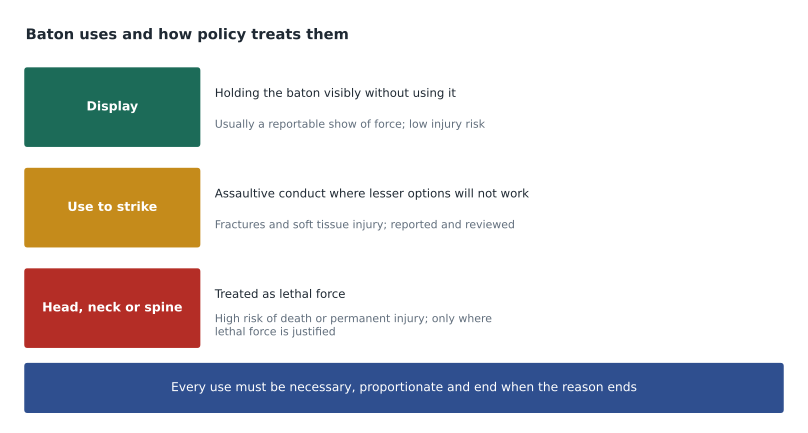
The law of force applies to batons in the same way as to every other weapon. A baton strike is a significant use of force. It must have a lawful purpose, be necessary because lesser options would not reasonably work, be proportionate to the threat and end when the reason ends. Under Graham v. Connor and Tennessee v. Garner, deadly force is reasonable only where the officer has probable cause to believe the person poses a significant threat of death or serious physical injury. Because a baton strike to the head can cause death or serious physical injury, policies treat it as deadly force, subject to that higher threshold.
Policies in both countries also set out areas of the body that officers must not intentionally strike except where lethal force would be justified, namely the head, neck and spine, because strikes there are most likely to cause permanent injury or death. That restriction is a legal and policy limit, not a technique; training on how to use a baton lawfully takes place only in certified courses.
Injury risk
Baton strikes commonly cause bruising, swelling and pain, and can cause fractures of the arms, hands, legs and ribs, especially in older people and people with weaker bones. Strikes to the head can cause skull fractures, bleeding in the brain and death. Even strikes that do not land where intended can cause serious injury, because people move, turn and fall. Unlike a conducted energy weapon or OC spray, a baton requires the officer to be within arm's length or close to it, which means the officer is also at risk of being hit, disarmed or injured.
Research on baton injuries is more limited than for conducted energy weapons, but studies of police use of force generally find that impact weapons are associated with higher rates of injury to the person than OC spray or conducted energy weapons, partly because they are often used in close, prolonged struggles. That is one reason many U.S. agencies expanded access to other less-lethal weapons over the past two decades. Joan Ivey tells the class that the baton injuries she sees are usually broken forearms and hands, from people raising their arms to protect their heads.
Batons in history and oversight
Batons have been at the center of some of the most important moments in policing history. In Los Angeles in March 1991, officers struck Rodney King dozens of times with batons during an arrest, and a bystander's video of the beating became one of the most widely seen recordings in policing history. Two officers were later convicted in federal court of violating his civil rights, after a state jury had acquitted them, and the independent commission that followed reshaped how police use of force is supervised and reviewed. Desjardins tells the class that every officer who carries a baton should know these events, because public trust in police use of force is still shaped by them.
Haddad adds a fictional case from training files that she uses every year, set in the neighboring service of Bay Township in 2019. An officer struggling with a man on the ground during an arrest for public intoxication struck him on the head with his baton, causing a skull fracture. The man had been resisting, but was not armed and was outnumbered by three officers. The review found that the strike was not justified as lethal force, and the officer was convicted of felonious assault and dismissed. 'He told the investigators he was aiming for the shoulder,' Haddad says. 'That is why policy says you do not strike near the head unless lethal force is justified. People move. You will not always hit what you aim for.'
| Event | Action | Area | Category |
|---|---|---|---|
| Malhotra, Market St, Oct 1 | Display | — | Show of force (reportable) |
| Bay Township case, 2019 | Strike | Head | Lethal force: requires a threat of death or grievous harm |
| Training scenario C | Strike | Upper arm | Intermediate force: requires assaultive conduct and proportionality |
The categories turn on where and how the baton is used, not on the baton itself. That is why reports must be specific. 'Used baton' tells a reviewer almost nothing; 'struck the subject twice on the outside of the right thigh while he was kicking at Officer Coutu' tells them the action, the area, the number of strikes and the conduct that justified them, which are the facts the review will test.
The table shows that the same weapon can fall into three different categories depending on how it is used. Malhotra's display was a show of force that Port Ardent's policy requires officers to report. The Bay Township strike was lethal force and was not justified. A strike to an arm in a training scenario would be intermediate force, which still has to be justified by assaultive behavior and proportionality.
Reporting and review
Most U.S. agencies require a use-of-force report for any baton strike, and many require one for drawing or displaying a baton. Malhotra filed a report on the Market Street call describing the display. Okeke filed a short supplementary report. The sergeant who reviewed them noted that Malhotra's position behind the corner of the building and his choice to talk rather than advance were the reasons the call ended without injury, and added it to the platoon's training examples.
Fane was released on conditions not to go near his former employer or its property. In October, he pleaded guilty to mischief and agreed to pay for the damage to the truck, and was referred to a counseling program through his union.
Defensive use and the reality of close distance
Malhotra tells the class that the most common reason an officer actually uses a baton is not to make an arrest but to defend against an attack that has already started at close range, when there is no time to create distance. Even then, the law still asks whether the force was necessary and proportionate, and whether it stopped when the attack stopped. 'If you are being hit, you are entitled to defend yourself,' he says. 'You are not entitled to keep hitting someone who has stopped.'
Haddad adds that the baton's place in policing has changed. Twenty years ago, she says, many officers expected to use their batons several times a year. Today, most Port Ardent officers go years without striking anyone, partly because they carry other options and partly because training now puts so much weight on distance and communication. The 2025 annual report shows four baton strikes in the whole city, all against people who were actively attacking an officer or another person, and all reviewed and found to be within policy.
Equipment care and accountability
Batons, like all weapons, are issued to individual officers, recorded in the service's inventory and inspected. Officers may carry only the baton they have been issued and trained on, and may not modify it. A baton involved in an incident causing serious injury may be seized as evidence. Ohio agencies specify approved batons in policy, and officers who carry unapproved weapons can be disciplined. These rules matter because the legal protection for carrying and using a weapon depends on the officer being authorized and trained to carry that particular weapon.
Desjardins closes the discussion with the question of appearance. A baton is the most recognizable weapon in policing, and its image, raised over a person on the ground, has appeared in some of the most damaging photographs in the history of both countries. 'People who see a baton raised do not think about policy categories,' he says. 'They think about what it looks like. That is not a reason never to use one when you must. It is a reason to make sure that when you do, you can explain every second of it.'
In every case, the officer's report has to explain the threat, the options considered and the result.
Worked problem
Is a baton strike justified?
Two officers try to arrest a man for breaching a court order. He pulls his arm away and tries to walk off. One officer draws a baton and strikes him on the thigh. He is not armed and has not tried to hit anyone. Was the strike justified?
Show solution
- Purpose: arresting him for breaching a court order is lawful.
- Behavior: pulling away and walking off is active resistance or flight, not assaultive behavior.
- Options: two officers can use physical control, follow him, call for more officers or arrest him later.
- Proportionality: a baton strike is significant force and is not proportionate to non-assaultive resistance.
Answer: The strike was very likely excessive and outside policy. The officers had lesser options available.
Common mistakes
MistakeDrawing a baton is not a use of force.
InsteadDisplaying a baton is a show of force that many policies require officers to report.
MistakeA baton strike is low-level force.
InsteadA baton strike is significant force that can cause fractures and serious injury.
MistakeAn officer aiming away from the head is protected if the strike lands on the head.
InsteadPeople move; policy prohibits strikes near the head unless lethal force is justified, and officers are responsible for the result.
MistakeAny object can be used as a baton.
InsteadImprovised impact weapons are discouraged or prohibited except in emergencies, and must be justified and reported.
Summary and key terms
- Batons may be displayed, held for control under some training systems, or used to strike; certified training is required.
- Baton strikes are significant force and must meet the legal test of necessity, proportionality and reasonableness.
- Intentional strikes to the head, neck or spine are treated as lethal force.
- Batons commonly cause bruises and fractures, and head strikes can be fatal.
- The Rodney King beating in 1991 shows the lasting effect of excessive baton use on public trust.
- Displays and strikes must be reported and reviewed under policy.
- Deadly force
- Force likely to cause death or serious physical injury, justified only by a significant threat of death or serious injury.
- Impact weapon
- A weapon that injures or controls by blunt force, such as a baton.
- Show of force
- Displaying a weapon to signal readiness to use it, without using it.
- Improvised impact weapon
- An object not designed as a weapon, such as a flashlight, used to strike.
Practice problems
Work each problem on paper first, then reveal the answer to check.
Why did Malhotra draw his baton at the Market Street call?
Show answer
So he would not have to draw it in an instant if Fane came at him with the pipe; he kept it low and kept talking.
Why are strikes to the head, neck or spine treated as lethal force?
Show answer
Because they are most likely to cause death or permanent injury.
What injuries does Joan Ivey most often see after baton strikes?
Show answer
Broken forearms and hands from people raising their arms to protect their heads.
Why do policies discourage improvised impact weapons?
Show answer
They are not designed for the purpose, officers are not trained with them and injury risk is harder to predict.
Lesson quiz · 5 questions
Score 60% or more to complete this lesson.
Create a free account to save your progress, take quizzes and earn a certificate.