
LES-217 · Lesson 2 of 12 · 20 min
The law of force and less-lethal weapons
▶ Video coming soon A video version of this lesson is on the way.
Four days after the Bayview Avenue incident, Officer Tomas Ruiz sat down with Sergeant Haddad to go over his use-of-force report. Haddad did not start with the weapon. She started with a blank sheet of paper and asked him to write down, in order, what he knew, what he saw and what he was trying to prevent at the moment he decided to use his conducted energy weapon. 'The law does not care which tool you used first,' she told him. 'It cares about why you used force at all, whether the amount of force matched the threat, and whether you stopped when the reason stopped. The tool comes last.'
In class, Desjardins puts Ruiz's list on the screen with his permission. Ostrowski was holding a broken bottle with a jagged edge. He had ignored repeated requests to put it down over about seven minutes. He was shouting that people were following him. He had stepped toward a woman leaving the laundromat, Hana Bekele, with the bottle raised, and was about four meters from her. Ruiz's purpose was to stop Ostrowski from cutting Bekele before he reached her. 'That list,' Desjardins says, 'is the start of every legal analysis you will ever do about less-lethal force.'
The legal framework
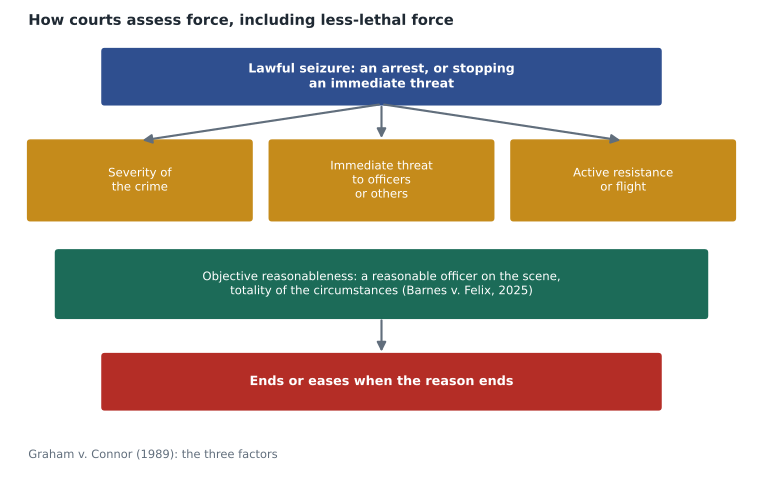
In the United States, the Fourth Amendment governs the force police use in making an arrest or other seizure, and it applies to less-lethal weapons exactly as it applies to other force. In Graham v. Connor in 1989, the Supreme Court held that force is judged by objective reasonableness: whether the officer's actions were objectively reasonable in light of the facts and circumstances, judged from the perspective of a reasonable officer on the scene and without regard to the officer's underlying intent. The Court highlighted three factors: the severity of the crime, whether the suspect poses an immediate threat to the safety of officers or others, and whether the suspect is actively resisting or attempting to evade arrest by flight. In Barnes v. Felix in 2025, the Court held that the totality of the circumstances, including events earlier in the encounter, must be considered, not just the moment the threat arose.
Most federal cases about less-lethal weapons are civil lawsuits under section 1983 of the federal civil rights law, in which a person claims that force violated the Fourth Amendment. In these cases, officers often raise qualified immunity, a defense that protects officers from personal liability unless they violated a constitutional right that was clearly established at the time. Ohio applies the federal constitutional standard to police force, and the state's voluntary certification standards require agencies to have written policies limiting force to what is objectively reasonable.
How courts see less-lethal weapons
Courts in both countries have rejected the idea that less-lethal weapons are minor force. In Bryan v. MacPherson, decided in 2009 and amended in 2010, the Ninth Circuit held that a conducted energy weapon used in probe mode is an intermediate, significant level of force that must be justified by the government's interest. It found that using one without warning on an unarmed, agitated man who was standing about twenty feet away during a seatbelt stop was excessive, although the officer received qualified immunity because the rule was not clearly established at the time. In Estate of Armstrong v. Village of Pinehurst in 2016, the Fourth Circuit held that officers who used a conducted energy weapon five times in drive-stun mode over about two minutes on a man with mental illness who had wrapped himself around a signpost used excessive force. The court said that physical resistance is not the same as a risk of immediate danger, and that these weapons are proportional only in response to an immediate danger. The officers received qualified immunity, but the court warned that the rule was now clearly established in that circuit.
The lesson from these cases is the same in both countries: a less-lethal weapon is not justified merely because a person is refusing to do what they are told. It is justified when the person presents a real threat of harm that cannot reasonably be managed with less force. Many U.S. agency policies, shaped by the 2011 guidelines from the Police Executive Research Forum and the U.S. Department of Justice's COPS Office, allow conducted energy weapons only against people who are actively aggressive or actively resisting in a way likely to cause injury, and not against people who are passive.
Applying the law to Bayview Avenue
Desjardins walks the class through Ruiz's decision. First, a lawful purpose: Ostrowski was about to commit an assault with a weapon on Hana Bekele, and stopping him was a lawful purpose , as well as a step toward a lawful arrest. Second, necessity: the officers had spent seven minutes asking him to put the bottle down. He was too far away to reach by hand before he could reach Bekele, and any attempt to grab him would have brought officers within reach of the broken glass. Third, proportionality: a person armed with a broken bottle and moving toward someone presents a threat of serious injury. A single cycle from a conducted energy weapon was proportionate to that threat, and was far less than the lethal force that a knife-like weapon might have justified in some circumstances. Fourth, the force ended when the reason ended: Ostrowski fell, dropped the bottle and was handcuffed during the cycle, and Ruiz did not activate the weapon again.
The class debates one point. Amara Okafor asks whether the officers could have done more to keep Bekele away, for example by asking her to go back inside the laundromat earlier. Haddad agrees that it is a fair question, and says it is exactly the kind of earlier decision that courts now look at , because Barnes v. Felix requires the totality of the circumstances. 'Bekele came out of a side door they could not see,' she says. 'But in the review, we added a point about assigning one officer to watch for bystanders. That comes up in lesson 12.'
| Conduct | Options allowed |
|---|---|
| Cooperative | Presence, communication |
| Passive resistance | Presence, communication, physical control |
| Active resistance | Presence, communication, physical control |
| Assaultive | Up to an intermediate weapon |
| Serious harm or death | Up to lethal force |
| Case | Conduct | Option used | Result |
|---|---|---|---|
| Ostrowski, about 4 m from Bekele with a broken bottle | Assaultive | Intermediate weapon | Within policy |
| Man wrapped around a signpost, refusing to let go | Passive resistance | Intermediate weapon | Not within policy |
| Woman refusing to leave a car, not threatening | Passive resistance | Physical control | Within policy |
The second case shows why a model like this is useful in training. A man holding onto a signpost and refusing to let go is frustrating, and a conducted energy weapon would end the standoff quickly, but his conduct is passive resistance. The model points the officer back to the options that fit: more time, more officers, communication and, if an arrest is necessary, physical control. Using an intermediate weapon to save time is exactly the pattern that courts and reviews have criticized.
The example is deliberately simple. Real policies describe behavior more carefully, and every decision depends on all the circumstances, including the officer's size and training, the number of officers, the environment and the person's condition. But the logic is the one courts use: the force option must match the threat. A person who is only passively resisting is not a reason to use a conducted energy weapon, however frustrating the situation is.
Criminal, civil and disciplinary consequences
An officer who uses a less-lethal weapon unlawfully can face three kinds of consequences. Criminal charges are possible when the force is clearly excessive, such as assault or civil rights offenses under federal law. Civil lawsuits can be brought against the officer and the employer for injuries. And discipline under the agency's policies and any collective agreement can lead to penalties up to dismissal. In serious cases, more than one of these can follow the same incident.
For officers, the practical protection is the same as the legal test. Know the purpose, use force only when lesser options will not reasonably work, match the force to the threat, stop when the threat ends, and write it all down accurately and promptly. Haddad tells the class that the officers she has seen get into trouble with less-lethal weapons almost never got there because of one bad second. 'They got there because they used the weapon to make someone comply, rather than to stop a real threat, and then they wrote a report that did not match the video.'
| Question | Bayview Avenue answer |
|---|---|
| What was the purpose? | Stop an imminent assault with a broken bottle on Hana Bekele |
| Were lesser options tried or not reasonably available? | Seven minutes of talking; too far to reach safely by hand |
| Was the force proportionate? | One cycle against an armed person advancing on a bystander |
| Did it end when the reason ended? | No further activation after he dropped the bottle and was handcuffed |
| Was it reported accurately? | Report written the same night; matched the weapon log and video |
The officer who did not use the weapon
Desjardins asks the class to look at the Bayview Avenue video from Coutu's camera rather than Ruiz's. Coutu also carried a conducted energy weapon that night, and she never drew it. She explains that the two officers had agreed in the first minute who would do what: she would talk, and Ruiz would cover and decide on any weapon. 'If both of us had our weapons out, pointed at a frightened man, he would have been more frightened,' she says. 'And if both of us had fired, we would have doubled the exposure for no reason. One voice, one weapon ready, one plan.'
Haddad adds that the law looks at each officer's force separately. If Coutu had also used her weapon at the same moment, she would have had to justify that second use on its own, and most policies would have made it very difficult to do so. A second simultaneous use would have been judged under Graham v. Connor like any other force, and the 2011 national guidelines advise against more than one officer activating a weapon on the same person at the same time.
Force used to protect someone else
The Bayview Avenue decision was about protecting a third person, Hana Bekele, rather than the officers themselves. Courts in both countries recognize that preventing serious harm to a member of the public is one of the strongest reasons for police force. The same questions still apply: was the threat to the third person real and imminent, would a lesser option have protected them in time, and did the force stop when the threat stopped? Desjardins points out that it would have been a very different case if Bekele had been safely inside the laundromat behind a locked door. 'The threat is what makes the force reasonable,' he says. 'Take away the threat, and the same five seconds becomes excessive.'
Worked problem
Refusing to get out of a car
During a traffic stop, a driver refuses to get out of his car after being told he is under arrest for driving while suspended. He keeps both hands on the steering wheel and says he will not move. He is not threatening anyone. An officer suggests using a conducted energy weapon to make him get out. Would that be justified?
Show solution
- Purpose: arresting him is lawful.
- Behavior: holding the steering wheel and refusing is passive resistance; there is no threat of harm.
- Case law and policy: courts have found these weapons excessive against people who are passive or not presenting an immediate danger.
- Alternatives: time, talking, more officers, a supervisor and physical control are all available.
Answer: Using a conducted energy weapon would very likely be excessive and outside policy. The officers should slow down, keep talking, call a supervisor and use the lowest level of force needed if physical removal becomes necessary.
Common mistakes
MistakeA less-lethal weapon may be used whenever a person refuses to comply.
InsteadA less-lethal weapon is justified only when the person presents a real threat of harm that cannot reasonably be managed with less force.
MistakeThe law has a separate test for each weapon.
InsteadThe same law of force applies to every weapon; the weapon is part of the proportionality or reasonableness question.
MistakeIf force was justified at the start, every later activation is justified.
InsteadEach use or activation must be justified on its own, and force must end when the reason ends.
MistakeQualified immunity means the force was lawful.
InsteadQualified immunity protects officers from personal liability when the law was not clearly established; it does not mean the force was reasonable.
Summary and key terms
- Graham v. Connor and Barnes v. Felix govern less-lethal force like any other force.
- Force must have a lawful purpose and be necessary, proportionate and reasonable, and it must end when the reason ends.
- Bryan v. MacPherson and Estate of Armstrong v. Village of Pinehurst treat conducted energy weapons as significant force, not justified by mere non-compliance.
- Passive resistance is not, on its own, a reason to use a less-lethal weapon.
- Unlawful force can lead to criminal, civil and disciplinary consequences.
- Accurate, prompt reports that match the video and weapon data are part of lawful use.
- Qualified immunity
- A defense protecting officers from personal liability unless they violated a clearly established constitutional right.
- Section 1983
- The federal civil rights law under which people sue for constitutional violations by officers.
- Proportionality
- Matching the type and amount of force to the threat and resistance.
- Passive resistance
- Refusing to cooperate without threatening or attempting to harm anyone.
Practice problems
Work each problem on paper first, then reveal the answer to check.
What four questions did Haddad and Desjardins apply to Ruiz's decision?
Show answer
Lawful purpose, necessity, proportionality, and whether the force ended when the reason ended.
What did the Fourth Circuit say in Armstrong about physical resistance?
Show answer
Physical resistance is not the same as a risk of immediate danger.
Why was the driver holding the steering wheel not a reason to use a conducted energy weapon?
Show answer
He was passively resisting and presented no threat of harm.
What three kinds of consequences can follow unlawful use of a less-lethal weapon?
Show answer
Criminal charges, civil lawsuits and discipline.
Lesson quiz · 5 questions
Score 60% or more to complete this lesson.
Create a free account to save your progress, take quizzes and earn a certificate.