
LES-217 · Lesson 3 of 12 · 20 min
Use-of-force models and where less-lethal options fit
▶ Video coming soon A video version of this lesson is on the way.
Jesse Morningstar arrives at the third class with a question from his weekend shift as a security guard at the Harbor Mall. A guard there had asked him where pepper spray fit 'on the ladder' of force. 'I didn't know what to say,' he tells the class. 'Is there a ladder? Do police climb it one step at a time?'
Haddad smiles. 'That is exactly the picture we are trying to get rid of,' she says. 'For years, police training showed force as a staircase, and officers were taught that they climbed it one step at a time. Real situations do not work that way. A person can go from talking calmly to swinging a bottle in two seconds, and back again. Modern models are designed to help officers think, not to tell them which step comes next.'
From staircases to circles
Early use-of-force models, developed from the 1970s onward, often looked like a staircase or a ladder, with officer presence at the bottom, then verbal commands, then soft physical control, then hard physical control, then intermediate weapons, then lethal force. These linear models were simple to teach, but they had two problems. They suggested that officers had to try every lower step before moving up, which is not what the law requires, and they suggested that officers should keep climbing until the person complied, rather than coming back down when the threat eased.
In the United States, there is no single national model. Many agencies once used linear force continuums, and some still do, but many have moved to decision-making models that emphasize continuous assessment. The Police Executive Research Forum's Critical Decision-Making Model, part of its training guide called Integrating Communications, Assessment and Tactics, has the core values of ethics and the sanctity of life at its center, surrounded by five steps: collect information, assess the situation, threats and risks, consider police powers and agency policy, identify options and determine the best course of action, and act, review and re-assess. Agencies combine a model like this with written policies that describe the types of resistance and the force options allowed in response.
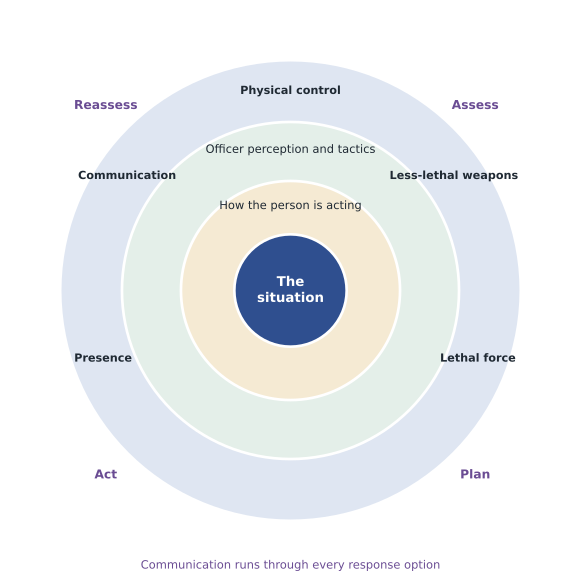
Where less-lethal weapons fit
In these models, less-lethal weapons sit in the intermediate band, between physical control and lethal force. They are typically associated with assaultive behavior, or with active resistance that is likely to cause injury, and some policies allow particular weapons, such as OC spray, at slightly lower levels than others. But a model is not a lookup table. It does not say that a particular behavior always justifies a particular weapon. It helps the officer explain how they perceived the situation and why they chose a response, and it reminds them that the response must change when the situation changes.
Courts do not judge force by whether an officer followed a model. They apply the Fourth Amendment standard from Graham v. Connor. But agency policies based on these models are often stricter than the constitutional minimum, and an officer who violates policy can be disciplined even if the force was constitutional.
Haddad adds a point she makes in every requalification. 'The models put communication around everything. You talk before, during and after. When Ruiz used his conducted energy weapon on Ostrowski, Coutu was still talking to him: drop it, stay down, you're okay, we're getting you help. That is in the model, and it is in the video, and it matters.'
Perception and tactical considerations
The middle ring of the circular models, the officer's perception and tactical considerations, is where much of the real decision happens. Two officers facing the same person may reasonably perceive the situation differently because of their size, training, experience, injuries or fatigue, and the models and the law both allow for that. Tactical considerations include the number of officers present, whether backup is coming, the distance between the officer and the person, whether there is cover or an obstacle between them, the environment, such as traffic, water, stairs or a crowd, and the time available.
For less-lethal weapons, the environment is especially important. A conducted energy weapon that causes a person to fall can be far more dangerous on a staircase, beside a road, near water or on a balcony than on a grassy field. OC spray in a crowded indoor space can affect bystanders and officers. A baton is useless and dangerous in a narrow space where an officer cannot keep distance. Haddad tells the class that the decision not to use a weapon because of the environment is one of the most important decisions an officer makes, and one of the least visible.
| Tactical consideration | Why it matters for less-lethal options |
|---|---|
| Distance | More distance gives more time and more options; some weapons work only within certain ranges |
| Number of officers | One officer may need a weapon where three could use physical control or simply wait |
| Environment | Falls, traffic, water, stairs and bystanders change the risk of every option |
| Person's condition | Age, frailty, pregnancy, intoxication and illness raise medical risk |
| Time | If there is no immediate threat, waiting is usually the safest option |
Behavior categories in practice
The class practices placing behavior into categories using the 2026 incidents. Walter Haines at Maple Court was holding a knife, but he was in his own room, standing still, and talking to his care aide through the doorway. His behavior was concerning, and officers kept their distance, but he was not attacking anyone. Shawn Petrie outside the Dockside Social was punching a man who was on the ground, which is assaultive behavior against a third party. Ostrowski at the laundromat moved from shouting and waving the bottle, which officers managed by talking and keeping their distance, to stepping toward a bystander with the bottle raised, which was assaultive behavior with a weapon that could cause serious injury.
The man at the October 1 call behind Market Street, Derek Fane, was swinging a metal pipe at a parked car. That was damage to property, and he was armed with an object that could kill. But he was not moving toward anyone, and Malhotra was about eight meters away behind the corner of a building. Malhotra drew his baton and held it at his side while talking, which is a display of a weapon rather than a use of it. After about ninety seconds, Fane dropped the pipe. 'Placing a person in a category is the first step,' Desjardins says. 'The second step is noticing when they move to a different one, and moving with them.'
| Minutes from arrival | Conduct | Officer response | Policy limit | Above limit? |
|---|---|---|---|---|
| 0.0 | Active resistance | Communication | Physical control | No |
| 3.5 | Active resistance | Communication | Physical control | No |
| 7.1 | Assaultive | Intermediate weapon | Intermediate weapon | No |
| 7.3 | Passive resistance | Physical control | Physical control | No |
| 9.0 | Cooperative | Communication | Communication | No |
Reading down the response column shows what reviewers call a proportionate curve: the force rises only when the conduct rises, and falls as soon as the conduct falls. The two tenths of a minute between 7.1 and 7.3 matter as much as anything else in the table, because they show that the officers stopped using the weapon and moved to physical control within seconds of Ostrowski going down. If the response had stayed at an intermediate weapon after the conduct dropped to passive resistance, the line at 7.3 minutes would have been above the limit.
The timeline is a simplified version of the Bayview Avenue incident. It shows the officers communicating for the first seven minutes, using an intermediate weapon only when the behavior became assaultive, and coming back down to physical control and then communication as soon as Ostrowski stopped resisting. If the last line had shown the officers still using the weapon after he was cooperative, the check would have flagged it.
Choosing not to use a weapon
Use-of-force models describe the options an officer may use. They do not require the officer to use them. In many situations the best choice is to create distance, wait for more officers, bring in a mental health worker, a negotiator or a supervisor, or simply leave a person alone in a safe place until they calm down. Many U.S. policies now list tactical repositioning and disengagement as options and require officers to use de-escalation when it is safe and feasible. The next lesson covers those choices in detail.
Haddad finishes with Jesse's original question. 'So, is there a ladder? No. There is a situation, a person whose behavior can change at any moment, an officer who keeps assessing, and a set of options, of which the weapon on your belt is one of the last and least likely to be the right one. Tell your security guard friend that.'
Why the models keep changing
Use-of-force models are revised regularly as research, court decisions and inquiries change what is considered good practice. In the United States, the deaths of people in police custody, including the killing of George Floyd in Minneapolis in 2020, led many states and agencies to rewrite their use-of-force policies, adding duties to intervene, requirements to de-escalate where feasible, bans or limits on neck restraints and stricter rules for less-lethal weapons. Haddad tells the class that the models they learn now will probably change again before they retire. 'What will not change,' she says, 'is the idea that you keep assessing and that your response has to fit what is in front of you.'
She also warns against treating a model as a script to recite in a report. 'I read reports that say the subject was assaultive, therefore an intermediate weapon was justified, as if that settles it. It doesn't. Tell me what he did, how far away he was, what he had in his hand, what you tried, and why the weapon was the right choice. The model is a way of organizing your thinking. The facts are what justify the force.'
| Model language | What the report should say instead |
|---|---|
| Subject was assaultive | He stepped toward Hana Bekele with the broken bottle raised to shoulder height, about four meters from her |
| Verbal commands were ineffective | For about seven minutes Coutu asked him to put the bottle down; he shouted and kept hold of it |
| Intermediate weapon was deployed | Ruiz gave a warning and used his conducted energy weapon for one five-second cycle |
| Subject was controlled | He fell, dropped the bottle, was handcuffed and was sat up within about thirty seconds |
Marco asks whether officers ever get it wrong in the other direction, by waiting too long. Haddad says they do, and that the models and the law protect officers who act when a real threat requires it. 'The point is not to be slow,' she says. 'The point is to fit the response to what is actually happening, and to change it the moment that changes.'
Worked problem
Placing a response in the model
A woman at a bus shelter is shouting at passers-by and refuses to leave when an officer asks. She is not threatening anyone. When the officer reaches for her arm, she pulls away and walks off. A second officer suggests using OC spray to stop her leaving. Using a circular model, how should the officers think about this?
Show solution
- Situation: a public disturbance with no one in danger.
- Behavior: refusing and pulling away is passive or active resistance, not assaultive behavior.
- Perception and tactics: two officers, open space, no weapon, no immediate threat.
- Response options: communication, time and, if an arrest is lawful and necessary, physical control; an intermediate weapon is not proportionate.
Answer: OC spray would not fit the behavior. The officers should keep talking, consider whether an arrest is needed at all, and if it is, use physical control or let her walk away and follow up later.
Common mistakes
MistakeOfficers must try every lower level of force before moving to a higher one.
InsteadOfficers may move directly to the option that fits the situation, and must move back down when the situation eases.
MistakeA use-of-force model justifies force.
InsteadThe model explains the officer's reasoning; the Fourth Amendment decides whether force was constitutional, and policy may be stricter.
MistakeA behavior category always calls for a specific weapon.
InsteadModels are not lookup tables; all the circumstances matter, including the environment and the person's condition.
MistakeDrawing a weapon is the same as using it.
InsteadDisplaying a weapon is different from using it, but it should still be justified and is often reportable under policy.
Summary and key terms
- Linear force staircases have largely been replaced by circular or decision-making models.
- PERF's Critical Decision-Making Model places ethics and the sanctity of life at the center, surrounded by five decision steps.
- Less-lethal weapons sit in the intermediate band, typically for assaultive behavior or active resistance likely to cause injury.
- Tactical considerations such as distance, environment, number of officers and the person's condition shape the choice.
- Communication runs through every response option.
- Choosing not to use a weapon, by creating distance or waiting, is often the best option.
- Critical Decision-Making Model
- PERF's five-step model with ethics and the sanctity of life at its center.
- Use-of-force model
- A diagram that helps officers assess a situation and explain their choice of response.
- Tactical repositioning
- Moving to a safer position, such as behind cover or further away, to gain time and options.
- Display of a weapon
- Showing a weapon without using it, which may still be reportable.
Practice problems
Work each problem on paper first, then reveal the answer to check.
What were the two main problems with linear force staircases?
Show answer
They suggested officers had to try every lower step first, and they suggested climbing until compliance rather than coming back down.
Why did Malhotra drawing his baton not count as using it?
Show answer
He displayed it at his side while talking and never struck Fane.
Name three tactical considerations that affect less-lethal options.
Show answer
Any three of distance, number of officers, environment, the person's condition and time.
Does following a model make force lawful?
Show answer
No; the Fourth Amendment still decides, and policy may be stricter.
Lesson quiz · 5 questions
Score 60% or more to complete this lesson.
Create a free account to save your progress, take quizzes and earn a certificate.