
LES-217 · Lesson 1 of 12 · 20 min
Less-lethal options: purpose, terms and limits
▶ Video coming soon A video version of this lesson is on the way.
Sergeant Lisa Haddad opens the course by putting four objects on the table at the front of the classroom: a yellow conducted energy weapon with its cartridge removed, a small canister of oleoresin capsicum spray marked INERT in red, a collapsed expandable baton, and a body-worn camera. She asks the students which of the four has prevented the most injuries in Port Ardent over the past year. Priya Sandhu points to the conducted energy weapon. Marco DiSanto picks the baton. Jesse Morningstar, after a long pause, points to the camera.
'Closer,' Haddad says, 'but the honest answer is none of them. What prevents most injuries is an officer who talks, waits, gets help and keeps their distance. These tools matter, and you will learn the law and policy that govern every one of them. But if you leave this course thinking of them as solutions, I have failed. They are options of last resort among the options that do not involve a firearm, and every one of them can injure or kill someone in the wrong circumstances.'
This course follows several incidents from 2026 in Port Ardent, the fictional city used throughout the program. Professor Ray Desjardins teaches it with Haddad, who supervises B platoon and has taught the service's annual use-of-force requalification for eleven years. Paramedic Joan Ivey, whom students met in the arrest course, joins several classes to talk about what happens after a weapon is used. The course is about law, policy, medical risk and accountability. It does not teach anyone how to use these weapons. That training happens only in a supervised, certified setting with qualified instructors, and only for officers who are authorized to carry them.
What less-lethal means
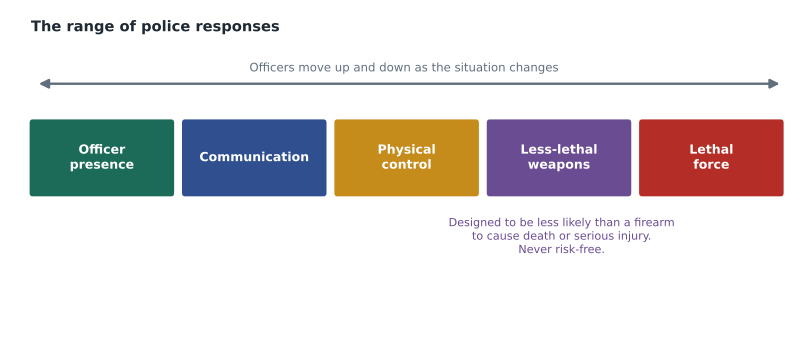
Police use several terms for weapons that are not firearms and are not intended to cause death: non-lethal, less-lethal, less-than-lethal, intermediate weapons and intermediate force options. The choice of word matters. 'Non-lethal' suggests a weapon that cannot kill, and no such weapon exists. People have died after being struck with batons, sprayed with OC, exposed to conducted energy weapons and hit by impact munitions, usually when the weapon was combined with other factors such as drug intoxication, heart disease, a fall, prolonged restraint or a struggle. 'Less-lethal' is now the more common term in police training and research because it is more honest: these weapons are designed and expected to be less likely to cause death or serious injury than a firearm, not to be harmless.
In the United States, many agency policies group these weapons as less-lethal or intermediate force options, which sit between hands-on control and deadly force. The phrase signals that the weapon is used when physical control alone is not enough or is not safe, and when deadly force is not justified. Whatever the word, the law treats the use of any of these weapons as a use of force that must be justified, reported and reviewed.
Why police carry less-lethal weapons
The basic argument for less-lethal weapons is that they give officers a way to stop a dangerous person without the high risk of death that comes with a firearm, and without the close-quarters struggle that injures both officers and the people they are arresting. A person holding a knife ten meters away cannot be safely restrained by hand, and in some situations a conducted energy weapon or another less-lethal option is the only way to end the threat without shooting. Research on police use of force in several countries has found that when agencies introduced conducted energy weapons or OC spray and governed them well, injuries to officers and to the people they arrested often fell, mainly because fewer encounters ended in prolonged physical struggles.
The arguments against are just as important. Less-lethal weapons can be used too early, against people who are not a real threat, simply because they are available and seem safe. Researchers sometimes call this lowering the threshold: an officer who would never have used a baton against a person who refused to get out of a car might use a conducted energy weapon, because it feels less violent. Human rights organizations and inquiries in both countries have documented cases where these weapons were used as tools of pain compliance against people who were passive, restrained or in mental health crisis. And people with certain medical conditions, people who are intoxicated or exhausted, and people who fall from a height or onto a hard surface can be seriously hurt or killed even when the weapon works as designed.
Desjardins writes two sentences on the board. 'A less-lethal weapon is justified only when force is justified. The fact that a weapon is less lethal does not make it less of a use of force.' He tells the class that almost every inquiry, court decision and oversight report they will read in this course comes back to those two ideas.
The four main categories
This course covers four categories of less-lethal weapons. The first is the conducted energy weapon, often called by a brand name. It uses electrical current to interfere with a person's muscle control or to cause pain. The second is aerosol irritant spray, almost always oleoresin capsicum, the active ingredient in hot peppers, which causes intense burning of the eyes, skin and airways. The third is the impact weapon held in the hand, mainly the baton. The fourth is the impact munition: a projectile fired from a launcher, such as a sponge-tipped round or a bean bag round, designed to strike a person from a distance without penetrating the body.
| Category | How it works in general terms | Main risks discussed in this course |
|---|---|---|
| Conducted energy weapon | Electrical current interferes with muscle control or causes pain | Falls, secondary injuries, risk to vulnerable people, repeated or long exposure |
| OC spray | Irritant causes burning of eyes, skin and airways | Breathing problems, cross-contamination, people with asthma, positional asphyxia afterwards |
| Baton and impact tools | Blunt force from a hand-held tool | Fractures, head injuries, serious injury if used against the head or neck |
| Impact munitions | Projectile strikes from a distance | Serious injury or death, especially from strikes to the head, neck or chest |
Each category has its own legal and policy rules, its own medical risks and its own aftercare. Each also has its own history of controversy, which has shaped the rules officers follow today. The lessons that follow take each category in turn, after first setting out the law of force, the use-of-force models that place these weapons in context, and the de-escalation skills that should come first.
Who may carry these weapons
In the United States, state and local laws on civilian possession of stun guns, conducted energy weapons and pepper spray vary widely, and many states allow adults to carry pepper spray for self-defense. For police, the rules come mainly from agency policy, state training standards and the Constitution. In Ohio, the Ohio Peace Officer Training Commission sets basic academy training standards, and the state's voluntary certification standards for agencies, developed by the Ohio Collaborative Community-Police Advisory Board, require written use-of-force policies. Each agency decides which officers may carry which less-lethal weapons and sets its own qualification and requalification requirements, usually based on manufacturer training and national guidance.
In Port Ardent, every front-line officer carries OC spray and a baton after completing recruit training. Conducted energy weapons are issued to officers who have completed a separate certification course and who requalify every year. Haddad runs those requalifications. 'If an officer misses requalification, the weapon comes off their belt the same day,' she says. 'No exceptions. The legal protection for carrying it depends on being trained and authorized to carry it.'
| Officer | Last requalified | Days since | Status |
|---|---|---|---|
| Coutu | September 4, 2025 | 166 | Current |
| Ruiz | November 20, 2025 | 89 | Current |
| Okeke | January 30, 2025 | 383 | Not current: weapon must be withdrawn |
| Malhotra | June 12, 2025 | 250 | Current |
Okeke's requalification lapsed on January 30, 2026, eighteen days before the shift, so 365 + 18 = 383 days have passed. A supervisor reading the roster should catch this before the shift starts, not after the weapon has been used.
The example uses a simple twelve-month rule. Real policies may count to the end of a month, allow a short grace period or require more frequent training, and officers should know the rule that applies to them. What matters for this course is the principle: authority to carry a less-lethal weapon depends on current training, and supervisors must check it.
The incidents in this course
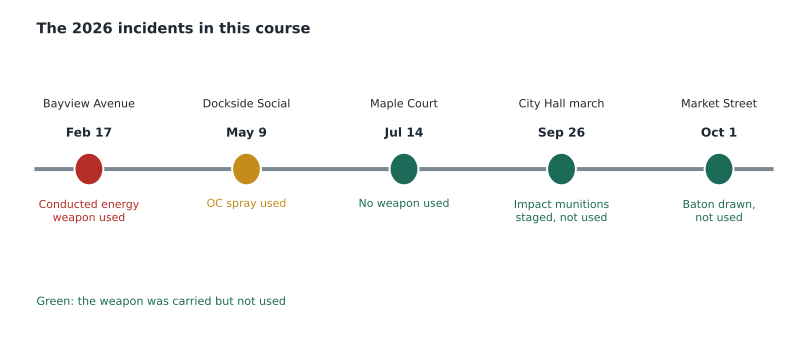
Haddad introduces the incidents the class will study. On Tuesday, February 17, 2026, at about 19:40, Officers Nadine Coutu and Tomas Ruiz were sent to the parking lot of a laundromat on Bayview Avenue, where a man was shouting and waving a broken bottle. The man, Tyler Ostrowski, was 29 and appeared to be in a crisis brought on by stimulant drugs. The officers spoke with him for about seven minutes. When he moved toward a woman leaving the laundromat with the bottle raised, Ruiz used his conducted energy weapon. Ostrowski fell, broke his wrist, was handcuffed and was taken to hospital. That incident runs through most of the course and is the subject of the capstone review in lesson 12.
On Saturday, May 9, Probationary Officer Sofia Reyes used OC spray to stop a man named Shawn Petrie from punching another man who was on the ground outside the Dockside Social, a bar on Front Street. On Tuesday, July 14, Reyes and Officer Femi Okeke spent twenty-two minutes with Walter Haines, an 84-year-old man with dementia who was holding a kitchen knife in his room at the Maple Court seniors' residence, and resolved the call without using any weapon at all. On Thursday, October 1, Officer Dev Malhotra drew his baton but did not use it when a man swinging a metal pipe at a parked car finally put the pipe down. And at the September 26 demonstration outside City Hall, which students studied in the emergency management course, the public order unit was on standby with impact munitions that were never deployed.
'Look at the pattern,' Desjardins says. 'Five incidents, and in three of them, the weapon was never used. That is not luck. Good officers spend most of their careers carrying these tools and almost never using them, and the times they choose not to use them are as important as the times they do.'
No weapon is risk-free
Joan Ivey, the paramedic, speaks for a few minutes at the end of the first class. She has been to dozens of calls where a less-lethal weapon was used. 'Most of the time, the person is sore, scared and angry, and they recover within an hour,' she says. 'But I have also seen broken wrists and cheekbones from falls, eye injuries, a man who stopped breathing on the ground after a long struggle, and a woman with asthma who could not breathe after being sprayed. The weapon is only one part of what happens. The fall, the drugs, the heart condition nobody knew about, the restraint afterwards, how quickly someone calls us: those decide whether the person goes home or goes to the morgue.'
She leaves the class with three questions she wants every officer to ask after any use of a less-lethal weapon: Is this person breathing normally and getting better, not worse? What else could have hurt them, such as a fall, a struggle or drugs? And who is watching them now? The course returns to those questions in lesson 10.
Worked problem
Choosing the right word in a report
An officer's draft report says: 'I deployed my non-lethal weapon on the subject, which caused no harm, and he was then taken into custody.' What is wrong with this sentence, and how should it be rewritten?
Show solution
- 'Non-lethal' is inaccurate; no weapon is free of the risk of death or serious injury.
- 'Caused no harm' is a conclusion the officer may not be able to support; the person should be assessed and any injuries described.
- 'Deployed my weapon' does not say which weapon, how it was used or for how long.
- 'The subject' is vague; reports should name the person.
Answer: A better version: 'I used my conducted energy weapon on Tyler Ostrowski for one five-second cycle. He fell to the asphalt and was handcuffed. I saw no injury at the time, but he said his left wrist hurt, and paramedics assessed him at the scene.'
Common mistakes
MistakeLess-lethal weapons are non-lethal.
InsteadLess-lethal weapons are designed to be less likely to kill than a firearm, but people have died after their use.
MistakeIf a weapon is less lethal, using it is not really a use of force.
InsteadEvery use of a less-lethal weapon is a use of force that must be justified, reported and reviewed.
MistakeCarrying a weapon means being expected to use it.
InsteadMost officers carry these weapons for years and rarely use them; choosing not to use them is often the right decision.
MistakeAnyone trained once may carry the weapon indefinitely.
InsteadAuthority to carry depends on current training and regular requalification.
Summary and key terms
- Less-lethal weapons are designed to be less likely than a firearm to cause death or serious injury, but none is risk-free.
- The four categories in this course are conducted energy weapons, OC spray, batons and impact munitions.
- A less-lethal weapon is justified only when force is justified, and its use must be reported and reviewed.
- In the United States, agency policy, state training standards and the Constitution govern police use of less-lethal weapons.
- Authority to carry depends on current training and requalification.
- Many encounters end without the weapon being used, and that is often the best outcome.
- Intermediate force option
- A term many agencies use for less-lethal weapons that sit between physical control and deadly force.
- Less-lethal weapon
- A weapon designed to be less likely than a firearm to cause death or serious injury, though not risk-free.
- Conducted energy weapon
- A weapon that uses electrical current to interfere with muscle control or cause pain.
- OC spray
- Oleoresin capsicum spray, an irritant made from hot peppers.
- Impact munition
- A projectile fired from a launcher and designed to strike without penetrating.
Practice problems
Work each problem on paper first, then reveal the answer to check.
Why is 'less-lethal' a more accurate term than 'non-lethal'?
Show answer
Because people have died after these weapons were used; they are less likely to kill than a firearm, not harmless.
Name the four categories of less-lethal weapons in this course.
Show answer
Conducted energy weapons, OC spray, batons and impact tools, and impact munitions.
What does Desjardins mean by lowering the threshold?
Show answer
Using a less-lethal weapon in situations where no force, or less force, would otherwise have been used, because the weapon seems safe.
What three questions does Joan Ivey want officers to ask after any use of a less-lethal weapon?
Show answer
Is the person breathing normally and improving, what else could have hurt them, and who is watching them now?
Lesson quiz · 5 questions
Score 60% or more to complete this lesson.
Create a free account to save your progress, take quizzes and earn a certificate.