
LES-217 · Lesson 5 of 12 · 20 min
Conducted energy weapons: how they work and what research shows
▶ Video coming soon A video version of this lesson is on the way.
Sergeant Haddad brings a printout to class: the data download from Officer Ruiz's conducted energy weapon, taken by the service's weapons technician the morning after the Bayview Avenue incident. It is a short table. At 18:58 on February 17, at the start of the shift, the weapon recorded a function test. At 19:47:12, it recorded a trigger pull with a cartridge connected, and a cycle lasting five seconds. Nothing else was recorded until the weapon was taken out of service the next morning and sealed in an evidence bag.
'Every one of these weapons is a witness,' Haddad tells the class. 'It records when it was switched on, when the trigger was pulled, how long each cycle lasted and, on newer models, more than that. It cannot tell you whether the use was justified. But it can tell you whether the report is accurate, and that is where a lot of careers have ended.' The class will come back to weapon data in lesson 11. This lesson explains in general terms how these weapons work and what research has found about their effects.
How conducted energy weapons work
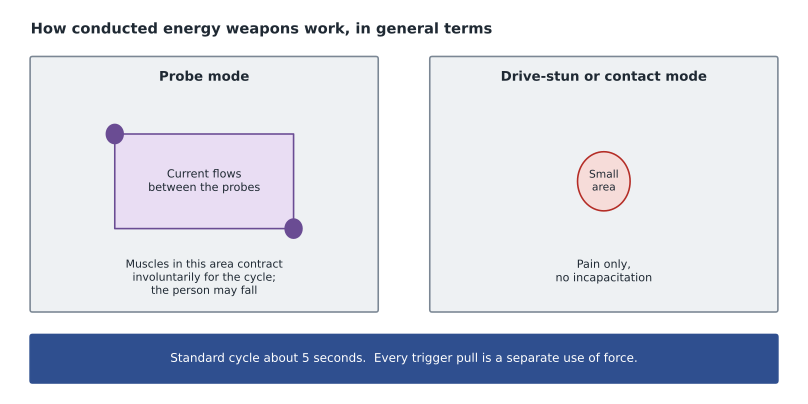
A conducted energy weapon delivers short pulses of electrical current. Police models generally work in two ways. In probe mode, the weapon fires two small probes attached to thin insulated wires. When both probes make contact with the person, the current flows between them through the body. The pulses are designed to stimulate the nerves that control muscles, causing the muscles between the probes to contract involuntarily. This is sometimes called neuromuscular incapacitation. If the probes are far enough apart, the effect can be strong enough that the person cannot control their movements for the length of the cycle and usually falls. The effect stops when the cycle ends, and most people can move normally again within seconds.
In what is called drive-stun or contact mode, the weapon is pressed directly against the person without probes, or with the probes too close together for a wide circuit. In that mode, the current affects only a small area and does not cause incapacitation. It causes intense pain. Because drive-stun is essentially a pain compliance tool, it has been the focus of some of the strongest criticism from courts and inquiries, and many policies now restrict or discourage it, as lesson 6 explains.
A standard cycle on most police models lasts about five seconds, and the officer can end it sooner or extend it by holding the trigger, depending on the model. Each pull of the trigger is a separate use of force that must be justified on its own. Most models also have a way to show a visible and audible electrical arc without firing probes, sometimes called a spark or arc display, which some policies treat as a warning that may lead the person to comply without the weapon being fired. Many U.S. agencies treat pointing the weapon or showing the arc as a reportable show of force.
This lesson describes how the weapons work only so that officers and students can understand their risks and the reasons for the rules. Using one safely requires a certified course, practical training under supervision, and regular requalification. Nothing in this course replaces that.
What research says about safety
Conducted energy weapons have been studied extensively since they came into wide police use in the early 2000s, and the research has produced a fairly consistent picture with important uncertainties. In 2011, the U.S. National Institute of Justice published a study of deaths following the use of these weapons, prepared by a panel of medical experts. It found no conclusive medical evidence that short-term exposure poses a high risk of serious injury or death to healthy adults who are not stressed or intoxicated, and estimated the risk of death in that group to be very low. The panel concluded that the weapons can be used safely when they follow accepted national guidelines and appropriate policy, and recommended that every death following their use be investigated by an independent forensic pathologist.
The same research, and much since, has identified people and circumstances where the risk is higher. People who are under the influence of stimulant drugs, who are already exhausted from a struggle or a long period of agitation, who have heart disease, or who are very young, elderly, frail or pregnant face greater risk. Long or repeated exposures increase risk, and national guidelines in the United States advise avoiding total exposure of more than fifteen seconds. Medical researchers have also published case reports suggesting a risk to the heart's rhythm when current passes close to the heart, and manufacturers' own warnings reflect this, which is one reason policies and training address the risk to the person's heart and breathing.
Investigations of deaths after these weapons were used have found that the person was often also affected by drugs, heart disease, a long struggle or prolonged restraint, which makes it difficult to say whether the weapon caused the death, contributed to it or was simply present. A Reuters investigation published in 2017 identified more than a thousand deaths in the United States since 2000 that followed the use of these weapons by police, and found that in about 150 of them, a coroner or medical examiner listed the weapon as a cause or contributing factor. Those findings, and lawsuits and coroners' reports, have shaped the guidelines and agency policies that officers follow today.
Secondary injuries
For most people, the most common serious injuries after a conducted energy weapon is used are not caused by the electricity at all. They are caused by falling. A person who loses muscle control cannot break their fall and may hit their head, face or wrist on the ground. Falls from height, down stairs or into traffic can be fatal. Other injuries include puncture wounds from the probes, which can become infected, and, rarely, eye injuries when a probe strikes the face. People have also been seriously burned when a weapon was used near flammable liquids or vapors, including gasoline and some aerosol sprays.
Tyler Ostrowski's broken wrist at Bayview Avenue was a secondary injury. He fell forward onto the asphalt and put out his left hand. He also had a probe lodged near his collarbone, which policy required an emergency physician to remove at hospital rather than an officer at the scene. Joan Ivey, who was the paramedic on that call, tells the class that a fall onto a hard surface is the risk she worries about most. 'Every time I hear a conducted energy weapon was used, my first question is: what did they land on?'
Effectiveness
Conducted energy weapons do not always work. A probe may miss, the probes may land too close together for a wide circuit, thick or loose clothing may stop a probe making contact, or a wire may break. Some people, particularly those who are highly agitated or intoxicated, may not be stopped even when the probes hit. Agency reviews in several cities have found that the weapons fail to stop the person in a substantial share of uses. This matters for two reasons. First, an officer who expects the weapon to end the situation may be in danger when it does not. Second, a weapon that does not work the first time creates pressure to use it again, which increases medical risk and can turn a justified first use into an unjustified series of uses.
Haddad tells the class that this is why the backup plan matters. At Bayview Avenue, Coutu stood a few meters to the side of Ruiz with her own weapon holstered and her hands free, ready to handcuff Ostrowski as soon as he went down, and Ruiz had already told her what he would do if the probes missed: step back behind the patrol car and keep talking. 'You never put all your trust in one tool,' she says. 'You plan for it failing.'
| Time | Event | Seconds | Counts as exposure? |
|---|---|---|---|
| 18:58:04 | Function test | 1 | No: a spark test at the start of the shift |
| 19:47:12 | Trigger with cartridge | 5 | Yes |
Only trigger events count toward exposure, so the total is one cycle of 5 seconds, well within the 15-second guideline. The function test is recorded so that the log can show the weapon was working when the shift began.
The log shows exactly what Ruiz's report said: one trigger pull, one five-second cycle. If the log had shown three trigger pulls and fifteen seconds, the report would have had to explain each of them, and the person would have needed hospital assessment under most policies. Desjardins points out that the log does not show whether the probes hit, how far apart they were, or what Ostrowski was doing. Those facts come from the officers, the video and the medical records.
Testing and maintenance
Because the output of a conducted energy weapon matters for safety, services test their weapons and keep records. Many U.S. agencies follow manufacturer guidance and national recommendations to test weapons periodically, keep them under an inventory system and withdraw any weapon involved in a death or serious injury for testing. Officers also carry out a function test at the start of every shift, which appears in the log, and must report any fault immediately.
After Bayview Avenue, Ruiz's weapon was withdrawn and tested, and was found to be working within the manufacturer's specifications. Because Ostrowski was seriously injured, the department's professional standards unit took the weapon, cartridge and probes as evidence for its review.
Training and certification
Officers in Port Ardent who carry conducted energy weapons first complete a multi-day certification course that combines classroom instruction on law, policy, medical risk and reporting with practical scenarios under the direct supervision of certified instructors. They must pass a written test and practical assessments, and they requalify every year. Much of the course time is spent on decisions rather than on the weapon itself: when not to use it, how to recognize vulnerable people, how to plan for failure, and how to give care afterwards. Haddad tells the class that the scenarios she remembers most from her own certification were the ones where the correct answer was to holster the weapon and keep talking.
In Ohio, agencies set their own certification and requalification requirements, usually based on the manufacturer's instructor program and national guidance, and keep records that are reviewed in accreditation and in lawsuits. A record of current training is one of the first documents any investigator asks for after a conducted energy weapon is used.
Desjardins adds one more point about research. Much of the early research on conducted energy weapons was funded by the manufacturer or carried out by researchers with ties to it, and critics have argued that this shaped the conclusions. Later independent studies, coroners' reviews and journalistic investigations have filled in much of the picture. 'Read the research the way a court would,' he says. 'Ask who did it, how many people it covered, whether those people looked like the people officers actually use these weapons on, and whether anyone else has found the same thing.'
Worked problem
Reading a log against a report
An officer's report says he used his conducted energy weapon once for five seconds. The weapon's log shows three trigger events within twenty seconds: five seconds, five seconds and four seconds. What should a supervisor do?
Show solution
- Recognize that the log shows three activations totaling 14 seconds, not one.
- Ask the officer to explain each activation and whether each was justified.
- Check the video and witness statements to see what the person was doing at each point.
- Make sure the person received medical assessment appropriate to the actual exposure.
- Document the discrepancy and refer it under policy; an inaccurate report is a serious matter on its own.
Answer: The supervisor should treat the difference as significant, review each activation separately and ensure the record is corrected and the discrepancy is examined.
Common mistakes
MistakeConducted energy weapons are harmless because the effect stops when the cycle ends.
InsteadMost people recover quickly, but falls, repeated exposures and vulnerable conditions can cause serious injury or death.
MistakeDrive-stun works the same way as probe mode.
InsteadDrive-stun causes pain without incapacitation and is restricted or discouraged in many policies.
MistakeIf the weapon does not work, use it again.
InsteadEach activation must be justified on its own; officers should plan for failure and consider other options.
MistakeThe weapon's log shows whether the use was justified.
InsteadThe log shows when and how long the weapon was activated; justification depends on the facts.
Summary and key terms
- Conducted energy weapons deliver electrical pulses; in probe mode they can cause brief involuntary muscle contraction and a fall.
- Drive-stun mode causes pain without incapacitation.
- Each trigger pull or cycle is a separate use of force, and US national guidelines advise avoiding total exposure over 15 seconds.
- Research finds low risk in healthy adults, but higher risk with drugs, exhaustion, heart disease, frailty, pregnancy and long or repeated exposure.
- Falls cause many of the most serious injuries.
- The weapons do not always work, so officers must plan for failure; weapons are tested and their logs checked against reports.
- Probe mode
- Firing two probes so that current flows between them through the body.
- Drive-stun mode
- Pressing the weapon against the person; causes pain without incapacitation.
- Neuromuscular incapacitation
- Involuntary muscle contraction that prevents a person from controlling their movements during a cycle.
- Cycle
- One period of current, usually about five seconds.
- Secondary injury
- An injury caused by a fall or other effect of the weapon rather than by the current itself.
Practice problems
Work each problem on paper first, then reveal the answer to check.
What is the difference between probe mode and drive-stun mode?
Show answer
Probe mode can cause brief loss of muscle control between the probes; drive-stun causes localized pain without incapacitation.
Which people face higher risk from conducted energy weapons?
Show answer
People on stimulant drugs, exhausted people, people with heart disease, and very young, elderly, frail or pregnant people.
What caused Ostrowski's broken wrist?
Show answer
Falling forward onto the asphalt, a secondary injury.
Why does it matter that these weapons do not always work?
Show answer
Because officers may be in danger if they rely on them, and failure creates pressure to use them again, increasing risk.
Lesson quiz · 5 questions
Score 60% or more to complete this lesson.
Create a free account to save your progress, take quizzes and earn a certificate.