
LES-211 · Lesson 10 of 12 · 19 min
Young people as victims: exploitation, online harms and crossover youth
▶ Video coming soon A video version of this lesson is on the way.
In October, during one of his counseling sessions with Anita Shah, Devon Hart said something that changed how Bell saw the robbery. An older man in the Lindell towers, about 21, had been giving Devon and two other boys money and vape cartridges for months, and had told them he would pay for phones 'no questions asked'. When Devon fell behind on what he owed him, the man said Devon would have to 'make it up'. Shah, who, like police, is a mandatory reporter of child abuse and neglect under Ohio law, contacted Bell and children services. Desjardins tells the class that this is a common pattern: the young person who offends is often also a young person who has been harmed, and youth officers must be able to see both at once.
Young people are the most victimized age group
Victimization surveys in both countries show that adolescents and young adults are victimized at higher rates than any older group, for violent offenses especially. Much of this victimization is by other young people: assaults at school, robberies of phones and shoes, bullying and harassment, sexual assaults by peers and dating partners. Much of it is never reported to police. Young people may fear retaliation, worry about getting into trouble themselves, distrust police, or not see what happened as a crime. Ben Arsenault almost did not report the robbery; the dog walker called 911. When young victims do come forward, the way officers respond affects whether they will ever do so again.
Desjardins draws on what students learned in the victimology course. Young victims benefit from the same trauma-informed approach as adults: safety first, a calm explanation of what will happen, choice where possible, and no blame. They also need things adults may not: a parent or other trusted adult, if they want one; an explanation pitched to their age; and attention to how the incident affects school, friendships and online life. Nadia Brooks helped Ben's school arrange a different route home for him and checked in with him twice in the months after the robbery.
Duty to report child abuse and neglect
Under Revised Code 2151.421, law enforcement officers, along with teachers, health care workers, social workers and many others, are mandatory reporters: if they know or have reasonable cause to suspect that a child under 18, or a person with a disability under 21, has suffered or faces a threat of abuse or neglect, they must immediately report it to the public children services agency or law enforcement. Failure to report is an offense. Many Ohio counties have child advocacy centers where police, children services, medical and mental health staff work together, so that a child is interviewed once, by trained people, rather than repeatedly. Bell reminds students that a young person in front of them as a suspect may be a child in need of protection, and that the two investigations must be kept separate in the officer's mind even when they involve the same people.
Crossover youth
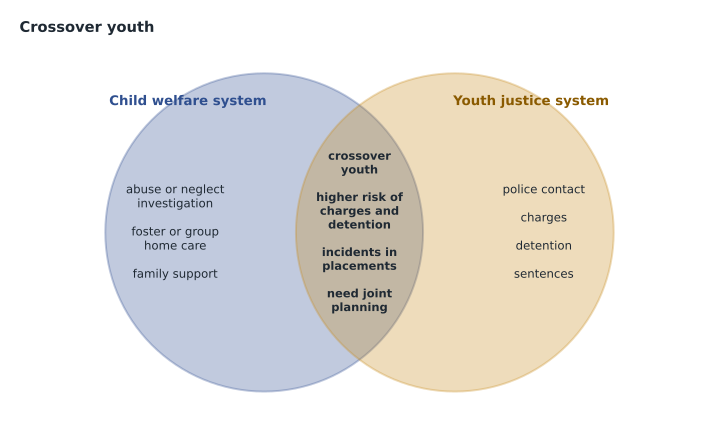
Researchers use the term crossover youth, or dual-status youth, for young people who are involved with both the child welfare system and the youth justice system. Studies in both countries have found that young people in care are much more likely than others to be charged, detained and placed in custody, and that some of that involvement arises from behavior in group homes, such as damaging property or assaulting staff, that would be handled by parents at home. A call from a group home about a teenager who has smashed a window may be a police matter, but it is also a sign that the placement is not working. Many jurisdictions, including several Ohio counties, have adopted crossover youth practice models that bring child welfare and juvenile justice agencies together to make joint decisions, avoid unnecessary detention and share information appropriately.
Bell gives the class a rule of thumb for calls from group homes and foster homes: before charging, ask what staff would have done if this were a teenager in their own family, and whether the home's own behavior management plan has been tried. Charge when the behavior is serious or someone has been hurt, not because a placement wants a young person removed. And always ask the young person, privately, whether they are safe where they live.
Exploitation by adults
Adults sometimes exploit young people to commit offenses for them, believing that youth will be treated more leniently. The pattern Devon described, with gifts, debts and then pressure to commit crimes to pay them off, is typical of what researchers call criminal exploitation. It is similar to the grooming process used in sexual exploitation. Signs that a young person may be exploited include new possessions or money they cannot explain, relationships with much older people, frequent unexplained absences, multiple phones, sudden changes in friends, and fear of a particular person. Officers should treat exploited young people as victims first, even when they have committed offenses, and focus enforcement on the adults. Ohio law treats adults who involve children in crime seriously, and Ohio's Safe Harbor provisions, enacted in 2012 in House Bill 262, allow a juvenile court to hold a delinquency complaint in abeyance when there is reason to believe a child charged with certain offenses is a victim of human trafficking and the offense relates to that victimization; the court must appoint a guardian ad litem, may order services, and must dismiss the complaint and expunge the records if the child completes the diversion.
Bell's investigation of the man Devon described, assisted by the major crime unit, led to charges against him in November for possessing stolen property and contributing to the unruliness or delinquency of children, an offense under Ohio law, among others. Devon's disclosure did not change his own disposition, which he had already received, but it changed his supervision plan: Shah arranged for Devon to move his counseling to a program for youth involved with older offenders, and Devon's grandmother asked for help moving to a different building. Desjardins tells students that Devon's case is a reminder that the most important question in a youth investigation is sometimes not 'who did this?' but 'who else is involved?'
Online harms
Much of young people's lives happen online, and so do many of the harms that bring them to police attention. Three kinds of cases are especially common in youth work. The first is cyberbullying and harassment: threats, humiliating posts and campaigns against a young person, which may amount to criminal harassment, uttering threats or other offenses when serious. The second is the non-consensual sharing of intimate images, which is an offense in Ohio and most states. The third, and fastest growing, is sextortion: an offender, often an adult posing as a young person and often outside the country, persuades a young person to send an intimate image and then threatens to share it unless the young person pays money or sends more images. The FBI and the National Center for Missing and Exploited Children report sharp increases in financial sextortion, which most often targets boys, and some victims have died by suicide.
Officers responding to sextortion should reassure the young person that they are the victim and that they are not in trouble, tell them not to pay or send anything more, preserve the evidence without forwarding the images, help them report the accounts to the platform and to the NCMEC CyberTipline, and connect them with support. Images of young people also raise a specific legal problem. Intimate images of anyone under 18 fall within child sexual abuse material laws, even when a young person took them of themselves. Prosecuting teenagers under child pornography laws for consensually sharing images with each other has been widely criticized, and Ohio's legislature has considered bills to create a separate, lesser response for minors. Port Ardent's policy, like many services', is that consensual image exchange between young people of similar age is dealt with by education, parents and the school, not charges, while coercion, distribution to others, threats and exploitation by adults are investigated as serious offenses.
# Screening a youth file for possible exploitation indicators (invented checklist).
indicators = {"unexplained money or goods": True, "relationship with much older person": True,
              "debt or 'owing' someone": True, "multiple phones": False,
              "frequent unexplained absences": True, "sudden change in friends": False}
present = [k for k, v in indicators.items() if v]
print("indicators present:", len(present), "of", len(indicators))
for k in present:
    print(" -", k)
print("refer for exploitation assessment:", len(present) >= 3)indicators present: 4 of 6 - unexplained money or goods - relationship with much older person - debt or 'owing' someone - frequent unexplained absences refer for exploitation assessment: True
A checklist like this is not a diagnosis. It is a prompt to ask more questions and to involve people with specialist training. Bell says that, looking back, three of the indicators for Devon were in the file in May, and no one connected them.
Missing and runaway young people
Reports of missing young people are among the most common calls youth officers handle, and most involve teenagers who have run away from home or a care placement and return within a day or two. It is tempting to treat these as routine. Bell warns against that. Young people who run away repeatedly are at much higher risk of sexual and criminal exploitation, substance use and violence, and a pattern of running is one of the strongest warning signs that something is wrong at home, in a placement or in the young person's relationships. Running away is a status offense in Ohio, but the JJDPA restricts detaining status offenders, and detention is not a safe place for a child who runs. Good practice includes taking every report seriously, recording the circumstances, speaking with the young person privately when they are found, in a return interview, about where they went, who they were with and why they left, and passing concerns to the child protection agency or an exploitation specialist. A return interview is often the moment a young person first discloses what is happening to them, and an officer who treats the conversation as paperwork may miss it.
Worked problem
A call from a group home
Staff at a group home call police at 11 p.m. because a 14-year-old girl came back four hours past curfew, refused to say where she had been, and threw a chair at a staff member, missing her. She has a new phone and new clothes the staff did not buy. The staff want her charged so she will be moved. What should the officers consider?
Show solution
- Throwing a chair at someone could be an assault, but no one was hurt, and the incident happened in a care placement where behavior plans should come first.
- The new phone and clothes, lateness and refusal to explain are possible signs of exploitation; she may be a victim.
- The officers should speak with her privately, with care, about whether she is safe, and avoid an approach that makes her less likely to disclose.
- They should involve the children services agency responsible for her and record their observations; a charge to secure a move would misuse the justice system.
- If exploitation is suspected, the case should be referred to officers with specialist training.
Answer: Treat her as a possible victim first; involve the child protection agency and specialists; consider charges only if the behavior is serious enough on its own.
Common mistakes
MistakeYoung people who offend and young people who are victims are different groups.
InsteadMany young people are both, and exploitation can drive offending.
MistakeA young person who sends an intimate image is to blame for sextortion.
InsteadThe young person is the victim; the offender is the person making threats.
MistakeCharging a teenager in care is the way to get them a better placement.
InsteadPlacement decisions belong to the child protection system; charges should reflect the seriousness of the behavior.
MistakeReporting a suspicion of abuse is optional for police.
InsteadPolice are mandatory reporters under Revised Code 2151.421.
Summary and key terms
- Adolescents are the most victimized age group, often by other young people, and much of it goes unreported.
- Police are mandatory reporters of suspected child abuse and neglect under Revised Code 2151.421.
- Crossover youth are involved in both child welfare and youth justice and need coordinated responses.
- Ohio's Safe Harbor provisions allow trafficked children's complaints to be held in abeyance and dismissed after diversion.
- Sextortion is a fast-growing online harm; reassure victims, preserve evidence, report and connect them with support.
- Consensual image sharing between young people is handled differently from coercion, distribution and adult exploitation.
- Crossover youth
- Young people involved with both child welfare and youth justice systems.
- Criminal exploitation
- Adults using young people to commit offenses, often through gifts, debts and pressure.
- Grooming
- Building trust and dependence in order to exploit someone.
- Sextortion
- Threatening to share intimate images unless the victim pays or sends more.
- Duty to report
- A legal obligation to report suspected child abuse or neglect.
- Child advocacy center
- A setting where police, child protection and other professionals work together on child abuse cases.
Practice problems
Work each problem on paper first, then reveal the answer to check.
What did Devon disclose to Anita Shah, and why did it matter?
Show answer
An older man had been giving him money and goods and pressuring him to steal phones to pay a debt; it showed he was being exploited.
Name three signs that a young person may be exploited.
Show answer
Unexplained money or goods, relationships with much older people, debts, unexplained absences, multiple phones.
In the code example, how many indicators were present?
Show answer
4 of 6.
What should an officer tell a young person who is being sextorted?
Show answer
That they are the victim and not in trouble, not to pay or send more, and that police will help preserve evidence and report it.
Lesson quiz · 5 questions
Score 60% or more to complete this lesson.
Create a free account to save your progress, take quizzes and earn a certificate.