
LES-206 · Lesson 9 of 12 · 20 min
Strip searches, bodily samples and dignity
▶ Video coming soon A video version of this lesson is on the way.
At 00:28, Mason Pruitt stood at the booking counter at Port Ardent's central station while Sergeant Larocque read Malhotra's notes on the screen. Two items mattered: Reyes had seen Pruitt push his right hand down the front of his waistband as she walked up to his car, and Malhotra had felt a soft, lumpy object at the front of Pruitt's groin, under his clothing, during the roadside search. Pruitt had been arrested for possession for the purpose of trafficking. Larocque asked Malhotra two more questions, looked at the property list and made her decision. 'I'm authorizing a strip search,' she said. 'Two male officers, the search room, in stages. Tell him why first.'
Riley Dunn had been booked an hour earlier. Larocque did not authorize a strip search for him. He had been arrested for assault, nothing suggested he was hiding anything, and the ordinary search at booking, along with removing his belt and shoelaces, was enough to keep him and the cells safe. Desjardins asks the class to explain the difference. 'Grounds,' Jesse Morningstar says. 'Pruitt's search had grounds connected to the offense. Dunn's would have had none.'
Why strip searches are different
A strip search means removing or rearranging some or all of a person's clothing to permit a visual inspection of the private areas of their body, such as the genitals, buttocks or breasts, or undergarments. It is one of the most intrusive things police can do short of a medical procedure. People who have been strip searched describe it as humiliating and degrading, and for people who have experienced sexual violence or other trauma, it can be retraumatizing. That is why both countries set much higher thresholds for strip searches than for ordinary searches incident to arrest.
In the United States, strip searches are governed by the Fourth Amendment's reasonableness test, which balances the need for the search against the invasion of personal rights, considering the scope, manner, justification and place, as Bell v. Wolfish described in 1979. In Florence v. Board of Chosen Freeholders in 2012, a five to four majority of the Supreme Court held that jails may require people being admitted to the general population to undergo a visual strip search without individualized suspicion, because of the security risks of contraband in a jail. Searches outside that setting, such as at the roadside or in a station holding area, generally need individualized justification. Ohio adds a statute, section 2933.32 of the Revised Code, which applies to people detained or arrested for misdemeanors or traffic offenses. It allows a strip search only on probable cause to believe the person is concealing evidence of a crime, such as contraband or a weapon, that could not otherwise be discovered, or for a legitimate medical or hygienic reason. It requires written authorization from the head of the agency or a designated person except in a medical emergency, requires the searchers to be of the same sex as the person, requires the search to be done where only they can observe it, and requires a written report with a copy to the person. Violations are crimes and can lead to civil damages.
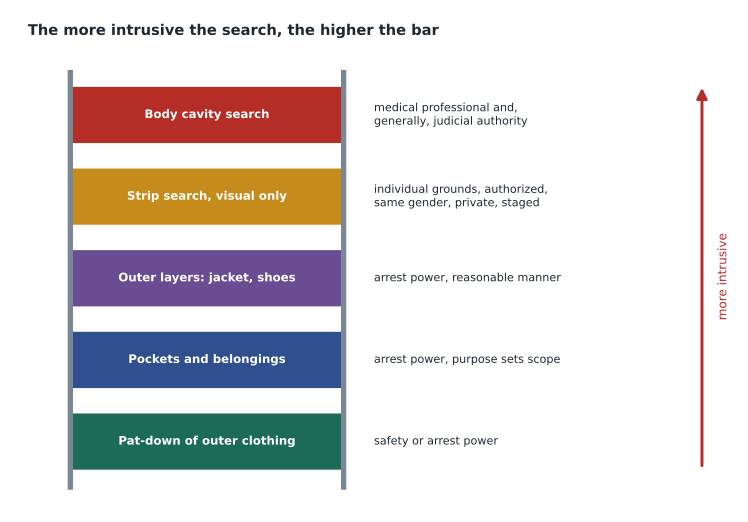
Because Pruitt was arrested for a felony, Ohio's misdemeanor strip search statute did not apply directly, but Port Ardent's policy applies the same safeguards to every strip search: individual probable cause, supervisor authorization, two officers of the same sex, a private room, a staged search so the person is never fully undressed, a visual inspection only, the chance to remove anything themselves, and a written report.
The Pruitt strip search
Malhotra and Constable Tomas Ruiz conducted the search in the search room, a private space next to booking with no window and no camera covering the search area itself, under the service's policy. Before they started, Malhotra told Pruitt what would happen and why: 'We have reason to believe you have something hidden at the front of your underwear, connected to why you were arrested. We're going to search you in stages. You'll never be fully undressed. If you have something, you can take it out and hand it to us yourself.' Pruitt said nothing for a moment, then reached into the front of his underwear and handed over a small knotted plastic bag holding more blue pills. The officers completed the search in stages, found nothing else and returned his clothing.
Malhotra's notes recorded the authorization, the grounds, the start and end times, who was present, the stages of the search, what Pruitt said, what he handed over and the fact that no force was used and no body cavity search was done. Larocque added her authorization and the grounds to the custody record. Port Ardent's policy requires the same written report that Ohio's statute requires for misdemeanor arrests, with a copy given to the person. Desjardins points out that the strip search found evidence that would almost certainly have been lost or ingested in the cells, which shows why the power exists. 'The safeguards are not there to stop you finding evidence,' he says. 'They are there to make sure the search happens only when it is justified, and in a way the person and the public can accept.'
When strip searches go wrong
Before Florence, many lower courts had struck down blanket strip search policies for people arrested for minor offenses, and many agencies, including in Ohio, still limit strip searches outside jail intake to cases with individualized suspicion. Lawsuits over unlawful strip searches, including searches in public view and searches of people arrested for minor traffic offenses, have led to significant damages and policy changes. Larocque tells the class that the most common error she sees is officers treating a strip search as part of booking rather than as a separate decision that needs its own grounds and authorization.
Gender, identity and vulnerability
Same-gender searching protects dignity, but it raises questions when a person is transgender, non-binary or two-spirit, or when their gender presentation does not match their identification. Port Ardent's policy, like many services' policies developed with human rights guidance, asks the person which gender of officer they would prefer for each part of a search, and respects that preference where it is safe and practicable, including splitting a search between officers of different genders. Officers should never search a person to determine their sex or genitals, and should never make comments about a person's body or identity.
Young people, people with disabilities, people who are pregnant and people who disclose past trauma need additional care. For juveniles, agencies generally require higher-level authorization and additional safeguards, and many states restrict strip searches of children in detention. Officers should explain clearly, slow down, offer the person choices about the order of the search where possible, and consider whether a less intrusive alternative, such as a body scanner where one is available, can meet the same purpose.
Body cavity searches and bodily samples
A body cavity search, meaning a physical inspection of a body cavity beyond a visual inspection, is in a category of its own. Ohio's statute requires a warrant for a body cavity search of a person arrested for a misdemeanor or traffic offense except in a medical emergency, and requires it to be performed by a physician, registered nurse or licensed practical nurse. For other arrests, the Fourth Amendment requires a high level of justification, and agencies generally require a warrant and a medical professional. If officers believe a person has concealed drugs internally, the priority is medical: drugs packaged and swallowed or inserted can leak and cause a fatal overdose. The person should be taken to hospital, and evidence questions can be dealt with there under proper authority.
Bodily intrusions such as blood draws are governed by the Fourth Amendment. In Schmerber v. California in 1966, the Supreme Court allowed a warrantless blood draw in the circumstances of that case, but in Missouri v. McNeely in 2013 it held that the natural dissipation of alcohol does not automatically create an emergency, so a warrant is generally needed. In Maryland v. King in 2013, the Court upheld taking a cheek swab for DNA at booking from people arrested for serious offenses, and Ohio law requires DNA samples from people arrested for felony offenses.
| Question | Pruitt | Dunn |
|---|---|---|
| Lawful arrest? | Yes, trafficking | Yes, assault |
| Grounds that evidence or a weapon is hidden on the body? | Yes: hand to waistband, object felt at groin | No |
| Connected to the reason for arrest? | Yes, drugs for trafficking | Not applicable |
| Authorized by a supervisor? | Yes, Larocque | Not applicable |
| Same gender, private, staged, visual only? | Yes | Not applicable |
| Outcome | Pruitt handed over a second bag | No strip search; ordinary booking search only |
Trauma-informed practice and alternatives
Larocque tells the class that the way a strip search is conducted can make the difference between an experience a person can recover from and one that harms them for years. People in custody have higher rates of past abuse and sexual violence than the general population, and a strip search can bring back the feelings of powerlessness and violation they experienced then. Trauma-informed practice does not mean avoiding necessary searches. It means explaining what will happen and why, giving the person as much control as possible, such as choosing the order in which clothing is removed and replaced, keeping the number of people to the minimum, using calm, neutral language, never commenting on the person's body and stopping to check in if the person becomes distressed.
Some services have introduced body scanners, similar to those used in airports and some correctional facilities, which can detect objects hidden under clothing or inside the body without the person undressing. Where they are available and lawful to use, scanners can replace some strip searches, although they raise their own questions about privacy, radiation for some types and the handling of images. Other alternatives include keeping a person under close observation instead of searching them, if the purpose is to stop them using or passing on something, or seeking medical assessment when internal concealment is suspected.
Desjardins asks the class to imagine being the person in the search room. Jesse Morningstar says the thing he would most want is to be told the truth about why it was happening. Amara Okafor says she would want to know who would see her and whether there was a camera. Both are things officers can almost always provide. 'The law sets the minimum,' Desjardins says. 'Your professionalism decides how close to the minimum you operate, or how far above it.'
Larocque adds a final point about records. Strip search records are reviewed more closely than almost any other document in the cells, by supervisors, by prosecutors, by defense lawyers and sometimes by oversight bodies. The record should allow someone who was not there to answer four questions: why was the search needed, who authorized it, how was it done, and what was found. If the record cannot answer one of those questions, the search will be hard to defend, however justified it actually was. Pruitt's record answered all four on one page, with the officers' notes attached.
Worked problem
Applying the threshold
A woman is arrested for shoplifting a jacket. She is calm and cooperative. At booking, the officer suggests a strip search 'to be safe', because she is going to be held until morning on an outstanding warrant from another city. What should the custody sergeant decide?
Show solution
- Check the arrest: lawful arrest for theft and on a warrant.
- Look for grounds: is there any reason to believe she is hiding a weapon or evidence on her body? Nothing suggests it.
- Consider the purpose: the jacket has been recovered; holding her overnight is not by itself a reason to strip search.
- Decide: no strip search; conduct the ordinary booking search, remove items that could cause harm and monitor her.
Answer: Without individual grounds connected to the offense or safety, a strip search is not justified.
Common mistakes
MistakeA strip search is part of normal booking.
InsteadIt is a separate decision that needs its own grounds and authorization.
MistakeIf a strip search finds something, it was justified.
InsteadJustification depends on the grounds before the search, not what was found.
MistakeOfficers can search a person to determine their sex.
InsteadNever; ask about preferences and respect them where safe and practicable.
MistakeOfficers should recover swallowed drug packages at the station.
InsteadInternal concealment is a medical emergency; the person goes to hospital.
Summary and key terms
- The Fourth Amendment balances need against intrusion; Florence allows visual strip searches at jail intake to the general population.
- Ohio's section 2933.32 requires probable cause, written authorization, same-sex searchers, privacy and a written report for misdemeanor and traffic arrests.
- Strip searches are not routine and must not be part of booking by default.
- Gender identity, youth, disability, pregnancy and trauma call for added care and stated preferences.
- Body cavity searches require medical professionals and, generally, judicial authorization; internal concealment is a medical emergency.
- Blood draws generally need a warrant under McNeely; DNA cheek swabs at booking for serious offenses were upheld in Maryland v. King.
- Strip search
- Removing or rearranging clothing to permit visual inspection of private areas or undergarments.
- Body cavity search
- A physical inspection of a body cavity beyond a visual inspection.
- Staged search
- A search in which clothing is removed and replaced in parts so the person is never fully undressed.
- Internal concealment
- Hiding drugs or other items inside the body, which can cause a fatal overdose.
Practice problems
Work each problem on paper first, then reveal the answer to check.
What grounds supported Pruitt's strip search?
Show answer
His hand going to his waistband, the object felt at his groin and the connection to the trafficking arrest.
Why was Dunn not strip searched?
Show answer
Nothing suggested he was hiding a weapon or evidence; the ordinary booking search was enough.
Name four safeguards for a strip search.
Show answer
Supervisor authorization, same-gender officers, a private room, a staged search, visual inspection only, a record.
What should officers do if they believe a person has swallowed drug packages?
Show answer
Treat it as a medical emergency and take the person to hospital.
Lesson quiz · 5 questions
Score 60% or more to complete this lesson.
Create a free account to save your progress, take quizzes and earn a certificate.