
LES-206 · Lesson 1 of 12 · 20 min
Arrest in policing: purposes, principles and accountability
▶ Video coming soon A video version of this lesson is on the way.
Professor Ray Desjardins opens the course by writing two words on the whiteboard: Lawful. Humane. 'Every arrest you make for the rest of your career has to be both,' he tells the class. 'An arrest takes away a person's liberty. It is one of the most serious things the state can do to someone who has not been convicted of anything. That power is given to you on trust. The law tells you when you may use it, how far you may go, and what you owe the person once they are in your hands. This course is about all three.'
The students have already followed one night shift in Port Ardent in the officer safety course, which ended with Probationary Officer Sofia Reyes and her field training officer, Officer Dev Malhotra, arresting a wanted passenger without any trouble at all. This course follows a different shift, six weeks later. On Friday, March 6, 2026, Reyes and Malhotra worked the afternoon shift from three in the afternoon to three the next morning. They made three arrests that night, and each one raised a different set of questions about authority, rights, force, searching and care. None of the three made the news. Desjardins chose them for that reason. 'Most arrests are routine,' he says. 'The routine ones are where habits are formed, and the habits are what protect everyone when a routine arrest stops being routine.'
Sergeant Lisa Haddad, who supervised the platoon in the officer safety course and teaches her service's annual use-of-force requalification, returns as a guest. A second guest joins her: Sergeant Monique Larocque, who has spent eighteen years in the service and the last six as a custody sergeant in charge of the cells at Port Ardent's central station. Larocque has a simple rule that she repeats often. 'When a person comes through my door, they are my responsibility. I do not care how they behaved on the street. I care that they leave my cells in the same condition they came in, or better.'
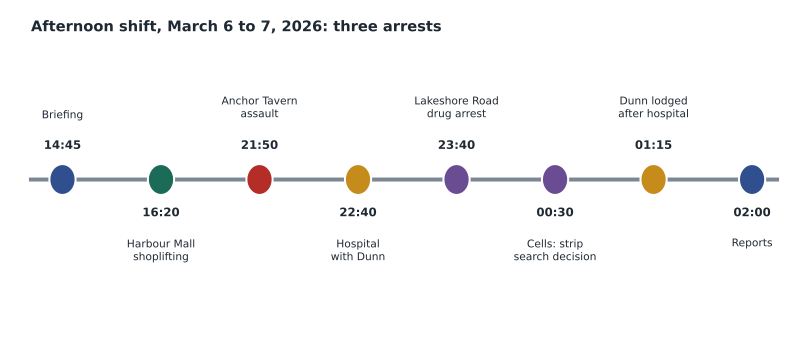
Three arrests, three sets of questions
At 16:20, a loss prevention officer at Harbor Mall named Callum Price held Dana Whitcomb, 34, after watching her leave a pharmacy with cosmetics and vitamins worth about 180 dollars that she had not paid for. Reyes and Malhotra took over from him, explained why she was under arrest, gave her the required information about her rights and released her a little more than an hour later with a document requiring her to come to court. The questions that arrest raised were about who has the power to arrest, what happens when a private citizen makes the first arrest, and when an officer should release rather than hold.
At 21:50, the officers were sent to the Anchor Tavern on Dock Street, where a doorman named Luis Ferraro had been punched by a customer he had asked to leave. When they arrived, the customer, Riley Dunn, 27, was still shouting at Ferraro on the sidewalk and swung at him again as the car pulled up. Dunn was very intoxicated. He refused to put his hands behind his back, pulled away and ended up on the ground, where the officers held him briefly before getting him up. Paramedics later found a cut on the back of his head that had happened before police arrived, and Dunn spent an hour at the hospital before he was lodged in the cells. That arrest raised questions about force, restraints, medical risk and the duty of care.
At 23:40, Reyes stopped a car on Lakeshore Road for speeding. The driver, Mason Pruitt, 31, was nervous, and Reyes saw him push his right hand down the front of his waistband as she walked up. A small bag of what looked like pills was in plain view in the center console. Pruitt was arrested for possession for the purpose of trafficking. His car was searched, his phone lit up with messages on the passenger seat, and at the station Sergeant Larocque had to decide whether he should be strip searched. That arrest raised questions about searching people, vehicles and phones, and about the most intrusive searches police can conduct.
Why arrest matters
An arrest is the use of legal authority to take control of a person, usually so that they can be brought before the justice system. It is more than a detention. A detention is a temporary restriction on someone's liberty, such as when an officer stops a person to investigate. An arrest is a decision that the person is now in custody: they are not free to leave, they may be searched, they may be taken to a station, and they may be held until a court or an official decides whether to release them. Every one of those consequences affects the person's liberty, privacy, dignity and sometimes their physical safety.
The purposes of arrest are limited. In the United States, arrest brings a person before the court to answer a charge, stops ongoing crime, and allows police to establish identity and preserve evidence. The Fourth Amendment requires that an arrest be reasonable, which means it must be supported by probable cause, and state law adds rules about when officers should cite and release rather than take someone into custody. An arrest that does not serve one of these purposes, or that continues after the purpose has been met, is not only unfair. It may be unlawful.
Desjardins puts a question to the class: if an officer has the legal power to arrest, does that mean the officer should arrest? Jesse Morningstar says no, because many offenses can be handled with a warning, a ticket or a document requiring the person to attend court. Amara Okafor adds that arresting someone who could have been released makes the encounter longer, increases the chance of a struggle, and fills the cells with people who did not need to be there. Desjardins agrees with both. The decision to arrest is a judgment about authority, purpose and proportion, and officers will be asked to explain it.
Principles for every arrest
Throughout the course, Desjardins and the guests return to a short list of principles. They apply to every arrest, from a shoplifter who is apologizing in a security office to a person who is fighting on a sidewalk.
- Know your authority. Before you act, know which law gives you the power to arrest, search or use force, and what its limits are.
- Tell people what is happening. Give the reason for the arrest and explain rights promptly and in language the person understands.
- Use the least intrusive means that will work. Choose the lowest level of force, restraint and search that achieves the lawful purpose, and reassess as the situation changes.
- Protect dignity. Treat the person with respect, protect their privacy during searches, and do not humiliate or punish.
- Watch for medical risk. A person under your control may be injured, intoxicated, ill or in crisis, and their condition can change quickly.
- Document everything. Record what you did, why you did it and what you observed, as soon as possible.
- Be accountable. Expect your decisions to be reviewed by supervisors, courts, oversight bodies and the public, and make decisions you can explain.
Haddad adds that these principles are not in tension with officer safety. 'An officer who tells a person why they are being arrested gets more cooperation. An officer who uses only the force needed is less likely to turn a struggle into an injury. An officer who watches the person's breathing catches a medical emergency in time. Every one of these principles makes the arrest safer for everyone.'
Accountability: who reviews an arrest
An arrest is reviewed in many ways, often months after it happens. A supervisor reviews the officer's notes, any use-of-force report and the body-worn camera recording. A prosecutor reviews the file before deciding whether to proceed. Defense counsel looks for any step that was not lawful, because evidence obtained in breach of the person's rights may be excluded. A judge decides whether the arrest, the searches and the force were justified. If someone is seriously injured or dies, an independent body investigates. In Ohio, the Bureau of Criminal Investigation in the Attorney General's office commonly investigates police use of deadly force and deaths in custody at the request of local agencies, and people can bring complaints to the agency and civil lawsuits in court.
Larocque tells the class that the cells are among the most closely reviewed places in a police service. Every cell is recorded on video, every check is logged, and every injury or medical concern is written down. 'People sometimes think that once the door closes, nobody is watching,' she says. 'The opposite is true. Everything that happens in my area is recorded, and every serious incident is reviewed by people outside the service. That is how it should be. If you do your job properly, the recording is your best friend.'
| Arrest | Main questions | Lessons |
|---|---|---|
| Harbor Mall shoplifting | Authority, citizen's arrest, rights, release | 2, 3, 11 |
| Anchor Tavern assault | Communication, force, restraints, medical risk, duty of care | 4, 5, 6, 10 |
| Lakeshore Road drug arrest | Searching people, vehicles and phones, strip searches | 7, 8, 9 |
| All three | Transport, custody, documentation and review | 11, 12 |
Arrest and public trust
Desjardins asks the class to think about arrest from the point of view of the person being arrested and the people watching. For the person, an arrest is often one of the most frightening experiences of their life, even when they know they did something wrong. They lose control over where they go, who they can call and what happens next. For bystanders, an arrest is one of the most visible things police do. A shopper in Harbor Mall who saw Dana Whitcomb led out of the pharmacy, or a group outside the Anchor Tavern filming Riley Dunn on the sidewalk, will form an opinion of the whole service from what they see in a few minutes.
Research on procedural justice, which the students studied in earlier courses, shows that people judge police partly on outcomes but mostly on process. Were they given a reason? Were they spoken to with respect? Was the force used proportionate and stopped as soon as it was no longer needed? Did the officers seem to care whether the person was hurt? Officers who handle arrests well build trust even with people who disagree with the arrest itself, and officers who handle them badly can damage trust in a way that takes years to repair. 'You will never control whether a person likes being arrested,' Haddad says. 'You control whether they, and everyone watching, can see that you did it fairly.'
The class also discusses who is most affected when arrest powers are used badly. Communities that have experienced over-policing, including many Indigenous, Black and racialized communities, often carry a long memory of unfair arrests, unnecessary force and deaths in custody. Federal investigations, state commissions and civil lawsuits in the United States have repeatedly led to changes in how police arrest, restrain and care for people. Desjardins tells the students that knowing this history is part of being a professional. It explains why people may react to an arrest with fear or anger that has little to do with the officer in front of them, and why every lawful, humane arrest matters.
Worked problem
Choosing whether to arrest
An officer finds a 19-year-old who has spray-painted his initials on a park bench. He admits it, gives his name and address, which the officer confirms, and offers to clean it. There is no sign he will keep doing it. Should the officer arrest him?
Show solution
- Identify the authority: the officer has grounds to believe a mischief offense was committed, so a power to arrest may exist.
- Identify the purposes: his identity is confirmed, the evidence is a photograph of the bench, and nothing suggests the offense will continue.
- Consider less intrusive options: a warning with restitution, a referral to a youth or diversion program, or a document requiring him to attend court.
- Consider proportion: taking him into custody would be intrusive and would serve no purpose the other options do not already serve.
Answer: The officer has authority but no good reason to take him into custody; a less intrusive option meets every purpose.
Common mistakes
MistakeIf you have the power to arrest, you should arrest.
InsteadAuthority is only the first question; purpose and proportion decide whether arrest is the right choice.
MistakeAn arrest is just a longer detention.
InsteadAn arrest takes a person into custody, with consequences for liberty, privacy and dignity that a brief detention does not have.
MistakeOnce a person is in custody, their behavior on the street decides how they are treated.
InsteadEvery person in custody is owed the same lawful, humane treatment and care.
MistakeRecording devices exist to catch officers.
InsteadAccurate recording protects everyone and supports officers who act properly.
Summary and key terms
- An arrest takes a person into custody and must be both lawful and humane.
- Arrest must be supported by probable cause, and state law often favors citation and release for minor offenses.
- Having the power to arrest does not mean arrest is the right choice.
- Core principles are authority, explanation, least intrusive means, dignity, medical vigilance, documentation and accountability.
- Supervisors, prosecutors, defense counsel, courts and independent bodies review arrests.
- Arrest
- Taking a person into custody under legal authority, usually to bring them before the justice system.
- Detention
- A temporary restriction on a person's liberty, such as a stop to investigate.
- Custody
- The state of being under police control and not free to leave.
- Principle of restraint
- The idea that the least restrictive response that meets the lawful purpose should be used.
- Duty of care
- The legal and moral responsibility police have for the safety and health of a person in their custody.
Practice problems
Work each problem on paper first, then reveal the answer to check.
What two words does Desjardins write on the board, and why?
Show answer
Lawful and humane; every arrest must be both.
Name three purposes of arrest.
Show answer
To bring a person before the court, to stop an offense continuing and to preserve evidence (also identity).
Why might arresting a person who could have been released be less safe?
Show answer
It lengthens the encounter, increases the chance of a struggle and fills the cells unnecessarily.
Who reviews an arrest after it happens?
Show answer
Supervisors, prosecutors, defense counsel, judges and, for serious incidents, independent bodies.
Lesson quiz · 5 questions
Score 60% or more to complete this lesson.
Create a free account to save your progress, take quizzes and earn a certificate.