
LES-206 · Lesson 2 of 12 · 20 min
The legal authority to arrest
▶ Video coming soon A video version of this lesson is on the way.
The security office at Harbor Mall is a small room behind the pharmacy with two chairs, a desk and a bank of camera monitors. When Reyes and Malhotra arrived at 16:31, Dana Whitcomb was sitting in one of the chairs with her coat on her lap, and Callum Price, the loss prevention officer, was standing by the door. A plastic basket on the desk held the cosmetics and vitamins she had walked out with. Price had already told her that she was being held for police. Reyes's first question to Price was the one Desjardins wants every student to ask first: 'What did you see, and what authority did you act under?'
Desjardins tells the class that an officer who cannot answer the question 'what is my authority?' should not take the next step. Authority comes from statute and from the common law as interpreted by the courts. It sets out who may arrest, for what kind of offense, on what standard of belief, and with what limits. An arrest made without authority is unlawful, and an unlawful arrest has consequences that ripple through everything that follows: the searches that came with it, the statements the person made and the force used to make it.
Arrest by a private person
Ohio's merchant detention law, section 2935.041 of the Revised Code, allows a merchant or an employee or agent of a merchant who has probable cause to believe that items offered for sale were unlawfully taken to detain the person in a reasonable manner, for a reasonable length of time, within the store or its immediate vicinity. The detention may be used to recover the property, to have a peace officer make an arrest or to obtain a warrant, and for theft-related conduct to offer a pretrial diversion program. The merchant may not search the person, search or seize their property without consent, or use undue restraint. Ohio law also gives private persons a limited power to arrest for a felony, under section 2935.04.
Price told Reyes that he had watched Whitcomb on camera putting items into her bag in the cosmetics aisle, then followed her past the last point of sale and out the doors. He stopped her about ten meters outside, identified himself, and asked her to come back inside, which she did. He had not searched her bag; she had taken the items out herself and put them in the basket. Reyes wrote it all down. 'His account matters because our authority builds on his,' Malhotra told her later. 'If he got it wrong, we inherit the problem.'
Malhotra explained that Price had acted within section 2935.041: he had probable cause from what he saw, he detained her in the store's immediate vicinity, he did not search her, and he called police promptly. Once Reyes and Malhotra arrived, the next question was their own authority.
A peace officer's power to arrest
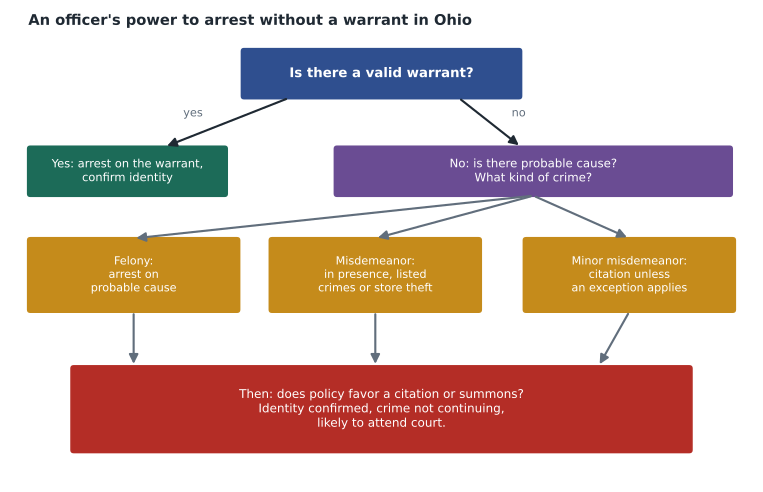
Under Ohio law, section 2935.03 of the Revised Code allows a peace officer to arrest without a warrant a person found violating a law of the state or an ordinance within the officer's jurisdiction, and to arrest for a felony and for certain listed misdemeanors, including offenses of violence such as domestic violence, on reasonable grounds even if the offense did not happen in the officer's presence. Section 2935.041 adds a specific power: a peace officer may arrest without a warrant a person they have probable cause to believe committed an unlawful taking in a store, within a reasonable time afterwards. Petty theft is a first-degree misdemeanor, so Reyes had a power to arrest Whitcomb on probable cause.
Probable cause means that the facts and circumstances known to the officer would lead a reasonable person to believe that the person committed an offense. The Supreme Court described the standard in Beck v. Ohio in 1964, an Ohio case, and has repeated since that it is a practical, common-sense judgment about probabilities, not proof. It is judged objectively, based on what the officer knew at the time. Reyes had Price's direct observations, the camera footage he showed her and the items in the basket.
The two standards are close, and both are higher than the suspicion needed for a brief investigative stop. Desjardins draws a line on the whiteboard and marks points along it: a hunch, reasonable suspicion, probable cause, and proof beyond a reasonable doubt. A hunch justifies nothing. Reasonable suspicion can justify a brief investigative detention. Only the third point justifies an arrest, and only the fourth justifies a conviction. 'Most of the arguments you will have in court about an arrest are about which side of that third point you were on,' he says.
Limits on the power: when arrest is not needed
Ohio law limits the power for the least serious offenses. Under section 2935.26 of the Revised Code, when a person commits a minor misdemeanor, an officer who could arrest must issue a citation instead unless the person needs medical care or cannot ensure their own safety, cannot or will not offer satisfactory proof of identity, refuses to sign the citation, or has previously failed to appear or comply on a citation for the same offense. In State v. Brown in 2003, the Ohio Supreme Court held that a custodial arrest for a minor misdemeanor, without one of those exceptions, also violates the Ohio Constitution, even though the U.S. Supreme Court held in Atwater v. City of Lago Vista in 2001 that the Fourth Amendment does not forbid such arrests. Petty theft is more serious than a minor misdemeanor, so Ohio law did not require a citation for Whitcomb, but Port Ardent's policy directs officers to cite and release first-time shoplifters whose identity is confirmed.
Reyes confirmed Whitcomb's identity from her driver's license and a records check. She had no record and no outstanding matters. She apologized, said she had lost her job in January and had been embarrassed to ask for help. Reyes told her she was under arrest for theft, explained her rights and asked a few questions. Then she and Malhotra talked through the decision. The identity question was settled, the evidence was in the basket and on video, nothing suggested the theft would continue, and there was no reason to think Whitcomb would not come to court. Reyes released her with a summons to appear in municipal court, following Port Ardent's policy, and noted that she would recommend Whitcomb for the prosecutor's diversion program for first-time theft. The whole process took 70 minutes, most of it paperwork.
Arrest warrants and entering homes
Arrest on a warrant follows a different path. A justice or judge who issues a warrant has already decided that there are grounds, so an officer executing it needs to confirm that the warrant is valid and in force and that the person in front of them is the person named. Warrants are confirmed through state and national databases before an arrest is made. To enter a home to make a routine arrest, police generally need an arrest warrant and reason to believe the person is inside, as the Supreme Court held in Payton v. New York in 1980, and a search warrant to enter the home of a third person to find the subject, unless exigent circumstances such as hot pursuit or an imminent risk of harm exist.
Desjardins stresses that the home has special protection in both countries. An arrest in a public place on reasonable grounds may be lawful, while the same arrest made by walking into a person's living room without a warrant or exigent circumstances may not be. Students who go on to patrol will face this distinction often, especially on calls where a suspect has gone home before police arrive.
When an arrest is unlawful
An arrest is unlawful if it is not supported by probable cause or is made in a way the law does not allow, such as entering a home without a warrant or exigent circumstances. The U.S. Supreme Court has held that a reasonable mistake of law can sometimes support a traffic stop, as in Heien v. North Carolina in 2014, but officers cannot rely on that as a general excuse, and evidence found after an arrest without probable cause is likely to be suppressed under the exclusionary rule. The consequences of an unlawful arrest are serious: evidence may be excluded, the person may sue, and the officer may face discipline.
| Release factor | Answer in the practice case | Points toward holding? |
|---|---|---|
| Is the person's identity confirmed? | yes | no |
| Is the evidence secured? | yes | no |
| Is the offense likely to continue or be repeated? | no | no |
| Is the person likely to miss court? | no | no |
| Does the person need medical care or protection? | no | no |
Any single factor pointing toward holding would call for a closer look: an unconfirmed identity, evidence still at risk, an offense likely to continue, a real risk of not attending court, or a need for care or protection. In the practice case none does, so the conclusion is release at the earliest reasonable opportunity.
The checklist is a teaching aid, not a decision tool. Real decisions require judgment about the facts, and an officer may find reasons to hold that do not fit neatly into a list. But the exercise shows the structure of the decision: when every factor points to release, the law expects release.
Arresting the wrong person
A warrant authorizes the arrest of the person it names, not anyone who looks like them. Officers who arrest on a warrant must take reasonable steps to confirm identity: comparing the name, date of birth and physical description, checking photographs and fingerprints where available, and listening when the person says they are not the one named. Mistaken identity arrests happen most often with common names, people who have had their identity stolen and relatives who share a name. If an officer arrests the wrong person in good faith on a valid warrant, the arrest may still be lawful at first, but once it becomes clear that the person is not the one named, they must be released immediately and the error recorded. Continuing to hold them is not lawful.
Haddad tells the class about a night early in her career when she arrested a man on a warrant for his cousin, who had used his name. He told her calmly in the car that he had been arrested by mistake twice before and showed her a letter from the court confirming it. She called the court's after-hours line, confirmed it, and released him at the curb. 'He thanked me for listening,' she says. 'That told me how rarely it happened.'
Arresting outside your area
Ohio officers generally have arrest authority within their own jurisdiction, with limited exceptions, such as hot pursuit that begins inside the jurisdiction, mutual aid agreements and certain offenses on state highways. Officers who make an arrest outside their usual area should notify the local service, which may have information about the person and the location, and must record why and how the arrest was made.
Worked problem
Checking the authority chain
A loss prevention officer at a hardware store calls police to say he has detained a man who left without paying for a drill. When officers arrive, the man says he paid at the garden center and shows a receipt dated today for a drill of the same model. How should the officers approach their authority?
Show solution
- Start with the private arrest or detention: ask what the loss prevention officer saw, whether he kept the man in view and whether he checked other tills.
- Assess the new information: the receipt may mean no offense occurred, or it may belong to a different purchase; check the time and till number against the store's records.
- Decide whether the officers' own standard is met: without reasonable grounds or probable cause that a theft occurred, they have no power to arrest.
- If the grounds are not met, end the detention, explain the outcome to both people and document the decision.
Answer: Officers must form their own grounds; they cannot simply adopt a private arrest if the facts do not support it.
Common mistakes
MistakeA loss prevention officer's arrest gives police automatic authority to hold the person.
InsteadOfficers must form their own reasonable grounds or probable cause before they arrest.
MistakeReasonable grounds means proof beyond a reasonable doubt.
InsteadIt means a reasonable probability, both believed by the officer and objectively reasonable.
MistakeAn honest mistake about the law makes an arrest lawful.
InsteadOfficers cannot rely on mistakes of law as a general excuse; evidence may be suppressed.
MistakeOfficers can always walk into a home to arrest a suspect they have grounds for.
InsteadEntering a home generally requires a warrant unless exigent circumstances exist.
Summary and key terms
- Ohio's merchant detention law lets stores detain on probable cause, in a reasonable manner and for a reasonable time, without searching the person.
- Ohio law gives officers the power to arrest without a warrant on probable cause for felonies, many misdemeanors and store thefts.
- Probable cause is a practical, objective judgment about probabilities, as in Beck v. Ohio.
- Section 2935.26 requires a citation for most minor misdemeanors, and State v. Brown bars custodial arrest for them under the Ohio Constitution.
- Entering a home to arrest generally requires a warrant unless exigent circumstances exist.
- An unlawful arrest can taint the searches, statements and force that follow.
- Probable cause
- Facts that would lead a reasonable person to believe the person committed an offense.
- Citation
- A document requiring a person to appear in court, issued instead of a custodial arrest.
- Hybrid offense
- An offense the prosecution may treat as more or less serious; in Canada it counts as indictable for arrest until the Crown elects.
- Exigent circumstances
- Urgent situations, such as hot pursuit or an imminent risk of harm, that can justify acting without a warrant.
- Warrant
- A court order authorizing an arrest or search.
Practice problems
Work each problem on paper first, then reveal the answer to check.
What is the first question an officer should ask before arresting?
Show answer
What is my authority, and are its conditions met?
Under Ohio's merchant detention law, what may a store employee not do?
Show answer
Search the person, seize their property without consent, or use undue restraint.
Why was Whitcomb released rather than held?
Show answer
Her identity was confirmed, the evidence was secured, the offense was not continuing, and she was likely to attend court.
What usually allows police to enter a home without a warrant to arrest?
Show answer
Exigent circumstances such as hot pursuit or an imminent risk of harm.
Lesson quiz · 5 questions
Score 60% or more to complete this lesson.
Create a free account to save your progress, take quizzes and earn a certificate.