
LES-206 · Lesson 11 of 12 · 21 min
Transport, custody and release
▶ Video coming soon A video version of this lesson is on the way.
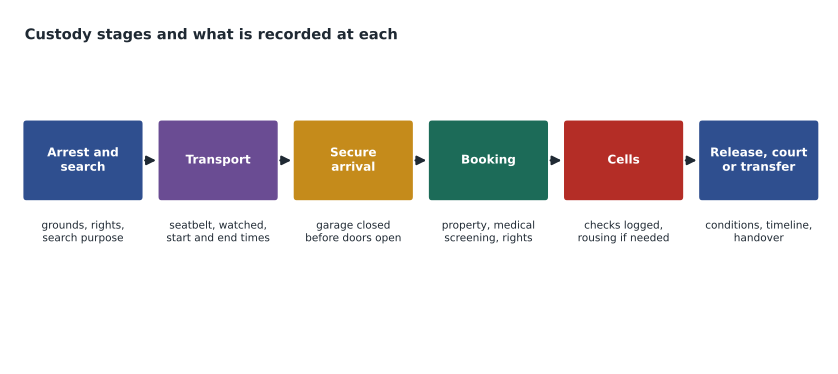
Car 14 pulled into the secure garage at Port Ardent's central station at 01:09 with Riley Dunn in the back seat, back from the hospital. The garage door closed behind them before anyone opened a car door. Reyes radioed the time and the odometer reading to dispatch, as she had when they left the hospital. Inside, Sergeant Larocque was waiting at the booking counter with the hospital's written instructions already on her screen, sent ahead by Malhotra. Within ten minutes, Dunn had been searched again, his property listed and signed for, his medical information and the doctor's instructions entered on the custody record, his rights repeated, and he was lying on a mattress in cell 3 on his side, with an officer assigned to check on him every fifteen minutes.
This lesson follows people from the moment they are put in a police car to the moment they leave police custody, whether by being released, being taken to court or being handed to another agency. Desjardins calls it the part of an arrest that nobody films and everybody reviews. 'The street is where most arrests are made,' he says. 'The car and the cells are where most deaths in custody happen. The rules for this part of the job are written in coroner's reports.'
Transporting a person in custody
Transport begins before the person is put in the car. Officers check the back seat at the start of every shift and again before and after every transport, so that they can say with certainty that anything found there came from the person they transported. The person is searched incident to arrest before being placed in the car, for their own safety and the officer's. They are seated upright, never lying face down, with a seatbelt fastened. Officers watch them throughout, using the in-car camera and the mirror, and talk to them. A person who goes quiet in the back seat may be falling asleep, or may be losing consciousness.
Many services require officers to radio the start and end of every transport, with the time and odometer reading, and to note any stops. This protects both the person and the officer, especially when the person is of a different gender from the transporting officer, is a youth, or has made or might make a complaint. Officers should take the most direct route, avoid unnecessary stops, and never leave a person in custody alone in a vehicle. If the person becomes unwell, the officer stops in a safe place, assesses and calls for paramedics, or goes directly to a hospital.
Desjardins mentions a practice that has led to deaths and lawsuits in several countries: putting a restrained person in the back of a van without a seatbelt and driving in a way that throws them around, sometimes called a rough ride. 'There is no lawful purpose for it,' he says. 'It is an assault, and if the person dies, it can be manslaughter or worse. Seatbelts, smooth driving and constant observation are not optional.'
Booking
Booking is the formal process of receiving a person into custody. At Port Ardent, it has several parts, each recorded in the custody record and on video. The arresting officer explains the arrest, the grounds and any force used. The custody sergeant decides whether to accept the person into custody, which includes deciding whether they need medical assessment first. The person is searched again, and their property is listed, counted and signed for. They are asked a set of questions about their health, medications, injuries, drug and alcohol use, thoughts of suicide or self-harm, and any disabilities or needs. Their rights are given or repeated, and they are given the opportunity to contact a lawyer. Their identity is confirmed, and fingerprints and photographs may be taken where the law allows.
Ohio law requires agencies to take fingerprints of people arrested for felonies and many misdemeanors and send them to the Bureau of Criminal Identification and Investigation, which is why Dana Whitcomb was told she would be fingerprinted when she appeared in court. Booking also includes deciding where the person will be held. People are separated by gender, and policies address the placement of transgender and non-binary people based on their safety and their stated identity. Youths are held separately from adults. People who are intoxicated, at risk of suicide or medically vulnerable are placed where they can be watched most closely.
Larocque tells the class that the booking questions are only as good as the way they are asked. 'If you read the suicide question off the screen in a bored voice while you're typing, you will get a “no” every time,' she says. 'Look at the person. Ask it like you care about the answer. If they hesitate, stop and talk.' She also tells the officers to pass on anything they saw or heard on the street. Dunn had told Reyes in the car, between swearing, that 'it doesn't matter anyway'. Reyes passed it on, and Larocque asked Dunn about it directly at booking. He said he had meant his job, not himself, and showed no other signs of risk, but Larocque noted it and asked the morning shift to ask again when he was sober.
Life in the cells
People in police cells are usually held for hours, not days, while they sober up, wait for release or wait to be taken to court. The cells must be safe, clean and monitored. Cells are designed to remove ligature points and other hazards. Video recording covers cell areas, with privacy screening where policy requires it, such as toilet areas. People must have access to water, food at reasonable intervals, a toilet, and medical care. Checks are done at the frequency set by the custody sergeant based on each person's risk, and they are logged. Ohio's minimum standards for jails and temporary holding facilities, set under state law, govern the care of people held in police facilities, and local policies add detail.
Larocque's rule about checks is that they are never skipped and never faked. Coroner's juries have repeatedly found that officers recorded checks that did not happen, or checked through a window without seeing that a person had stopped breathing. 'The check log is a legal document,' she tells the class. 'If you write that you checked, you went to the cell, you looked properly and you got a response if the person needed rousing. If you didn't, you write that you didn't and why. Lying on a check log can end your career, and it can end a life.'
Release by police
Most people arrested by police are released without ever seeing a judge in custody. In Ohio, officers can release many people arrested for misdemeanors on a citation or summons, and courts use bond schedules that allow people arrested for many misdemeanors to be released on their own recognizance or after posting a set bond before they see a judge. In 2022, Ohio voters approved a constitutional amendment requiring courts to consider public safety, among other factors, when setting the amount and conditions of bail. Release conditions must still be reasonably related to the risks the person presents.
Riley Dunn was released at 08:10 the next morning, once he was sober and had been assessed again by the morning sergeant. Under the municipal court's bond schedule for a first-degree misdemeanor assault, he was released on his own recognizance with a court date and a condition, set under the court's standing orders, not to return to the Anchor Tavern. He was given a copy of the hospital's head injury instructions.
Holding for court
Some people are not released by police because the law or the circumstances require a judge to decide. Mason Pruitt, charged with felony trafficking in a substance believed to contain fentanyl, was held for an initial appearance. Under County of Riverside v. McLaughlin, a person arrested without a warrant must generally receive a judicial determination of probable cause within 48 hours, and Ohio's criminal rules require an initial appearance without unnecessary delay. Pruitt appeared by video before a municipal court judge on Saturday morning, who found probable cause and set bond with conditions. The arresting officers' notes, the custody record and the synopsis of the evidence were ready for the hearing because Reyes and Malhotra had completed them before going off shift.
Desjardins emphasizes that delay in bringing a person before a judge is itself a rights issue. A person held longer than the law allows, because officers did not finish their paperwork or a file was not sent, can have the charges affected and the service can be held liable. 'The clock starts when you put the cuffs on,' he says. 'Plan for it.'
Transfers and handovers
People sometimes leave police custody by being transferred: to a hospital, to a provincial or county jail, to youth custody, to another police service on a warrant, or to immigration authorities. Every transfer is a moment when information can be lost. The receiving agency needs to know about medical conditions, medications, suicide risk, injuries, behavior and any force used. Port Ardent's policy requires a written handover form and a verbal briefing for every transfer, and both are recorded. Larocque says the question she asks herself before any handover is simple: 'If this person dies tonight in someone else's care, will the people there have known everything I knew?'
Worked problem
Checking the 24-hour clock
Pruitt was arrested at 23:46 on Friday, March 6, and appeared in court at 10:30 on Saturday, March 7.
Show solution
- From 23:46 to midnight: 14 minutes.
- From midnight to 10:30: 10 hours 30 minutes.
- Total: 10 hours 44 minutes.
- \[10 + \frac{44}{60} \approx 10.73\ \text{hours}\]
Answer: About 10.73 hours, well within 24 hours and so within the limit in either country.
The example uses Pruitt's arrest and appearance times. Ten hours and forty-four minutes is well within the limit, but Desjardins notes that a Friday-night arrest in a small service without weekend court can reach the limit quickly, which is why custody sergeants track the clock for every person held.
| Person | How they left custody | When |
|---|---|---|
| Dana Whitcomb | Summons at the scene; diversion recommended | 17:41, March 6 |
| Riley Dunn | Own recognizance under the bond schedule, from the station | 08:10, March 7 |
| Mason Pruitt | Bond set by a judge at the initial appearance | 10:30 hearing, March 7 |
Young people in custody
Young people who are arrested are held separately from adults, and their parents or another appropriate adult must be notified as soon as possible. Ohio law requires that a child taken into custody be held separately from adults and that a parent, guardian or custodian be notified promptly, and federal juvenile justice requirements limit holding juveniles in adult facilities. Young people are more likely than adults to be frightened, to misunderstand what is happening and to say what they think officers want to hear. Officers should explain the process in plain language, keep the time in custody as short as possible and consider release to a parent or other responsible adult at the earliest opportunity.
Worked problem
A release decision
At 06:00, a woman arrested at 02:00 for causing a disturbance while intoxicated is now sober. She has no record, a fixed address and a job she needs to get to. She was rude to officers when arrested. What should the officer in charge decide?
Show solution
- Consider the law: the principle of restraint and the bond or release rules favor release at the earliest reasonable opportunity.
- Consider the risks: identity is confirmed, she is sober, the disturbance is over and she is likely to attend court.
- Consider conditions: none appear necessary; any condition must be connected to a real risk.
- Ignore irrelevant factors: being rude to officers is not a reason to hold her or add conditions.
Answer: Release her now with a court date and no conditions, and record the reasons.
Common mistakes
MistakeOfficers can let a person lie down across the back seat if they are tired.
InsteadPeople in custody must be seated upright with a seatbelt and observed.
MistakeThe booking questions are a formality.
InsteadThey are a key safety tool; ask them properly and pass on what you observed.
MistakeRelease conditions are a way to manage people who were difficult.
InsteadConditions must be necessary, reasonable and connected to real risks.
MistakePaperwork can wait until the next shift.
InsteadCourt timelines start at arrest; complete the file before going off shift.
Summary and key terms
- Check the vehicle before and after every transport; search, seat, belt and watch the person.
- Radio the start and end of transports and never leave a person alone in a vehicle.
- Booking records the arrest, property, medical screening, rights and identity, and decides placement.
- Cells must be safe and monitored, and checks must be real and accurately logged.
- Citations, summonses and bond schedules allow early release; the 2022 amendment requires courts to consider public safety in setting bail.
- People arrested without a warrant must generally receive a probable cause determination within 48 hours.
- Transfers require full written and verbal handovers.
- Bond schedule
- A court-set list of release amounts or terms for common offenses, allowing release before seeing a judge.
- Initial appearance
- The first court appearance after arrest, where bail and conditions are addressed.
- Booking
- The formal process of receiving a person into custody, recording property, health, rights and identity.
- Custody record
- The log of everything that happens to a person in custody.
- Handover
- The transfer of information when a person moves to another agency's custody.
Practice problems
Work each problem on paper first, then reveal the answer to check.
Why are vehicles checked before and after every transport?
Show answer
So officers can say with certainty that anything found came from the person transported.
What did Larocque do about Dunn's comment that 'it doesn't matter anyway'?
Show answer
Asked him directly at booking, recorded it and asked the morning shift to ask again when he was sober.
Why was Dunn's release condition appropriate?
Show answer
It was directly connected to the offense and the risk of repeating it.
In the worked example, how long was Pruitt in custody before his appearance?
Show answer
About 10.73 hours.
Lesson quiz · 5 questions
Score 60% or more to complete this lesson.
Create a free account to save your progress, take quizzes and earn a certificate.