
LES-206 · Lesson 7 of 12 · 19 min
Searching a person incident to arrest
▶ Video coming soon A video version of this lesson is on the way.
On the gravel shoulder of Lakeshore Road at 23:46, with car 14's lights flashing behind them and car 9 pulling in ahead, Malhotra told Mason Pruitt what was about to happen: 'You're under arrest, so I'm going to search you now for anything that could hurt us or you, and for evidence. Keep your hands where they are and tell me if there's anything sharp in your pockets.' Pruitt said there was a knife in his right front pocket. Malhotra found a folding knife clipped there, a wallet, a set of keys, a roll of cash and two phones, one of which was vibrating. When he patted the front of Pruitt's waistband, where Reyes had seen him push his hand, he felt something soft and lumpy under the clothing at the front of his groin. He did not reach inside. He told Pruitt what he had felt, told Reyes, and the officers decided that the item would be dealt with at the station.
Desjardins pauses the story there. 'Every one of those decisions has a legal basis and a legal limit,' he says. 'Why could Malhotra search Pruitt without a warrant? What was he allowed to look for? Why did he stop at the clothing? This lesson answers the first two questions. The next two lessons answer the rest.'
The power to search incident to arrest
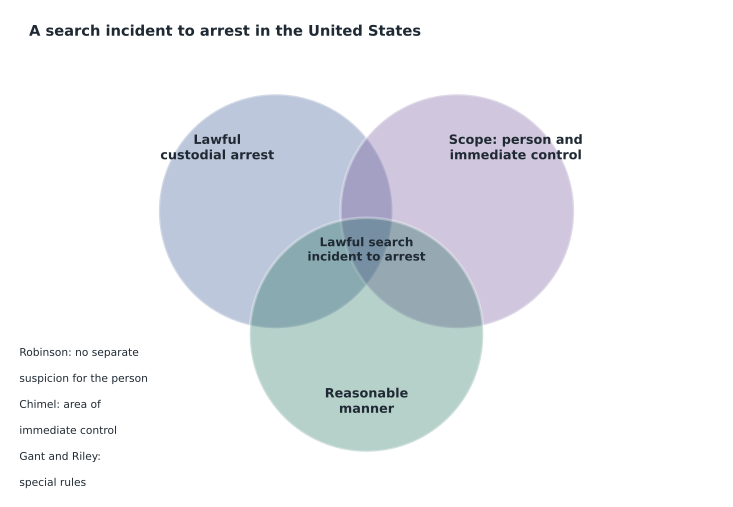
In the United States, searches incident to arrest are a long-standing exception to the warrant requirement. In Chimel v. California in 1969, the Supreme Court held that officers may search the arrested person and the area within their immediate control, meaning the area from which they might gain possession of a weapon or destructible evidence. In United States v. Robinson in 1973, the Court held that a full search of the person is reasonable after any lawful custodial arrest, without any separate requirement that the officer believe a weapon or evidence will be found. The search must still be conducted reasonably, and the arrest must be lawful.
Two features of the U.S. rule matter in practice. First, Robinson's bright-line rule applies to custodial arrests. In Knowles v. Iowa in 1998, the Court held that officers may not conduct a full search incident to arrest when they only issue a citation and do not make a custodial arrest. Second, the area-of-control part of the rule has limits, especially for vehicles and phones, which the next lesson covers.
What the search may cover
The search incident to arrest covers the person, their clothing and things they are carrying, such as a bag, a purse or the contents of their pockets. Officers can open containers on the person if the purpose of the search supports it, for example a cigarette pack that could hold a razor blade or drugs. The search must be proportionate to its purpose: a quick pat-down for weapons is proportionate to a safety purpose, while a detailed examination of every paper in a wallet needs an evidence purpose connected to the offense.
When Reyes arrested Dana Whitcomb for theft, she asked Whitcomb to open her shoulder bag so she could check for other unpaid items. The bag was in Whitcomb's possession at the moment of arrest, which put it within the scope of a search incident to arrest. Reyes looked through the main compartment and found a phone, keys, a wallet and a receipt for groceries from another store. There were no other store items. She did not search the wallet or the phone, because there was no reason to think they held evidence of the theft. She noted what she had searched, what she found and why she had stopped.
For Riley Dunn, the search at the car was a safety search before transport. Malhotra checked his pockets and waistband and found a wallet, a lighter, a set of keys and a phone, all of which went into a property bag. Dunn had no weapons. Malhotra told the class he had not looked through the wallet or the phone, because there was no connection between their contents and an assault on a doorman. 'If he'd been arrested for using a stolen credit card, the wallet would have been different,' he said.
Timing and place
The search is usually done right after the arrest, because the safety and evidence purposes are most urgent then. A delay does not automatically make the search unlawful, but the officer must be able to explain it, and the further the search is from the arrest in time and place, the harder it is to say it was truly incidental. Officers often do a quick safety search at the scene and a more thorough search at the station, which is lawful as long as each search has a valid purpose. Searches of a home incident to arrest are limited to the area within the arrested person's immediate control, under Chimel, together with a limited protective sweep where officers have reason to believe someone dangerous may be present, under Maryland v. Buie in 1990.
Searching with dignity
A search touches a person's body, often in public, and can be humiliating even when it is lawful. Officers should explain what they are going to do before they do it, use the back of the hand or other methods taught at the academy for sensitive areas, avoid unnecessary comments, and protect the person's privacy as much as the situation allows. A safety pat-down at the roadside is very different from a search that removes clothing, which is covered in lesson 9. Port Ardent's policy, like that of many services, allows an officer of any gender to conduct an urgent safety pat-down incident to arrest, with professionalism and care, but directs that searches be done by an officer of the same gender as the person where practicable and requires more intrusive searches to be done by same-gender officers. Policies also allow transgender, non-binary and two-spirit people to state a preference for the gender of the officer who searches them, and direct officers to respect that preference where it is safe to do so.
Larocque emphasizes that searches should never be used to punish, intimidate or embarrass. 'If a person mouthed off to you on the street, that does not change what you are allowed to look for or how,' she says. 'The search is for safety and evidence. Full stop.'
Searches at booking and property
When a person is lodged in the cells, they are searched again and their property is listed and stored. This booking search, often called an inventory search, is a separate exception to the warrant requirement: in Illinois v. Lafayette in 1983, the Supreme Court held that police may search and inventory a person's belongings as part of routine booking procedures before jailing them. The property is listed in front of the person, who is asked to sign the list, and items such as belts, shoelaces and drawstrings may be removed to reduce the risk of self-harm. Cash is counted in front of the person and a second officer.
| Item | Quantity |
|---|---|
| Wallet, black leather | 1 |
| Keys on ring | 1 |
| Phone, blue case | 1 |
| Phone, black, no case | 1 |
| Folding knife | 1 |
| Cash, 20-dollar notes | 31 |
| Cash, 10-dollar notes | 4 |
Cash check: 31 + 4 = 35 banknotes, worth 31 × 20 + 4 × 10 = 620 + 40 = 660 dollars. The person is asked to confirm the count and sign the list.
The example uses invented figures similar to what Malhotra found on Pruitt. Counting and recording cash in front of the person and a second officer protects everyone: it prevents false accusations of theft, and it records evidence that may matter later in a trafficking case.
When the search is unlawful
If the arrest is unlawful, the search incident to it is also unlawful. If the search goes beyond its purpose, such as reading through a person's messages after an arrest for a minor assault, or is conducted in an abusive way, it can breach the person's rights. Evidence found in an unlawful search may be suppressed under the exclusionary rule, along with evidence derived from it. The practical rules are straightforward: make sure the arrest is lawful, know your purpose, search only as far as the purpose allows, and write down what you did and why.
| Arrest | Search purpose | What was searched | What was not searched |
|---|---|---|---|
| Whitcomb, theft | Evidence of the theft | Shoulder bag main compartment | Wallet and phone: no link to the theft |
| Dunn, assault | Safety before transport | Pockets and waistband | Wallet and phone: no link to the assault |
| Pruitt, trafficking | Safety and evidence | Pockets, waistband from outside clothing | Under clothing: left for the station; phones: lesson 8 |
Finding evidence of another offense
Sometimes a lawful search incident to arrest turns up evidence of a different offense. When Malhotra searched Pruitt, he found the folding knife and the cash. If he had also found a stolen credit card in another person's name, he could have seized it, because it was in plain view during a lawful search and its incriminating nature was obvious. The key is that the search itself must stay within its lawful scope. An officer who finds unrelated evidence while searching properly may seize it. An officer who widens the search in the hope of finding unrelated evidence has stepped outside the power, and anything found that way may be excluded.
The same principle applies to the people around an arrest. Arresting one person does not give a power to search their companions. If Pruitt had had a passenger, the passenger could not be searched simply because Pruitt was arrested. The officers would need a separate lawful basis, such as a Terry frisk if they reasonably suspected the passenger was armed and dangerous, or probable cause to arrest the passenger too.
Searching in public
Searches incident to arrest often happen in public: at the roadside, outside a bar, in a mall. Officers should think about where the search happens as well as how. Moving a few meters to a quieter spot, turning the person away from a crowd, or doing a quick safety pat-down at the scene and a fuller search at the station can all reduce embarrassment without reducing safety. Reyes chose the mall's staff corridor for Whitcomb for exactly this reason. Larocque notes that complaints about searches are often less about what was searched than about where and how. 'Nobody likes being searched,' she says. 'People can accept it when they see it done professionally. They don't forgive being humiliated in front of their neighbors.'
Officers should also think about who will see the person's property. Wallets, phones and bags contain private information, photographs and medication that have nothing to do with the arrest. Looking only as far as the purpose requires, and handing the property straight into a sealed bag, protects that privacy. It also protects the officer from a later claim that something went missing or was read without authority. Malhotra's habit is to describe each item aloud to the camera as it goes into the bag, so that the recording and the property list match exactly.
Worked problem
Setting the scope
An officer arrests a woman on a warrant for failing to appear in court on a theft charge from last year. She is going to be transported to the station. She has a backpack and a phone. What may the officer search, and why?
Show solution
- Confirm the arrest is lawful: the warrant is valid and she is the person named.
- Identify the purposes: safety before transport clearly applies; evidence of failing to appear is unlikely to be in her backpack or phone.
- Scope: search her person and the backpack for weapons or items that could harm someone; do not examine the phone's contents.
- Record the purpose, what was searched and what was found.
Answer: A safety search of her person and backpack is justified; an evidence search of her phone is not.
Common mistakes
MistakeA search incident to arrest needs reasonable grounds to believe something will be found.
InsteadIt rests on the lawful custodial arrest; under Robinson, no separate suspicion is needed for the person.
MistakeAny search after an arrest is lawful.
InsteadThe search must be connected to a valid purpose and conducted reasonably.
MistakeOfficers should search everything a person has, just in case.
InsteadThe scope of the search is set by its purpose.
MistakeA person who was rude can be searched more thoroughly.
InsteadSearches are for safety and evidence, never to punish.
Summary and key terms
- Chimel v. California and United States v. Robinson allow a search of the person and the area of immediate control after a lawful custodial arrest.
- The purpose of the search sets its scope.
- Knowles v. Iowa bars a full search incident to arrest when only a citation is issued.
- Searches should normally happen promptly; delays must be explained.
- Searches must protect dignity, with same-gender searchers where practicable and respect for stated preferences.
- Booking searches and property lists protect the person, the cells and the evidence.
- Area of immediate control
- The area from which an arrested person could reach a weapon or evidence, under Chimel.
- Inventory search
- A routine search and listing of belongings at booking, under Illinois v. Lafayette.
- Incident to arrest
- Connected to the arrest in purpose, time and place.
- Property bag
- A sealed bag for an arrested person's belongings, listed and signed for at booking.
Practice problems
Work each problem on paper first, then reveal the answer to check.
What three conditions make a search incident to arrest lawful?
Show answer
A lawful custodial arrest, a scope limited to the person and area of immediate control, and a reasonable manner.
Why did Reyes not search Whitcomb's wallet and phone?
Show answer
There was no reason to think they held evidence of the theft.
Why did Malhotra not reach under Pruitt's clothing on the roadside?
Show answer
That would be a more intrusive search requiring its own justification and privacy; it was left for the station.
Why is cash counted in front of the person and a second officer?
Show answer
It prevents false accusations and records evidence accurately.
Lesson quiz · 5 questions
Score 60% or more to complete this lesson.
Create a free account to save your progress, take quizzes and earn a certificate.