
LES-206 · Lesson 5 of 12 · 22 min
The law of force in arrest and control
▶ Video coming soon A video version of this lesson is on the way.
Malhotra's body-worn camera recorded the arrest of Riley Dunn from the moment the car doors opened. Desjardins plays the first ninety seconds for the class without sound, then again with sound. In the silent version, students see an officer step between two men, a third person crossing his arms, an officer taking hold of his arm, a hard pull, two officers and the man going to the ground, a third officer arriving, and then everyone sitting up. With sound, they hear Malhotra's voice the whole time: 'Stop. Step back. You're under arrest for assaulting him. Turn around for me. You can walk with me or we'll hold your arms. Is there anything I can say? Okay, we're holding your arms. Stop pulling. Stop kicking and we'll help you up. Okay, sitting you up now. Breathe. You're okay.'
'Every use of force you make will be judged by someone who was not there,' Desjardins tells the class. 'They will watch the video, read your notes, hear from the person you arrested, and ask one question: was it justified? This lesson is about how the law answers that question.'
The legal framework
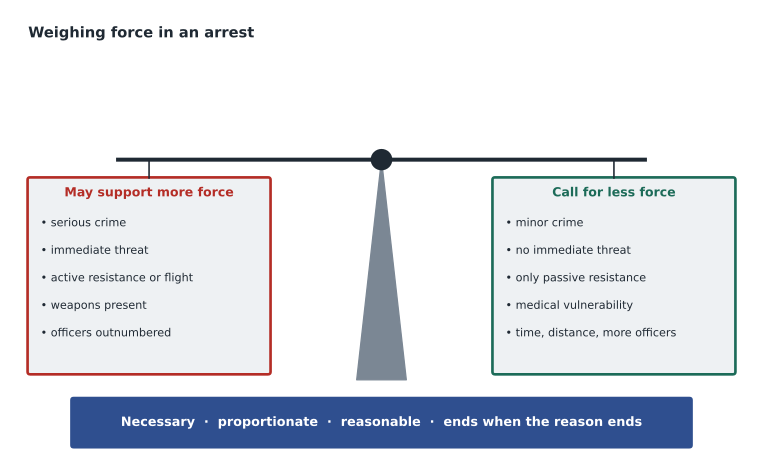
The Fourth Amendment governs force used in making an arrest or other seizure. In Graham v. Connor in 1989, the Supreme Court held that force is judged by objective reasonableness: whether the officer's actions were objectively reasonable in light of the facts and circumstances confronting them, without regard to their underlying intent. The Court named three factors in particular: the severity of the crime, whether the suspect poses an immediate threat to the safety of officers or others, and whether the suspect is actively resisting or attempting to evade arrest by flight. In Tennessee v. Garner in 1985, it held that deadly force to prevent the escape of a fleeing suspect is reasonable only if the officer has probable cause to believe the suspect poses a significant threat of death or serious physical injury.
The Supreme Court has repeatedly said that reasonableness must be judged from the perspective of a reasonable officer on the scene, rather than with 20/20 hindsight, and must allow for the fact that officers are often forced to make split-second judgments in circumstances that are tense, uncertain and rapidly evolving. In Barnes v. Felix in 2025, the Court unanimously rejected the idea that courts should look only at the moment the threat arose, holding that the totality of the circumstances, including what happened earlier in the encounter, must be considered. For people already in custody before trial, Kingsley v. Hendrickson in 2015 held that the test is whether the force was objectively unreasonable.
Desjardins summarizes what the two systems share. Force must be connected to a lawful purpose. It must be necessary, meaning lesser options would not reasonably work. It must be proportionate to the threat and the resistance. It must be reasonable when the whole situation is considered from the officer's point of view at the time. And it must stop, or ease, when the reason for it ends. 'None of these tests asks whether the officer was angry or whether the person deserved it,' he says. 'The law looks at the facts and the purpose, not at how anyone felt.'
Applying the law to Riley Dunn
Haddad walks the class through the Dunn arrest the way she would review a use-of-force report. First, was there a lawful purpose? Yes: the officers had seen Dunn swing at Ferraro and had reasonable grounds to arrest him for assault, and they needed to stop the assault and take him into custody. Second, were lesser options tried? Yes: Malhotra asked, explained, offered options and asked a confirming question before taking hold of Dunn's arm. Third, was the force proportionate? Dunn was actively resisting and had just tried to hit someone, so holding his arms was a low level of force proportionate to that behavior. When he pulled away hard, the officers took him to the ground in the controlled way they are trained to, which is a higher level of force, but one connected directly to stopping his escape and preventing him from hitting anyone else.
Fourth, did the force end when the reason ended? The body-worn camera shows Dunn was on the ground for about 40 seconds. During that time he kicked twice. Once he stopped kicking and was handcuffed, Malhotra told him he would be sat up, and the officers sat him up within a few seconds. They did not keep any weight on him once he was restrained. 'That last part is what I look at most closely,' Haddad says. 'A lot of serious injuries and deaths in custody happen after the person has stopped resisting, because officers stay on top of them out of habit or adrenaline. Getting a person up and breathing as soon as they are under control is not only good practice. It is a legal duty.'
| Camera time (min:s) | Event |
|---|---|
| 00:00 | Car doors open |
| 00:06 | Dunn swings at Ferraro; Malhotra steps between them |
| 00:31 | Arrest announced; options offered |
| 00:48 | Confirming question asked |
| 00:55 | Malhotra takes hold of Dunn's arm |
| 00:58 | Dunn pulls away; taken to the ground |
| 01:12 | Coutu arrives |
| 01:31 | Handcuffs applied |
| 01:38 | Dunn sat up |
Worked problem
Three intervals a reviewer checks
From the timeline, find the time spent talking before any force, the time on the ground and the time from handcuffs to sitting up.
Show solution
- Talking before force: from 00:06 to 00:55 is 49 seconds.
- On the ground: from 00:58 to 01:38 is 40 seconds.
- Handcuffs to sitting up: from 01:31 to 01:38 is 7 seconds.
Answer: 49 seconds of talking before force, 40 seconds on the ground and 7 seconds from handcuffs to sitting up.
The timeline shows what Haddad wants every officer to notice: the officers spent almost fifty seconds talking before using any force, the time on the ground was under a minute, and the person was sitting up seven seconds after the handcuffs were on. Those numbers will be in the use-of-force report and in any review.
Force by private persons
Loss prevention officers, security guards and ordinary citizens sometimes use force in making an arrest. Ohio's merchant detention statute allows detention only in a reasonable manner and forbids undue restraint, and private persons who use excessive force can be criminally and civilly liable. Police who take over from a private arrestor should ask what force was used and look for injuries. Callum Price told Reyes he had not touched Whitcomb at all; she had walked back into the store with him. Reyes noted it, and noted that Whitcomb agreed.
Duty to intervene and to report
Officers have a duty not only to use force lawfully themselves but also to act when they see another officer using force that is clearly excessive. Federal courts have long held that an officer who fails to intervene to stop another officer's clearly excessive force, when they had a realistic opportunity to do so, can be liable under federal civil rights law, and many agencies and state standards now write a duty to intervene into policy. Desjardins calls this the hardest skill in the course. 'It is easy to say you will intervene. It is hard to put your hand on a senior colleague's shoulder and say “that's enough” in the middle of a struggle. Practice the words now, so they are there when you need them.'
Ohio agencies set their own use-of-force reporting rules, consistent with the Ohio Collaborative's statewide standards, and many require a report for any force beyond routine handcuffing. Ohio agencies also report use-of-force data to state and national data collections. Because Dunn was taken to the ground and later needed medical attention for his head, Malhotra and Reyes both completed reports before going off shift. Haddad reviewed the reports and the video and wrote that the force was justified and ended promptly.
Officer-created jeopardy
A recurring question in force cases is whether officers created the danger they then responded to, for example by rushing into a situation that could have been slowed down. In Barnes v. Felix, the Supreme Court left open how officers' own earlier conduct should factor in, but its holding that the totality of the circumstances matters means courts will look at the whole encounter, not just the final seconds. For officers, the practical lesson is the one from the previous lesson: plan the approach, use time and distance where possible, and communicate before acting. Those choices reduce the chance that force will be needed and make any force that is needed easier to justify.
| Question | Dunn arrest | Assessment |
|---|---|---|
| Lawful purpose? | Arrest for assault seen by officers; stop further assault | Yes |
| Lesser options tried? | Ask, explain, options, confirm over about 50 seconds | Yes |
| Proportionate? | Holding arms, then a controlled takedown for active resistance | Yes |
| Ended when the reason ended? | Sat up 7 seconds after handcuffing; no weight on him | Yes |
| Reported? | Both officers filed reports; supervisor reviewed video | Yes |
Choosing a response and reassessing
Use-of-force models and training programs give officers a way to think through a response under pressure. The officer safety course introduced a decision cycle: gather information, assess the situation and risk, consider the authority and policy, identify options, act and review, and go around again as the situation changes. Many U.S. agencies now use decision-making models, such as the Police Executive Research Forum's Critical Decision-Making Model, that emphasize continual reassessment and de-escalation rather than a fixed ladder of steps. The models do not tell an officer what to do. They help officers explain why they did what they did, and they reinforce that a response chosen in one second may be wrong a second later.
Officers have a range of options, from presence and communication through physical control, intermediate weapons and, at the extreme, lethal force. The weapons and their use are covered in other courses. For arrests, the most important options are often the least dramatic: waiting for another officer, creating distance, letting a person calm down, or deciding not to make the arrest now and getting a warrant later. Malhotra tells the class that if Riley Dunn had stopped swinging and simply walked away down Dock Street, the right choice would probably have been to follow at a distance, wait for car 9 and talk to him again, rather than tackling a drunk man on an icy sidewalk. 'He changed that choice by trying to hit Ferraro,' Malhotra says. 'Not by being rude to me.'
Haddad adds that the officers' size, number, training and fatigue also matter. Two officers can often control a resisting person with less force than one, because they can each control an arm without anyone striking or going to the ground. That is one reason officers are trained to wait for backup when the situation allows, and one reason Coutu's arrival ninety seconds after the takedown made it easier to finish the handcuffing gently.
Worked problem
Judging a short struggle
An officer arrests a woman for theft. She is calm until the officer reaches for her arm, then she pulls her arm back and says 'Don't touch me.' The officer immediately pushes her against a wall and holds her there for two minutes while waiting for backup. She does not struggle again. Was the force justified?
Show solution
- Lawful purpose: arresting for theft is lawful if there are grounds.
- Lesser options: the officer did not explain or ask before reaching for her arm, and did not respond to her words.
- Proportion: pulling an arm back and objecting is at most brief passive or active resistance; a push against a wall may be more than needed.
- Ending: holding her for two minutes after she stopped resisting was not connected to any continuing need.
Answer: Some brief control might have been justified, but the lack of communication and the continued hold after resistance ended are likely to be found unreasonable.
Common mistakes
MistakeForce is judged by how dangerous the person turned out to be.
InsteadForce is judged by what a reasonable officer knew and perceived at the time, without hindsight.
MistakeIf the person resisted at the start, any later force is justified.
InsteadForce must ease or stop when the reason for it ends.
MistakeOfficers must use exactly the minimum force, measured precisely.
InsteadCourts allow for split-second judgments, but the force must still be objectively reasonable.
MistakeIntervening against a colleague is disloyal.
InsteadOfficers have a duty to intervene against clearly excessive force.
Summary and key terms
- Graham v. Connor judges force by objective reasonableness, weighing the severity of the crime, the threat and resistance or flight.
- Barnes v. Felix requires courts to consider the totality of the circumstances, not only the moment of threat.
- Force must be connected to a lawful purpose and must ease when the reason ends.
- Private persons who arrest must also use only reasonable force.
- Officers have a duty to intervene against clearly excessive force and to report force as policy requires.
- Planning, time, distance and communication reduce the need for force and help justify any force used.
- Objective reasonableness
- The Graham v. Connor test: whether a reasonable officer on the scene would see the force as reasonable.
- Proportionality
- Matching the level of force to the level of threat and resistance.
- Duty to intervene
- An officer's obligation to act when they see another officer using clearly excessive force.
- Use-of-force report
- A written report of force used, reviewed by supervisors and used for training and accountability.
Practice problems
Work each problem on paper first, then reveal the answer to check.
What four questions does Haddad ask about any use of force?
Show answer
Was there a lawful purpose, were lesser options tried, was the force proportionate, and did it end when the reason ended?
How long was Dunn on the ground, and how quickly was he sat up after handcuffing?
Show answer
About 40 seconds on the ground; sat up 7 seconds after handcuffing.
What three factors did Graham v. Connor name?
Show answer
The severity of the crime, the immediate threat and active resistance or flight.
Why is getting a restrained person up quickly a legal duty?
Show answer
Serious injuries and deaths often happen after resistance ends; continued weight or holding is not justified once the reason has ended.
Lesson quiz · 5 questions
Score 60% or more to complete this lesson.
Create a free account to save your progress, take quizzes and earn a certificate.