
LES-206 · Lesson 10 of 12 · 22 min
Medical risk and the duty of care
▶ Video coming soon A video version of this lesson is on the way.
When Riley Dunn was sat up on the sidewalk outside the Anchor Tavern, Reyes saw blood in his hair. Dunn said he did not know how it got there. Luis Ferraro did: about twenty minutes before police arrived, Dunn had stumbled and hit the back of his head on the corner of a table inside the bar, then got up and carried on drinking. Malhotra called for paramedics. When Paramedic Joan Ivey arrived, she found a small cut on the back of Dunn's scalp, a strong smell of alcohol, slurred speech and a man who kept asking the same questions. 'Head injury plus intoxication,' she told Malhotra. 'I can't tell you which one is causing what. He needs to be seen at the hospital before he goes in a cell.'
At the station, Sergeant Larocque had already been told by radio that Dunn was coming. Her answer was the same as the paramedic's. 'I will not lodge a person with a head injury who is that intoxicated without a doctor clearing him,' she said. 'If he goes to sleep in my cell and the bleed is inside his skull, nobody will know until it's too late.' Reyes and Malhotra took Dunn to Port Ardent General. An hour later, a doctor examined him, decided he did not need a scan at that point, and gave written instructions: he was fit to be held in custody, but should be checked and woken regularly, and brought back immediately if he became harder to wake, vomited repeatedly, had a seizure or developed new confusion or weakness.
The duty of care
When police take a person into custody, they take away that person's ability to look after themselves: to seek help, to see a doctor, to take their medication, to leave if they feel unwell. The law responds by placing responsibility for the person's health and safety on the police. Under the Fourteenth Amendment's due process clause, people in pretrial custody are entitled to medical care for serious needs, and in City of Revere v. Massachusetts General Hospital in 1983, the Supreme Court held that due process requires the government to provide medical care to people injured while being apprehended by police. Officers and agencies can be liable under federal civil rights law for deliberate indifference to a serious medical need, a standard drawn from Estelle v. Gamble in 1976, and state law adds negligence and wrongful death claims. Deaths in custody in Ohio are commonly investigated by the Bureau of Criminal Investigation.
Larocque puts the duty in simple terms for the class. 'From the moment you put your hand on someone and say “you're under arrest”, you are their doctor's receptionist, their pharmacist and their emergency contact. You don't have to be a medic. You have to notice, ask, write it down and get help.'
Medical red flags on arrest
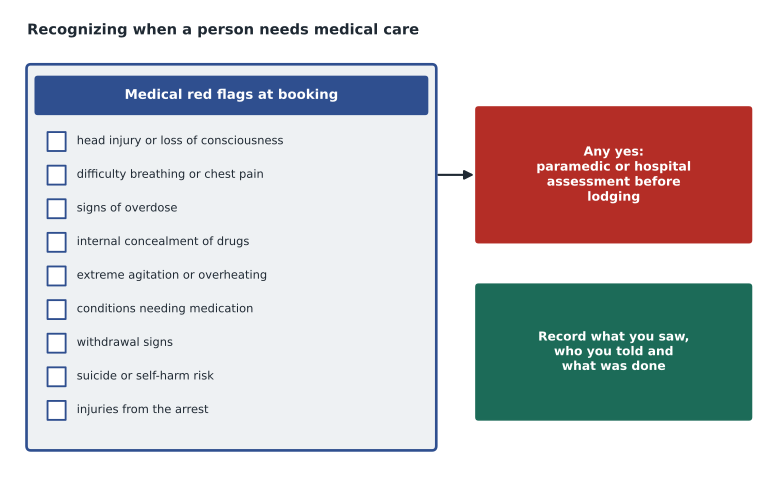
Officers are not medical professionals, but they must recognize signs that a person needs medical assessment. Desjardins gives the class a list that Port Ardent uses in training and on the booking screen. Any of these should lead to a paramedic or hospital assessment before or instead of lodging in a cell.
- Head injury, especially combined with intoxication, or any loss of consciousness.
- Difficulty breathing, chest pain, or a person saying they cannot breathe.
- Signs of overdose, such as pinpoint pupils, slow or noisy breathing, blue lips or being hard to wake.
- Known or suspected internal concealment of drugs.
- Extreme agitation, confusion, very high body temperature or unusual strength, especially after a struggle.
- Diabetes, epilepsy, heart conditions, asthma, pregnancy or other conditions that need medication or monitoring.
- Signs of alcohol or drug withdrawal, such as shaking, sweating, hallucinations or seizures.
- Thoughts of suicide or self-harm, or a recent attempt.
- Injuries from the arrest or from before it, including any use of force.
Haddad stresses the item about agitation. 'You will hear an old term for this, excited delirium. Major medical organizations no longer accept it as a diagnosis, and you should not use it in your reports,' she says. 'What matters for you is what it described: a person who is extremely agitated, confused, overheated and struggling is in a medical emergency. You call paramedics early, you get the struggle over as quickly and gently as you can, you get them off their stomach, and you watch their breathing.'
Intoxication and head injury
Intoxication is the most common medical issue in police custody, and it is dangerous in its own right. A very intoxicated person can stop breathing, choke on vomit, fall and hit their head, or have alcohol poisoning that looks like ordinary drunkenness. Intoxication also hides other problems. A person with a head injury, low blood sugar, a stroke or an overdose can look and sound drunk. That is why head injury plus intoxication is treated as a red flag, and why many services do not lodge a person who cannot stand, walk or answer simple questions without medical clearance.
Once Dunn was cleared by the hospital, Larocque put him on enhanced monitoring. Port Ardent's policy requires in-person checks at set intervals for intoxicated people, with officers waking the person and getting a response, not simply looking through the window. Federal and state guidance, and many lawsuit settlements, have emphasized that checks on intoxicated detainees must include rousing the person and confirming a meaningful response. The checks were logged on the cell screen with the time, the officer's name and Dunn's response. At 04:10, during a check, Dunn vomited. The officer turned him on his side, stayed with him, called Larocque and checked his responses against the hospital's instructions. He was awake, answering and not confused, and he did not vomit again. Larocque noted it and increased the frequency of checks until morning.
Worked problem
Building a rousing-check schedule
A detainee was lodged at 01:15 and is expected to be sober and assessed at 07:30. The custody sergeant orders checks every 15 minutes, starting at lodging. How many checks are needed?
Show solution
- Time covered: from 01:15 to 07:30 is 6 hours 15 minutes, or 375 minutes.
- Intervals: 375 ÷ 15 = 25.
- Checks: one at the start plus one at the end of each interval, 25 + 1 = 26.
- Schedule: 01:15, 01:30, 01:45 and so on, ending at 07:30.
Answer: 26 checks, the first at 01:15 and the last at 07:30.
The schedule shows that monitoring an intoxicated person properly is real work: twenty-six checks over a little more than six hours, each one requiring an officer to go to the cell, wake the person and record the response. Larocque plans her staffing around it. 'If I have four intoxicated people in on a Friday night, I need someone doing nothing but checks,' she says. 'If I don't have that person, I call the duty inspector. I do not skip checks.'
Drugs and overdose
Mason Pruitt had been arrested with pills that the drug unit believed were likely counterfeit tablets containing fentanyl. When Larocque booked him, she asked directly whether he had swallowed or hidden anything inside his body. He said he had not. She recorded the question and the answer, noted that he showed no signs of overdose, and put him on regular checks with the same rousing requirement. The booking desk at Port Ardent, like many police stations, keeps naloxone, which can reverse an opioid overdose, and every officer who works in the cells is trained to use it. Ohio, like most states, has a Good Samaritan law that offers limited protection from some drug charges for people who seek help for an overdose, and officers should know how it works.
Desjardins tells the class that internal concealment is one of the situations where a medical response must come before an evidence response. A person who has swallowed packages of drugs to hide them from police can die if a package leaks. If officers have reason to believe that has happened, the person goes to hospital, and any questions about evidence are dealt with there under proper legal authority.
Mental health and suicide risk
People in custody are at higher risk of suicide and self-harm, especially in the first hours after arrest, when they may be intoxicated, frightened, ashamed or facing the loss of a job, a relationship or their liberty. Booking includes questions about suicidal thoughts and past attempts, and officers should pass on anything they observed or were told during the arrest. Items that could be used for self-harm, such as belts, shoelaces, cords and some clothing, are removed. People assessed as being at higher risk are placed on closer observation, which may mean constant in-person watching. The psychology and crisis response course covered how to ask about suicide directly and how to respond. In custody, the same principles apply: ask, listen, take it seriously and get help.
Recording and handing over
Every medical observation, question and decision should be recorded: what the officer saw, what the person said, who was told, what advice was given and what was done. Records protect the person, because the next officer or the next shift can see what has happened and what to watch for. They also protect the officers, because they show that the duty of care was taken seriously. When Dunn was released in the morning, the release officer gave him a copy of the hospital's head injury instructions and told him to see a doctor if he developed headaches, vomiting or confusion. 'The duty of care does not end the moment he walks out the door,' Larocque says. 'It ends when he is safely back in charge of himself.'
| Person | Medical concern | Action taken |
|---|---|---|
| Riley Dunn | Head cut before arrest, heavy intoxication | Paramedic assessment, hospital clearance, rousing checks, recovery position after vomiting, instructions on release |
| Mason Pruitt | Possible fentanyl, possible internal concealment | Direct question at booking, signs of overdose checked, rousing checks, naloxone available |
| Mason Pruitt | Red mark on wrist from handcuffs | Photographed, recorded, checked again before court |
| Dana Whitcomb | None observed; distressed about job loss | Asked about well-being; given information about community supports on release |
Medical conditions that look like something else
Several common medical conditions can be mistaken for intoxication or deliberate non-compliance. Low blood sugar in a person with diabetes can cause confusion, slurred speech, sweating and aggression, and it can be fatal if untreated; a person wearing a medical alert bracelet or carrying an insulin pen should be assessed immediately. A person after an epileptic seizure may be confused, sleepy and uncooperative for some time. A stroke can cause slurred speech and weakness on one side. Alcohol withdrawal, which can begin within hours of a person's last drink, can cause shaking, sweating, hallucinations and seizures, and is a medical emergency in its severe forms.
Medications are part of the duty of care. People in custody may need regular medication for diabetes, epilepsy, heart conditions, mental illness or opioid use disorder, and missing doses can be dangerous. Policies differ on whether people can take their own medication in police cells, but they all require officers to ask about medication, record the answer and get medical advice when a dose will be missed. Larocque tells the class that the most important question at booking is often the simplest: 'Is there anything about your health I need to know to keep you safe tonight?'
Finally, officers should know when to call for help. Paramedics, nurses at the station where available, and hospital staff are partners in the duty of care, not an inconvenience. Larocque has never criticized an officer for calling paramedics for someone who turned out to be fine. She has criticized officers for not calling.
Worked problem
A sleeping prisoner
At 03:00, an officer checking cells sees a man who was arrested for being intoxicated in public lying on his back, snoring loudly, and does not wake him because he is 'clearly asleep'. The man was not assessed by a medic. What should have happened?
Show solution
- Recognize the risk: loud snoring in a very intoxicated person can be a sign of airway obstruction, not ordinary sleep.
- Rouse him and get a meaningful response, as the monitoring policy requires.
- If he cannot be roused easily, call for paramedics immediately and place him in the recovery position.
- Record the check, the response and any action; review why he was lodged without assessment if he met the criteria.
Answer: A check on an intoxicated person must include rousing and a response; snoring is not proof that he is safe.
Common mistakes
MistakeThe duty of care is a medical job for paramedics.
InsteadOfficers must notice, ask, record and get help; the duty starts at arrest.
MistakeA person who is talking is fine.
InsteadTalking does not rule out a head injury, overdose or breathing problem.
MistakeExcited delirium is a diagnosis to put in a report.
InsteadDescribe what you saw; treat extreme agitation and overheating as a medical emergency.
MistakeA cell check means looking through the window.
InsteadChecks on intoxicated people require rousing and a meaningful response.
Summary and key terms
- Due process requires medical care for people in custody, and deliberate indifference to serious needs can create liability.
- Head injury plus intoxication, breathing problems, overdose signs, internal concealment, extreme agitation, medical conditions, withdrawal, suicide risk and injuries are red flags.
- Red flags call for paramedic or hospital assessment before lodging.
- Intoxicated people need regular checks that include rousing and a meaningful response.
- Naloxone should be available and staff trained to use it.
- Record every medical observation and decision, and hand over information on release.
- Deliberate indifference
- Knowing of and disregarding a serious risk to a person's health or safety.
- Fit to be held
- A medical decision that a person can safely be held in custody, often with instructions.
- Rousing check
- A cell check in which the officer wakes the person and gets a meaningful response.
- Naloxone
- A medication that can reverse an opioid overdose.
Practice problems
Work each problem on paper first, then reveal the answer to check.
Why did Larocque refuse to lodge Dunn without hospital clearance?
Show answer
Head injury plus heavy intoxication could hide a bleed inside his skull.
What did the officer do when Dunn vomited at 04:10?
Show answer
Turned him on his side, stayed with him, called the sergeant and checked his responses against the hospital's instructions.
Why is internal concealment treated as a medical emergency?
Show answer
A leaking package can cause a fatal overdose.
In the worked example, how many checks were scheduled?
Show answer
Twenty-six.
Lesson quiz · 5 questions
Score 60% or more to complete this lesson.
Create a free account to save your progress, take quizzes and earn a certificate.