
LES-206 · Lesson 4 of 12 · 20 min
Approach, communication and gaining compliance
▶ Video coming soon A video version of this lesson is on the way.
The call to the Anchor Tavern came in at 21:47: a customer had punched a doorman and was refusing to leave. Car 14 was four blocks away. On the drive, Malhotra asked Reyes the question he asks before every call: 'What do we know, and what's the plan?' They knew one man had been assaulted, the suspect was described as a white man in his late twenties in a gray hoodie, there might be a crowd, and alcohol was involved. The plan was simple. Malhotra would be the contact officer and speak to the suspect; Reyes would be cover, check on the doorman and watch the crowd. Constable Nadine Coutu in car 9 was two minutes behind.
When they pulled up at 21:50, Riley Dunn was standing on the sidewalk shouting at Luis Ferraro, who was holding a napkin to his lip. As the car stopped, Dunn stepped forward and swung at Ferraro again, missing. That changed the timing of everything. 'If he hadn't swung, I'd have taken thirty seconds to talk from a distance,' Malhotra told the class later. 'Once he swung, I had to put myself between him and Ferraro right away. The plan stays the same. The speed changes.'
This lesson is about the approach and the words that come before, during and after an arrest. Desjardins tells the students that communication is the most important control tool an officer has. Most people comply with clear, calm, respectful direction. Many people who start out angry or frightened can be brought to comply if they are given time, information and a way to cooperate without losing face. Force is sometimes necessary, but in the great majority of arrests it is avoided, or kept to a minimum, by what the officer says and how they say it.
Planning the approach
The officer safety course covered approach planning in detail, and the same principles apply to arrests. Officers should use the information they have, decide roles, consider where the person is and who else is around, and think about what could go wrong. For an arrest, three additional questions matter. First, what is the authority and the reason, so that the officer can state them clearly? Second, what level of cooperation is likely, based on what is known about the person and the situation? Third, what does the officer want the person to do first, such as stay where they are, keep their hands visible or step away from someone? Having that first request ready makes the opening moments calmer.
For Dana Whitcomb in the mall security office, the approach was easy to plan. She was sitting down, calm and alone with a loss prevention officer. Reyes entered, introduced herself and Malhotra, and spoke to Price briefly at the door before turning to Whitcomb. For Mason Pruitt on Lakeshore Road, the approach was the planned traffic stop approach the students learned in the previous course, until Reyes saw his hand go to his waistband. She stepped back, told him calmly to keep both hands on the steering wheel, and waited for Malhotra to move to the passenger side before saying anything else.
Words that gain compliance
Desjardins teaches a simple sequence that many police services use in some form. It is not a script, but it gives officers a structure when they are under stress.
- Ask. Start with a polite request: 'Sir, I need you to step over here with me.' Many people comply at this stage.
- Explain. If the person hesitates, explain why: 'You're under arrest for assaulting the doorman, and I need to make sure everyone is safe.'
- Offer options. Give a real choice with consequences: 'You can walk to the car with me, or we'll have to hold your arms. I'd rather you walk.'
- Confirm. Give a last chance: 'Is there anything I can say to get you to walk with me?'
- Act. If the person still refuses and action is necessary, act with the minimum force needed, and keep talking.
The sequence works because it respects the person's ability to choose and gives them information before force is used. Haddad says the 'confirm' step is the one officers most often skip, because by then they are frustrated. 'That last question has saved more fights than anything else I know,' she says. 'Sometimes the person just needs to say something angry first, and then they walk.'
Officers also need to manage tone, volume and body language. A loud, sharp command can be right in an emergency, such as when someone is about to hit another person, but it should drop back to a calm, steady voice as soon as the emergency passes. Standing at an angle rather than square on, keeping hands visible and relaxed, and using the person's name all reduce tension. Short, specific requests are easier to follow than long explanations, especially for people who are intoxicated, frightened or in crisis.
Levels of cooperation and resistance
Many U.S. agencies, including in Ohio, describe a person's behavior in levels such as compliant, passive resistance, active resistance, aggressive resistance and aggravated or deadly resistance. These categories are not set by the Constitution but are used in training and policy to help officers choose and explain a response, and the Ohio Collaborative's statewide standard on use of force expects agencies to train officers to de-escalate and use only the force that is objectively reasonable. These categories help officers describe and justify their responses. They do not dictate a single correct response, and they change from moment to moment.
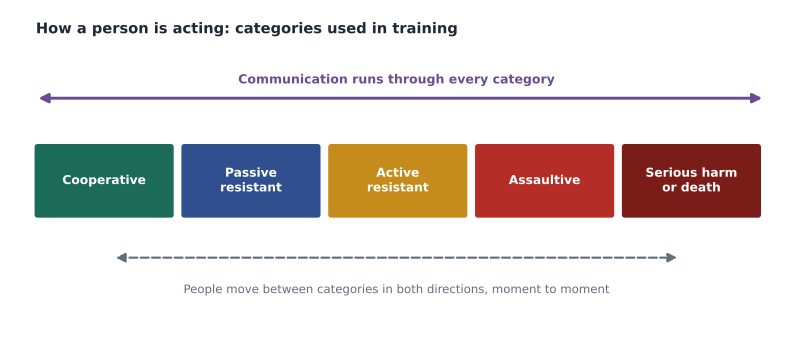
Desjardins asks the class to describe Riley Dunn's behavior over the first two minutes. Marco DiSanto starts: when the car pulled up, Dunn was assaultive, because he swung at Ferraro. When Malhotra stepped between them and told Dunn to stop, Dunn stepped back and stood still, shouting, which was closer to passive resistance. When Malhotra told him he was under arrest and asked him to turn around and put his hands behind his back, Dunn crossed his arms and refused, which was passive resistance. When Malhotra took hold of his arm, Dunn pulled away hard and tried to walk off, which was active resistance. Priya Sandhu adds that once he was on the ground and the officers told him he would be helped up when he stopped kicking, he stopped kicking, and from then on he was mostly cooperative, though still swearing.
The point of the exercise is that a person's behavior is not fixed. Officers have to watch for change in both directions and adjust. Force that was justified when a person was actively resisting must ease as soon as they stop. Communication runs through the whole encounter, from the first words to the moment the person is lodged in a cell.
Bystanders and recording
Outside the Anchor Tavern, about a dozen people had come out to watch, and several were recording on their phones. Reyes, as cover officer, placed herself where she could see both Dunn and the crowd and asked people to stay on the other side of the patio railing. Nobody interfered. Several federal appeals courts have recognized that people have a First Amendment right to record police performing their duties in public, subject to reasonable limits such as not interfering with officers' work, and agencies in Ohio generally train officers to treat such recording as lawful, and officers should not seize phones or demand that recordings be deleted without legal authority.
Haddad tells the class to treat bystanders as part of the safety picture and as potential witnesses rather than as opponents. A short explanation such as 'He's under arrest for assaulting the doorman; please stay back so nobody gets hurt' often calms a crowd. Arguing with people who are recording, or trying to block their view, usually makes things worse. 'Act as if your mother is watching the video,' she says. 'Because someone's mother is.'
Communication with people in crisis
Some people the police arrest are in a mental health crisis, experiencing a psychotic episode, having a medical emergency that looks like intoxication, or living with a cognitive disability that makes it hard to process commands. The psychology and crisis response course covered recognition and de-escalation in depth. For arrests, the main lesson is that a person who is not complying may not be able to comply. Signs such as confusion, disorientation, talking to people who are not there, extreme agitation, unusual strength or overheating call for slowing down, getting more help, including paramedics, and reconsidering whether arrest is the right response at all. Officers should also remember that hearing loss, autism and some medical conditions can look like non-compliance.
| What the contact officer said | Kind |
|---|---|
| Stop. Step back from him now. | direct |
| Sir, I need you to stay right there. | direct |
| You're under arrest for assaulting the doorman. | explain |
| Turn around and put your hands behind your back. | direct |
| You can walk to the car with me, or we'll have to hold your arms. I'd rather you walk. | options |
| Is there anything I can say to get you to walk with me? | confirm |
| Stop kicking and we'll help you up. | direct |
| Okay. We're going to sit you up now. Breathe. | direct |
Tally: five direct commands, one explanation, one set of options and one confirming question. Reviewers sort each line by its main purpose: a question asking the person to agree is a confirming question; a line giving the reason is an explanation; a line offering a choice gives options; anything else is a direct command.
The made-up transcript shows a mix of direct commands, an explanation, options and a confirming question. Haddad uses exercises like this in requalification training, where officers review their own body-worn camera audio. Many are surprised by how often they repeat a command without ever explaining it or offering a choice.
| Step | Example | Purpose |
|---|---|---|
| Ask | "I need you to step over here with me." | Gives the person a chance to comply voluntarily |
| Explain | "You're under arrest for assaulting the doorman." | Gives the reason and reduces confusion |
| Offer options | "You can walk with me, or we'll have to hold your arms." | Lets the person choose and save face |
| Confirm | "Is there anything I can say to get you to walk with me?" | A last chance before force |
| Act | Minimum force needed, while still talking | Achieves the lawful purpose safely |
Communication after the arrest
Communication does not stop when the handcuffs go on. In the car, at the station and in the cells, officers continue to explain what is happening, answer reasonable questions and listen. People in custody are often frightened, confused or angry, and many of the problems that arise after an arrest, such as a person refusing to leave the car or becoming aggressive at booking, can be prevented by telling them what will happen next. 'We're going to the station. You'll be searched again there, your property will be listed, and you'll have a chance to call a lawyer. Then the sergeant will decide whether you can be released tonight.' A few sentences like that can change how the next hour goes.
Officers must also be careful about what they say. Comments about the person's guilt, the strength of the evidence or what will happen in court can be treated as attempts to elicit a statement, and promises about release or charges can make any statement involuntary. Threats are never acceptable. Desjardins gives the class a simple rule: explain the process, never argue the case. Reyes found that Riley Dunn's swearing slowed down when she told him, in a level voice, exactly what would happen at the hospital and how long it would probably take. By the time they reached the emergency department, he was asking her whether the hockey game had gone to overtime.
Worked problem
Choosing the first words
An officer arrives at a convenience store where the clerk says a regular customer, an older man, has just threatened him after being refused cigarettes. The man is standing by the door, red-faced and breathing heavily. What should the officer's first words and actions be?
Show solution
- Position at a safe distance, at an angle, with the clerk out of reach of the man.
- Introduce yourself by name and use a calm voice: 'Hi, I'm Constable Reyes. Can you tell me what happened?'
- Listen before deciding whether there are grounds for an arrest; the threat may or may not be an offense.
- Watch for signs of a medical problem, such as chest pain or confusion, given his color and breathing.
Answer: Start with calm words and listening; the decision to arrest comes after the officer understands what happened.
Common mistakes
MistakeRepeating a command louder makes it more effective.
InsteadExplaining, offering options and confirming are usually more effective than repeating.
MistakeBehavior categories decide the response automatically.
InsteadThey describe behavior to help officers choose and explain a response, and they change moment to moment.
MistakePeople recording an arrest are interfering.
InsteadRecording from a reasonable distance is generally lawful; officers should explain and not seize phones without authority.
MistakeA person who does not comply is choosing not to.
InsteadSome people cannot comply because of crisis, illness, intoxication or disability.
Summary and key terms
- Plan the approach: know the authority, the likely cooperation and the first request you will make.
- Ask, explain, offer options, confirm and then act is a useful structure under stress.
- Tone, volume, stance and short, specific requests reduce tension.
- Agencies describe behavior in levels from compliant to aggravated resistance to help officers choose and explain their response.
- Behavior changes in both directions, and force must ease when resistance stops.
- Bystanders and recordings are part of the picture; explain and keep people safe rather than arguing.
- Contact officer
- The officer who speaks to and deals with the person.
- Cover officer
- The officer who watches the person, the surroundings and any crowd.
- Passive resistance
- Refusing to cooperate without physically fighting, such as going limp or crossing arms.
- Active resistance
- Physically resisting, such as pulling away, without attacking the officer.
- Assaultive behavior
- Attacking or attempting to attack another person.
Practice problems
Work each problem on paper first, then reveal the answer to check.
Why did Malhotra move straight between Dunn and Ferraro?
Show answer
Dunn swung at Ferraro again, so the risk of further assault meant he had to act immediately.
What are the five steps in the compliance structure?
Show answer
Ask, explain, offer options, confirm and act.
How did Dunn's behavior change over the first two minutes?
Show answer
From assaultive to passive resistant to active resistant and then mostly cooperative.
What should officers do about people recording an arrest?
Show answer
Keep them at a safe distance, explain what is happening and not seize phones without legal authority.
Lesson quiz · 5 questions
Score 60% or more to complete this lesson.
Create a free account to save your progress, take quizzes and earn a certificate.