
LES-203 · Lesson 12 of 12 · 19 min
Capstone: the collision report, charges and review
▶ Video coming soon A video version of this lesson is on the way.
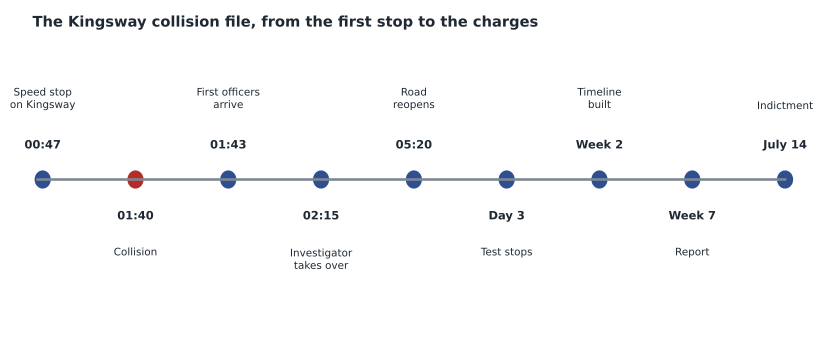
Seven weeks after the collision, Kowalczyk sent his reconstruction report to Haddad and the county prosecutor's office. It ran to 46 pages, with 31 photographs, a scale diagram, the recorder report, the signal log, the test stop results, the time-distance analysis and an appendix of calculations. Rosa Pereira had come home after three weeks in hospital and was walking with a cane. Her daughter had called the traffic office four times to ask what was happening. This final lesson follows the file from the report to the charging decision, looks at how officers support the people affected by a serious collision, and ends with a review of the whole night.
Desjardins asks the class to read the report's conclusions before anything else. 'Look at what it does not say. It does not say Halloran is guilty. It does not say Ana Pereira did nothing wrong. It says what the evidence shows, how confident the investigator is in each finding, and what each finding is based on. That is what a court needs, and it is what the families deserve.'
The collision report form
Every reportable collision produces a standard report, separate from any reconstruction. In Ohio, police complete the OH-1 Traffic Crash Report, which records the date, time and location, the road, weather and light conditions, the vehicles, drivers, occupants and non-motorists, the injuries, the contributing circumstances and a diagram. Reports are submitted to the Ohio Department of Public Safety, where they become part of the state crash database that engineers, researchers and policymakers use, and the data also feed national systems such as NHTSA's.
Haddad reminds the class that the form is not a formality. 'Somebody in an engineering office will use your form to decide whether Kingsway needs a left-turn arrow. If you write unknown for the light conditions or forget to tick the box for a hand-held device, you have given them wrong data. Fill it in like it matters, because it does.' In fact, the city installed a protected left-turn arrow at Kingsway and Mill Street for all hours in September 2026, citing the collision cluster on Kingsway and this collision in particular.
The reconstruction report
A reconstruction report is an expert report. It sets out the investigator's qualifications, the evidence examined, the methods used and the conclusions reached, in enough detail that another qualified person could check every step. Kowalczyk's report followed the structure his unit uses for all serious collisions.
| Section | What it contains |
|---|---|
| Summary | A one-page statement of the findings and their basis |
| Qualifications | The investigator's training, experience and certifications |
| Scene | Roads, signals, signs, lighting, weather, surface, and the scale diagram |
| Vehicles | Each vehicle's condition, damage, recorder data and mechanical inspection |
| People | Drivers, occupants, witnesses, injuries and impairment screening |
| Physical evidence | Marks, gouges, debris, final rest positions and photographs |
| Analysis | Speed, time-distance, avoidability, momentum and electronic evidence |
| Conclusions | Each finding, with its confidence and the evidence it rests on |
| Appendices | Calculations, test data, logs and the full recorder report |
The report's conclusions were stated in plain language. The pickup was traveling at about 47 to 48 mph, and not less than 40 mph, in a 30 mph zone when its driver began braking. The hatchback's driver began her turn when the pickup was about 247 ft away; for a vehicle traveling at the limit, that would have been an adequate gap. The pickup's driver began to respond about 0.9 seconds after the turn began; with a typical response, he could have stopped before the point of impact even at the speed he was traveling. A message was sent from his phone about one second before the turn began. Neither driver was impaired by alcohol, and there was no evidence of drug impairment. Both vehicles were mechanically sound. The signals were operating as designed.
Deciding on charges
The decision to charge belongs to different people in the two countries. In Ohio, police can file charges, but for felonies the county prosecutor decides whether to present the case to a grand jury for indictment, based on whether the evidence supports the charge beyond a reasonable doubt and whether prosecution is appropriate. Traffic citations are filed by the officer in municipal court and prosecuted by the city prosecutor.
Kowalczyk and Haddad met with the prosecutor in July. They discussed whether the evidence supported vehicular assault under section 2903.08 of the Revised Code, which in this situation requires proof that Halloran caused serious physical harm while driving recklessly, meaning with heedless indifference to a known risk. The prosecutor's view was that the speed, the phone use and his earlier speeding stop that night gave a reasonable basis to present the case, and a grand jury indicted Halloran for vehicular assault, a felony of the fourth degree, on July 14, 2026, along with misdemeanor charges of speeding and using a hand-held device. Ana Pereira was not charged.
Halloran is presumed innocent. At the time of this lesson, his case had not been tried. Kowalczyk tells the class that he expects the defense to challenge the drag factor, the alignment of the clocks, the inference from the phone message and the length of the anti-lock marks. 'Good. That is what defense lawyers are for. Every one of those challenges is answered in the report, because we knew they were coming.'
| Decision | Who makes it | Test |
|---|---|---|
| Filing a traffic citation | The investigating officer | Probable cause |
| Presenting a felony to a grand jury | The county prosecutor | Sufficient evidence and the interests of justice |
| Indictment | The grand jury | Probable cause |
| Guilt | The court or jury | Proof beyond a reasonable doubt |
Victims and families
Serious collisions leave people injured, frightened and often angry, and they usually know little about how investigations and prosecutions work. The investigating unit has a duty to keep them informed. Ohio's Constitution, as amended by Marsy's Law in 2017, gives crime victims rights to information about the case, to be present and heard at proceedings, to be treated with fairness and respect, and to restitution, and Ohio law requires agencies to tell victims about those rights. Port Ardent's traffic unit assigns a family liaison officer to every collision involving death or serious injury.
Teague was the Pereiras' liaison. She called Ana Pereira the morning after the collision, visited the family at the hospital two days later, explained the investigation in plain terms, and called again each time a major step was completed, including the day the charges were laid. She also connected the family with victim services. Ana Pereira's main question in the first weeks was whether she had caused her mother's injuries by turning. Teague could not tell her the conclusion until the report was finished. When she could, she explained carefully what the report found and what it did not decide.
Reviewing the night
Port Ardent's traffic unit reviews every serious collision investigation, as the course has done with other incidents. The review asks what went well, what could have been done better, and what should change. The table shows the scores Haddad and Kowalczyk gave, from 0 to 2 for each area.
| Area | Score | Comment |
|---|---|---|
| Scene safety | 2 | Cruiser placed upstream with lights; road closed quickly |
| Life and first aid | 2 | Malhotra stayed with Rosa Pereira and called for extrication early |
| Perimeter | 1 | First perimeter missed the faint start of the anti-lock marks; later extended |
| Early photographs | 2 | Reyes's 14 photographs preserved the debris before the rescue |
| Witnesses | 2 | Siddiqui identified and his dashboard camera secured with written consent |
| Impairment screening | 2 | Both drivers screened and observations recorded |
| Rights and statements | 2 | Rights given promptly; first statements written word for word |
| Electronic evidence | 2 | Signal log, bank video, recorders and phone obtained lawfully |
| Earlier contact | 1 | Coutu's speed stop was well documented but not linked to the collision until the next day |
| Family liaison | 2 | Liaison assigned within 12 hours; regular updates |
Worked problem
Scoring the review
Eight areas scored 2 and two areas scored 1. What is the total out of 20, and what share of the possible score is that?
Show solution
- \[8 \times 2 + 2 \times 1 = 18\]
- 18 out of 20 is 90 in 100.
Answer: 18 out of 20, or 90 in 100 of the possible score.
The review led to three changes. First, first officers at serious collisions are now told to search for the start of marks with a flashlight held low, beyond where they first see them, before taping the perimeter. Second, when a driver is involved in a serious collision, dispatchers now automatically search the computer-aided dispatch system for any police contact with the same driver or vehicle in the previous 24 hours, so that earlier stops like Coutu's are linked at once. Third, the unit added a short module on aligning clocks from different devices to its annual training.
Testifying as a collision investigator
Collision reconstructionists usually testify as expert witnesses, which means they may give opinions, not only describe what they saw. Before an expert can give opinion evidence in an Ohio court, the judge must be satisfied under Ohio Rule of Evidence 702 that the testimony relates to matters beyond the knowledge of ordinary people, that the witness is qualified by knowledge, skill, experience, training or education, and that the testimony is based on reliable scientific, technical or other specialized information. The defense can challenge the expert's qualifications and methods at a hearing before trial. Kowalczyk keeps a current résumé of his training, his reconstruction certifications and the cases in which he has testified, because he is asked for it every time.
An expert's credibility depends on staying within their expertise and being open about uncertainty. Kowalczyk testifies to what the marks, the recorder and the calculations show, gives ranges rather than single numbers, explains each step in plain language with his scale diagram, and says clearly when a question is outside his field, such as the medical cause of Rosa Pereira's injuries. He also answers the defense's questions as fully and fairly as the prosecutor's. 'I am not there for either side,' he tells the students. 'I am there to explain what the evidence shows. The moment a jury thinks I am arguing for one side, everything I say is worth less.'
In fatal collisions, investigators also work with the coroner, who in Ohio investigates the cause and manner of sudden or violent deaths and issues findings that become part of the official record; in larger counties this work is done by a medical examiner's office with forensic pathologists on staff. The coroner's investigation is separate from the criminal case, but it often relies on the collision investigators' findings, and its recommendations, such as calls for safer intersections or changes to licensing rules, can reach far beyond a single case.
Kowalczyk also reminds the students that the officers who were at the scene first will testify as well, not only the experts. Reyes and Malhotra will be asked what they saw when they arrived, what Halloran said and when, how the scene was protected and how his Miranda warnings were given. Their reports, written that night, will be the most important thing they bring to court. Each of them will also be asked whether they discussed the case with each other before writing, which is why Port Ardent officers write their own reports separately.
What this course has covered
Desjardins ends the course where it began, with the Pereira family. 'Every lesson in this course was really about one question: how do we keep people like Rosa Pereira safe, and when we fail, how do we find out honestly what happened? The traffic law, the speed devices, the stops, the breath tests, the marks on the road and the square roots are all tools for answering that question. Use them carefully. Write everything down. And remember that behind every collision report is a family waiting for a phone call.'
Common mistakes
MistakeThe reconstruction report should say who is guilty.
InsteadIt sets out findings and their basis; guilt is for the court.
MistakeThe officer alone decides whether a serious charge goes ahead.
InsteadThe prosecutor and grand jury decide whether a felony goes ahead.
MistakeFamilies should hear nothing until the case is over.
InsteadVictims have rights to information, and a liaison officer keeps them informed.
MistakeA good investigation has nothing to learn from a review.
InsteadEven strong investigations find improvements, such as linking earlier contacts sooner.
Summary and key terms
- The collision report form feeds the data that guide engineering and enforcement.
- A reconstruction report explains the evidence, methods and confidence behind each finding.
- Felonies go to the prosecutor and grand jury; vehicular assault requires recklessness in this situation.
- The accused is presumed innocent; the report must anticipate challenges.
- Victims and families have rights to information and support, delivered through a liaison officer.
- Reviews score what went well and lead to concrete changes.
- Reconstruction report
- An expert report explaining how and why a collision happened.
- Family liaison officer
- An officer assigned to keep victims and families informed during an investigation.
- Recklessly
- Acting with heedless indifference to a known risk, the mental state for vehicular assault in this situation.
- After-action review
- A structured review of an incident to identify strengths and improvements.
Practice problems
Work each problem on paper first, then reveal the answer to check.
What did the reconstruction report conclude about the gap Ana Pereira accepted?
Show answer
That it would have been adequate for a vehicle traveling at the speed limit.
What mental state must be proven for vehicular assault in this situation?
Show answer
Recklessness, meaning heedless indifference to a known risk.
What did Teague do as the family liaison?
Show answer
Kept the family informed at each step, explained the investigation and connected them with victim services.
What three changes came out of the review?
Show answer
Searching for the faint start of marks before taping, automatic checks for earlier contacts, and training on aligning clocks.
Lesson quiz · 5 questions
Score 60% or more to complete this lesson.
Create a free account to save your progress, take quizzes and earn a certificate.