
LES-203 · Lesson 9 of 12 · 21 min
Documenting the collision scene: evidence, photographs and measurements
▶ Video coming soon A video version of this lesson is on the way.
When Kowalczyk took over the Kingsway investigation at 02:15, he walked the scene twice before he touched anything. The first time he walked from east to west along the pickup's path, starting well beyond the first visible mark, looking at the road with his flashlight held low so that the beam would raise the texture of any marks. The second time he walked the hatchback's path, from the eastbound lanes through its turn to its final rest against the curb on the north-west corner. Only then did he decide what to photograph, what to measure and in what order. 'The scene tells you a story,' he tells the class. 'Your job in the first hour is to write it down before anyone changes it.'
This lesson covers the kinds of physical evidence found at collision scenes, how they are photographed and measured, and how investigators turn measurements into a scale diagram. The aim is a record so complete that another investigator, or a court, could understand the scene years later without ever having stood in the intersection.
Marks on the road
Tire marks are the most important physical evidence at many collisions, because they show where vehicles went and, sometimes, how fast. A skid mark is made by a tire that is locked and sliding without rotating; it is usually dark, straight and of even width, and it begins abruptly when the wheels lock. Vehicles with anti-lock brakes, which now includes almost every car and light truck on the road, rarely leave classic skid marks, because the system releases and reapplies the brakes many times a second. Instead they leave lighter, sometimes broken marks, often called anti-lock or ABS marks, which can be hard to see and easy to miss.
A yaw mark, sometimes called a critical speed scuff, is made by a tire that is rotating but also sliding sideways, as happens when a vehicle is steered too sharply for its speed. Yaw marks are curved, and they often show diagonal striations across their width. Lesson 11 explains how their curve can be used to estimate speed. A scuff mark is a short, irregular mark made at impact, when a tire is suddenly pushed sideways. Investigators also look for gouges and scrapes in the road surface made by metal parts dragged or driven into the pavement at impact; these are often the best evidence of the exact point of impact.
| Evidence | How to recognize it | What it can show |
|---|---|---|
| Skid mark | Dark, straight, even width, abrupt start | Path before impact; speed from length and drag factor |
| Anti-lock braking mark | Light, sometimes broken, may fade in and out | Path and braking; speed with care |
| Yaw mark | Curved, with diagonal striations | Path in a turn or swerve; critical speed |
| Impact scuff | Short, sharp change in a tire mark | Approximate point of impact |
| Gouge or scrape | Cut or scratch in the pavement from metal | Point of impact and post-impact path |
| Debris and fluids | Glass, plastic, dirt, coolant, oil | Area of impact and paths to final rest |
| Final rest positions | Where vehicles and objects stopped | Post-impact movement and energy |
On Kingsway, the pickup's front tires had left two light anti-lock marks in the westbound curb lane, one under each front wheel. As Kowalczyk finally measured them, the marks began about 79 feet east of a short, sharp scuff and a set of gouges in the asphalt, where the pickup's front bumper and frame had been driven down by the impact. The first officers had seen the marks start about 5 feet closer to the gouges; with his flashlight held low, Kowalczyk found the faint true start of the left front mark, which was why he extended the perimeter. Beyond the gouges, a curved line of fresh scrapes led north-west to the hatchback's final rest, and a scatter of broken plastic and glass covered an area about 30 feet by 20 around and beyond the gouges.
Marks on the vehicles
The vehicles themselves are evidence. Investigators photograph and measure the damage to each vehicle, a process called crush measurement, which can later be used to estimate the energy absorbed in the collision. They note the direction of the damage, transfers of paint between vehicles, the positions of the gear selector, light switches and seats, whether seat belts were worn, airbag deployment, and the condition of the tires and brakes. They also note anything that may have distracted a driver, such as a phone, food or an open drink, and where it was found. On Kingsway, Kowalczyk noted that the hatchback's right side was pushed in a maximum of 19 inches at the front passenger door, that both front airbags and the right-side curtain airbag had deployed, and that both occupants had been belted. In the pickup, a phone lay on the floor in front of the passenger seat, with its screen cracked.
Photographing the scene
Photographs are the most efficient way to record a scene, but only if they are taken systematically. Investigators work from overall photographs, which show the whole scene and its approaches from each direction, to mid-range photographs, which show the relationship between items of evidence, to close-up photographs of individual items, taken first without and then with a scale or marker in the frame. Every photograph is recorded in a photo log with its number, time, location, direction and subject. Night photography needs more care: investigators use a tripod and long exposures or powerful lighting, and they photograph the same marks again in daylight if the scene is still available.
| Type | Purpose | Example on Kingsway |
|---|---|---|
| Overall | Show the whole scene and each approach | View west along Kingsway from 60 m east of the first mark |
| Mid-range | Show how items relate to each other | The end of the anti-lock marks, the gouges and the debris field together |
| Close-up without scale | Show the item exactly as found | The gouge marks in the asphalt |
| Close-up with scale | Allow measurement from the photograph | The same gouges with a scale and an evidence marker |
| Driver's view | Show what a driver could see | View from the pickup driver's eye height at the start of the marks |
Kowalczyk's team took 212 photographs on Kingsway that night, in addition to the 14 Reyes took before the rescue. They also took a series of driver's-view photographs from a vehicle like the pickup, parked at points along its path with the camera at the driver's eye height, and from a vehicle like the hatchback in the left-turn position. Those photographs became important in lesson 11, when the investigators had to decide what each driver could have seen and when.
Measuring the scene
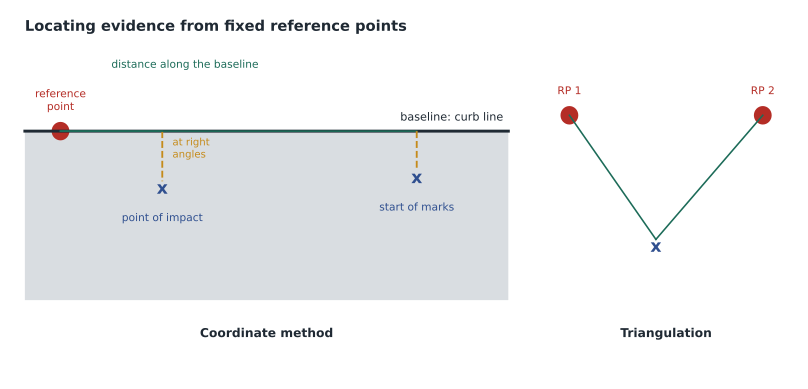
Photographs show what evidence looks like; measurements show exactly where it is. The basic principle is to locate every item of evidence in relation to fixed reference points that will still be there after the scene is cleared, such as a curb corner, a hydrant or a utility pole. Two traditional methods are still taught because they need only a tape measure and can be checked in court: the coordinate method and triangulation.
In the coordinate method, the investigator picks a reference point and a baseline, usually the edge of the road or the curb line. Each item is located by two measurements: its distance along the baseline from the reference point, and its distance at right angles from the baseline. In triangulation, each item is located by its distances from two reference points, which forms a triangle that can be redrawn later. Triangulation works better when there is no straight edge to use as a baseline, such as in a parking lot or on a curve.
Worked problem
Locating the point of impact
Kowalczyk's reference point is the end of the curb return on the north-east corner of Kingsway and Mill Street, and his baseline is the north curb of Kingsway. The gouges at the point of impact are 20.3 ft east of the reference point along the curb and 11.2 ft south of the curb. The start of the anti-lock marks is 99.3 ft east and 9.8 ft south. How long is the path from the start of the marks to the point of impact?
Show solution
- The difference along the baseline is 99.3 minus 20.3, which is 79.0 ft. The difference across is 11.2 minus 9.8, which is 1.4 ft.
- The straight-line distance is found with the Pythagorean theorem.
- \[\sqrt{79.0^2 + 1.4^2} = \sqrt{6242.96} \approx 79.0 \text{ ft}\]
- Because the marks run almost parallel to the curb, the small sideways shift makes almost no difference to the length.
Answer: About 79.0 ft from the start of the marks to the point of impact.
Total stations, scanners and drones
Many services now measure scenes with a total station, a surveying instrument that measures angles and distances electronically to a reflector held over each item, and records thousands of points accurately in an hour. Others use three-dimensional laser scanners, which record millions of points in a few minutes, or drones that take overlapping photographs from above so that software can build an accurate map of the scene, a method called photogrammetry. These tools are faster and more accurate than tape measures, but the principle is the same: every point is fixed in relation to permanent references, so the scene can be rebuilt later. Kowalczyk used the unit's total station on Kingsway; the drone was not flown because of the darkness and a light rain that began at 03:30.
The rain mattered. Wet asphalt has a lower drag factor than dry asphalt, and the collision happened on a dry road. Kowalczyk recorded the time the rain began and made sure that the measurements of the marks and the photographs of the road surface were completed before then. He also noted the air temperature, the road surface type and its condition, because lesson 10 shows how the drag factor depends on them.
The scale diagram
From the measurements, investigators draw a scale diagram of the scene, showing the roads, lanes, signals and signs, the marks, debris, gouges, final rest positions and the reference points. Diagrams drawn at the scene are field sketches, not to scale but fully labeled with every measurement. The final diagram is drawn to scale, today usually with computer software, and becomes an exhibit at trial. The scale must be stated on the diagram, along with a north arrow and a legend.
Worked problem
Drawing to scale
Kowalczyk's final diagram is drawn at a scale of 1 inch to 20 feet. How long should the 79.0 ft path of the anti-lock marks be on the diagram?
Show solution
- At 1 inch to 20 feet, each 20 ft on the road is 1 inch on the diagram.
- \[79.0 \div 20 = 3.95 \text{ in}\]
Answer: 3.95 inches on the diagram.
Electronic and other evidence
Modern collisions leave electronic evidence as well as physical marks. Most vehicles now have an event data recorder, often part of the airbag control module, which records a few seconds of data before and during a crash, such as speed, throttle, braking, seat belt use and steering. Phones record calls, messages and app use with exact times. Dashboard cameras, traffic cameras and nearby businesses' security cameras may have recorded the collision itself. Signal controllers record timing, as lesson 8 described. Each source needs its own legal authority to obtain, which lesson 11 covers, and each must be secured quickly before it is overwritten.
On Kingsway, the electronic evidence included Siddiqui's dashboard camera, which had recorded the intersection from the Mill Street stop line; the city's signal log; a bank security camera that recorded part of the westbound lanes; the event data recorders in both vehicles; and Halloran's phone. Kowalczyk asked Siddiqui for permission to copy his camera's memory card at the scene, which Siddiqui gave in writing, and he had an officer go to the bank's security company first thing in the morning.
Common mistakes
MistakeModern cars always leave clear skid marks.
InsteadAnti-lock brakes leave lighter, sometimes broken marks that are easy to miss.
MistakeClose-up photographs need only a scale in the frame.
InsteadTake each close-up first without and then with a scale, so the item is shown exactly as found.
MistakeA tape-measured diagram is no longer useful.
InsteadTape methods still work and are easy to explain; total stations and scanners apply the same principles faster.
MistakeVehicle damage is only relevant to insurance.
InsteadCrush, airbag deployment, belts and items inside the vehicle are all evidence.
Summary and key terms
- Skid, anti-lock, yaw and scuff marks, gouges, debris and final rest positions each show part of what happened.
- Vehicles are evidence: crush, airbags, belts, controls and objects inside all matter.
- Photographs move from overall to mid-range to close-up, with and without scale, and are logged.
- The coordinate method and triangulation locate evidence from fixed reference points.
- Total stations, scanners and drones apply the same principles more quickly.
- Electronic evidence, from event data recorders to dashboard cameras, must be secured quickly and lawfully.
- Anti-lock braking mark
- A light, sometimes broken tire mark left by a vehicle braking hard with anti-lock brakes.
- Point of impact
- The location where the vehicles first made contact.
- Coordinate method
- Locating evidence by a distance along a baseline and a distance at right angles to it.
- Event data recorder
- A device in a vehicle that records data from the seconds before and during a crash.
Practice problems
Work each problem on paper first, then reveal the answer to check.
What is the difference between a skid mark and a yaw mark?
Show answer
A skid mark comes from a locked, sliding tire; a yaw mark from a rotating tire sliding sideways in a turn.
Why did Kowalczyk extend the perimeter?
Show answer
Because he found a faint continuation of the pickup's anti-lock mark farther east.
What are the two measurements in the coordinate method?
Show answer
The distance along the baseline from the reference point and the distance at right angles from the baseline.
Why was the rain at 03:30 important?
Show answer
Because wet pavement has a lower drag factor, so the dry-road measurements and photographs had to be finished first.
Lesson quiz · 5 questions
Score 60% or more to complete this lesson.
Create a free account to save your progress, take quizzes and earn a certificate.