
LES-203 · Lesson 4 of 12 · 19 min
The traffic stop: authority, conduct and fairness
▶ Video coming soon A video version of this lesson is on the way.
Between 19:00 and 01:40 on the Friday night, the officers on Port Ardent's B platoon made twenty-three traffic stops. Most lasted under ten minutes. One produced an arrest for impaired driving, one led to a warrant arrest, and the rest ended with tickets, warnings or no action at all. The stop that Reyes and Malhotra made on Harbor Road at 22:15, the speeding stop Coutu made on Kingsway at 00:47, and the check stop that caught an impaired driver at 23:10 each began with the same legal question: what gave the officer the power to stop the vehicle at all?
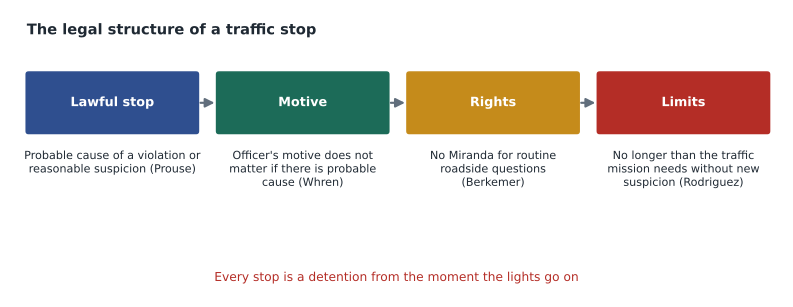
Desjardins treats the traffic stop as a meeting point of three things the class has studied separately: the law of detention, the communication skills that make encounters go well, and the fairness concerns that shape public trust. 'Every stop is a detention,' he says. 'The driver is not free to leave. That means the law applies from the moment the lights go on, and so does the driver's sense of whether you are treating them fairly.'
The legal authority to stop
In the United States, a traffic stop is a seizure under the Fourth Amendment. In Delaware v. Prouse in 1979, the U.S. Supreme Court held that police may not stop individual vehicles at random to check licenses and registrations without reasonable suspicion, although checkpoints that stop every vehicle, or every vehicle in a neutral pattern, can be lawful. A stop is lawful when the officer has probable cause to believe a traffic violation occurred or reasonable suspicion that the driver or an occupant is involved in criminal activity. In Michigan Department of State Police v. Sitz in 1990, the Court upheld sobriety checkpoints that meet neutral, published guidelines.
The power to stop also has limits. In Whren v. United States in 1996, the Court held that a stop based on probable cause of a traffic violation is reasonable under the Fourth Amendment even if the officer's real motive is to investigate something else; the officer's subjective motive does not matter. The Ohio Supreme Court reached the same result under the Ohio Constitution in Dayton v. Erickson the same year. But in Rodriguez v. United States in 2015, the Court held that a stop may last no longer than needed to deal with the traffic violation, unless the officer develops reasonable suspicion of something more. A dog sniff that adds time to a completed stop, without new suspicion, violates the Fourth Amendment.
| Question | What the law says |
|---|---|
| Can police stop a car at random? | No, they need probable cause or reasonable suspicion (Delaware v. Prouse, 1979) |
| Can police set up a sobriety checkpoint? | Yes, with neutral, published guidelines (Michigan v. Sitz, 1990) |
| Does the officer's motive matter? | No, if there is probable cause of a violation (Whren, 1996) |
| How long can the stop last? | Only as long as the traffic mission needs, without new suspicion (Rodriguez, 2015) |
Detention, rights and the driver
A driver stopped at the roadside is seized, but in Berkemer v. McCarty in 1984, the U.S. Supreme Court held that the ordinary traffic stop is not custodial interrogation, so Miranda warnings are not required for routine roadside questions such as whether the driver has been drinking. Once the driver is placed under arrest, or the stop becomes as restrictive as a formal arrest, Miranda applies before questioning. In Pennsylvania v. Muniz in 1990, the Court held that routine booking questions and the physical performance of sobriety tests are not testimonial, though some questions, such as asking the date of the driver's sixth birthday, can be.
Officers may ask drivers for their license, registration and proof of insurance, and drivers are legally required to produce them. Under section 4507.35 of the Revised Code, a driver must display their license on demand of a police officer, and drivers must also show proof of financial responsibility. Passengers are in a different position. In Brendlin v. California in 2007, the U.S. Supreme Court held that passengers are also seized during a traffic stop and can challenge its lawfulness. Officers may order the driver out of the car under Pennsylvania v. Mimms in 1977 and passengers out under Maryland v. Wilson in 1997, but passengers generally have no duty to identify themselves unless the officer has reasonable suspicion of an offense.
Choosing the place and time
The officer controls where a stop happens more than any other part of it. A good location is one where the vehicles can get fully off the traveled road, where there is light, where other traffic can pass safely and where the driver will not be tempted to stop in a dangerous spot. On Kingsway, Coutu waited until the pickup had passed a curve and the entrance to a closed bank lot before turning on her lights. 'People stop wherever they are when the lights come on,' she says. 'If you light them up just before a bridge, they stop on the bridge.'
Officers also think about the time of the stop. A stop that can wait until a safer location is reached usually should. A stop on a highway at night carries the risk of a secondary collision, which is one of the leading causes of officer deaths on duty in both countries. Ohio's move-over law, section 4511.213 of the Revised Code, requires drivers to move over a lane, or slow down if they cannot, when passing a stationary public safety vehicle with its lights flashing.
Communication at the window
The first words at the window shape the rest of the stop. Desjardins teaches a structure many services use, which can be remembered as greeting, identity, reason and request: a polite greeting, the officer's name and service, the reason for the stop, and the request for documents. Research on procedural justice, introduced in earlier courses, has found that drivers who are told why they were stopped and treated with respect are more likely to see the stop as fair, even when they receive a ticket, and more likely to obey the law in future.
Coutu's opening words to Halloran, captured on her body-worn camera, were these: 'Good evening, I'm Officer Coutu with Port Ardent Police. I stopped you because my laser showed your speed at 50 miles per hour in a 30 zone. May I see your license, ownership and insurance, please?' Kowalczyk plays the clip for the students and then plays a different clip, from another service's training library, where an officer begins with 'Do you know why I stopped you?' The second driver became defensive within seconds. 'Do not make the driver guess,' Kowalczyk says. 'Tell them.'
| Step | What it does | Example from Coutu's stop |
|---|---|---|
| Greeting | Sets a respectful tone | "Good evening." |
| Identity | Tells the driver who is stopping them | "I'm Officer Coutu with Port Ardent Police." |
| Reason | Explains the detention, as the law requires | 'Your speed was 50 in a 30.' |
| Request | States what the officer needs | "May I see your license, ownership and insurance?" |
| Explanation at the end | Tells the driver what happens next | "Here is your ticket, and here is how you can dispute it." |
Officer safety principles
Traffic stops carry real risk, both from passing traffic and, less often, from occupants. Officer safety at traffic stops is covered in detail in other courses. The principles that matter here are planning and information: running the plate before the stop when possible, telling dispatch the location and the plate before making the stop, choosing the location, watching the occupants' hands and movements, and calling for backup before the stop when the information suggests a higher risk. NCIC and Ohio's LEADS system can tell an officer before the stop whether the vehicle is stolen, whether the registered owner has a suspended license or outstanding warrant, and whether there are cautions about the owner.
A records check can itself give grounds for a stop. In Kansas v. Glover in 2020, the U.S. Supreme Court held that an officer who learns that the registered owner's license is revoked may reasonably infer, absent other information, that the owner is driving, and may stop the vehicle to find out.
Bias, data and fair stops
The fairness of traffic stops has been one of the most studied questions in policing. Ohio is one of many states where agencies collect demographic data on traffic stops, and the Stanford Open Policing Project, which assembled data on nearly 100 million stops across the country, found that Black drivers were stopped at higher rates than white drivers and searched more often, while searches of Black drivers were less likely to find contraband. The project also found that the gap in stop rates narrowed after dark, when officers are less able to see a driver's race, which suggests that some of the difference reflects bias rather than driving behavior.
Desjardins presents the data without softening it, and then turns to what officers can control. 'Base every stop on what the vehicle is doing, not on who is in it. Focus on the behaviors that injure people. Explain the reason at the start. Make the stop as short as the reason allows. Record the outcome honestly, including when you did nothing. And ask yourself, every so often, whether the people you stop for minor things look like the people you are not stopping.'
Worked problem
Is the stop taking longer than it needs to?
Coutu's speed stop of Halloran began at 00:47:30 and the citation was handed over at 00:54:10. Her agency's typical time for a speed stop with a records check is about 7 minutes. Was the stop longer than usual?
Show solution
- Find the length of the stop by subtracting the start time from the end time.
- \[00{:}54{:}10 - 00{:}47{:}30 = 6 \text{ min } 40 \text{ s}\]
- Six minutes and forty seconds is slightly under the typical seven minutes.
- The stop was no longer than the traffic mission needed, which is the test in Rodriguez v. United States.
Answer: About 6 minutes 40 seconds, slightly shorter than usual.
Ending the stop and recording it
How a stop ends matters as much as how it begins. The officer should explain the outcome, whether a ticket, a warning or no action, and explain what the driver can do next, such as paying, disputing or fixing an equipment problem. Officers then record the stop: time, location, reason, driver, vehicle, outcome and any search or force. Port Ardent officers record every stop in the computer-aided dispatch system and the records management system, and the department publishes annual stop data. Coutu's record of the Halloran stop took two minutes and later became one of the most important pieces of the collision file.
When a driver is upset
Some drivers are angry, frightened or upset from the first moment of a stop. A driver may be late for work, worried about losing their license, or carrying a history of bad experiences with police. Officers are trained to treat strong emotion as information rather than as a challenge. Lowering the voice, explaining the reason again, giving the driver a chance to speak and describing the next steps calmly often settle a stop that started badly. Malhotra's advice to Reyes is to let the driver finish before answering. 'Most people want to be heard more than they want to win. Let them say it, then explain what happens next.'
When a driver refuses to provide documents or to follow a lawful direction, the officer explains the legal requirement and the consequence of refusing, and gives the driver time to comply. If the driver still refuses, the officer may have grounds to arrest, for example for failing to display a license on demand or for obstructing official business under section 2921.31. Calling a supervisor and slowing the stop down are usually better choices than escalating it, and body-worn camera recordings help courts and complaint reviewers see exactly what was said.
Common mistakes
MistakePolice may stop any car at random to check documents.
InsteadRandom document stops are unlawful under Delaware v. Prouse; police need probable cause or reasonable suspicion, except at lawful checkpoints.
MistakeAsking "Do you know why I stopped you?" is a good way to start.
InsteadTelling the driver the reason at the start is clearer, lawful and more likely to be seen as fair.
MistakeA stop may last as long as the officer wishes once it has begun.
InsteadIt may last only as long as its legitimate purpose requires, unless new grounds arise.
MistakeFairness concerns are only about officer attitudes.
InsteadThey are also about where, when and for what officers choose to stop vehicles, which data can reveal.
Summary and key terms
- Stops need probable cause or reasonable suspicion (Prouse); neutral checkpoints are allowed (Sitz).
- The officer's motive does not matter if there is probable cause (Whren), but the stop cannot be extended without new suspicion (Rodriguez).
- Every stop is a detention, so the driver must be told the reason promptly.
- Officers control the location and timing of a stop, which are key to safety.
- A respectful opening that states the reason makes stops safer and fairer.
- Stop data has shown racial disparities; focusing on dangerous behavior and recording outcomes honestly helps.
- Detention
- A restriction of a person's liberty by police; every traffic stop is one.
- Pretext stop
- A stop made for a traffic reason when the officer is also interested in something else.
- Procedural justice
- Fair treatment in police encounters: voice, respect, neutrality and trustworthy motives.
- Move-over law
- A law requiring drivers to slow down and change lanes when passing stopped emergency vehicles.
Practice problems
Work each problem on paper first, then reveal the answer to check.
What did Delaware v. Prouse decide?
Show answer
That police may not stop individual cars at random to check licenses without reasonable suspicion.
What are the four parts of the opening structure Desjardins teaches?
Show answer
Greeting, identity, reason and request.
Why did Coutu wait to stop the pickup until it passed the curve?
Show answer
So that the stop would happen in a safe location with room to pull off the road.
Why are Miranda warnings not needed for roadside questions?
Show answer
Because Berkemer v. McCarty held that an ordinary traffic stop is not custodial interrogation.
Lesson quiz · 5 questions
Score 60% or more to complete this lesson.
Create a free account to save your progress, take quizzes and earn a certificate.