
LES-203 · Lesson 2 of 12 · 19 min
Traffic law: offenses, licenses and the rules of the road
▶ Video coming soon A video version of this lesson is on the way.
At 22:15 on the Friday night, three hours before the Kingsway collision, Officer Sofia Reyes and her field training officer, Officer Dev Malhotra, stopped a gray minivan on Harbor Road for going through a red light. The driver produced a license, but the registration in the glove box belonged to a different vehicle, and the insurance card had expired two weeks earlier. In ten minutes at the side of the road, Reyes dealt with three different kinds of traffic law: the rules of the road, the licensing and registration of drivers and vehicles, and the requirement to carry insurance. She also had to decide which of the possible charges were worth laying.
Desjardins uses the minivan stop to introduce the structure of traffic law. 'Most of what you enforce on the road is not criminal law,' he tells the class. 'It is state law, written to keep traffic moving safely, and it has its own rules about how offenses are proven and punished. You need to know where your authority comes from, what the offense actually requires, and what happens to the ticket after you hand it over.'
Where traffic law comes from
In the United States, each state writes its own traffic law, and federal law mostly sets standards for vehicles, commercial drivers and highway funding. Ohio's traffic laws are found mainly in Title 45 of the Ohio Revised Code, including Chapter 4511 on traffic rules, Chapter 4510 on driver's license suspensions and Chapter 4513 on equipment. Financial responsibility, meaning insurance, is covered in Chapter 4509. Serious driving crimes such as vehicular homicide and vehicular assault appear in Chapter 2903, and cities like Port Ardent adopt traffic codes that mirror state law and are enforced in municipal court.
The split matters for officers because it decides which court hears the case, what the officer must prove and what penalties are possible. A speeding citation under the city's traffic code is a minor misdemeanor heard in municipal court, usually resolved with a fine and points. A vehicular assault charge under state law can be a felony, prosecuted in common pleas court, with prison time and a lifetime record.
Kinds of traffic offenses
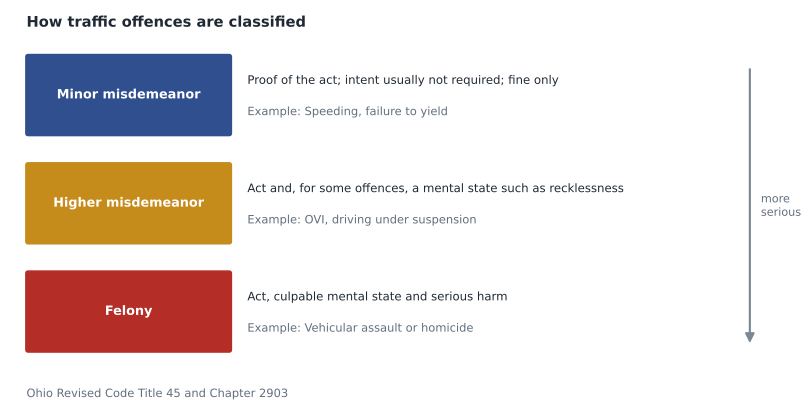
Most state traffic offenses are what American courts call strict liability or public welfare offenses: the prosecution must prove that the defendant did the prohibited act, but it usually does not have to prove intent. Speeding is the classic example; a driver who did not realize how fast they were going is still guilty. Ohio classifies most traffic violations as minor misdemeanors, which carry a fine but no jail, while more serious ones, such as reckless operation repeat offenses, driving under suspension and OVI, are misdemeanors of a higher degree. Crimes such as vehicular assault and vehicular homicide require a culpable mental state, such as recklessness or negligence, set out in the statute.
| Type | What must be proven | Example |
|---|---|---|
| Strict liability (minor misdemeanor) | The act; intent usually not required | Speeding, failure to yield, equipment violations |
| Misdemeanor with mental state | The act and a mental state such as recklessness | Reckless operation, OVI repeat offenses |
| Felony | The act, a mental state and serious harm, beyond a reasonable doubt | Aggravated vehicular assault or homicide |
Licensing: who may drive
Ohio uses graduated licensing for drivers under 18: a temporary instruction permit, then a probationary license with night-time and passenger restrictions, then a full license. Ohio drivers under 21 who are found with a low concentration of alcohol, starting at 0.02 grams per 100 milliliters of blood, can be charged with operating a vehicle after underage consumption. Ohio's point system assigns points for convictions; a driver who reaches 12 points within two years faces a suspension.
Driving while suspended or prohibited is one of the offenses most closely linked to serious crashes, because drivers who have lost their license have often lost it for dangerous behavior. Driving under suspension is an offense under section 4510.11 and related sections of the Revised Code, and the penalties increase for suspensions imposed for OVI. When Reyes ran the minivan driver's license, it came back valid. Had it come back suspended, the stop would have become more serious, and the vehicle could have been impounded.
Registration and insurance
Every motor vehicle on a public road must be registered to an owner and carry valid plates. Registration links the vehicle to a person who can be held responsible for it, and it lets police identify stolen vehicles, unpaid tolls and vehicles involved in crimes. The minivan's registration permit belonged to the driver's previous van, which he had sold a month earlier. The van he was driving was registered in his name but he had left the new permit at home. Ohio law requires that the vehicle be registered and display valid plates, and police can confirm registration electronically. Reyes confirmed the registration through records in under a minute.
Insurance is a separate requirement. Ohio's financial responsibility law requires every driver to maintain proof of insurance or another approved form of financial responsibility, and drivers who cannot show proof can face a license suspension, reinstatement fees and the impoundment of their plates. Ohio also checks insurance at random through the Bureau of Motor Vehicles. The expired insurance card turned out to be the old card; the driver's insurer confirmed by phone that the policy had been renewed. Reyes noted the confirmation in her notebook and did not charge him.
Malhotra uses this to make a point about discretion. 'The law gave her three possible charges. One was a real safety offense, the red light. Two were paperwork that turned out to be fine. She charged the red light and let the rest go once she confirmed it. That is a good use of discretion. A ticket for a permit left at home does nothing for road safety.'
The rules of the road
Most of the offenses that cause collisions are found in the rules of the road: speed, signals, right of way, turning, lane use, following distance, passing and the duties at crosswalks and school buses. For investigators, the most important rules are the ones that decide who had to yield. At the Kingsway collision, the central legal question was the left turn. Section 4511.42 of the Ohio Revised Code requires a driver turning left at an intersection to yield the right of way to any vehicle approaching from the opposite direction that is within the intersection or so close as to be an immediate hazard. The rule raises an obvious question that the rest of this course tries to answer: how close is close enough to be an immediate hazard, and does it matter that the other vehicle was speeding?
The answer in both countries is that the right of way is not a license to drive dangerously. A driver with the right of way is still expected to drive at a lawful speed and to take reasonable steps to avoid a collision. If the approaching vehicle was traveling far over the limit, the turning driver may have judged the gap correctly for a vehicle traveling at the limit. Investigators therefore need both the legal rule and the physical evidence of speed before they can decide who, if anyone, should be charged.
| Rule | Ohio Revised Code | Why it matters in collisions |
|---|---|---|
| Speed limits | Section 4511.21 | Speed raises crash risk and severity |
| Reckless operation | Section 4511.20 | Covers willful or wanton disregard of safety |
| Traffic control devices | Section 4511.12 | Red-light running causes serious side-impact crashes |
| Left turns | Section 4511.42 | Left-turn conflicts are a common injury collision |
| Duty after a crash | Section 4549.02 | Drivers must stop and give information |
Speed limits and how they are set
Ohio's speed law sets prima facie limits by type of area: 20 mph in school zones during restricted hours, 25 mph in urban districts, 35 mph in some other areas, and higher limits on rural roads and highways, up to 70 mph on some interstates. A prima facie limit means that driving above it is evidence of unreasonable speed, and section 4511.21 also requires every driver to drive at a speed that is reasonable for the conditions, even below the posted limit.
Officers sometimes forget that the posted limit is the maximum for ideal conditions. On a rainy night, in fog or in heavy traffic, a driver can be traveling below the limit and still be driving too fast. Ohio's reasonable-speed rule and its assured clear distance ahead rule, which requires drivers to be able to stop within the distance they can see ahead, cover this situation. Investigators often find that the most important speed question in a collision is not whether the driver exceeded the limit, but whether they could have stopped in the distance they could see.
Worked problem
Is it worth the charge?
Reyes stops a driver for traveling 49 mph in a posted 30 mph zone on Kingsway at 23:00. How far over the limit is the driver, and what share of the limit is that?
Show solution
- The amount over the limit is 49 minus 30.
- \[49 - 30 = 19 \text{ mph}\]
- 19 mph over a 30 mph limit is close to two-thirds of the limit again: 19 divided by 30 is about 0.63.
- The charge is speeding under section 4511.21, a minor misdemeanor, with points on the driver's record.
Answer: 19 mph over, or about 63 in 100 above the limit: a serious speeding charge.
After the ticket: how traffic cases move through court
In Ohio, most traffic violations are charged on the Ohio Uniform Traffic Ticket, which serves as both the citation and the complaint. Minor misdemeanors can usually be paid without a court appearance through the violations bureau, unless the court requires an appearance. More serious charges, such as OVI or driving under suspension, require an appearance. At trial, the officer is usually the main witness, which is why notes matter so much.
Haddad, who supervised Reyes and Malhotra that night, reminds the class that the court sees only what the officer wrote down. 'You will testify about a red light six months later. You will not remember the color of the van or what the driver said. Your notes will. Write down what you saw, where you were, what the light was doing and what the driver said, in that order.'
Equipment and vehicle fitness
Traffic law also sets standards for the vehicle itself: working headlights, tail lights and brake lights, tires with adequate tread, brakes that work on every wheel, a clear windshield, mirrors and, for heavy vehicles, detailed rules on loads, axle weights and inspections. Section 4513.02 of the Revised Code makes it an offense to drive a vehicle that is in an unsafe condition or lacks required equipment, and officers can order an unsafe vehicle off the road. Equipment defects rarely cause serious crashes on their own, but worn tires, failed brakes and missing lights can turn a driver's mistake into a collision. That is why a collision investigation always includes an examination of the vehicles' mechanical condition, as lesson 12 shows.
Equipment stops also raise fairness questions, because they give officers wide discretion over which vehicles to stop. A burned-out license plate light is a lawful reason to stop a car, but it does little for road safety, and stops for minor equipment defects have been shown to fall most heavily on drivers with older cars and on communities that are already stopped often. Many services now encourage officers to use warnings or repair notices for minor defects and to focus enforcement on the defects that actually make a vehicle dangerous.
Common mistakes
MistakeAll traffic offenses are criminal offenses.
InsteadMost are minor misdemeanors under state or city law; only the serious ones, such as vehicular assault, are felonies.
MistakeA driver who is under the posted limit cannot be driving too fast.
InsteadDrivers must also drive at a speed that is reasonable for the conditions.
MistakeA driver with the right of way has no duty to avoid a collision.
InsteadEvery driver must still drive lawfully and take reasonable steps to avoid a crash.
MistakeEvery possible charge should be laid.
InsteadOfficers should focus on the offenses that affect safety and use discretion for paperwork errors that are quickly corrected.
Summary and key terms
- Traffic law comes mostly from Title 45 of the Ohio Revised Code and city traffic codes, with serious offenses in Chapter 2903.
- Most traffic offenses are strict liability minor misdemeanors; serious ones require a mental state such as recklessness.
- Licensing, registration and insurance laws make sure drivers are qualified and victims can be compensated.
- Right-of-way rules decide who must yield, but they do not excuse dangerous driving by the other driver.
- Posted limits are maximums for ideal conditions; drivers must also drive at a reasonable speed.
- Good notes are the core of every traffic prosecution.
- Strict liability
- An offense that does not require proof of intent.
- Minor misdemeanor
- Ohio's lowest class of offense, punishable by a fine but not jail.
- Prima facie limit
- A speed limit above which driving is evidence of unreasonable speed.
- Right of way
- The legal priority of one road user over another in a particular situation.
- Discretion
- An officer's judgment about whether and how to enforce the law in a particular case.
Practice problems
Work each problem on paper first, then reveal the answer to check.
Why is speeding usually treated as a strict liability offense?
Show answer
Because the prosecution need prove only the act, not that the driver intended to speed.
What must a left-turning driver do?
Show answer
Yield to oncoming traffic that is in the intersection or close enough to be an immediate hazard.
Why did Reyes not charge the minivan driver for the insurance card?
Show answer
Because the insurer confirmed the policy was valid; the card in the van was simply out of date.
What is the difference between the posted limit and a reasonable speed?
Show answer
The posted limit is the maximum for good conditions; a reasonable speed may be lower in rain, fog or traffic.
Lesson quiz · 5 questions
Score 60% or more to complete this lesson.
Create a free account to save your progress, take quizzes and earn a certificate.