
LES-203 · Lesson 1 of 12 · 20 min
Traffic safety and the purpose of enforcement
▶ Video coming soon A video version of this lesson is on the way.
At 01:40 on Saturday, May 16, 2026, a pickup truck traveling west on Kingsway struck a small hatchback that was turning left onto Mill Street. The driver of the hatchback, Ana Pereira, 34, was badly bruised. Her mother, Rosa Pereira, 61, who was in the passenger seat on the side the pickup hit, was taken to Port Ardent General with a broken pelvis and three broken ribs. The pickup's driver, Brent Halloran, 29, was not hurt. Within an hour of the crash, Sergeant Andre Kowalczyk of the traffic bureau was standing in the intersection with a measuring wheel, a camera and a flashlight, looking at the marks on the road.
Kowalczyk has worked in traffic for sixteen of his twenty-two years with the Port Ardent Police Department, and for the last nine he has been one of the service's two trained collision reconstructionists. He joins Professor Ray Desjardins as a guest instructor for this course at Maumee Valley Community College. 'Most of you will never fire your weapon at work,' he tells the class on the first day. 'Every one of you will go to collisions. Many of you will go to a fatal one in your first year. And the way you handle the first twenty minutes will decide whether anyone ever knows what really happened.'
This course follows one Friday night shift and its aftermath in Port Ardent. It begins with why traffic work matters, moves through traffic law, speed enforcement and the traffic stop, spends three lessons on impaired driving, and then follows the Kingsway collision from the first call to the final report. Along the way it introduces the physics and arithmetic that collision investigators use, always as a way of answering a legal question: what happened, who was responsible and what can be proven.
Why traffic work matters
Road crashes kill and injure far more people than violent crime does. In the United States, the National Highway Traffic Safety Administration counted 39,254 traffic deaths in 2024, and its early estimate for 2025 was about 36,640, which would be the lowest in several years. By comparison, the FBI counts somewhat under 20,000 murders in a typical recent year. For people between their teens and their mid-thirties, motor vehicle crashes are one of the leading causes of death in both countries.
Behind the numbers are a small set of causes that appear again and again in investigations: speed too high for the conditions, alcohol and drugs, distraction, fatigue, failure to wear a seat belt, and failure to yield at intersections. Each one is a choice a driver makes, which is why enforcement can change outcomes. A driver who expects to be stopped for speeding slows down; a driver who believes a check stop may be around the next corner is less likely to drive after drinking. The aim of traffic enforcement is not to write tickets but to change those choices.
Desjardins asks the class to think about the Pereira family. 'Rosa Pereira did nothing wrong. She was a passenger. Her daughter made a left turn she makes every week. Whatever the investigation shows about who should have yielded, the question for us as a society is why a collision like that one sends a 61-year-old woman to hospital for three weeks. Traffic policing is one of the answers.'
Three tools: engineering, education and enforcement
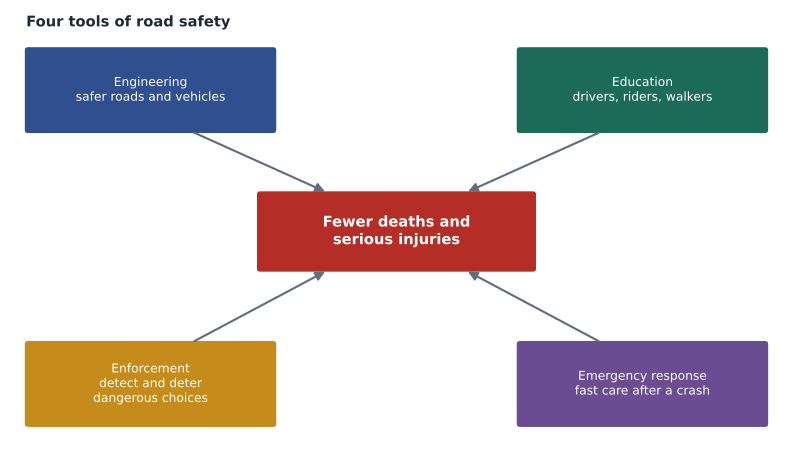
Road safety professionals have long described three tools for reducing crashes, sometimes called the three Es: engineering, education and enforcement. Engineering means designing roads and vehicles so that mistakes are less likely and less harmful, for example with roundabouts, protected left-turn signals, rumble strips, crash barriers, airbags and electronic stability control. Education means teaching drivers, cyclists and pedestrians about risks and rules, from driver training to public campaigns. Enforcement means police and other agencies detecting and deterring dangerous behavior. Many agencies now add a fourth E, emergency response, because fast medical care saves lives after a crash happens.
The three tools work best together. A campaign about impaired driving is more effective when people also see check stops on the road. A new speed limit on a residential street works better when the street is also narrowed and the limit is enforced in the first weeks. Kowalczyk tells the students that his unit meets each month with the city's traffic engineers. 'We bring them the collision data. They bring us the redesigns. Sometimes the best thing I can do for an intersection is tell an engineer it needs a left-turn arrow, not put an officer there every night.'
The Safe System approach
The U.S. Department of Transportation adopted a National Roadway Safety Strategy in 2022 based on what is called the Safe System approach, and many American cities have set Vision Zero goals of eliminating road deaths and serious injuries. The Safe System approach starts from two ideas. First, people will always make mistakes, so the road system should be built so that a mistake does not cost a life. Second, the human body can only survive a limited amount of force, so speeds should be kept low enough in places where people are exposed, such as at intersections and on streets with pedestrians, that a crash is survivable.
The second idea explains why speed is so central to traffic safety. The energy in a moving vehicle increases with the square of its speed. A car traveling at twice the speed carries four times the energy into a crash. Research on pedestrian collisions has repeatedly found that the risk of death rises steeply as impact speed rises: a pedestrian struck at around 20 mph usually survives, while one struck at around 40 mph is much more likely to die. Lesson 10 returns to the energy idea when it explains how investigators estimate speed from the marks a vehicle leaves when it brakes.
Worked problem
Speed and energy
A car traveling at 30 mph is involved in a crash. How much more energy would the same car carry into the crash at 42 mph?
Show solution
- Kinetic energy is proportional to the square of the speed, so the mass cancels and only the ratio of the speeds matters.
- The ratio of the speeds is 42 divided by 30, which is 1.4.
- \[1.4^2 = 1.96\]
- The car carries almost twice as much energy into the crash, even though its speed rose by only two-fifths.
Answer: About 1.96 times as much energy, nearly double, for a speed only 12 mph higher.
What police do in traffic safety
Police contribute to traffic safety in several ways. They enforce the rules of the road, especially the ones most closely linked to serious crashes. They investigate collisions to find out what happened, to lay charges where the evidence supports them and to give engineers and planners accurate information. They manage traffic at crash scenes, events and emergencies. And they collect data, because every collision report becomes part of the statistics that guide where enforcement and engineering are needed next.
Enforcement is most useful when it is focused. Port Ardent's traffic unit uses what Kowalczyk calls data-led deployment: each quarter, the unit maps the previous year's injury collisions and the locations of public complaints, and assigns enforcement to the places and times where serious crashes cluster. On Kingsway between Harbor Road and Mill Street, the map shows a cluster of left-turn collisions at night, most involving a vehicle traveling well over the limit. 'That is why we were on Kingsway that night with a speed detection unit,' Kowalczyk says. 'And it is why, when the call came, I was only four minutes away.'
| Factor | Why it matters | Typical police response |
|---|---|---|
| Speed | Raises both the chance of a crash and its severity | Speed enforcement at high-risk locations and times |
| Alcohol and drugs | Slows reaction, impairs judgment and coordination | Sobriety checkpoints, field sobriety tests, drug recognition evaluations |
| Distraction | Takes eyes and attention off the road | Enforcing hand-held device laws |
| Seat belts | Unbelted occupants are far more likely to die | Seat belt enforcement and campaigns |
| Failure to yield | Causes many intersection and pedestrian crashes | Intersection enforcement and collision investigation |
Enforcement, legitimacy and fairness
Traffic stops are the most common way people come into contact with police. That makes them powerful in two directions. A traffic stop done well can save a life and leave the driver thinking the officer was fair even if a ticket was issued. A traffic stop done badly can leave a driver angry, humiliated or frightened, and when stops fall unevenly on some communities, they can damage trust in the police for years. Large studies of traffic stop data in the United States, including the Stanford Open Policing Project's review of nearly 100 million stops, have found that Black drivers are stopped and searched at higher rates than white drivers. Lesson 4 looks at how officers can make stops lawful, focused and fair.
Desjardins connects this to the purpose of enforcement. 'If the point is to change behavior and save lives, then the stops that matter most are the ones at the places and times where people are getting hurt, for the behaviors that hurt them. A stop for a broken license plate light in a neighborhood where nobody has been hurt in a crash in five years does far less for road safety than a speed check on Kingsway at one in the morning.'
The investigator's mindset
Collision investigation is a form of criminal investigation, even when no criminal charge is laid. It follows the same principles covered in earlier courses: preserve life first, secure the scene, document before anything is moved, keep an open mind, and test every theory against the physical evidence. The difference is that much of the evidence at a collision is fragile and temporary. Tire marks fade under traffic and rain. Debris is swept away when the road is cleared. Vehicles are towed. Witnesses leave. Electronic data in a vehicle can be overwritten. The first officers on scene therefore have a duty to protect evidence that they may not yet understand.
Kowalczyk keeps a card in his notebook with three questions he asks at every collision: What happened? Why did it happen? Who is responsible, if anyone? The first question is answered mostly by physical evidence and data, the second by combining that evidence with what drivers and witnesses say, and the third by applying the law to the facts. 'People want me to start with the third question,' he says. 'Families want to know who is to blame. I can only answer that once I have honestly answered the first two.'
When and where serious crashes happen
Serious crashes are not spread evenly across the week. In both countries, crashes involving alcohol and high speed cluster at night and on weekends, while crashes involving distraction and congestion are more common in daytime traffic. Rural roads see fewer crashes than city streets but a far higher share of deaths, because speeds are higher, roads are often undivided and help takes longer to arrive. Young male drivers are overrepresented in speed and impairment crashes, and older drivers in intersection crashes where judging gaps and speeds becomes harder. Port Ardent's collision map reflects all of these patterns, which is why the traffic unit schedules most of its speed and impairment enforcement on Friday and Saturday nights.
How this course is organized
Lessons 2 and 3 cover the traffic laws officers enforce most often and the science behind speed enforcement. Lesson 4 covers the legal authority and conduct of traffic stops. Lessons 5 to 7 cover impaired driving: the offenses, the roadside investigation and the evidence that proves impairment or a prohibited concentration. Lessons 8 to 11 follow the Kingsway collision: scene management, documentation, speed from tire marks and the analysis of time and distance. Lesson 12 brings the investigation together in a final report and a review of what the officers did well and what they could have done better.
Throughout the course, the arithmetic is kept to what a patrol officer or a collision investigator actually uses: multiplication, square roots and unit conversions. Every calculation is shown step by step in worked examples. U.S. examples use feet and miles per hour, as most American police and courts do. The physics is the same in either system; only the constants change.
Common mistakes
MistakeTraffic enforcement is mainly about writing tickets.
InsteadThe goal is to change dangerous driving choices and prevent deaths and injuries.
MistakeSpeed matters only for whether a crash happens.
InsteadSpeed also determines how much energy is released in a crash, and so how badly people are hurt.
MistakeCollision investigation starts once the reconstructionist arrives.
InsteadIt starts with the first officer, who must protect fragile evidence such as tire marks, debris and witnesses.
MistakeRandom stops anywhere are as useful as focused enforcement.
InsteadEnforcement focused on high-risk places, times and behaviors does more for safety and is fairer.
Summary and key terms
- Road crashes kill and injure far more people each year than violent crime.
- Speed, impairment, distraction, seat belt non-use and failure to yield are the main causes officers target.
- Engineering, education, enforcement and emergency response work best together.
- The Safe System approach assumes people make mistakes and keeps speeds survivable where people are exposed.
- Traffic stops are the most common police contact, so fairness and focus matter.
- Collision investigation follows the same principles as any investigation, with especially fragile evidence.
- Safe System approach
- A road safety strategy that designs roads, vehicles and speeds so human mistakes do not cost lives.
- Vision Zero
- A goal of eliminating road deaths and serious injuries.
- Data-led deployment
- Assigning enforcement to the places and times where serious collisions cluster.
- Kinetic energy
- The energy of a moving object, proportional to its mass and the square of its speed.
Practice problems
Work each problem on paper first, then reveal the answer to check.
What are the four Es of road safety?
Show answer
Engineering, education, enforcement and emergency response.
Why does a small increase in speed matter so much in a crash?
Show answer
Because the energy released rises with the square of the speed.
What three questions does Kowalczyk ask at every collision?
Show answer
What happened, why it happened and who is responsible, if anyone.
Why must the first officer on scene protect evidence?
Show answer
Because tire marks, debris, vehicle data and witnesses are fragile and temporary.
Lesson quiz · 5 questions
Score 60% or more to complete this lesson.
Create a free account to save your progress, take quizzes and earn a certificate.