
LES-202 · Lesson 2 of 12 · 21 min
Court structure and the path of a criminal case
▶ Video coming soon A video version of this lesson is on the way.
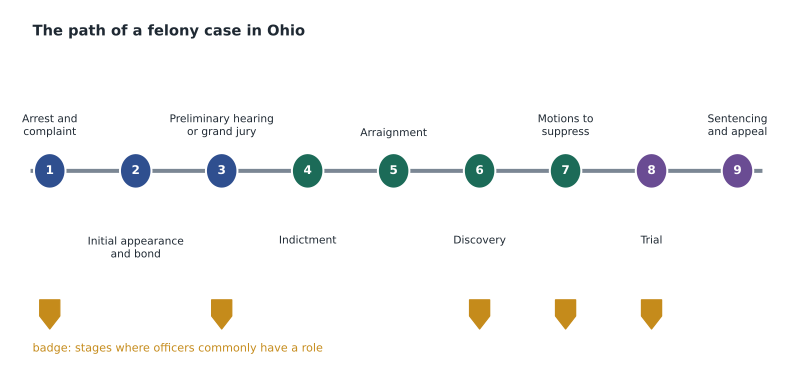
Shane Brennan was arrested on Crescent Street at 2:32 on the morning of March 14, 2026. His trial ended on October 15. Desjardins draws a line across the whiteboard and asks the class to fill in what happened between those two dates. The students offer 'court' and 'trial', and he keeps asking 'and before that?' until the line is crowded with steps. An initial appearance in Port Ardent Municipal Court. A bond. A complaint, then an indictment by the Lucas County grand jury. Arraignment in the Court of Common Pleas. Discovery. A motion to suppress and a hearing. A jury waiver. Then three days of trial. 'Every one of those steps,' Desjardins says, 'can involve a police officer, and several of them can go wrong because of something an officer did or did not do.'
This lesson explains how criminal courts are organized and how a case moves through them. Officers need to know this for practical reasons: to know which court a summons comes from, why a case is delayed, what a preliminary step is for, and what their role is at each stage. They also need it to explain the process to victims and witnesses, who are often confused and anxious about what will happen next.
The Ohio and federal court systems
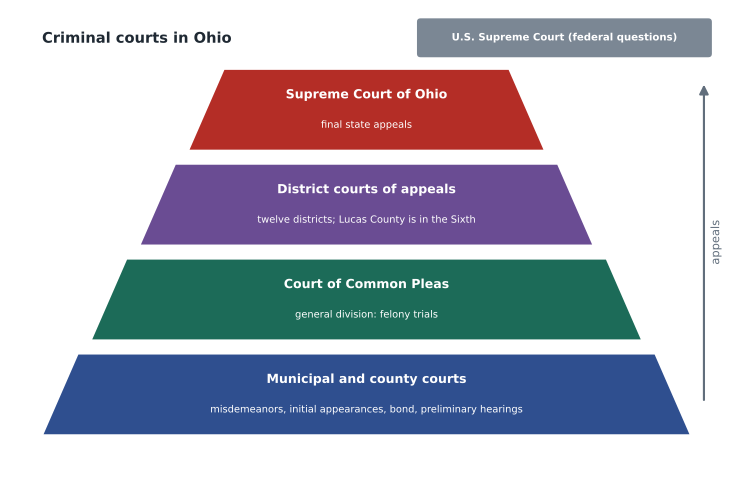
The United States has two parallel court systems. Federal courts apply federal criminal law, such as federal drug, firearms and fraud statutes, and are organized into district courts for trials, circuit courts of appeals, and the United States Supreme Court. State courts apply state criminal law, which is where almost all street crime is prosecuted. In Ohio, municipal and county courts hear misdemeanours, traffic cases and the first stages of felony cases, including initial appearances, bond and preliminary hearings. The court of common pleas, one in each of Ohio's 88 counties, is the general trial court; its general division hears all felony cases. Appeals go to one of twelve district courts of appeals, with Lucas County in the Sixth District, and then to the Supreme Court of Ohio. A case raising a federal constitutional question can reach the United States Supreme Court from the Supreme Court of Ohio.
Classifying offenses
Ohio divides offenses into felonies, which can be punished by a prison term, and misdemeanours, which can be punished by up to 180 days in jail. Felonies are graded from first degree, the most serious, to fifth degree, the least, with murder and aggravated murder in their own categories. Misdemeanours are graded from first to fourth degree, plus minor misdemeanours, which are punishable by fine only. Breaking and entering an unoccupied structure under Revised Code 2911.13 is a felony of the fifth degree. Burglary of an occupied structure under 2911.12 is much more serious, ranging from a fourth- to a second-degree felony, which reflects how much more serious society considers entering a place where people are or are likely to be.
In Ohio, a person charged with a felony has a constitutional right to indictment by a grand jury, and a right to a jury trial. The accused may waive a jury in writing under Criminal Rule 23(A) and be tried by the judge alone, which is called a bench trial. Felony juries in Ohio have twelve members and must reach a unanimous verdict. Misdemeanour juries have eight members, and in petty offenses the accused must request a jury in writing. In the Bayview case, Brennan chose a trial by judge alone. Kwan explains that defense lawyers often prefer a judge when the main issue is a legal one, such as whether evidence should be excluded, and when the defense wants to argue a reasonable doubt that depends on careful reasoning rather than sympathy.
From arrest to first appearance
After an arrest, the officer must decide whether to release the person or hold them for a court appearance. Under Ohio Criminal Rule 4 and 5, a person arrested without a warrant must be brought before a court without unnecessary delay, and a complaint must be filed. At the initial appearance the judge or magistrate informs the accused of the charges and rights, considers counsel, and sets bond under Criminal Rule 46, which favors release and allows financial conditions only when needed. Brennan appeared in Port Ardent Municipal Court on Monday, March 16, was released on a recognizance bond with a condition not to go to Bayview Pharmacy, and the case was set for a preliminary hearing. Desjardins notes that the release paperwork, including the time and conditions, is part of the disclosure package, and that a careless error in it, such as a wrong date to attend, can lead to a missed appearance and a warrant that is not the accused's fault.
Bail and release are covered in depth in other courses. For this course, the key point is that the officer's report at this stage, often called a probable cause affidavit or arrest report, is read by the court and by the defense and becomes part of the record. It must be accurate. Okeke's initial synopsis described the stop and said that 'a pat-down search revealed a pry bar and stolen property in the accused's backpack'. That sentence was not true: the pat-down was of Brennan's clothing, and Okeke found the property only by opening the backpack afterward. The defense lawyer, Helen Marchetti, noticed the discrepancy the moment she compared the synopsis with the in-car video.
Charging and the formal accusation
In Ohio, a felony case begins with a complaint, usually sworn by the arresting officer in municipal court. Within a set time, the case must either have a preliminary hearing, where a judge decides whether there is probable cause, or be presented to a grand jury. The grand jury, a group of citizens meeting in private with the prosecutor, hears evidence, often from the investigating officer, and decides whether to return an indictment. An indictment ends the need for a preliminary hearing. In the Bayview case, the Lucas County grand jury returned an indictment on April 2 for breaking and entering and possessing criminal tools under Revised Code 2923.24, and the case moved to the Court of Common Pleas. Whitlock, the investigating detective, testified for about twenty minutes before the grand jury.
Preliminary hearings and the grand jury
A preliminary hearing in Ohio is held in municipal court under Criminal Rule 5(B), where the judge decides whether there is probable cause to believe the accused committed a felony. The officer usually testifies and can be cross-examined. If the grand jury indicts first, no preliminary hearing is held, which is what happened in the Bayview case. Grand jury testimony is secret, but if the officer testifies at trial, the defense may in some circumstances obtain the officer's grand jury testimony to cross-examine on inconsistencies. Testimony at a preliminary hearing is recorded and can be used the same way. Kwan tells the class that whatever an officer says under oath at any stage can be compared with what they say at trial. 'There is only one version of the truth,' he says. 'Tell it the same way every time.'
Pretrial steps
After the formal accusation, the case enters a phase of disclosure, negotiation and pretrial motions. At arraignment in the common pleas court, the accused enters a plea, usually not guilty at first. Discovery is exchanged under Criminal Rule 16. Motions are filed, including motions to suppress evidence, which must generally be filed before trial under Criminal Rule 12. In the Bayview case, Marchetti filed a motion to suppress in May, arguing that the backpack search exceeded the scope of a lawful frisk. The court held an evidentiary hearing on September 1, at which Okeke testified, and granted the motion in part. Most criminal cases are resolved by a guilty plea before trial, often after negotiation about charges or the sentence position. Desjardins notes that officers sometimes resent plea resolutions, but a plea gives certainty, spares witnesses and victims, and often reflects a realistic view of the evidence.
Delay and the right to a timely trial
The Sixth Amendment guarantees a speedy trial, and Ohio's speedy trial statute, Revised Code 2945.71, requires a person charged with a felony to be brought to trial within 270 days of arrest, with each day spent in jail on the pending charge counting as three days. Delays caused by the defense, such as continuances it requests or motions it files, toll the clock. If the limit is exceeded, the accused must be discharged. Late discovery from police can push a case past the limit. The Bayview case went to trial about 213 days after arrest, and the motion to suppress tolled part of that time.
from datetime import date
# Bayview case: time from charge to the end of trial
charged = date(2026, 3, 14)
verdict = date(2026, 10, 15)
days = (verdict - charged).days
months = days / 30.44
print("days from charge to verdict:", days)
print("approximate months:", round(months, 1))
for label, ceiling in [("provincial court ceiling (Jordan)", 18), ("superior court ceiling (Jordan)", 30)]:
    print(f"{label}: {ceiling} months, used {round(100 * months / ceiling)} in 100")
ohio_limit = 270
print("Ohio felony limit (days, no jail time counted triple):", ohio_limit, "remaining:", ohio_limit - days)days from charge to verdict: 215 approximate months: 7.1 provincial court ceiling (Jordan): 18 months, used 39 in 100 superior court ceiling (Jordan): 30 months, used 24 in 100 Ohio felony limit (days, no jail time counted triple): 270 remaining: 55
The calculation shows that the case used about 40 of every 100 days allowed under the provincial court ceiling, and that in Ohio it had about 55 days to spare even without counting the time tolled by the defense motion. Kwan says this margin was not luck. The disclosure package went out complete in three weeks, the fingerprint report was ready before the first appearance, and the in-car video was disclosed with the first package rather than months later. 'When police get the file right early,' he says, 'delay applications go away.'
Trial, verdict, sentencing and appeal
A trial follows a set order. The prosecution makes an opening statement, at least in jury trials, and calls its witnesses, each examined in chief and then cross-examined by the defense. When the prosecution closes its case, the defense may move for a judgment of acquittal under Criminal Rule 29 if there is no evidence on an element. The defense may then call evidence, including the accused, though it is not required to. Both sides make closing submissions, and the trier of fact decides. In a jury trial, the judge instructs the jury on the law before it deliberates. If the accused is found guilty, sentencing usually takes place on a later date after a presentence investigation is prepared. Brennan's sentencing is scheduled for December 9, 2026.
Either side may appeal, within limits. The accused can appeal a conviction on errors of law, unreasonable verdicts or miscarriages of justice. The prosecution's right to appeal an acquittal is narrower in the United States, because double jeopardy bars retrial after an acquittal; Ohio prosecutors can appeal certain pretrial rulings, such as a decision granting a motion to suppress, before trial under Criminal Rule 12(K), if they certify that the ruling has made their case too weak to proceed. Kwan tells the class he considered and decided against an interlocutory appeal of the suppression ruling, because he thought the ruling was correct.
| Stage | Typical police role |
|---|---|
| Arrest and complaint | Write arrest report, swear complaint |
| Initial appearance and bond | Provide report; officer rarely testifies |
| Discovery | Assemble and deliver the complete file, including notes and video |
| Preliminary hearing or grand jury | Testify under oath; testimony is recorded |
| Motion to suppress | Testify about the search, detention or statement |
| Trial | Testify; produce exhibits and notes |
| Sentencing and appeal | Occasionally testify; provide information on the offense or prior record |
Worked problem
Explaining the process to a victim
Glenn Whitaker, the pharmacist, calls Detective Whitlock three weeks after the break-in. He has received a subpoena for a trial in October and wants to know why it takes so long, whether he has to come, and what will happen. How should Whitlock answer?
Show solution
- Explain that the accused has been charged and is presumed innocent, and that the time before trial is used for the prosecution to give the defense all the evidence, for both sides to prepare, and for any legal questions to be scheduled.
- Confirm that the subpoena is a court order and that he must attend unless the prosecutor tells him he is no longer needed, for example because the defense admits facts he would prove.
- Tell him that he will likely be asked about the condition of the store, what was taken and its value, and that he can review his statement before testifying.
- Refer him to the prosecutor's victim-witness advocate for court preparation and updates.
- Avoid predicting the outcome or giving opinions about the evidence or the accused.
Answer: Explain the stages plainly, confirm the subpoena must be obeyed, describe what he will be asked, refer him to support services, and do not predict the outcome.
Common mistakes
MistakeEvery felony case has a preliminary hearing.
InsteadIf the grand jury indicts first, there is no preliminary hearing.
MistakeA small error in the arrest report does not matter.
InsteadReports are part of the record and are compared with notes, video and testimony; errors damage credibility.
MistakeDelay is the court's problem, not the police's.
InsteadLate or incomplete disclosure by police is a common cause of delay that can end a case.
MistakeA guilty plea means the investigation was unnecessary.
InsteadPleas usually follow a realistic view of strong evidence that the investigation produced.
Summary and key terms
- Ohio felonies begin in municipal or county court and are tried in the court of common pleas; appeals go to the district courts of appeals and the Supreme Court of Ohio.
- Offenses are graded felonies and misdemeanours, and felonies require indictment by a grand jury unless waived.
- The accused may often choose trial by judge alone or by jury.
- Officers' reports at every stage become part of the record and must be accurate.
- Ohio's speedy trial statute sets 270 days for felonies, with jail days counting triple.
- Most cases resolve by plea; those that go to trial follow a set order from opening to verdict.
- Felony of the fifth degree
- The least serious grade of felony in Ohio.
- Jury waiver
- A written decision by the accused to be tried by a judge alone.
- Indictment
- A formal charge returned by a grand jury.
- Preliminary hearing
- A hearing to decide whether there is probable cause to send the case to the grand jury or trial.
- Arraignment
- The hearing where the accused is formally charged and enters a plea.
- Blended voir dire
- A hearing where evidence on an admissibility question and trial evidence are heard together.
Practice problems
Work each problem on paper first, then reveal the answer to check.
Why was Brennan not entitled to a preliminary hearing?
Show answer
The grand jury indicted him before a preliminary hearing was held.
In the code example, about how many months passed from charge to verdict?
Show answer
About 7.1 months (215 days).
What was wrong with Okeke's initial synopsis?
Show answer
It said the pat-down revealed the pry bar and property, when he actually found them by opening the backpack afterward.
Why might a defense lawyer choose a judge-alone trial?
Show answer
Because the main issues are legal or depend on careful reasoning, such as exclusion of evidence and reasonable doubt on identity.
Lesson quiz · 5 questions
Score 60% or more to complete this lesson.
Create a free account to save your progress, take quizzes and earn a certificate.