
LES-202 · Lesson 2 of 12 · 21 min
Court structure and the path of a criminal case
▶ Video coming soon A video version of this lesson is on the way.
Shane Brennan was arrested on Crescent Street at 2:32 on the morning of March 14, 2026. His trial ended on October 15. Desjardins draws a line across the whiteboard and asks the class to fill in what happened between those two dates. The students offer 'court' and 'trial', and he keeps asking 'and before that?' until the line is crowded with steps. A first appearance before a justice of the peace. A release order. Disclosure. A Crown election. A judicial pretrial. The accused's election of a judge alone in the Ontario Court of Justice. A Charter application filed with notice. Then three days of trial. 'Every one of those steps,' Desjardins says, 'can involve a police officer, and several of them can go wrong because of something an officer did or did not do.'
This lesson explains how criminal courts are organized and how a case moves through them. Officers need to know this for practical reasons: to know which court a summons comes from, why a case is delayed, what a preliminary step is for, and what their role is at each stage. They also need it to explain the process to victims and witnesses, who are often confused and anxious about what will happen next.
The Canadian court system
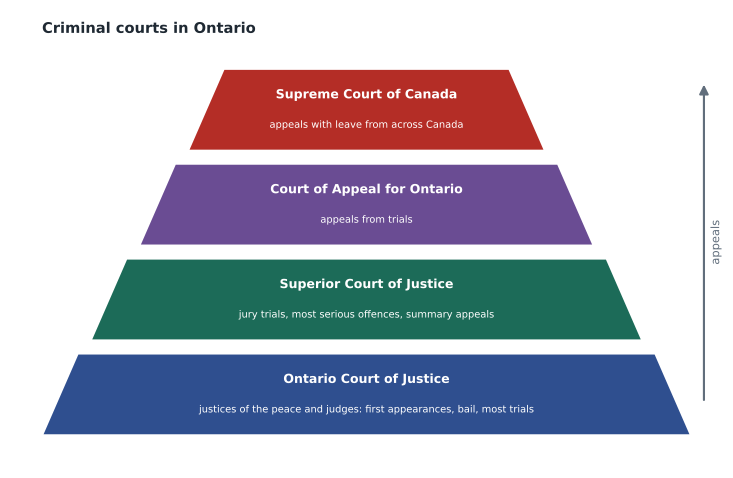
Canada has a single criminal law, the Criminal Code and other federal statutes, enforced across the country, but the courts that apply it are organized by the provinces. In Ontario, almost every criminal case starts in the Ontario Court of Justice, a provincial court whose judges are appointed by the province. That court hears bail hearings, most trials, and preliminary inquiries. The Superior Court of Justice is the province's superior court, with federally appointed judges; it hears jury trials, trials of the most serious offences, and appeals from summary conviction trials. The Court of Appeal for Ontario hears appeals from trials on indictment and further appeals in summary cases. Above it is the Supreme Court of Canada, which hears appeals with leave, and some appeals as of right, from across the country. Justices of the peace, who are not judges, preside over many first appearances and bail hearings in Ontario, issue search warrants, and hear provincial offences such as most traffic tickets.
Classifying offences
Criminal Code offences are divided into summary conviction offences, indictable offences and hybrid offences. Summary conviction offences are the least serious; they are tried in provincial court and, since 2019, carry a default maximum of two years less a day in custody. Indictable offences are more serious and carry higher maximums. Hybrid offences can be prosecuted either way, and the Crown chooses, which is called the Crown election. Break and enter of a place other than a dwelling-house, under section 348(1)(e), is hybrid: on indictment it carries up to ten years, and it can also be prosecuted summarily. Break and enter of a dwelling-house is a straight indictable offence with a maximum of life imprisonment, which reflects how much more serious society considers entering a home.
For indictable and hybrid offences prosecuted by indictment, the accused usually has a choice of trial mode under section 536: trial by a provincial court judge, trial by a superior court judge alone, or trial by a superior court judge and jury. A few offences, listed in section 553, are in the absolute jurisdiction of the provincial court, such as theft under 5,000 dollars, and the accused has no choice. The most serious, listed in section 469, such as murder, must be tried in superior court with a jury unless both the accused and the Attorney General consent otherwise. In the Bayview case, Brennan chose a trial by judge alone. Kwan explains that defence lawyers often prefer a judge when the main issue is a legal one, such as whether evidence should be excluded, and when the defence wants to argue a reasonable doubt that depends on careful reasoning rather than sympathy.
From arrest to first appearance
After an arrest, the officer must decide whether to release the person or hold them for a court appearance. Since the 2019 amendments to the Criminal Code, the principle of restraint in section 493.1 requires police and courts to give primary consideration to release at the earliest reasonable opportunity and on the least onerous conditions appropriate. An officer can release on an appearance notice or an undertaking with conditions, or the officer in charge can hold the person for a bail hearing before a justice, which must happen within 24 hours or as soon as possible. Brennan, who had a fixed address and no outstanding charges, was released by the officer in charge at 6:40 a.m. on an undertaking to attend court on April 7, with a condition not to attend Bayview Pharmacy. Desjardins notes that the release paperwork, including the time and conditions, is part of the disclosure package, and that a careless error in it, such as a wrong date to attend, can lead to a missed appearance and a warrant that is not the accused's fault.
Bail and release are covered in depth in other courses. For this course, the key point is that the officer's report at this stage, often called a synopsis or show cause report, is read by the court and by the defence and becomes part of the record. It must be accurate. Okeke's initial synopsis described the stop and said that 'a pat-down search revealed a pry bar and stolen property in the accused's backpack'. That sentence was not true: the pat-down was of Brennan's clothing, and Okeke found the property only by opening the backpack afterward. Marchetti noticed the discrepancy the moment she compared the synopsis with the in-car video.
Charging and the formal accusation
In Ontario, the charge is laid when an officer swears an information before a justice of the peace, setting out the offences. The Crown then reviews the case, a process called Crown screening, and may withdraw or amend charges. For hybrid offences, the Crown elects before the plea whether to proceed by indictment or summarily. In the Bayview case, Kwan elected to proceed by indictment because of Brennan's prior break-and-enter conviction, which would matter at sentencing. Whitlock, the investigating detective, spent an hour with Kwan reviewing the file before the election.
Preliminary inquiries
A preliminary inquiry is a hearing in provincial court where a judge decides whether there is enough evidence to commit the accused to trial. Since September 2019, under section 535 of the Criminal Code, a preliminary inquiry is available only for offences punishable by fourteen years or more, and only if the accused or the Crown requests one. Because break and enter of a non-dwelling carries ten years, Brennan was not entitled to one. Preliminary inquiries used to be an important way for the defence to test the Crown's witnesses before trial, and police officers often testified at them. They still happen in serious cases, and an officer's testimony at a preliminary inquiry is recorded and can be used to cross-examine the officer at trial if the two accounts differ. Kwan tells the class that whatever an officer says under oath at any stage can be compared with what they say at trial. 'There is only one version of the truth,' he says. 'Tell it the same way every time.'
Pretrial steps
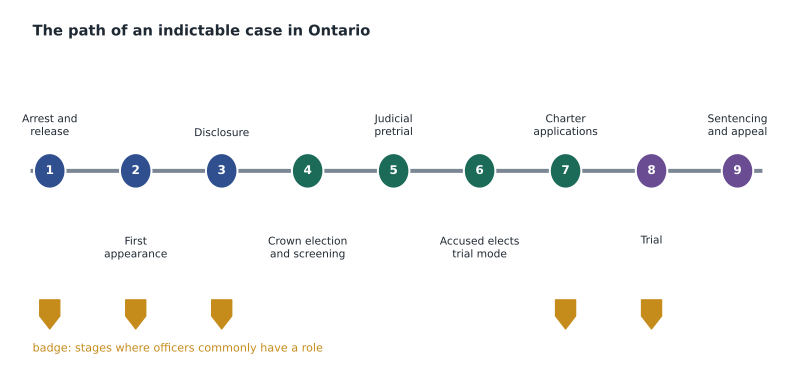
After the formal accusation, the case enters a phase of disclosure, negotiation and pretrial motions. Disclosure is provided to the defence, and the Crown and defence meet with a judge at a judicial pretrial to narrow the issues, estimate trial time and discuss resolution. Any application to exclude evidence under the Charter must be filed in advance with notice under the court's rules, setting out the grounds. In the Bayview case, Marchetti filed a Charter application in June alleging breaches of sections 8 and 10(b), and the court scheduled it to be heard as a blended voir dire at the start of the trial, meaning the evidence on the application and the trial evidence would be heard together where they overlapped. Most criminal cases are resolved by a guilty plea before trial, often after negotiation about charges or the sentence position. Desjardins notes that officers sometimes resent plea resolutions, but a plea gives certainty, spares witnesses and victims, and often reflects a realistic view of the evidence.
Delay and the right to a timely trial
Section 11(b) of the Charter guarantees the right to be tried within a reasonable time. In R. v. Jordan (2016), the Supreme Court of Canada set presumptive ceilings of 18 months from charge to the end of trial in provincial court and 30 months in superior court. Delay caused by the defence does not count. If the ceiling is exceeded, the delay is presumed unreasonable and the charges are stayed unless the Crown shows exceptional circumstances. Late or incomplete disclosure by police is one of the most common causes of Crown delay. The Bayview case ran seven months from charge to verdict, well within the ceiling.
from datetime import date
# Bayview case: time from charge to the end of trial
charged = date(2026, 3, 14)
verdict = date(2026, 10, 15)
days = (verdict - charged).days
months = days / 30.44
print("days from charge to verdict:", days)
print("approximate months:", round(months, 1))
for label, ceiling in [("provincial court ceiling (Jordan)", 18), ("superior court ceiling (Jordan)", 30)]:
    print(f"{label}: {ceiling} months, used {round(100 * months / ceiling)} in 100")
ohio_limit = 270
print("Ohio felony limit (days, no jail time counted triple):", ohio_limit, "remaining:", ohio_limit - days)days from charge to verdict: 215 approximate months: 7.1 provincial court ceiling (Jordan): 18 months, used 39 in 100 superior court ceiling (Jordan): 30 months, used 24 in 100 Ohio felony limit (days, no jail time counted triple): 270 remaining: 55
The calculation shows that the case used about 40 of every 100 days allowed under the provincial court ceiling, and that in Ohio it had about 55 days to spare even without counting the time tolled by the defence motion. Kwan says this margin was not luck. The disclosure package went out complete in three weeks, the fingerprint report was ready before the first appearance, and the in-car video was disclosed with the first package rather than months later. 'When police get the file right early,' he says, 'delay applications go away.'
Trial, verdict, sentencing and appeal
A trial follows a set order. The prosecution makes an opening statement, at least in jury trials, and calls its witnesses, each examined in chief and then cross-examined by the defence. When the prosecution closes its case, the defence may ask for a directed verdict if there is no evidence on an element. The defence may then call evidence, including the accused, though it is not required to. Both sides make closing submissions, and the trier of fact decides. In a jury trial, the judge instructs the jury on the law before it deliberates. If the accused is found guilty, sentencing usually takes place on a later date after a pre-sentence report is prepared. Brennan's sentencing is scheduled for December 9, 2026.
Either side may appeal, within limits. The accused can appeal a conviction on errors of law, unreasonable verdicts or miscarriages of justice. The prosecution's right to appeal an acquittal is narrower and is limited to questions of law alone. Kwan tells the class he considered and decided against appealing the acquittal on the break-in instruments charge, because he thought the ruling was correct.
| Stage | Typical police role |
|---|---|
| Arrest and release | Decide on release, prepare synopsis, swear information |
| Bail hearing | Provide show cause report; officer may testify |
| Disclosure | Assemble and deliver the complete file, including notes and video |
| Preliminary inquiry (14-year offences) | Testify under oath; testimony is recorded |
| Charter application | Testify about the search, detention or statement |
| Trial | Testify; produce exhibits and notes |
| Sentencing and appeal | Occasionally testify; provide information on the offence or prior record |
Worked problem
Explaining the process to a victim
Glenn Whitaker, the pharmacist, calls Detective Whitlock three weeks after the break-in. He has received a subpoena for a trial in October and wants to know why it takes so long, whether he has to come, and what will happen. How should Whitlock answer?
Show solution
- Explain that the accused has been charged and is presumed innocent, and that the time before trial is used for the prosecution to give the defence all the evidence, for both sides to prepare, and for any legal questions to be scheduled.
- Confirm that the subpoena is a court order and that he must attend unless the Crown tells him he is no longer needed, for example because the defence admits facts he would prove.
- Tell him that he will likely be asked about the condition of the store, what was taken and its value, and that he can review his statement before testifying.
- Refer him to victim services and the Victim/Witness Assistance Program for court preparation and updates.
- Avoid predicting the outcome or giving opinions about the evidence or the accused.
Answer: Explain the stages plainly, confirm the subpoena must be obeyed, describe what he will be asked, refer him to support services, and do not predict the outcome.
Common mistakes
MistakeEvery indictable case has a preliminary inquiry.
InsteadSince 2019, preliminary inquiries are limited to offences punishable by 14 years or more.
MistakeA small error in the arrest report does not matter.
InsteadReports are part of the record and are compared with notes, video and testimony; errors damage credibility.
MistakeDelay is the court's problem, not the police's.
InsteadLate or incomplete disclosure by police is a common cause of delay that can end a case.
MistakeA guilty plea means the investigation was unnecessary.
InsteadPleas usually follow a realistic view of strong evidence that the investigation produced.
Summary and key terms
- Ontario criminal cases begin in the Ontario Court of Justice; serious and jury cases go to the Superior Court; appeals go to the Court of Appeal and the Supreme Court of Canada.
- Offences are summary, indictable or hybrid, and the Crown elects how to proceed on hybrid offences.
- The accused may often choose trial by judge alone or by jury.
- Officers' reports at every stage become part of the record and must be accurate.
- Section 11(b) and Jordan set 18- and 30-month ceilings on delay.
- Most cases resolve by plea; those that go to trial follow a set order from opening to verdict.
- Hybrid offence
- An offence the Crown may prosecute summarily or by indictment.
- Election
- A choice of how to proceed, by the Crown (summary or indictment) or by the accused (mode of trial).
- Information
- The sworn document by which a charge is laid before a justice.
- Preliminary inquiry
- A hearing to decide whether there is enough evidence to commit the accused to trial.
- Judicial pretrial
- A meeting of Crown, defence and judge to narrow issues and plan the trial.
- Blended voir dire
- A hearing where evidence on an admissibility question and trial evidence are heard together.
Practice problems
Work each problem on paper first, then reveal the answer to check.
Why was Brennan not entitled to a preliminary inquiry?
Show answer
Break and enter of a non-dwelling carries ten years, below the 14-year threshold in section 535.
In the code example, about how many months passed from charge to verdict?
Show answer
About 7.1 months (215 days).
What was wrong with Okeke's initial synopsis?
Show answer
It said the pat-down revealed the pry bar and property, when he actually found them by opening the backpack afterward.
Why might a defence lawyer choose a judge-alone trial?
Show answer
Because the main issues are legal or depend on careful reasoning, such as exclusion of evidence and reasonable doubt on identity.
Lesson quiz · 5 questions
Score 60% or more to complete this lesson.
Create a free account to save your progress, take quizzes and earn a certificate.