
LES-202 · Lesson 1 of 12 · 25 min
The law of evidence: purpose, sources and key ideas
▶ Video coming soon A video version of this lesson is on the way.
Professor Desjardins opens the course by putting two photographs side by side on the screen. The first shows the back of a small pharmacy on Bayview Avenue in Port Ardent at night, a lower window pane smashed and a few shards still standing in the frame. The second shows the same window in daylight, with a numbered evidence marker beside each piece of glass on the ground. 'At about ten past two on Saturday morning, March 14, 2026,' he says, 'someone broke that window, climbed into Bayview Pharmacy, took the cash float from the till and six boxes of nicotine gum, and left on a bicycle. Seven months later, the man charged with it stood trial. Some of the evidence the police gathered was heard by the judge. Some of it was not, because of how it was obtained. This course is about why.'
The class has followed the Port Ardent police department through a robbery investigation in the last course. This course picks up where investigation ends and the courtroom begins. Desjardins tells the students that officers often think of court as something that happens after their work is done, but the opposite is true. Every note an officer writes, every exhibit bag they seal and every question they ask a suspect is written for a courtroom, whether they know it or not. The rules of evidence decide which of those things a judge or jury will ever see. An officer who understands the rules gathers evidence that survives; an officer who does not can do months of honest work and watch it excluded in an afternoon.
Desjardins introduces a guest who will visit throughout the course: Assistant Prosecuting Attorney Daniel Kwan, who prosecuted the Bayview case. Kwan has spent eleven years in the county prosecutor's office, and he tells the students he has two kinds of police witnesses: the ones whose notes he can trust completely and the ones whose notes he reads twice. 'You want to be the first kind,' he says. 'By the end of this course you will know what that takes.'
Why we have rules of evidence
A criminal trial is a search for the truth under rules designed to make the result fair and reliable. The court must decide whether the prosecution has proved, to the required standard, that the accused committed the offense charged. To do that it needs information, and the rules of evidence govern what information it may receive, how it must be presented and what use may be made of it. The rules have several purposes that pull in slightly different directions. Some rules exist to make fact-finding more accurate, such as the hearsay rule, which keeps out statements that cannot be tested by cross-examination. Some exist to protect fairness to the accused, such as the rule that the prosecution generally cannot prove guilt by showing that the accused is the kind of person who commits crimes. Some protect values outside the trial itself, such as privilege for communications with a lawyer, or the exclusion of evidence obtained by violating constitutional rights.
Desjardins tells the class that the rules are not technicalities that help the guilty escape. They are the accumulated experience of centuries of trials about which kinds of information tend to mislead. Juries and judges are human. They give too much weight to some kinds of evidence, such as a confident eyewitness or a prior criminal record, and the rules correct for that. They also reflect the idea that the state, which has enormous power, must follow rules when it uses that power against a person. A conviction obtained by breaking the rules may be overturned on appeal, which wastes the effort of everyone involved and puts the victim through the process twice.
Where the law of evidence comes from
In the United States, the law of evidence is mainly set out in written rules. Federal courts follow the Federal Rules of Evidence, adopted in 1975, and most states, including Ohio, have adopted rules modeled on them. The Ohio Rules of Evidence, adopted by the Supreme Court of Ohio in 1980 and amended many times since, apply in criminal trials in Ohio courts. Statutes in the Ohio Revised Code add some evidence rules, and court decisions interpret all of them. The United States Constitution also shapes evidence law: the Fourth Amendment protects against unreasonable searches and seizures, the Fifth Amendment protects against compelled self-incrimination, the Sixth Amendment guarantees the right to confront witnesses, and the Fourteenth Amendment's due process clause applies those protections to the states and requires the prosecution to disclose favorable evidence. The exclusionary rule, which keeps out evidence obtained by violating the Constitution, comes from decisions of the United States Supreme Court, including Mapp v. Ohio (1961), a case that began with a police search in Cleveland.
Kwan adds that police officers do not need to memorize the rules the way lawyers do, but they need to know the main ideas well enough to recognize when something they are about to do will create a problem in court. 'If you know what hearsay is, you know to find the person who actually saw it,' he says. 'If you know what continuity means, you never leave an exhibit on a desk. If you understand how evidence gets excluded, you stop and think before you open a bag.' He looks at Desjardins, who smiles, because the students will learn soon enough that the Bayview case turned on exactly that.
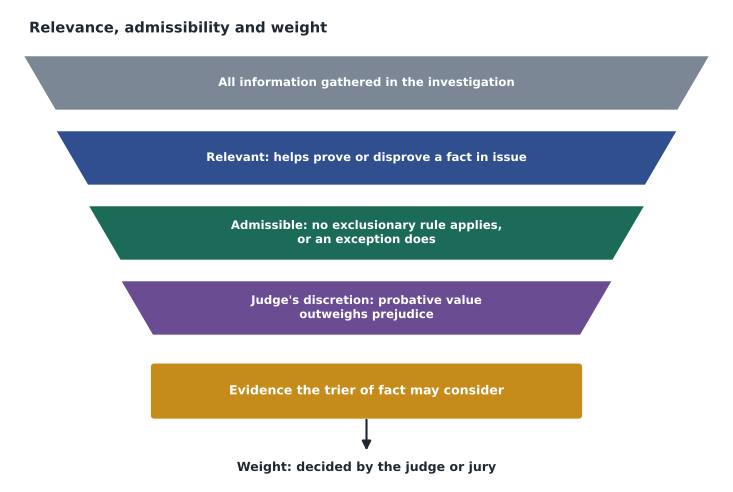
Facts in issue, relevance and materiality
Every criminal trial is about a set of facts in issue: the elements of the offense that the prosecution must prove, and any defenses that the accused raises. For breaking and entering under Ohio Revised Code 2911.13(A), the prosecution must prove that the accused, by force, stealth or deception, trespassed in an unoccupied structure with purpose to commit a theft offense or any felony there, together with the identity of the accused, the date and the location. In the Bayview case, nobody disputed that someone broke in and stole things. The only real fact in issue was identity: was it Shane Brennan?
Evidence is relevant if, as a matter of logic and human experience, it makes a fact in issue more or less likely than it would be without the evidence. The bar is low. A single piece of evidence does not have to prove anything on its own; it only has to move the needle. The fact that a man in a gray hoodie was seen on a bicycle a kilometer away eighteen minutes after the break-in does not prove he did it, but it makes it somewhat more likely, and so it is relevant. Evidence is material if it relates to a fact that actually matters to the case. Evidence that the pharmacist is a careful bookkeeper might be relevant to how much money was in the till, but if the amount is not disputed it is not material to anything the court must decide.
Ohio Evidence Rule 401 defines relevant evidence as evidence having any tendency to make the existence of any fact that is of consequence to the determination of the action more probable or less probable than it would be without the evidence. Rule 402 says relevant evidence is generally admissible and irrelevant evidence is not. Kwan tells the class that relevance is rarely the battle at trial. The battles are about admissibility and weight.
Admissibility and weight
Admissibility is a legal question for the judge: may the trier of fact hear this evidence at all? Relevant evidence is admissible unless a rule excludes it. The main exclusionary rules the course will cover are the hearsay rule, the rules about character and prior misconduct, the confessions rule, the exclusion of evidence obtained in breach of constitutional rights, the rules on opinion and expert evidence, and privilege. Most of these rules have exceptions. Even when no rule excludes it, a judge has a discretion to exclude evidence whose probative value is outweighed by its prejudicial effect, for example because it would inflame the jury, confuse the issues or take up time out of proportion to its value. In Ohio, Evidence Rule 403 requires exclusion where the danger of unfair prejudice, confusion of the issues or misleading the jury substantially outweighs probative value, and permits exclusion for undue delay or needless cumulative evidence.
Weight is a question of fact for the trier of fact: once evidence is admitted, how much does it prove? A fingerprint identification from a clear print in a place the accused had no innocent reason to touch carries great weight. A witness who glimpsed a stranger for two seconds in the dark carries little. The trier of fact is the jury in a jury trial, or the judge alone in a trial without a jury. The judge decides admissibility in both. When the judge sits alone, the judge wears both hats, and must be careful to put out of mind any evidence ruled inadmissible during the trial. Desjardins points out that many of the decisions officers make affect weight rather than admissibility. A careless note does not usually make evidence inadmissible, but it can make a court trust it much less.
Direct and circumstantial evidence
Direct evidence proves a fact in issue without the need for any inference: a witness who says 'I saw him climb through the window' gives direct evidence of identity, if believed. Circumstantial evidence proves a fact in issue only through an inference from other facts. A fingerprint on the inside of a broken window pane is circumstantial evidence that the person whose finger left it was the person who broke in, because the court must infer that the print was left during the break-in and not at some innocent time. Students often assume that direct evidence is stronger, but that is not true. Eyewitness evidence is direct and is a leading cause of wrongful convictions. Circumstantial evidence can be overwhelming, especially when several independent pieces point the same way.
In the United States, the Supreme Court of Ohio held in State v. Jenks (1991) that circumstantial and direct evidence have the same probative value, and that a jury need not be told that circumstantial evidence must exclude every reasonable hypothesis of innocence; the question is simply whether the evidence as a whole proves guilt beyond a reasonable doubt. Kwan says the Bayview case was a circumstantial case, and that the defense's job was to offer the judge an innocent explanation for each piece of evidence. 'My job was to show that the pieces together left no reasonable explanation except one.'
# Bayview case: the main pieces of identity evidence, each sorted by type
evidence = [
    ("911 call: tall man, hoodie with white logo, bicycle", "circumstantial", "admitted"),
    ("Laundromat camera: cyclist in lane 02:07 to 02:13", "circumstantial", "admitted"),
    ("Pharmacy camera: hoodie with white wave logo inside", "circumstantial", "admitted"),
    ("Officer saw accused on bicycle in matching hoodie", "circumstantial", "admitted"),
    ("Fingerprint on inside face of broken glass", "circumstantial", "admitted"),
    ("Pry bar and gum boxes found in backpack", "circumstantial", "excluded"),
]
admitted = [e for e in evidence if e[2] == "admitted"]
print("pieces of identity evidence:", len(evidence))
print("admitted:", len(admitted), " excluded:", len(evidence) - len(admitted))
print("direct evidence of identity:", sum(1 for e in evidence if e[1] == "direct"))
for name, kind, status in evidence:
print(f"{status:9} {name}")pieces of identity evidence: 6 admitted: 5 excluded: 1 direct evidence of identity: 0 admitted 911 call: tall man, hoodie with white logo, bicycle admitted Laundromat camera: cyclist in lane 02:07 to 02:13 admitted Pharmacy camera: hoodie with white wave logo inside admitted Officer saw accused on bicycle in matching hoodie admitted Fingerprint on inside face of broken glass excluded Pry bar and gum boxes found in backpack
The list shows something that surprises students: there was no direct evidence of identity at all. Nobody saw the burglar's face. Every piece of identity evidence required an inference, and the strongest piece found by the police, the stolen goods and the pry bar in the backpack, was the one the court never considered. The case was still proved, because the remaining pieces were independent of each other and all pointed the same way. Kwan tells the class that if the fingerprint had not been found, the outcome might well have been different, and the officer who opened the bag would have lost the case.
The burden and standard of proof
The prosecution bears the burden of proving every element of the offense beyond a reasonable doubt. The accused does not have to prove anything, call any evidence or testify. This follows from the presumption of innocence, which the United States Supreme Court has held is required by due process, including in In re Winship (1970), which held that due process requires proof beyond a reasonable doubt of every fact necessary to constitute the crime charged.
Ohio Revised Code 2901.05 defines reasonable doubt as present when jurors, after carefully considering and comparing all the evidence, cannot say they are firmly convinced of the truth of the charge, and proof beyond a reasonable doubt as proof of such character that an ordinary person would be willing to rely and act upon it in the most important of the person's own affairs. Ohio judges read this definition to juries.
Some issues in a criminal trial are decided on a lower standard. When the court decides whether a piece of evidence is admissible, the party relying on it usually has to establish the facts that make it admissible on a balance of probabilities, though the prosecution must prove the voluntariness of a confession beyond a reasonable doubt in some states; in Ohio and federal courts the prosecution proves voluntariness by a preponderance of the evidence. When an accused alleges that police violated a constitutional right, the accused usually carries the burden of showing the violation, though the burden can shift, for example when police searched without a warrant. These lower standards will matter in later lessons on voir dires and suppression hearings.
| Standard | What it means | Where it applies |
|---|---|---|
| Beyond a reasonable doubt | Much closer to certainty than to probability; no reasonable doubt based on the evidence | Proof of guilt on every element |
| Preponderance of the evidence | More likely than not | Most facts needed to admit evidence; many constitutional applications |
| Reasonable and probable grounds / probable cause | A credibly based probability; more than suspicion | Arrests, search warrants |
| Reasonable suspicion | A reasonable possibility based on specific facts; less than probable grounds | Investigative detention and protective searches |
Desjardins points out that the last two rows are standards officers apply on the street, and that courts will later review the officer's decision against them. An officer who arrests on reasonable suspicion, or searches beyond what a protective frisk allows, has made a mistake that the court will measure precisely. Officer Femi Okeke, who stopped Brennan on Crescent Street, had reasonable suspicion when he stopped him. Whether he had more than that when he opened the backpack was the question that took most of a day at trial.
Judicial notice, admissions and presumptions
Not everything at trial has to be proved by witnesses. A court may take judicial notice of facts so notorious that they are not reasonably disputed, such as the fact that it is dark at two in the morning in March, or that Port Ardent is in Lucas County, Ohio. The parties may also make admissions, agreeing that certain facts are proved so that witnesses do not need to be called. In the Bayview trial, the defense admitted that the break-in happened, that the property listed by the pharmacist was taken, and that the laundromat camera's clock was accurate. Those admissions shortened the trial by a day and let both sides focus on identity. In Ohio, such agreements are called stipulations, and they are read or shown to the trier of fact. Finally, some statutes create presumptions, which require the trier of fact to find one fact once another is proved unless there is evidence to the contrary; presumptions that shift a burden to the accused are carefully limited by constitutional law.
Worked problem
Sorting evidence in a simple case
A store manager reports that a laptop was stolen from her office. An employee, Carl, was seen by a co-worker leaving the office at 4:55 p.m. carrying a backpack. The laptop was found two days later for sale online under an account registered to Carl's email address. Carl has a conviction for theft from eight years ago. The manager says Carl 'always seemed shifty.' Classify each piece of information.
Show solution
- The co-worker's sighting of Carl leaving the office is relevant circumstantial evidence of opportunity; it does not show he took the laptop, but it makes it more likely.
- The online listing under Carl's email address is relevant circumstantial evidence, and probably the strongest; investigators should also establish that nobody else used the account.
- Carl's old theft conviction is relevant in a loose sense but generally inadmissible to prove he committed this theft, because it invites reasoning from bad character.
- The manager's opinion that Carl seemed shifty is not evidence of anything; it is an opinion based on impression, and it would be excluded.
- Each admissible piece is circumstantial, so the question at trial will be whether together they leave guilt as the only reasonable conclusion.
Answer: Sighting and listing are admissible circumstantial evidence; the old conviction and the opinion would be excluded.
Common mistakes
MistakeRelevant evidence is always admissible.
InsteadRelevant evidence is admissible unless an exclusionary rule or the judge's discretion keeps it out.
MistakeCircumstantial evidence is weak.
InsteadCircumstantial evidence can be very strong, especially when independent pieces point the same way.
MistakeAdmissibility and weight are the same thing.
InsteadAdmissibility decides whether evidence may be heard; weight decides how much it proves.
MistakeThe accused must explain the evidence against him.
InsteadThe prosecution bears the burden throughout; the accused need not testify or call evidence.
Summary and key terms
- The rules of evidence aim at accurate fact-finding, fairness to the accused and protection of values such as privilege and constitutional rights.
- Ohio criminal evidence law comes from the Ohio Rules of Evidence, statutes, court decisions and the United States Constitution.
- Evidence is relevant if it makes a fact in issue more or less likely, and material if the fact matters to the case.
- Admissibility is a legal question for the judge; weight is a question for the trier of fact.
- Direct evidence needs no inference; circumstantial evidence does, and can be just as strong.
- The prosecution must prove guilt beyond a reasonable doubt; lower standards apply to many admissibility questions.
- Fact in issue
- An element of the offense or a defense that the court must decide.
- Relevance
- A tendency to make a fact in issue more or less likely.
- Admissibility
- Whether the law allows the trier of fact to receive the evidence.
- Weight
- How much a piece of admitted evidence proves.
- Trier of fact
- The jury, or the judge in a trial without a jury, who decides the facts.
- Circumstantial evidence
- Evidence that proves a fact in issue only through an inference.
Practice problems
Work each problem on paper first, then reveal the answer to check.
What was the only real fact in issue in the Bayview trial?
Show answer
Identity: whether Shane Brennan was the burglar.
In the code example, how many pieces of identity evidence were direct evidence?
Show answer
None; all six were circumstantial.
Who decides admissibility in a jury trial, and who decides weight?
Show answer
The judge decides admissibility; the jury decides weight.
Name two facts the defense admitted in the Bayview trial.
Show answer
That the break-in happened and that the listed property was taken; also that the laundromat camera's clock was accurate.
Lesson quiz · 5 questions
Score 60% or more to complete this lesson.
Create a free account to save your progress, take quizzes and earn a certificate.