
LES-202 · Lesson 3 of 12 · 20 min
Discovery and disclosure: the prosecutor, the police and the defense
▶ Video coming soon A video version of this lesson is on the way.
Three weeks after the Bayview break-in, Detective Whitlock delivered the disclosure package to Kwan's office. It contained a synopsis, the 911 recording and the computer-aided dispatch log, two video files from the laundromat and the pharmacy, nineteen minutes of in-car video from Okeke's cruiser, 64 scene photographs, the scene examination report and the fingerprint report from the forensic identification officer, Grace Liu, the notes of five officers, the release paperwork, and Glenn Whitaker's statement and inventory list. Kwan reviewed it over a weekend. On Monday he called Whitlock with one question. 'The synopsis says the pat-down found the pry bar. The video shows Okeke unzipping the bag. Has anyone asked him about that?'
Desjardins tells the class that this phone call is what disclosure is for. The prosecution does not only pass the file to the defense; it reads it, and the reading often reveals problems the police did not notice. The defense would have seen the same thing within a week. Because the full package, including the video, was disclosed promptly, the problem surfaced early, while there was still time to deal with it honestly. If the video had been held back or overlooked, the problem would have surfaced at trial, in the worst possible way.
Why disclosure exists
Disclosure is the prosecution's obligation to give the accused the information it holds about the case. It exists because the state has vast investigative resources that the accused does not, and because a fair trial requires that the accused know the case to be met and have access to information that might help the defense. The obligation has become one of the most important duties in criminal procedure, and failures of disclosure are among the most common causes of wrongful convictions. Several of the Canadian and American wrongful conviction cases studied in the last course involved police or prosecutors holding information that pointed to someone else.
Disclosure law in the United States and Ohio
In Brady v. Maryland (1963), the United States Supreme Court held that due process requires the prosecution to disclose evidence favorable to the accused that is material to guilt or punishment. Giglio v. United States (1972) extended this to evidence that could be used to impeach a prosecution witness, such as a promise of leniency. Kyles v. Whitley (1995) held that the prosecutor is responsible for favorable evidence known to the police, even if the prosecutor never learned of it. Ohio Criminal Rule 16, rewritten in 2010, requires broad discovery in felony cases: on demand, the prosecution must provide the defendant's statements, the defendant's prior record, documents and tangible objects, results of examinations and tests, witness statements, police reports, the names of witnesses, and any evidence favorable to the defendant. The rule also allows the prosecution to certify that certain material should be disclosed only to defense counsel, or not at all until trial, to protect a witness, subject to review by the court. Discovery under Rule 16 is reciprocal: once the defense demands discovery, it must disclose certain information about its own case, such as reports from expert witnesses it intends to call.
Desjardins emphasizes that in both countries the police are not a separate island. Under Kyles, what the police know, the prosecution is treated as knowing, so a favorable piece of evidence sitting in a detective's desk is the prosecution's responsibility. If police fail to pass something on, the prosecution is in breach, and the remedy can include a new trial, an adjournment with costs, the exclusion of evidence, or in the worst cases a stay or dismissal of the charges.
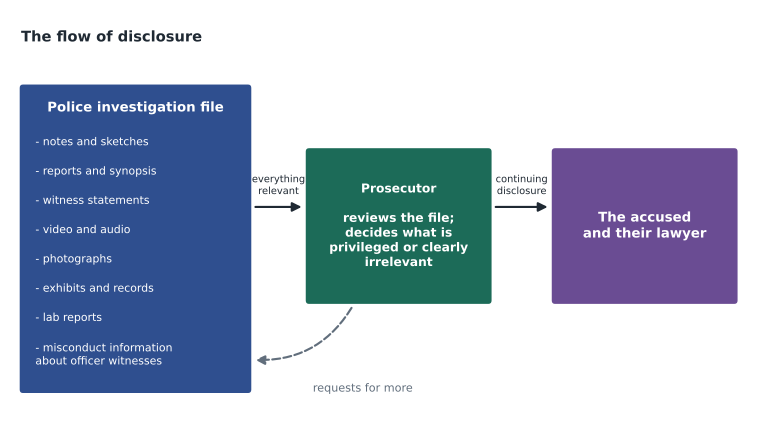
What the police file must contain
The rule of thumb is simple: if it was created or collected during the investigation and has any connection to the case, it goes to the prosecutor. The prosecutor, not the officer, decides whether something is irrelevant or privileged. Officers sometimes leave things out because they think they do not matter, because they are embarrassing, or because they point away from the accused. Each of those reasons is wrong, and the last is the most dangerous. Evidence that points away from the accused is exactly what the defense is entitled to see.
| Item | Why it must be included |
|---|---|
| All officers' notes, including rough notes and sketches | Notes are the officer's contemporaneous record and are used to test testimony |
| Reports, synopses and supplementary reports | They show what officers said happened and when |
| Witness statements, recorded and written | Including statements that are inconsistent or unhelpful to the prosecution |
| Video and audio: in-car, body-worn, interview, 911 and radio | Recordings often settle disputes about what happened |
| Photographs, sketches and scene examination reports | They show the scene as found and the steps taken |
| Exhibit records and continuity documents | They show who had each item and when |
| Lab and expert reports, including results that exclude the accused | Negative results are favorable evidence |
| Tips and leads, including those that were eliminated | They show other suspects were considered and how they were excluded |
| Impeachment information about officer witnesses (Giglio) | They may affect the officer's credibility |
In the Bayview case, the most important item for the defense was the in-car video. It showed the stop from the moment Okeke pulled up behind Brennan's bicycle at 02:29:05 until Brennan was placed in the cruiser at 02:33:20. Without it, the court would have had only Okeke's account. With it, the court could see that Okeke told Brennan he was being detained for a break-in, patted the outside of his clothing, then took the backpack off his shoulder, unzipped it and looked inside, all before saying anything about an arrest. The video also showed something favorable to the Crown: Brennan's gray hoodie with the white wave logo on the back, clearly visible under the cruiser's lights before the bag was touched.
Officers' notes and the duty to record
Officers' notes deserve special attention because they are disclosed in every case and used in almost every trial. Ohio does not have a single statute on police notes, but agency policies require them, Criminal Rule 16 makes police reports and witness statements discoverable, and courts treat an officer's notes as a key test of credibility. Notes written long after events, or shaped by talking with other officers, are routinely challenged in cross-examination. Good notes are made at the time or as soon as possible afterward; are written in permanent ink in a bound notebook or an approved electronic system; record times, observations, words spoken and actions taken; do not leave blank spaces or tear out pages; and are corrected by striking through with a single line and initialling, so the original remains readable.
Okeke made his notes between 4:40 and 5:20 a.m., after the arrest and booking, rather than at the roadside. That was not unusual for a busy night, and he recorded the times honestly. But his notes said 'stopped male 02:31' when the in-car video showed 02:29, and they said 'pat-down: hard object in backpack, located pry bar', which compressed two separate actions into one. Desjardins asks the class whether the errors were dishonest. Linh Tran says she thinks they were the kind of mistake people make when they write from memory two hours later and already know how the story ended. Desjardins agrees, and says that is exactly why notes should be made as close to events as possible, and why officers should check video before finalizing a report, recording in the notes that they did so.
# Compare times in Okeke's notes with the in-car video (video clock checked against true time)
events = [
    ("stop: pulled up behind bicycle", "02:31", "02:29:05"),
    ("told reason for detention", "02:31", "02:29:40"),
    ("pat-down of clothing", "02:32", "02:30:10"),
    ("backpack opened", "02:32", "02:31:15"),
    ("arrest announced", "02:33", "02:32:00"),
    ("rights to counsel read", "02:44", "02:44:30"),
]
def mins(t):
    p = [int(x) for x in t.split(":")] + [0]
    return p[0] * 60 + p[1] + p[2] / 60
for name, note, video in events:
    diff = mins(note) - mins(video)
print(f"{name:32} notes {note} video {video} difference {diff:+.1f} min")stop: pulled up behind bicycle notes 02:31 video 02:29:05 difference +1.9 min told reason for detention notes 02:31 video 02:29:40 difference +1.3 min pat-down of clothing notes 02:32 video 02:30:10 difference +1.8 min backpack opened notes 02:32 video 02:31:15 difference +0.8 min arrest announced notes 02:33 video 02:32:00 difference +1.0 min rights to counsel read notes 02:44 video 02:44:30 difference -0.5 min
The comparison shows a pattern. The times in the notes for the stop and the search are one to two minutes late, and the order of events in the notes is correct but compressed. The time for reading rights to counsel is accurate, because Okeke read them from a card and looked at his watch. The pattern is typical of notes written from memory: anchors that were checked are accurate, and events around them drift. The prosecution disclosed this comparison to the defense along with the video, which was the right thing to do, because it reflected on the reliability of the officer's account.
Lost and destroyed evidence
Disclosure is meaningless if evidence is lost before it can be disclosed. Police must preserve evidence that may be relevant, including items that seem unimportant at the time. Video systems in stores and vehicles overwrite their recordings, often within days, so investigators must capture video early. In Arizona v. Youngblood (1988), the United States Supreme Court held that failing to preserve evidence that was only potentially useful violates due process only if the police acted in bad faith; but destroying evidence that is clearly exculpatory violates due process regardless of good faith. Ohio courts follow these rules, and agencies' own evidence retention policies and Ohio Revised Code 2933.82, on preserving biological evidence, add duties. In the Bayview case, the pharmacy's video system overwrote after 72 hours. Whitlock collected the footage on the afternoon of March 14, which made it available at trial.
Third-party records and privilege
Some relevant records are held by people outside the prosecution, such as hospitals, schools, counselors, employers or private companies. They are not in the prosecution's possession, so the ordinary disclosure duty does not apply. The defense can obtain third-party records by subpoena under Criminal Rule 17, and courts may review sensitive records in private before deciding what to release. Privilege also limits disclosure. The most important privilege for police is informer privilege, which protects the identity of a confidential informant almost absolutely. The privilege yields only where disclosure is essential to a fair determination of the case, as the United States Supreme Court held in Roviaro v. United States (1957). Officers must keep informer information separate from the general file and tell the prosecutor about it in a way that protects the informant.
Disclosure is continuing
The duty does not end when the first package is delivered. New information, such as a lab result, a supplementary statement, a new witness, or a discovery that an earlier document was wrong, must be disclosed as it arrives, up to and during the trial. On May 4, Okeke wrote a supplementary report correcting his synopsis. It said that he had reviewed the in-car video, that the video accurately showed the sequence of events, and that the pat-down was of Brennan's clothing and the pry bar was found when he opened the backpack. Kwan disclosed the supplementary report the same day. Desjardins tells the students that writing that report was the moment Okeke protected his credibility. 'He could not undo the search,' he says. 'But he could make sure that nobody could ever say he hid what he did.'
Worked problem
Deciding what to disclose
In an assault case, an investigator's file contains: the victim's statement; a bystander's statement that the attacker was 'about five foot six' (the accused is six foot two); a security video that does not show the attack because the camera was pointed elsewhere; a note that a second bystander refused to give a statement; a tip from a caller naming a different man; and an officer's notebook entry that he 'lost sight of the suspect for about a minute'. The officer thinks only the victim's statement and the video matter. What must go to the prosecutor?
Show solution
- Everything listed must go to the prosecutor; the officer does not decide relevance.
- The bystander's height estimate is favorable to the accused and must be disclosed.
- The video, even though it does not show the attack, is relevant and must be disclosed, with an explanation of what it shows.
- The note about the bystander who refused to speak tells the defense a potential witness exists.
- The tip naming another man, and any steps taken to check it, must be disclosed, and the loss of sight in the notebook is directly relevant to identification.
Answer: All of it; the prosecutor decides on vetting, and the items that point away from the accused are the most important to disclose.
Common mistakes
MistakeOfficers can leave out information they think is irrelevant.
InsteadThe prosecutor decides relevance; officers provide everything connected to the case.
MistakeEvidence that helps the defense should be held until the defense asks for it.
InsteadFavorable evidence must be disclosed whether or not the defense asks.
MistakeOnce the file is delivered, disclosure is done.
InsteadDisclosure is continuing; new and corrected information goes out as it arrives.
MistakeCorrecting a report admits misconduct.
InsteadA prompt, honest correction protects the officer's credibility and the case.
Summary and key terms
- Brady, Giglio and Kyles require disclosure of favorable and impeachment evidence known to police, and Criminal Rule 16 requires broad, reciprocal discovery.
- The prosecutor, not the officer, decides what is irrelevant or privileged.
- Notes must be made as soon as practicable, independently, and corrected openly.
- Video and other perishable evidence must be preserved early; lost evidence must be explained.
- Third-party records and privileged material follow special procedures, and informer privilege is close to absolute.
- Disclosure is continuing, and correcting a mistake promptly protects the case.
- Discovery
- The exchange of information between prosecution and defense under Criminal Rule 16.
- Brady material
- Evidence favorable to the accused that is material to guilt or punishment.
- Giglio material
- Information that could be used to impeach a prosecution witness.
- Exculpatory evidence
- Evidence that tends to show the accused is not guilty.
- Continuing disclosure
- The ongoing duty to provide new information as it arrives.
- Informer privilege
- The rule protecting the identity of a confidential informant.
- Supplementary report
- A later report adding to or correcting an earlier one.
Practice problems
Work each problem on paper first, then reveal the answer to check.
What did Kwan notice when he reviewed the disclosure package?
Show answer
The synopsis said the pat-down found the pry bar, but the video showed Okeke unzipping the backpack.
In the code example, which time in Okeke's notes was accurate and why?
Show answer
The time for rights to counsel, because he read them from a card and checked his watch.
Why did Whitlock collect the pharmacy video on the afternoon of the break-in?
Show answer
The system overwrote recordings after 72 hours.
What did Okeke's supplementary report do?
Show answer
It corrected the synopsis, confirmed the video showed the true sequence, and was disclosed the same day.
Lesson quiz · 5 questions
Score 60% or more to complete this lesson.
Create a free account to save your progress, take quizzes and earn a certificate.