
LES-202 · Lesson 12 of 12 · 19 min
Capstone: reviewing the Bayview Pharmacy trial
▶ Video coming soon A video version of this lesson is on the way.
On the last day of the course, Desjardins hands each student a copy of Judge Abernathy's reasons for judgment, delivered orally on Thursday, October 15, 2026, and transcribed. They run to fourteen pages. He asks the class to read them twice: once as a citizen, to understand why Shane Brennan was found guilty of breaking into Bayview Pharmacy and not guilty of possessing criminal tools, and once as a police officer, to find every place where something an officer did, or failed to do, changed the result. Then, as in the investigation course, the class will review the case against a standard, score it, and decide what Port Ardent should do differently.
Kwan joins them for the final session. He tells the class that he reviews every trial he loses in part, not just the ones he loses entirely. 'This one we mostly won,' he says. 'But I want to know exactly why we lost the count we lost, because the next case might not have a fingerprint to fall back on.'
The reasons for judgment
The judge began by identifying the only real issue: identity. The defense had admitted that the pharmacy was broken into at about 02:10 on March 14, that the till float of 210 dollars and six boxes of nicotine gum were taken, and that the laundromat camera's clock was accurate. She then summarized her earlier rulings. She had admitted the first ninety seconds of the 911 call for the truth of its contents. She had qualified Grace Liu as an expert in friction ridge examination. And she had excluded the contents of the backpack because the search breached the Fourth Amendment, and no exception to the exclusionary rule applied. The roadside statement had been admitted, but she gave it little weight.
She then reviewed the evidence of identity. The 911 call described a tall man in a gray hoodie with a white wave-shaped logo on the back, with a bicycle. The laundromat video showed a cyclist in a gray hoodie arrive in the lane at 02:07:40 and leave at 02:13:05. The pharmacy video, corrected for its clock, showed a man of similar build in a gray hoodie with a white wave-shaped logo enter through the rear window at 02:10:30, go to the till and the shelf where the gum was kept, and leave at 02:12:40. Okeke's in-car video showed Brennan, sixteen minutes later and about a kilometer away, on a bicycle, wearing a gray hoodie with a white wave-shaped logo on the back. And Liu's evidence established that Brennan's right middle finger left a print on the inside face of a glass shard that remained in the broken window frame, in a place Whitaker's evidence showed no customer could reach.
Applying State v. Jenks, the judge considered whether the evidence, viewed as a whole, proved identity beyond a reasonable doubt. She addressed the defense arguments: that Brennan might have touched the glass at another time, that the hoodie was a common design, and that a man on a bicycle a kilometer away was a coincidence. She found that the print could not reasonably be explained by an innocent touch, and that the combination of the print, the matching logo, the timing and the bicycle proved identity beyond a reasonable doubt. She found Brennan guilty of breaking and entering under Revised Code 2911.13(A). On the criminal tools count, she found that without the pry bar there was no evidence, and acquitted. Sentencing is scheduled for December 9, 2026, after a presentence investigation.
Scoring the case
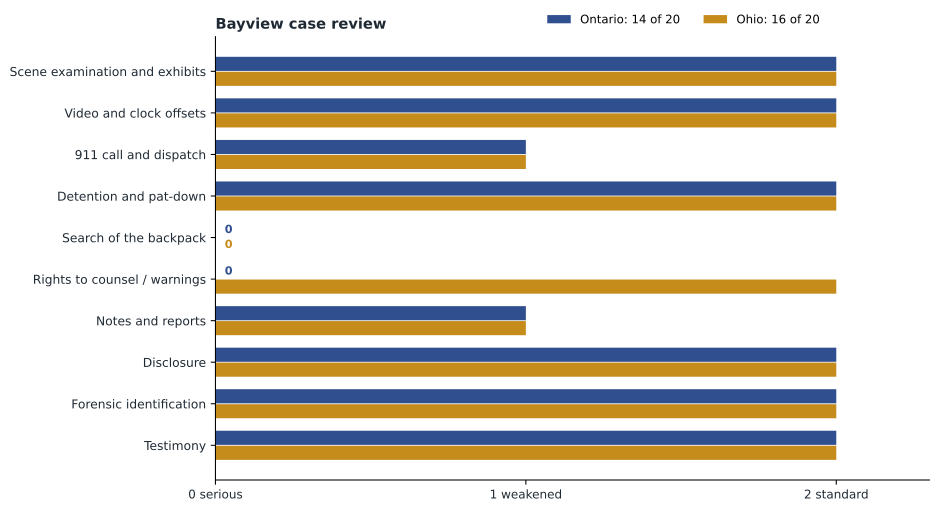
The class used a rubric with ten areas, each scored 0 for a serious problem, 1 for a problem that weakened the case, and 2 for work that met the standard. Each student scored the case alone, then the class compared scores and discussed differences. Priya Sandhu scored the 911 call and dispatch a 1, not because of anything the call-taker did wrong by the standards of the time, but because the logo never reached the officer who needed it. Marco DiSanto wanted to score notes and reports a 0, because the synopsis was wrong; the class settled on 1, because the error was corrected promptly and openly before trial and the notes recorded Brennan's words accurately. Nobody disputed the 0 for the backpack.
# Class review of the Bayview case: ten areas scored 0 to 2
areas = {
    "scene examination and exhibits": (2, 2),
    "video collection and clock offsets": (2, 2),
    "911 call and dispatch": (1, 1),
    "detention and pat-down": (2, 2),
    "search of the backpack": (0, 0),
    "rights to counsel / roadside question": (0, 2),   # (Ontario, Ohio)
    "notes and reports": (1, 1),
    "disclosure / discovery": (2, 2),
    "forensic identification": (2, 2),
    "testimony": (2, 2),
}
for i, place in enumerate(("Ontario", "Ohio")):
    total = sum(v[i] for v in areas.values())
    weak = [k for k, v in areas.items() if v[i] < 2]
print(f"{place}: {total} of {2 * len(areas)}; areas below standard: {', '.join(weak)}")Ontario: 14 of 20; areas below standard: 911 call and dispatch, search of the backpack, rights to counsel / roadside question, notes and reports Ohio: 16 of 20; areas below standard: 911 call and dispatch, search of the backpack, notes and reports
The two versions of the case score differently on one area. In Ohio, the roadside question was asked during a brief, non-custodial stop, so Miranda did not apply, and after the arrest Okeke gave the warnings properly and stopped questioning when Brennan invoked his rights. That area meets the standard. Desjardins tells the class that the difference is not about which officer was better; Okeke did the same things in both versions. It shows how much the rules of the jurisdiction matter, and why officers who move between jurisdictions, or who work near a border, must know which rules apply.
What went right
The class listed what the investigation did well, and why each mattered in court. Grace Liu examined the scene thoroughly, photographed the glass in place with a scale before removing it, and documented continuity so well that the defense barely questioned it. Erin Bose measured clock offsets before exporting video and recorded hash values, so the video was admitted without a fight and the recordings could be combined into a single accurate timeline. Whitlock collected the pharmacy video on the first afternoon, before it was overwritten. The disclosure package was complete and early, and included the in-car video that revealed the problem with the search. Okeke wrote a supplementary report correcting his synopsis as soon as he saw the video. Liu reported the unsuitable till print and her limitations honestly. And every officer who testified conceded what was true.
What went wrong, and why
The class traced the lost count back through a chain of small events. Mrs. Shaw mentioned the logo twenty-one seconds into her call. The call-taker typed a description before she finished and did not update it. The dispatcher broadcast what was typed. Okeke stopped a man who fit the generic description, which was reasonable. He patted him down for safety, which was lawful. Then, unsure whether he had grounds, he opened the bag to find out. Finally, writing his notes two hours later, he compressed the pat-down and the search into one sentence. None of these was a dramatic failure. Each was a habit or a gap that seemed harmless at the time.
Kwan adds one more. 'When you are unsure whether you have grounds, call it in,' he says. 'Okeke was alone, and that was part of the problem. If he had told dispatch he had a possible suspect on Crescent and asked whether the caller had given anything else, the call-taker would have played back the recording or checked her screen, and the logo would have come over the radio in thirty seconds. Every officer in this room will one day stand on a street at night, not sure if they have enough. That is the moment to get more information, not to search.'
Recommendations
The class drafted recommendations for the Port Ardent police department, as they had in the investigation course. Desjardins tells them that recommendations should be specific, address causes rather than symptoms, and be realistic.
| Problem | Recommendation |
|---|---|
| Caller's full description not broadcast | Call-takers read the full description back and update the record before ending the call; dispatchers rebroadcast updates to responding units |
| Search for evidence during a detention | Annual scenario training on the limits of protective searches, with the message: unsure of grounds, get more information |
| Questioning practice near the custody line | Reinforce warnings before questioning once a stop looks like an arrest |
| Notes written from memory compressed events | Officers review in-car or body-worn video before finalizing notes and reports, and record that they did so |
| Officer alone at an uncertain stop | Encourage officers to request backup or advice from a supervisor or dispatch before searching when grounds are uncertain |
| Good practices at risk of being lost | Use the Bayview case, with its clock offset and continuity records, as a training example of video and exhibit handling |
After the verdict
A verdict is not the end of the officers' involvement. At sentencing, the prosecution may file Brennan's record and a victim impact statement from Whitaker, describing the cost of the window, the lost stock and the effect on his staff, under Ohio's victims' rights provisions. Officers may be asked about restitution amounts or the circumstances of the offense. Either side may appeal within strict time limits, usually 30 days, and an appeal court may order a new trial, in which case the officers will testify again, and their earlier testimony will be compared with what they say the second time. Desjardins reminds them that the case file, the exhibits and the officers' notes must be kept until every appeal is finished.
Desjardins closes the course with the two photographs from the first day: the broken window at night and the numbered markers in daylight. 'Every piece of evidence in this case was gathered by people who knew it might end up in court,' he says. 'Most of it survived because they did the work properly. One piece did not, because of a choice that took two seconds. The rules you have learned in this course are not obstacles to good police work. They are a description of it.'
Worked problem
Writing a short case review
You are asked to write a one-paragraph review of a case in which a man was acquitted of possessing stolen property after a judge excluded the property because an officer searched his car without grounds during a traffic stop. The officer's notes said he 'smelled cannabis', but the in-car video showed him opening the trunk thirty seconds after the stop without mentioning any smell, and he admitted in cross-examination that he added the smell to his notes later. What should your review cover?
Show solution
- State the result and the reason: the property was excluded because the search lacked grounds, and the acquittal followed.
- Identify the root problem: a search without grounds, followed by a note that was altered to justify it after the fact.
- Address the credibility issue directly: the altered note is a serious matter of honesty, not just a legal error, and should be referred for review under the service's policies.
- Recommend specific remedies: training on grounds for vehicle searches, review of video before notes are finalized, and supervision of note-taking.
- Note what the officer's honest admission in cross-examination prevented: a finding that he lied under oath, which would have had wider consequences.
Answer: Result and reason, root cause, the credibility issue, specific remedies, and the importance of the honest admission.
Common mistakes
MistakeA partial acquittal means the investigation failed.
InsteadMost of the evidence survived; the review should find exactly why one part did not.
MistakeReviews are about blaming individuals.
InsteadGood reviews trace causes, including systems such as dispatch, and recommend fixes.
MistakeOnce the verdict is in, officers are done with the case.
InsteadSentencing, appeals and retrials can all require officers again, and files must be kept.
MistakeThe rules of evidence get in the way of police work.
InsteadThey describe careful, lawful police work, and following them is what makes evidence survive.
Summary and key terms
- The only real issue at trial was identity, and it was proved by independent pieces of circumstantial evidence.
- The 911 call, the corrected video timeline, the officer's observation and the fingerprint together left no reasonable doubt.
- The backpack's contents were suppressed, and the criminal tools count failed.
- The review scored the case 16 of 20, with the search scoring 0.
- The root causes were a description not broadcast, a search to find out whether there were grounds, and notes written from memory.
- Recommendations should address causes, be specific and keep what worked.
- Presentence investigation
- A report on the offender prepared by probation to help the court sentence.
- Reasons for judgment
- The judge's explanation of the verdict and the findings behind it.
- Rubric
- A scoring guide with defined standards for each area.
- Root cause
- The underlying reason a problem occurred, as opposed to its symptoms.
- Victim impact statement
- A statement by a victim describing the harm caused by the offense, considered at sentencing.
Practice problems
Work each problem on paper first, then reveal the answer to check.
What was the only real issue at the Bayview trial?
Show answer
Identity.
In the code example, what were the two totals?
Show answer
14 of 20 for Ontario and 16 of 20 for Ohio.
What chain of events led to the lost count?
Show answer
The logo was not broadcast, Okeke stopped a man fitting a generic description, searched the bag to find out whether he had grounds, and compressed the events in his notes.
What did Kwan say officers should do when unsure of grounds?
Show answer
Get more information, for example by calling dispatch, rather than searching.
Lesson quiz · 5 questions
Score 60% or more to complete this lesson.
Create a free account to save your progress, take quizzes and earn a certificate.