
LES-202 · Lesson 4 of 12 · 20 min
Hearsay and its exceptions
▶ Video coming soon A video version of this lesson is on the way.
At 2:09:50 on the morning of the break-in, Evelyn Shaw, 71, was awake in her apartment above the Harbor Wash laundromat, across the rear lane from Bayview Pharmacy. She heard glass break, looked out her kitchen window, and called 911. The call lasted three minutes and forty seconds. In it she said, among other things: 'There's a man breaking the back window of the drugstore. He's tall, he's got a gray hoodie on with something white on the back, like a wave. He's got a bike leaning on the fence. Oh, he's going in. He's inside now.' Seven months later, at trial, Mrs. Shaw testified for the prosecution. She remembered the glass and the bicycle. She could no longer say what color the hoodie was, or whether there was anything on the back.
Desjardins plays the recording for the class. Then he asks: 'Can the judge hear this?' The students say yes, obviously, it is the best evidence of what she saw. Desjardins says they are probably right about the result but wrong about the reason, and that the reason matters, because the same rule that let this recording in keeps out a great deal of other evidence police gather every day. This lesson is about that rule: the rule against hearsay.
What hearsay is
Hearsay is an out-of-court statement offered to prove the truth of its contents. All three parts of the definition matter. The statement was made outside the courtroom proceeding where it is now offered. It is offered to prove that what it says is true. And the person who made it, called the declarant, is not being cross-examined on it at the time it was made. If a witness testifies, 'My neighbor told me she saw a man with a gray hoodie,' and the statement is offered to prove the man wore a gray hoodie, it is hearsay. The witness can be cross-examined about whether the neighbor said it, but not about whether the neighbor was right.
Ohio Evidence Rule 801(C) defines hearsay as a statement, other than one made by the declarant while testifying at the trial or hearing, offered in evidence to prove the truth of the matter asserted. Rule 802 says hearsay is not admissible except as provided by the rules, statutes or the constitution. The same statement can be hearsay for one purpose and not for another. If a statement is offered only to show that it was made, for example to explain why an officer went to a particular address, or to show that a threat was uttered, it is not hearsay, because its truth does not matter. Kwan warns that this non-hearsay purpose is often abused: a prosecutor who offers a damning statement 'just to explain why the officer acted' may be trying to get its truth in through the back door, and judges watch for that.
Why hearsay is excluded
The hearsay rule exists because out-of-court statements carry four dangers that cross-examination is designed to expose. The declarant may have perceived the event inaccurately; may remember it wrongly; may have expressed it ambiguously; or may have been lying. A witness in court can be questioned on all four. A statement repeated by someone else cannot. The rule also reflects fairness: the accused has a right to confront and test the evidence against him. Desjardins tells the class that hearsay is not excluded because it is always unreliable. Much hearsay is perfectly accurate. It is excluded because the court has no reliable way to tell which is which unless something about the circumstances provides that assurance.
Exceptions in the Ohio rules
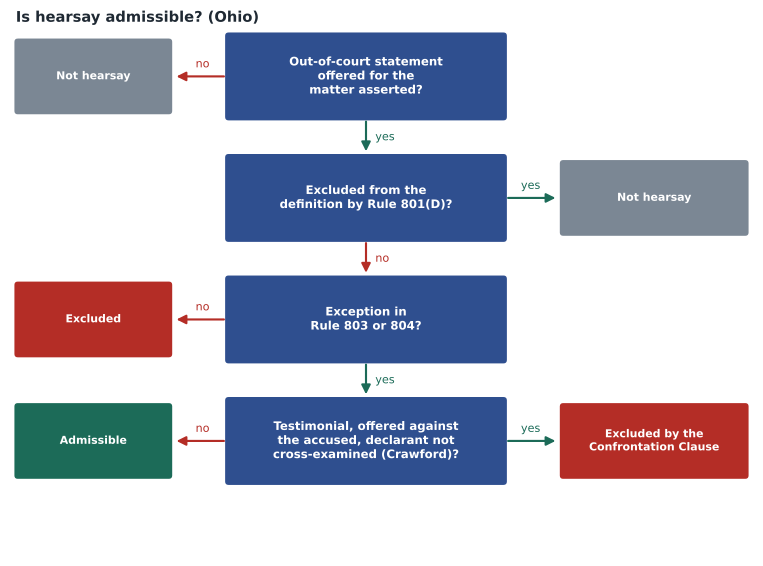
The Ohio Rules of Evidence list the exceptions. Rule 801(D) first takes some statements out of the definition of hearsay entirely: a statement by a party offered against that party, such as the accused's own statement offered by the prosecution, and certain prior statements of a witness who testifies and can be cross-examined, including a prior identification. Rule 803 lists exceptions that apply whether or not the declarant is available, including a present sense impression (a statement describing an event made while the declarant was perceiving it or immediately after), an excited utterance (a statement relating to a startling event made while under the stress of excitement it caused), statements for medical diagnosis or treatment, recorded recollection, and records of regularly conducted activity, usually called business records. Rule 804 lists exceptions that apply only when the declarant is unavailable, such as former testimony, statements against interest and dying declarations. Unlike the federal rules, the Ohio rules do not contain a general residual exception for trustworthy statements that fit no other category; Ohio Rule 807 is limited to certain statements by children in abuse cases.
| Exception | Why it is considered reliable | Police example |
|---|---|---|
| Excited utterance | Made under the stress of a startling event, before there is time to invent | A victim's words to the first officer seconds after an assault |
| Present sense impression | Describes what is happening as it happens, leaving no time for memory error or invention | A 911 caller narrating what she sees |
| Record of regularly conducted activity (Rule 803(6)) | Made routinely, in the ordinary course of business, by someone with a duty to be accurate | A store's inventory or sales records |
| Dying declaration | Made by a person who believes death is imminent | A victim's statement about who attacked them, made shortly before dying |
| Statement of a party opponent | Defined as not hearsay; subject to constitutional limits | The accused's statement to police |
The principled approach in Canada and the residual question in Ohio
Because the Ohio rules have no residual exception, a hearsay statement that does not fit a listed exception is excluded, however reliable it may seem. Officers sometimes find this frustrating. A witness gives a clear, detailed statement, then moves away or refuses to testify, and the statement cannot be used. The practical lesson is to identify which exceptions might apply early, and to preserve the circumstances that support them: the exact time of a 911 call, the declarant's emotional state, how soon after the event a statement was made, and any recording. Either way, the lesson for officers is the same. The way a statement is taken affects whether it can ever be used. A statement that is video-recorded, under oath or affirmation, with the witness warned about the consequences of lying, is far more likely to survive if the witness later recants or disappears.
The Confrontation Clause and testimonial statements
In the United States, the Sixth Amendment guarantees the accused the right to be confronted with the witnesses against him. In Crawford v. Washington (2004), the United States Supreme Court held that testimonial statements by a witness who does not testify at trial are inadmissible against the accused unless the witness is unavailable and the accused had a prior opportunity to cross-examine. This applies even if the statement fits a hearsay exception. In Davis v. Washington (2006), the Court held that statements made to police in the course of an interrogation are nontestimonial when the primary purpose is to enable police to meet an ongoing emergency, as in most 911 calls, and testimonial when the primary purpose is to establish or prove past events for a later prosecution, as in a formal statement taken after the danger has passed. Officers should understand that a victim's statement in a calm interview at the station is likely testimonial, and if the victim does not testify, it cannot be used against the accused.
The 911 call in the Bayview trial
Mrs. Shaw testified, so she could be cross-examined about what she remembered. The question was whether the recording could be admitted to prove the details she no longer remembered. Kwan argued that the call was both a present sense impression under Rule 803(1), because Mrs. Shaw was describing what she saw as she saw it, and an excited utterance under Rule 803(2), because she was under the stress of watching a break-in. Because the call was made to get police to an ongoing crime, it was nontestimonial under Davis, so the Confrontation Clause did not apply; and in any event Mrs. Shaw testified and could be cross-examined. Judge Abernathy admitted the call. Marchetti then cross-examined Mrs. Shaw about the lighting in the lane, the distance from her window to the pharmacy fence, which Whitlock had measured at 23 meters, and her eyesight. Those questions went to weight, not admissibility, and the judge took them into account.
# The 911 call, broken into statements with time from the start of the call
call = [
    (8,   "There's a man breaking the back window of the drugstore."),
    (21,  "He's tall, [description of his hoodie], something white on the back, like a wave."),
    (34,  "He's got a bike leaning on the fence."),
    (47,  "Oh, he's going in. He's inside now."),
    (96,  "Are you coming? I don't want to go down there."),
    (171, "I think it was the same man who rides by here some nights."),
]
for t, text in call:
    kind = "describes event as it happens" if t <= 90 else "later, reflective or speculative"
    print(f"{t:4d} s  {kind:31}  {text}")
narrated = [s for t, s in call if t <= 90]
print("statements describing the event as it happened:", len(narrated), "of", len(call))8 s describes event as it happens There's a man breaking the back window of the drugstore. 21 s describes event as it happens He's tall, [description of his hoodie], something white on the back, like a wave. 34 s describes event as it happens He's got a bike leaning on the fence. 47 s describes event as it happens Oh, he's going in. He's inside now. 96 s later, reflective or speculative Are you coming? I don't want to go down there. 171 s later, reflective or speculative I think it was the same man who rides by here some nights. statements describing the event as it happened: 4 of 6
The last statement in the list, made almost three minutes into the call, was different from the others. Mrs. Shaw was no longer describing what she saw; she was speculating about a man she might have seen before. Both sides agreed it should not be admitted for its truth, because it was not a description of the event and its basis was unknown. Desjardins says the distinction is a good example of how a court looks at each statement separately, even within a single recording.
Hearsay and police practice
Officers meet hearsay every day. A witness tells an officer what someone else saw. A victim tells the first officer what happened, then later refuses to testify. A store clerk repeats what a customer said. In each case the question for the officer is the same: who has first-hand knowledge, and can that person be found and interviewed? Hearsay in an officer's notes is useful as a lead, but rarely as evidence. A good investigator treats every 'someone told me' as an instruction to find the someone. When the first-hand witness cannot be found, the investigator should record everything that might support an exception: the exact words, the time, the declarant's emotional state, what the declarant could see, and whether the statement was recorded.
Officers also need to recognize their own hearsay. An officer cannot testify that a dispatcher told him the suspect was in a gray hoodie and use that to prove the suspect wore one, though the officer can testify that he received a description, to explain why he stopped someone. Okeke's testimony about Brennan's hoodie was not hearsay; he saw it himself, and the in-car video confirmed it.
Worked problem
Identifying hearsay
At a trial for assault, the prosecution wants to call four pieces of evidence: (1) an officer testifies that when he arrived, the victim, bleeding and crying, said 'Danny hit me with a bottle'; (2) the officer testifies that a neighbor told him the next day that she had seen Danny running away; (3) the officer testifies that dispatch told him to look for a man in a red jacket, to explain why he stopped Danny; (4) the victim's hospital chart, made by a nurse, records 'patient states struck with bottle'. Classify each.
Show solution
- Item 1 is hearsay if offered for its truth, but likely admissible as a excited utterance: it was made under the stress of the event, minutes later.
- Item 2 is hearsay with no apparent exception: it was made a day later, in a calm conversation; the neighbor should be found and called.
- Item 3 is not hearsay if offered only to explain why the officer stopped Danny, but it cannot be used to prove Danny wore a red jacket.
- Item 4 is a business or medical record; the statement in it may be admissible as a statement for medical diagnosis or treatment under Rule 803(4), at least as to the cause of injury.
- In each case, the officer's notes recording timing and demeanour will matter to the ruling.
Answer: Item 1 likely admissible as an exception, item 2 excluded, item 3 admissible for a limited non-hearsay purpose, item 4 likely admissible as a record.
Common mistakes
MistakeHearsay is any statement made outside court.
InsteadIt is hearsay only if offered to prove the truth of what was said.
MistakeHearsay is excluded because it is unreliable.
InsteadIt is excluded because its reliability cannot be tested without cross-examination, unless the circumstances provide assurance.
MistakeIf a witness testifies, their earlier statements can always be used.
InsteadA testifying witness's prior statements still need a rule that permits their use for their truth.
MistakeAn officer can repeat what a witness said instead of finding the witness.
InsteadThe first-hand witness should be found; hearsay is a lead, not a substitute.
Summary and key terms
- Hearsay is an out-of-court statement offered to prove the truth of its contents.
- It is excluded because the dangers of perception, memory, expression and honesty cannot be tested by cross-examination.
- Ohio lists exceptions in Rules 801(D), 803 and 804 and has no residual exception.
- The Confrontation Clause bars testimonial statements by a witness who does not testify, unless there was a prior opportunity to cross-examine.
- The 911 call in the Bayview case was admitted because it described the event as it happened.
- Officers should treat hearsay as a lead and record the circumstances that could support an exception.
- Present sense impression
- A statement describing an event made while or immediately after perceiving it.
- Excited utterance
- A statement relating to a startling event made under the stress of excitement it caused.
- Testimonial statement
- A statement whose primary purpose is to establish past events for prosecution.
- Confrontation Clause
- The Sixth Amendment right to confront witnesses against the accused.
- Hearsay
- An out-of-court statement offered to prove the truth of its contents.
- Declarant
- The person who made an out-of-court statement.
- Dying declaration
- A statement by a person who believes death is imminent, about the cause of death.
Practice problems
Work each problem on paper first, then reveal the answer to check.
Why could the 911 recording prove details Mrs. Shaw no longer remembered?
Show answer
It was a present sense impression and excited utterance, and it was nontestimonial under Davis.
In the code example, how many statements described the event as it happened?
Show answer
Four of the six.
Why was the statement at 171 seconds not admitted for its truth?
Show answer
It was speculation about a man she might have seen before, not a description of the event.
What should an officer do when a witness says 'my friend saw it'?
Show answer
Find and interview the friend, who has first-hand knowledge.
Lesson quiz · 5 questions
Score 60% or more to complete this lesson.
Create a free account to save your progress, take quizzes and earn a certificate.