
LES-202 · Lesson 10 of 12 · 20 min
Preparing for court
▶ Video coming soon A video version of this lesson is on the way.
On Monday, October 5, eight days before the trial, Officer Femi Okeke sat down with Kwan in a small meeting room at the prosecutor's office. He had brought his notebook, a copy of his synopsis and his supplementary report, and a laptop with the in-car video. Kwan had a list. They went through the night in order, minute by minute, with the video running. Kwan did not tell Okeke what to say. He asked him what he remembered, what he had written, and what the video showed, and he pointed out every place where the three did not line up. At the end he said, 'Marchetti is going to ask you why you opened the bag. You already know the true answer. Just give it.' Okeke said he would.
Desjardins tells the class that most of what happens in a courtroom is decided before anyone walks into it. Officers who arrive at court unprepared, having glanced at their notes in the hallway, make the mistakes that lose cases: they misremember times, contradict their own reports, guess when they should say they do not know, and get defensive under cross-examination. Officers who prepare well are calm, accurate and believable. This lesson covers how to prepare.
The subpoena and your obligations
Officers are usually notified of court dates through their service's court office, and they are often served with a subpoena under Criminal Rule 17. A subpoena is a court order. Failing to attend without lawful excuse can be contempt of court, and for an officer it is also a disciplinary matter. If an officer has a genuine conflict, such as a scheduled surgery or a mandatory course, they must tell the prosecutor as soon as they know, not on the morning of the trial, so that the court can be told and the schedule adjusted. Shift changes, vacations and transfers do not cancel a subpoena. Officers who leave the service remain bound by subpoenas served on them.
Reviewing the file
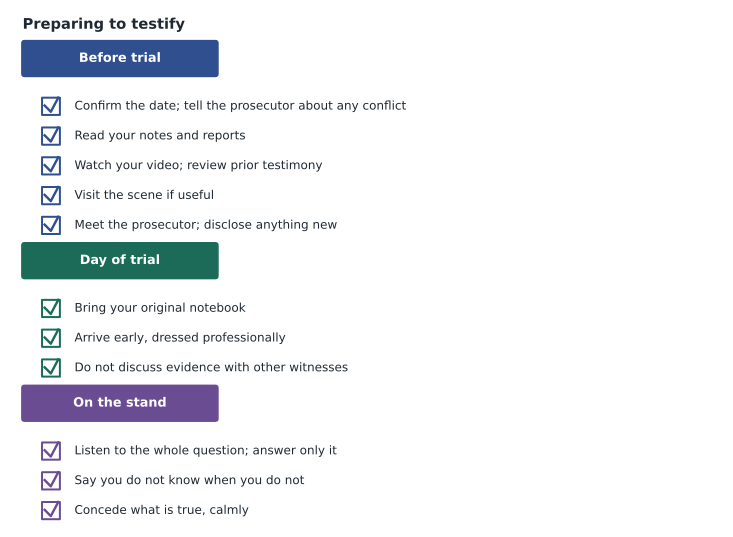
Preparation begins with the officer's own material. An officer should read their notes and reports, watch any video or listen to any audio they appear in, review their statements and any prior testimony, including any transcript from a preliminary hearing, suppression hearing or grand jury, and look at the exhibits they seized or handled. The goal is not to memorize a script. It is to refresh the officer's memory of what happened and to know exactly what their records say, so that nothing in cross-examination comes as a surprise. Where the records conflict, as Okeke's synopsis and the video did, the officer should know about it, understand why, and be ready to explain it honestly.
Okeke had testified once before in this case, at the September 1 suppression hearing, and he read the transcript twice. He also visited Crescent Street at night the week before trial, at the same hour, to remind himself of the lighting, the distance from his cruiser to where Brennan stood, and the position of the streetlight. Desjardins says a scene visit is one of the most valuable things a witness can do, as long as the officer is careful not to confuse what he sees now with what he saw then. If anything has changed, such as a new streetlight or a removed fence, he should note it.
Meeting the prosecutor
Prosecutors usually meet their key witnesses before trial. The meeting has legitimate purposes: to review the evidence the witness can give, identify documents and exhibits, explain the court process and what to expect in cross-examination, and find out about anything new. It also lets the prosecutor learn about problems in the evidence before the defense raises them. What the meeting must never become is coaching: suggesting what the witness should say, encouraging them to adopt a version of events they do not remember, or rehearsing answers. A prosecutor can tell a witness that the defense will ask about a topic; the prosecutor cannot tell the witness what to answer.
Anything new the officer tells the prosecutor in the meeting, such as a detail not in their notes, must be disclosed to the defense. At the meeting, Okeke mentioned that he had noticed Brennan's breath was quick, as if he had been riding hard, but had not written it down. Kwan wrote it in his own notes and disclosed it to Marchetti that afternoon, with a note that it had first been mentioned on October 5. Okeke asked whether that hurt the case. Kwan said it was a small point, and that disclosing it was the only way it could ever be used; if Okeke mentioned it for the first time on the stand, Marchetti would rightly ask why it appeared nowhere in his notes, and the judge might disregard it or doubt his other evidence.
Witnesses must not compare their evidence
Officers who were at the same event often want to talk about it before testifying. They must not discuss their evidence with each other. Courts routinely order witnesses excluded from the courtroom until they testify, under Evidence Rule 615, precisely so that each witness's account is independent. Discussing evidence with another witness outside court defeats the purpose of the order and can be a contempt. Even without an order, it creates the appearance of collusion and can destroy both officers' credibility. Defense lawyers routinely ask officers whether they discussed the case with other officers before testifying, and courts treat an affirmative answer seriously. Okeke and Constable Malhotra, who secured the rear of the pharmacy, rode to court in different cars and did not discuss the case.
# Okeke's preparation checklist for the Bayview trial
tasks = [
    ("confirm trial dates with court office", True),
    ("read notebook, synopsis and supplementary report", True),
    ("watch in-car video start to finish", True),
    ("review prior statements and any transcript", True),
    ("visit Crescent Street at night", True),
    ("meet the prosecutor", True),
    ("disclose new detail (breathing) through the prosecutor", True),
    ("locate original notebook for court", True),
    ("avoid discussing evidence with other witnesses", True),
]
done = sum(1 for _, ok in tasks if ok)
print(f"{done} of {len(tasks)} tasks complete")
for name, ok in tasks:
print(("[x] " if ok else "[ ] ") + name)9 of 9 tasks complete [x] confirm trial dates with court office [x] read notebook, synopsis and supplementary report [x] watch in-car video start to finish [x] review prior statements and any transcript [x] visit Crescent Street at night [x] meet the prosecutor [x] disclose new detail (breathing) through the prosecutor [x] locate original notebook for court [x] avoid discussing evidence with other witnesses
The checklist is simple, but each item has a reason. The original notebook matters because the court may want to see it, not a photocopy, to check for later additions or missing pages. Any earlier testimony matters because an inconsistency between earlier testimony and trial testimony is the easiest point for a defense lawyer to make. The scene visit matters because juries and judges trust witnesses who can describe a place precisely. And the instruction not to discuss evidence matters because a single conversation in a hallway can undo all the rest.
Exhibits and documents for court
Officers who seized or handled exhibits should know where they are and how they will get to court. Most services have an exhibit officer or court liaison who brings exhibits from the property room, but the officer should confirm it. Exhibits must remain sealed until they are produced in court, and the officer should be able to identify each item by its markings, describe where and when it was found and by whom, and account for its continuity. Officers should also bring any documents they may need to refer to, such as the original notebook, and should not bring anything they do not want the defense to see: anything an officer uses to refresh memory on the stand may be examined by the other side.
What the dispatch review found
After Okeke's testimony on the backpack, Sergeant Haddad asked the communications center to review the 911 call and the broadcast. The review found that the call-taker had entered 'M, tall, gray hoodie, bicycle' in the computer-aided dispatch record while Mrs. Shaw was still talking, and had not added 'white logo on back' when she mentioned it twenty-one seconds into the call. The dispatcher broadcast what was in the record. Nobody had done anything wrong by the standards of the time, but the review led to a change: call-takers now read the full description back to the caller and update the record before the call ends, and dispatchers repeat updated descriptions to units already responding. Desjardins tells the class that preparing for court sometimes reveals problems that are bigger than the case. 'If that logo had gone out on the radio,' he says, 'Okeke would have recognized it under his headlights, and he would have had his grounds before he ever touched the bag.'
Appearance, demeanour and the day of trial
Officers testify in uniform or in business clothing, depending on their service's policy and their role. Either way, they should look professional and neat. They should arrive early, check in with the prosecutor, and wait outside the courtroom if an exclusion order is in effect. They should turn off their phones and should not use social media about the case at all, before, during or after trial; posts by officers have been used to cross-examine them on bias. In the courtroom, they should address the judge properly, as Your Honor, or Judge, depending on local practice, and should be courteous to everyone, including defense counsel and the accused.
Officers sometimes feel that they are on trial when they testify, especially when their conduct is challenged, as Okeke's was. Desjardins tells the class that this feeling is natural and must be managed. The officer is not a party to the case and does not win or lose. Their job is to tell the court accurately what they did and saw. A calm officer who concedes a mistake is far more persuasive than a defensive one who argues with counsel. Judge Abernathy said in her reasons that she found Okeke to be a careful and honest witness, which is why she accepted his evidence about the hoodie and the bicycle even while ruling against the search.
After testifying
When an officer finishes testifying, the judge may excuse them or ask them to remain available. They should not discuss their testimony with officers who have not yet testified. If they realize afterward that they said something wrong, they should tell the prosecutor immediately, so the error can be corrected on the record. Finally, they should update their notes with any relevant events, such as being recalled, and return any exhibits through the proper channels.
| Do | Do not |
|---|---|
| Read your notes, reports and prior testimony | Memorize a script |
| Watch your video | Rely on your memory alone when a recording exists |
| Tell the prosecutor anything new, so it can be disclosed | Add new details for the first time on the stand |
| Know your exhibits and their continuity | Open sealed exhibits before court |
| Keep your evidence to yourself | Discuss the case with other witnesses |
| Bring your original notebook | Bring material you are not prepared to have examined |
| Tell the prosecutor at once about any conflict or error | Wait for the defense to find it |
Worked problem
Handling a late discovery
Two days before a trial for theft, an officer reviewing her body-worn camera footage notices that the accused said, 'I didn't take it, my brother did,' about ten seconds before she arrested him. Her notes record only 'accused made no statement'. What should she do?
Show solution
- Tell the prosecutor immediately, before trial, so the statement can be disclosed to the defense.
- Write a supplementary note recording when and how she discovered the statement, without changing her original notes.
- Review the rest of the footage to make sure nothing else is missing from her notes.
- Be ready to explain honestly on the stand why her notes were wrong, for example that she wrote them after the arrest and did not review the footage first.
- Do not decide herself whether the statement matters; the prosecutor and the court will decide how it can be used.
Answer: Disclose it at once through the prosecutor, document the discovery without altering the original notes, and explain the error honestly.
Common mistakes
MistakePreparing means memorizing what to say.
InsteadPreparing means refreshing memory and knowing what your records say.
MistakeIt is fine to compare notes with your partner before court.
InsteadWitnesses must keep their evidence independent; discussing it can destroy both officers' credibility.
MistakeA new detail can be mentioned for the first time in court.
InsteadNew details must be disclosed through the prosecutor before trial.
MistakeA subpoena can be ignored if your shift changes.
InsteadA subpoena is a court order; conflicts must be raised with the prosecutor early.
Summary and key terms
- A subpoena is a court order; officers must attend and raise conflicts early.
- Preparation means reviewing notes, reports, video, prior testimony and exhibits, and often visiting the scene.
- Meetings with the prosecutor review the evidence; they must never become coaching, and anything new must be disclosed.
- Witnesses must not discuss their evidence with each other, especially when an exclusion order is in effect.
- Officers should present professionally, stay calm and concede mistakes honestly.
- Preparing for court can reveal wider problems, such as the dispatch description that omitted the logo.
- Separation of witnesses
- An order under Evidence Rule 615 that witnesses wait outside the courtroom until they testify.
- Subpoena
- A court order requiring a witness to attend and testify.
- Witness preparation
- A legitimate review of evidence and process with the prosecutor before trial.
- Coaching
- Improperly suggesting what a witness should say.
- Scene visit
- A visit to the location before trial to refresh memory of layout and conditions.
Practice problems
Work each problem on paper first, then reveal the answer to check.
What new detail did Okeke mention to Kwan, and what did Kwan do?
Show answer
That Brennan was breathing quickly; Kwan disclosed it to the defense the same day.
In the code example, how many preparation tasks did Okeke complete?
Show answer
All nine.
Why did the logo never reach Okeke?
Show answer
The call-taker did not add it to the dispatch record, so it was not broadcast.
What changed after the dispatch review?
Show answer
Call-takers read descriptions back and update the record before the call ends, and dispatchers repeat updates to responding units.
Lesson quiz · 5 questions
Score 60% or more to complete this lesson.
Create a free account to save your progress, take quizzes and earn a certificate.