
LES-111 · Lesson 10 of 12 · 19 min
Equal protection, speech and assembly: the First and Fourteenth Amendments
▶ Video coming soon A video version of this lesson is on the way.
Linh Tran opens the discussion herself. Her older brother, she tells the class, was stopped four times in one summer while driving the family's minivan to his job, and none of the stops led to a ticket. Each officer was polite. Each had a reason. Her family still concluded that the police stop young Asian men for no reason, and nothing about any individual stop would have changed their minds. Desjardins thanks her and says her brother's summer captures the problem this lesson addresses: equality is not only about whether each officer behaves well in each encounter, but about whether the pattern of encounters across a community is fair. The second half of the lesson turns to a different kind of right, the freedoms that let people criticize, record and protest the police themselves.
Equal protection: the Fourteenth Amendment
The Equal Protection Clause forbids states to deny any person the equal protection of the laws. Intentional discrimination by police based on race violates it, and classifications based on race receive strict scrutiny. In Whren v. United States, the Court said the constitutional basis for objecting to intentionally discriminatory enforcement is the Equal Protection Clause, not the Fourth Amendment. But proving discriminatory purpose is difficult: in United States v. Armstrong in 1996, the Court required a defendant claiming selective prosecution to show that similarly situated people of other races were not prosecuted. Federal law, including Title VI of the Civil Rights Act of 1964, also prohibits discrimination by agencies receiving federal funds.
Courts have found that some police practices violate equal protection when the pattern is strong enough. In Floyd v. City of New York in 2013, a federal judge held that the New York Police Department's stop-and-frisk practices violated both the Fourth Amendment and the Equal Protection Clause, citing millions of stops that fell overwhelmingly on Black and Hispanic residents and rarely found weapons. The city entered a remedial process under court monitoring. Many states and cities now require agencies to collect and publish stop data so patterns can be examined.
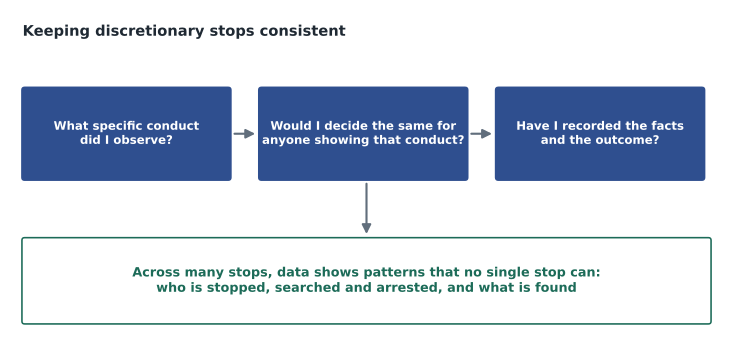
The class studied how to measure fairness in stop data in LES-105. Here Desjardins focuses on the constitutional point: an officer cannot defend a pattern by pointing to the reasonableness of each individual stop, and an officer's own good intentions do not answer a claim of adverse effect or a pattern of disparity. Officers protect equality in three practical ways. They base every stop on specific, recorded facts about behavior, never on appearance. They apply the same thresholds for stops, searches and arrests to everyone. And they support the service's collection and analysis of data, because patterns that individuals cannot see in their own work often become visible in aggregate.
Freedom of speech: the First Amendment
The First Amendment protects speech, including criticism of the police. In City of Houston v. Hill in 1987, the Supreme Court struck down an ordinance making it unlawful to interrupt an officer, holding that the freedom to verbally oppose or challenge police action without risking arrest is one of the principal characteristics of a free nation. Most federal appeals courts that have decided the question have recognized a First Amendment right to record police performing their duties in public, subject to reasonable restrictions. Officers may require people to keep a safe distance and may arrest for genuine interference, but not for recording or criticism alone. Arrests in retaliation for speech can lead to lawsuits; in Nieves v. Bartlett in 2019 the Court held that probable cause usually defeats a retaliatory arrest claim, and in Gonzalez v. Trevino in 2024 it held that a plaintiff can sometimes overcome that rule with objective evidence that others in similar situations were not arrested.
Amara Okafor asks what an officer should do when someone is filming from six feet away and shouting insults. Desjardins replays a clip from Port Ardent training: the officer continues the arrest, says once in a calm voice, 'You can record, but I need you to step back to the sidewalk,' and ignores the insults. The person keeps filming and keeps yelling, and nothing else happens. The video later shows a lawful, professional arrest and helps the officer in court. Desjardins tells the class that they should assume they are being recorded at every call and should welcome it, because a recording is often the best evidence that they did their job well.
Assembly, protest and public order
The First Amendment protects the right of the people peaceably to assemble and to petition the government. Government may impose reasonable, content-neutral restrictions on the time, place and manner of protests, such as permit requirements and limits on blocking traffic, but cannot restrict protest because of its message. Police can order a crowd to disperse when there is a clear and present danger of riot, disorder or interference with traffic, but the order must be clearly communicated and give people a real chance to leave. Mass arrests of peaceful protesters, including tactics that trap crowds before a dispersal order can be obeyed, have led to court findings and large settlements in several cities. Ohio law governs riot and failure to disperse in Revised Code 2917.04, which requires that persons be ordered to disperse and fail to do so.
Jesse Morningstar raises Indigenous land and resource protests, which have been central to many confrontations between police and communities. Desjardins agrees that they raise special issues: treaty rights, tribal sovereignty, court orders sought by companies, and the risk that police appear to act for one side of a political dispute. Experience at sites such as Standing Rock in 2016 and 2017 showed how quickly confrontations escalate when communication breaks down. Officers on these assignments need a clear legal basis for every action and a commitment to de-escalation.
Measuring a mass arrest
Port Ardent faced its own test two summers ago, when a protest against a pipeline expansion blocked the harbor road for several hours. Police made arrests in two stages: targeted arrests of people who had damaged equipment, and later a mass arrest of everyone on the road after a dispersal announcement. The program compares the outcomes of the two stages.
# Port Ardent road blockade protest: outcomes by arrest stage
stages = {
    "targeted arrests": {"arrested": 9, "charged": 8, "convicted": 6},
    "mass arrest": {"arrested": 112, "charged": 14, "convicted": 3},
}
for name, s in stages.items():
    charged = s["charged"] / s["arrested"]
    convicted = s["convicted"] / s["arrested"]
    print(f"{name:16s} arrested {s['arrested']:3d}  charged {charged:.2f}  convicted {convicted:.2f}")

released = stages["mass arrest"]["arrested"] - stages["mass arrest"]["charged"]
print("people in the mass arrest released without charge:", released)targeted arrests arrested 9 charged 0.89 convicted 0.67 mass arrest arrested 112 charged 0.12 convicted 0.03 people in the mass arrest released without charge: 98
Targeted arrests led to charges in nearly every case and convictions in two of three. The mass arrest led to charges for only about one person in eight and convictions for fewer than one in thirty: 98 people were held and released without any charge. A later review found that the dispersal announcement could not be heard at the back of the crowd. Desjardins tells the class that mass arrests of mostly peaceful people rarely produce convictions, often produce lawsuits and complaints, and almost always damage trust. Targeted action against people actually breaking the law is both more lawful and more effective.
Freedom of religion and policing
The First Amendment protects the free exercise of religion and forbids government establishment of religion, and these rights touch police work more often than students expect. Officers encounter religious dress during searches and booking, police places of worship and religious gatherings, and respond to hate crimes. Federal law, including the Religious Land Use and Institutionalized Persons Act for people in custody, protects religious exercise in detention facilities, and agencies generally accommodate religious practices where safety allows.
Desjardins tells the class about a call where a young officer, searching a man at the station, began to remove his turban in front of other prisoners. A sergeant stopped him, moved the search to a private room and called an officer who knew how to do it respectfully. Nothing was lost in safety, and the man later filed a compliment rather than a complaint. Respect for religious practice, Desjardins says, is not a special favor but part of the same equal treatment the Constitution requires.
Hate crimes and protecting expression
Police protect equality and expression in another way: by responding firmly to crimes motivated by hatred. Federal law, including the Matthew Shepard and James Byrd Jr. Hate Crimes Prevention Act of 2009, and Ohio's ethnic intimidation statute, Revised Code 2927.12, treat crimes motivated by race, religion and other protected characteristics more seriously. Speech that is merely offensive remains protected by the First Amendment; true threats, incitement to imminent lawless action and harassment are not. Officers must distinguish between protected expression, however offensive, and conduct that crosses into crime, and they must protect lawful speakers and protesters from violence even when the officers or the public disagree with the message.
Jesse asks how officers decide where that line is in the middle of a heated protest. Desjardins says the test is conduct, not viewpoint: threats, assaults, damage and genuine obstruction are policed the same way no matter which side commits them, and speech is left alone no matter how much anyone dislikes it. Officers who apply that rule consistently can defend every decision they make.
Desjardins ends the section with a point about trust. The communities most likely to see police as unfair are often the ones that most need police protection from crime, including hate crime. Every respectful search, every protest policed by its conduct rather than its message and every stop based on behavior rather than appearance is a small piece of evidence to those communities that the Constitution's promises apply to them. Linh says that if the officers who stopped her brother had explained the reason each time and recorded it, her family might have reached a different conclusion, or at least would have had something to check. Desjardins agrees that explanation and documentation are not only legal duties but the beginning of accountability.
Worked problem
Recording the Lakeshore Hardware arrest
As Brandt is arrested on Pine Street, a man on a nearby balcony films with his phone and shouts that the police are harassing a disabled kid. The probationary officer calls up, 'Stop filming or I'll take your phone as evidence.'
Show solution
- Identify the right: filming police in public and criticizing them is protected by the First Amendment.
- Ask whether the man is interfering: he is on a balcony, out of the way, and not obstructing anything.
- Assess the threat to take the phone: seizing a phone to stop recording, or threatening to, has no legal basis here and could be seen as retaliation.
- Consider evidence value: if the video may show the arrest, the right step is to ask whether the man will share it, and if needed seek a production order or warrant, not to seize it on the spot.
- Identify the better response: ignore the shouting, continue the arrest professionally, and later note the possible witness and video.
Answer: The officer's threat was improper. The recording is protected speech, and it may well become evidence that the arrest was done properly.
Common mistakes
MistakeIf each stop is reasonable, the overall pattern must be fair.
InsteadEquality looks at patterns as well as individual stops; disparities can arise from many decisions that each seem reasonable.
MistakeOfficers can order people to stop recording them.
InsteadMost federal appeals courts recognize a right to record police in public; officers can set a safe distance but not ban recording.
MistakeSwearing at an officer is grounds for arrest.
InsteadVerbal challenges to police are protected speech under Hill; arrest requires a real offense, not criticism.
MistakeArresting everyone at a protest is the safest way to restore order.
InsteadMass arrests of mostly peaceful people rarely lead to convictions and often to lawsuits; target people actually breaking the law.
Summary and key terms
- The Equal Protection Clause forbids intentional discrimination; Floyd found stop-and-frisk practices unconstitutional.
- Officers protect equality by basing stops on recorded behavior, applying consistent thresholds and supporting data analysis.
- The First Amendment protects criticism and, in most circuits, recording of police; retaliatory arrests can lead to suits.
- Protest can be regulated by content-neutral time, place and manner rules; dispersal orders must be clear and give time to leave.
- Mass arrests and trapping crowds have led to court findings and settlements.
- Targeted enforcement against actual lawbreakers is more lawful and more effective than mass arrests.
- Equal Protection Clause
- The Fourteenth Amendment guarantee against denial of equal protection of the laws.
- Selective enforcement
- Enforcing the law against people because of a protected trait such as race.
- Racial profiling
- Using race to select people for greater scrutiny.
- Retaliatory arrest
- An arrest made because of a person's protected speech.
- Time, place and manner
- Content-neutral rules that may regulate when, where and how protest happens.
- Dispersal order
- A clearly communicated order for a crowd to leave, required before arrest for failure to disperse.
Practice problems
Work each problem on paper first, then reveal the answer to check.
Why did the Court in Whren point to the Equal Protection Clause?
Show answer
Because it held that subjective motives do not affect Fourth Amendment reasonableness, so discriminatory enforcement must be challenged under equal protection.
What did City of Houston v. Hill protect?
Show answer
The freedom to verbally oppose or challenge police action without risking arrest.
In the harbor road data, how many people in the mass arrest were released without charge?
Show answer
112 minus 14, which is 98.
How should an officer respond to a bystander who films from a safe distance and shouts insults?
Show answer
Continue the work professionally, ignore the insults, set a safe distance only if needed, and note the bystander as a possible witness.
Lesson quiz · 5 questions
Score 60% or more to complete this lesson.
Create a free account to save your progress, take quizzes and earn a certificate.