
LES-111 · Lesson 3 of 12 · 20 min
Due process of law: the Fifth and Fourteenth Amendments
▶ Video coming soon A video version of this lesson is on the way.
Desjardins opens Lesson 3 with a story most of the class already knows from the news: a man who spent more than a decade in prison for a crime he did not commit, convicted on the strength of a confident eyewitness and a jailhouse informant, freed only when DNA testing pointed to someone else. He asks the class what went wrong. Priya Sandhu says the eyewitness was mistaken. Jesse Morningstar says the informant lied. Desjardins agrees, then adds a third answer that unsettles them: the police procedures made both errors more likely. The lineup was built around the suspect, the officer running it knew which photo was the suspect's, and the informant was promised a deal that the defense never heard about. Each step was a failure of what the Constitution calls due process of law.
What due process protects
The Fifth Amendment says no person shall be deprived of life, liberty or property without due process of law, and the Fourteenth Amendment imposes the same requirement on the states. Courts read due process in two ways. Procedural due process requires fair procedures before the state takes away liberty: notice, a hearing and an impartial decision maker. Substantive due process protects certain fundamental rights from government interference regardless of procedure, and forbids government conduct that shocks the conscience. In Rochin v. California in 1952, for example, the Supreme Court held that police violated due process when they had a suspect's stomach pumped to recover capsules he had swallowed.
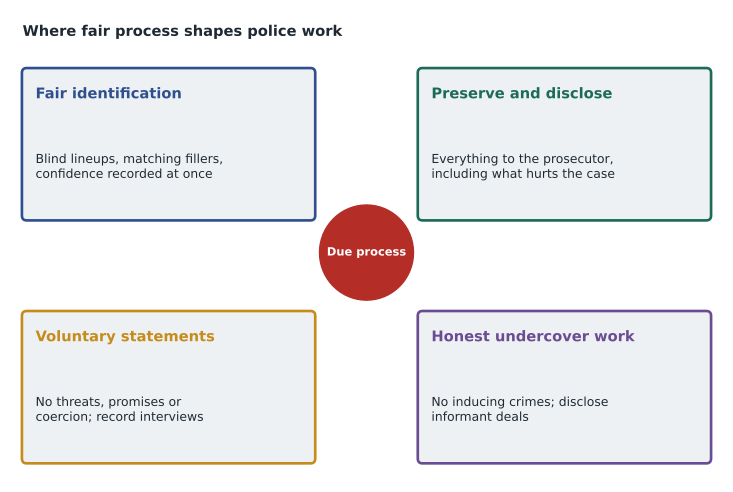
For police, due process matters most in four areas: how they conduct identification procedures, how they preserve and disclose evidence, how they question people, and how they conduct undercover and sting operations. The more specific amendments, such as the Fourth on searches and the Sixth on counsel, govern most other situations, and courts generally prefer to analyze a claim under the specific amendment when one applies.
Fair identification procedures
Mistaken eyewitness identification is the leading factor in wrongful convictions that DNA evidence later overturned. The Supreme Court has held that suggestive identification procedures can violate due process. In Manson v. Brathwaite in 1977, it said courts must ask whether, despite any suggestiveness, the identification is reliable, considering factors such as the witness's opportunity to view, attention, the accuracy of the description, certainty and the time elapsed. In Perry v. New Hampshire in 2012, it limited the rule to suggestive circumstances arranged by police. The National Academy of Sciences issued a major report on eyewitness identification in 2014, and many states, including Ohio under Revised Code 2933.83, require specific lineup procedures by law.
Good practice, drawn from both research and state law and policy, now looks broadly the same on both sides of the border. The lineup should be administered blind, by an officer who does not know which person is the suspect, so that the officer cannot give cues, even unconsciously. The witness should be told that the person may or may not be present and that the investigation will continue either way. Fillers, the non-suspects, should match the witness's description so the suspect does not stand out. Photos should be shown in a way that prevents comparison shopping, often one at a time. And the witness's confidence should be recorded in their own words immediately, before any feedback, because confidence grows after a witness is told they picked the right person.
A simple measure of lineup fairness is the mock witness test. People who never saw the crime are given only the witness's description and asked to pick who matches best from the lineup. If the lineup is fair, their picks should be spread across all the faces. If most of them pick the suspect, the lineup is suggestive, because the suspect is the only one who fits. Researchers summarize this with a number called the effective size: roughly how many faces in the lineup are real choices.
# Mock witness test for two six-person photo lineups.
# 60 people who never saw the crime read the description and pick the best match.
lineups = {
    "lineup A": [11, 9, 12, 8, 10, 10],    # suspect is position 3
    "lineup B": [4, 3, 38, 6, 5, 4],       # suspect is position 3
}
for name, picks in lineups.items():
    total = sum(picks)
    shares = [p / total for p in picks]
    # Effective size: 1 / sum of squared shares (equals 6 when picks are spread evenly)
    effective = 1 / sum(s * s for s in shares)
    suspect_share = shares[2]
print(f"{name}: suspect chosen {picks[2]} of {total} ({suspect_share:.2f}), effective size {effective:.1f}")lineup A: suspect chosen 12 of 60 (0.20), effective size 5.9 lineup B: suspect chosen 38 of 60 (0.63), effective size 2.3
In lineup A the picks are spread out, the suspect is chosen about one time in six, and the effective size is close to the full six faces. In lineup B the suspect draws 38 of 60 picks and the effective size is about 2.3: for practical purposes, the witness had only two real choices. An identification from lineup B would be weak evidence, and a court could find it unnecessarily suggestive and question its reliability.
Preserving and disclosing evidence
In Brady v. Maryland in 1963, the Supreme Court held that the prosecution violates due process when it suppresses evidence favorable to the accused that is material to guilt or punishment, regardless of good or bad faith. Giglio v. United States in 1972 extended this to evidence affecting a witness's credibility, such as promises made to an informant, and Kyles v. Whitley in 1995 made clear that the prosecutor is responsible for favorable evidence known to the police even if the prosecutor never saw it. For evidence that police fail to preserve, Arizona v. Youngblood in 1988 held that there is no due process violation unless the police acted in bad faith, although many states, by statute or under their own constitutions, protect accused persons more.
For officers, the practical rule is simple: everything goes in the file. Desjardins tells the class about a case in which an officer left out a witness's statement that the suspect was 'shorter than me', because the officer thought the witness was confused. Months later the statement surfaced, the defense argued the investigation had been shaped to fit the suspect, and the case fell apart. If the officer had included the note and explained it, there would have been nothing to argue about. Disclosure failures are rarely about hiding the truth deliberately; they are usually about an officer deciding, alone, what is relevant.
Questioning and the principle against self-incrimination
Due process requires that a confession be voluntary. Long before Miranda, the Supreme Court excluded confessions obtained by physical abuse, as in Brown v. Mississippi in 1936, and by psychological coercion such as relentless questioning, threats and promises. Courts look at the totality of the circumstances, including the suspect's age, education and mental state and the length and conditions of the questioning. In Colorado v. Connelly in 1986, the Court held that coercive police activity is a necessary part of an involuntary confession; a statement driven by the suspect's own mental illness alone does not violate due process. Lesson 8 covers voluntariness and Miranda in detail.
Undercover work, informants and entrapment
In the United States, entrapment is a defense that usually goes to the jury rather than a constitutional rule. Federal courts and most states use the subjective test: the defense succeeds if the government induced the crime and the defendant was not already predisposed to commit it. In Jacobson v. United States in 1992, the Supreme Court reversed a conviction after federal agents spent two and a half years sending a man mailings before he ordered prohibited material, holding that the government had not shown he was predisposed. Some states use an objective test that focuses on the police conduct instead. A few courts also recognize a due process defense for government conduct so outrageous that it shocks the conscience, though it rarely succeeds.
Informants raise their own due process issues. Jesse asks why police use people who might lie. Desjardins answers that informants often have information no one else can get, but their motives, whether money, leniency or revenge, have to be recorded and disclosed. Every promise, payment and prior unreliable tip belongs in the file. Under Giglio, every deal is disclosable impeachment material, and the informant's identity can be ordered disclosed where it is essential to a fair defense. An informant whose deal is hidden is the kind of witness who produces wrongful convictions.
Vague laws and police discretion
Due process forbids laws so vague that ordinary people cannot understand what is prohibited or that invite arbitrary enforcement. In Kolender v. Lawson in 1983, the Supreme Court struck down a California law that required people who loitered to provide credible and reliable identification, because it left the decision entirely to the officer. In Papachristou v. Jacksonville in 1972, it struck down a vagrancy ordinance for similar reasons. The lesson for officers is that a power which depends entirely on the officer's personal view of who seems suspicious is exactly the kind of power courts distrust.
Tunnel vision and the duty to investigate fairly
Fundamental fairness also shapes how investigations are run, not only how evidence is handled at the end. Inquiries into wrongful convictions on both sides of the border have identified tunnel vision as a recurring cause: investigators settle on a suspect early and then interpret every new fact as confirming their theory, while ignoring or explaining away facts that point elsewhere. Studies of exonerations by the National Registry of Exonerations and others have repeatedly found tunnel vision behind wrongful convictions, and many agencies now train investigators to identify and test alternative explanations.
Desjardins gives the class three habits that guard against it. First, write down every lead, including the ones that seem to point away from the suspect, and record what was done with each. Second, ask a colleague who is not invested in the case to argue the other side before charges are laid. Third, treat disconfirming evidence as just as important as confirming evidence: a witness who says the suspect was elsewhere, a fingerprint that does not match or a timeline that does not fit deserves the same effort as a piece of evidence that supports the theory. These habits are not legal requirements in themselves, but they are what fair process looks like in practice, and they produce the kind of complete file that disclosure obligations demand.
Jesse asks whether these habits slow investigations down. Desjardins concedes that they take time at the start but says they save far more at the end, because a case built on a tested theory survives cross-examination and a case built on an untested one often does not. He also points out that wrongful convictions leave the real offender free to harm someone else, so fairness to suspects and protection of the public turn out to be the same goal.
Worked problem
A lineup at Port Ardent
A woman is robbed at a bus shelter at dusk. She describes the robber as a white man in his twenties, about 5 ft 11 in, with a beard and a gray hoodie. Officers arrest a suspect nearby who matches, and a detective prepares a photo lineup. The detective, who arrested the suspect, plans to show the six photos side by side and say, 'Take your time, I think you'll recognize him.' Three of the five fillers are clean-shaven.
Show solution
- Identify the problems: the administrator knows the suspect; the instruction suggests the robber is present; the photos are shown together; and most fillers do not match the beard in the description.
- Fix the fillers: choose five fillers who match the key features of the description, including a beard, age range and build.
- Fix the administration: have an officer who does not know the suspect show the photos, preferably one at a time, with the instruction that the person may or may not be present.
- Record the result: write down the witness's words and confidence immediately, before any feedback.
- Disclose everything: the lineup, the instructions, the witness's words and any earlier failures to identify go to the prosecutor.
Answer: A fair lineup protects both the suspect and the case. A suggestive one risks a wrongful conviction and a due process challenge.
Common mistakes
MistakeA confident eyewitness is a reliable eyewitness.
InsteadConfidence is a weak guide to accuracy, especially after feedback. Record confidence immediately and use fair procedures.
MistakeOfficers can leave out information that seems irrelevant or confusing.
InsteadUnder Brady and Kyles, favorable information known to police counts as known to the prosecution; give the prosecutor everything.
MistakeUndercover officers may offer anyone the chance to commit a crime.
InsteadInducing a crime by someone who was not predisposed can make out entrapment, as in Jacobson.
MistakeDue process only matters at trial.
InsteadFair process begins in the investigation: identification, preservation of evidence and questioning all happen in the field.
Summary and key terms
- Due process requires fair procedures and forbids conduct that shocks the conscience.
- Fair identification procedures are blind, use matching fillers, warn that the person may not be present and record confidence immediately.
- The mock witness test and effective size show whether a lineup gives the witness real choices.
- Brady, Giglio and Kyles require disclosure of favorable evidence, including evidence known only to police.
- Confessions must be voluntary under the totality of the circumstances.
- Entrapment depends on inducement and lack of predisposition, as in Jacobson.
- Procedural due process
- The requirement of fair procedures before the state takes away liberty or property.
- Substantive due process
- Protection of fundamental rights and against conduct that shocks the conscience.
- Brady material
- Evidence favorable to the accused that the prosecution must disclose.
- Blind administration
- A lineup run by an officer who does not know which person is the suspect.
- Predisposition
- A defendant's readiness to commit the crime before government involvement.
- Void for vagueness
- The doctrine striking down laws too unclear to give notice or limit enforcement.
Practice problems
Work each problem on paper first, then reveal the answer to check.
Why should the officer who runs a lineup not know which person is the suspect?
Show answer
So the officer cannot give cues, even unconsciously, that steer the witness toward the suspect.
In lineup B, the suspect was chosen 38 times out of 60 by mock witnesses. What does that suggest?
Show answer
The lineup is suggestive: the suspect is the only face that fits the description, so the effective size is only about 2.3.
What did Brady require?
Show answer
That the prosecution disclose evidence favorable to the accused that is material to guilt or punishment.
What must be shown for the subjective entrapment defense to succeed?
Show answer
That the government induced the crime and the defendant was not already predisposed to commit it.
Lesson quiz · 5 questions
Score 60% or more to complete this lesson.
Create a free account to save your progress, take quizzes and earn a certificate.