
LES-111 · Lesson 12 of 12 · 19 min
Capstone: leading decisions and a constitutional review of a Port Ardent case file
▶ Video coming soon A video version of this lesson is on the way.
For the capstone, Desjardins gives each student the same assignment Prosecutor Liu performs every week: review a complete police file, step by step, and decide whether each action respected the Constitution. The file is the one the class has followed since LES-104, the Lakeshore Hardware break-in of March 14, 2026, and the arrest of Kyle Brandt. Each student must identify every point at which a right was engaged, state the authority for each police action, flag every problem, predict how a court would treat it, and recommend what officers should do differently. They must also prepare a one-page casebook of the leading decisions they relied on. Desjardins tells them that the goal is not to find someone to blame. It is to learn to see a file the way a judge will see it, months later, with the time to examine every minute.
The method
The review follows the order of events and asks the four questions from Lesson 1 at each step: what were the officers doing, what right was engaged, where did their authority come from, and what duties followed? For each step the reviewer records the facts from the notes, video and reports, the applicable rule and leading case, an assessment of whether the step was lawful, the likely consequence if it was not, and a recommendation. Amara Okafor builds a spreadsheet with one row per step. Priya Sandhu adds a column for the source of each fact, because, as she puts it, a review is only as good as the evidence for what happened. Desjardins approves both.
Step 1 and 2: the broadcast and the stop
The file begins with an alarm at 02:13 and a call at 02:14. Officer Patel's stop of Brandt at 02:29:15, about three blocks east and fifteen minutes after the alarm, rests on the broadcast description: a thin man with short dark hair, limping, carrying a black backpack, heading east. The class agrees that Patel had reasonable suspicion under Terry: the description was specific, the time and place were close, and the backpack matched. Brandt was seized when Patel told him to stop, and the stop was brief and focused. Jesse Morningstar adds a caution: the description included a limp, and Brandt had one. Without the limp and the backpack, a thin man with dark hair would describe hundreds of people, and the stop would be much weaker. The reviewer's job includes saying which facts carried the weight.
Step 3 and 4: the arrest and the backpack
At 02:29:40 the unit 12 officers arrived and saw drills sticking out of the open backpack. That observation, combined with the description and location, gave probable cause to arrest for breaking and entering. The drills were in plain view from where the officers lawfully stood, and the search of the backpack, which found three drills and a reciprocating saw with serial numbers matching the store's records, was within the area of Brandt's immediate control under Chimel and lawful as a search incident to arrest. Marco DiSanto notes that the crowbar found in the alley at 02:33 raises no issue at all: it was found in a public place, not on anyone's person, so no one had a reasonable expectation of privacy in it.
Step 5: rights and the lawyer request
Here the class finds little to criticize. Brandt was not questioned before his rights were read at 02:37, so no Miranda issue arises from the timing. He asked for a lawyer, and from that moment Edwards barred any questioning about the break-in unless counsel was present or he re-initiated. Amara recommends that the service train officers to read rights at the time of arrest whenever possible anyway, because it removes any argument about what happened in the gap. Brandt's call with a lawyer began at 03:12, about 35.5 minutes after his request, which matters less in the US system, where the key protection is that no questioning occurred in the meantime.
Step 6 and 7: the cruiser remark, the station question and the phone
Brandt's unprompted remark in the cruiser, that the owner's tools were not worth much, was volunteered. The class agrees it is likely admissible if voluntary. The probationary officer's follow-up, 'So you admit you took them?', was improper, but Brandt's answer was a denial, so little turns on it beyond a training point. The station question is more serious. The detective's 'just between us' question about the missing tools, while Brandt waited for his lawyer, violated Edwards, so the answer is inadmissible, and the pawn shop evidence is at risk if the statement is found involuntary. Finally, the phone: officers noted the visible message preview and sought a warrant before examining the messages. Linh Tran rates this step exemplary: it followed Riley exactly.
Scoring the file
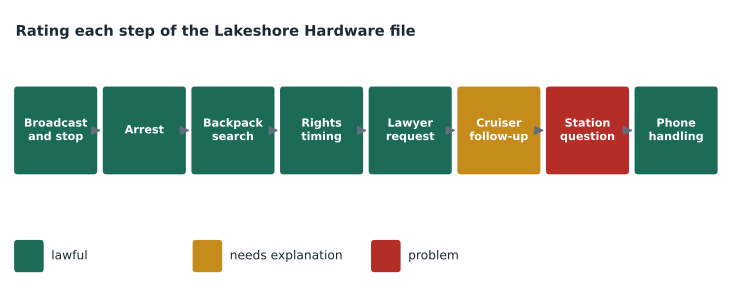
Desjardins asks the class to summarize the review numerically so that Sergeant Haddad can compare files over time. Each step gets a rating: 2 for lawful and well documented, 1 for lawful but needing explanation, and 0 for a problem likely to cost evidence. The program totals the ratings and lists the steps that need attention.
# Capstone review of the Lakeshore Hardware file (US version)
steps = [
    ("broadcast and stop", 2),
    ("arrest", 2),
    ("backpack search", 2),
    ("rights advice timing", 2),
    ("lawyer request honored", 2),
    ("cruiser follow-up question", 1),
    ("station question", 0),
    ("phone handling", 2),
]
score = sum(r for _, r in steps)
best = 2 * len(steps)
print("file score:", score, "of", best, "->", round(score / best, 2))
for name, r in steps:
    if r < 2:
        label = "problem" if r == 0 else "needs explanation"
print(f" {name}: {label}")file score: 13 of 16 -> 0.81 cruiser follow-up question: needs explanation station question: problem
The file scores 13 out of 16. One step, the station question, is a genuine problem, and one needs explanation. Haddad tells the class that this is a typical profile for a solid file: the core of the investigation was lawful, and the problems came from small departures late in the process, when officers were tired and the urgency had passed. She will use the review to coach the detective and the probationary officer, and to remind the platoon that the rules apply just as strictly at 4 a.m. in the station as at 2 a.m. on the street.
The casebook
Each student's casebook lists the leading decisions they used, with a one-line statement of what each case decided and why it mattered to the file. Desjardins's model casebook, distributed after the assignment, is below. He reminds the class that the law keeps changing, so a casebook is a living document: officers should check for new decisions every year, and their services' legal advisors publish updates when an important case comes down.
| Topic | Leading case | What it means for officers |
|---|---|---|
| Searches | Katz v. United States (1967); Mapp v. Ohio (1961) | Privacy expectations define searches; unlawful evidence is excluded in state courts |
| Detention or stops | Terry v. Ohio (1968); Rodriguez v. United States (2015) | Stops need reasonable suspicion and must not outlast their mission |
| Counsel | Miranda v. Arizona (1966); Edwards v. Arizona (1981) | Warn before custodial interrogation; stop questioning after a request for counsel |
| Statements | Missouri v. Seibert (2004); Berghuis v. Thompkins (2010) | No question-first tactics; invocations must be clear |
| Phones | Riley v. California (2014); Carpenter v. United States (2018) | Get a warrant for phones and long-term location data |
| Exclusion | United States v. Leon (1984); Utah v. Strieff (2016) | Exceptions can admit evidence, but deterrence remains the purpose |
Writing the review
The final product is a short written review, addressed to Sergeant Haddad, that a busy supervisor can read in ten minutes. Desjardins gives the class a structure: a two-sentence summary of the file and the overall assessment; the steps in order, each with facts, rule, assessment and recommendation; a list of the problems ranked by consequence; and two or three training recommendations. He asks them to write in the plain, neutral style they practiced in LES-104: no blame, no adjectives, just what happened, what the law requires and what to do next time. Linh asks whether the review should mention what went well. Desjardins says yes, always: officers learn as much from seeing good practice named as from seeing mistakes, and a review that only criticizes will not be read with an open mind.
He closes the course by returning to the pocket Constitution from Lesson 1. The rights in it, he says, are not obstacles placed in the way of police work. They describe what fair police work looks like: stopping people for reasons, telling them why, letting them speak to a lawyer, searching only with authority, and never pressuring anyone into a statement. Officers who do those things consistently build cases that hold up in court and communities that trust them. The class's next course, LES-112, turns these principles into detailed procedures for arrest, search and detention.
Using the review to improve practice
A review is only useful if someone acts on it. Haddad explains how Port Ardent uses file reviews. Each month, sergeants review a sample of files from their platoons using the same method as the capstone, and the results go into a simple tracking sheet. Patterns that show up in more than one file, such as rights advice delayed while officers secure a scene, or phones examined before a warrant arrives, become topics for the next shift briefing. Individual problems are handled through coaching, and repeated problems through a formal improvement plan. The goal, she says, is to catch habits early, while they are still small.
She also describes how reviews feed back into policy. When reviews showed that officers were unsure how to handle volunteered remarks from detainees waiting for a lawyer, the service added a short section to its custody procedures and a laminated reminder in every cruiser. When reviews showed that warrant applications for phones often lacked a clear time window, the legal advisor created a template. Each change came from a pattern in the files, not from a single incident, and each was simple enough to use at three in the morning.
Desjardins tells the class that the officers who become the best reviewers are usually the ones who have reviewed their own files first. He encourages each student to keep a habit, once they are working, of rereading their own notes and reports a day after a significant arrest and asking the four questions from Lesson 1. Problems caught that way can often be fixed through proper late entries and early disclosure, before they become issues in court.
Worked problem
Ranking the problems
Using the review, the class must rank the problems in the Lakeshore Hardware file by their likely consequence and propose one training fix for each.
Show solution
- List the problems: the probationary officer's follow-up question in the cruiser and the detective's station question.
- Rank by consequence: the station question is first, because it costs the statement and puts the pawn shop evidence at risk; the cruiser question is second, because the answer was a denial.
- Propose fixes: a clear station protocol that no one speaks to a detainee about the offense while a lawyer call is pending; a reminder to give rights advice immediately or note the safety reason for delay; and coaching for new officers on responding to volunteered remarks.
- Name what went well: a specific broadcast, a lawful stop and arrest, a properly connected search, careful phone handling and accurate timekeeping.
- State the overall assessment in two sentences.
Answer: The core of the investigation was lawful; one late, avoidable question created the only serious problem. The fixes are simple and cost nothing.
Common mistakes
MistakeA file review is about finding someone to blame.
InsteadThe purpose is to see the file as a court will and to improve practice; name what went well as well as the problems.
MistakeIf the main evidence is lawful, small problems do not matter.
InsteadSmall departures can cost statements and derivative evidence and damage credibility; they also reveal habits that matter in other cases.
MistakeA casebook only needs to be learned once.
InsteadThe law changes with new decisions; review the casebook every year and follow legal updates.
MistakeReviews should be detailed and technical.
InsteadA good review is short, plain and neutral, with facts, rules, assessments and recommendations a supervisor can act on.
Summary and key terms
- A constitutional file review follows events in order and asks the four questions at each step.
- Each step needs facts from the record, the rule and leading case, an assessment, the likely consequence and a recommendation.
- In the Lakeshore Hardware file, the stop, arrest, search and phone handling were lawful; the station question was the serious problem.
- Scoring steps lets supervisors compare files and target training.
- A casebook of leading decisions is a living document that officers update as the law changes.
- Constitutional rights describe what fair, effective police work looks like.
- File review
- A step-by-step examination of an investigation to assess whether each action was lawful.
- Casebook
- A summary of leading decisions and what each means for police practice.
- Training recommendation
- A specific change in practice proposed to prevent a problem from recurring.
- Derivative evidence
- Evidence found as a result of earlier evidence, such as items located because of a statement.
- Plain view
- Seeing evidence from a lawful position, as with the drills in the backpack.
- Neutral style
- Writing that states facts and rules without blame or loaded language.
Practice problems
Work each problem on paper first, then reveal the answer to check.
What four questions does the review ask at each step?
Show answer
What were the officers doing, what right was engaged, where did their authority come from, and what duties followed?
Why was the crowbar found in the alley not a constitutional issue?
Show answer
It was in a public place, not on anyone's person or property, so no one had a reasonable expectation of privacy in it.
Which step in the Lakeshore Hardware file was the most serious problem, and why?
Show answer
The detective's station question while Brandt waited for his lawyer, because it violated the rules on questioning after a request for counsel and puts the statement and derivative evidence at risk.
Why should a review name what went well?
Show answer
Officers learn from seeing good practice named, and a review that only criticizes will not be read with an open mind.
Lesson quiz · 5 questions
Score 60% or more to complete this lesson.
Create a free account to save your progress, take quizzes and earn a certificate.