
IRW-210 · Lesson 7 of 12 · 23 min
High-strength bolts and tightening methods
▶ Video coming soon A video version of this lesson is on the way.
The bolt-up crew follows the connectors through the frame, and at Ashcroft the bolt-up crew was Nate. On the morning of September 30, before the first brace connections were tightened, he set a tension calibrator on a bench in the site trailer, a heavy steel cylinder with a dial gauge on top and a hole through the middle for a bolt. With Shay holding the bolt head and the general contractor's inspector watching, he put three twist-off bolts from the lot on the job through the calibrator, one at a time, and tightened each with the spline wrench until the spline snapped off. Each time, he read the gauge and wrote the number on his sheet. All three were above the minimum. "Now we know this lot, this wrench and this method work," he said. "Now we can start."
This lesson covers the high-strength bolts used in steel frames and how to recognize them, how bolts are stored and handled, and the methods used to bring bolts to their snug-tight condition and to their specified pretension: turn-of-nut, calibrated wrench, twist-off bolts and direct tension indicators.
High-strength structural bolts
Structural bolts on most building jobs are made to ASTM F3125, which brought several older bolt standards together. Its main grades are A325 and A490, which are heavy hex bolts, and F1852 and F2280, which are twist-off bolts with the same strengths as A325 and A490. A490 and F2280 bolts are stronger, but they are also less forgiving: they are not galvanized, and they are more sensitive to over-tightening and to reuse. The most common sizes in buildings are 3/4 in and 7/8 in, and the Linwood and Ashcroft jobs used 3/4 in bolts.
Every structural bolt is marked on its head with its grade and the manufacturer's mark. Nuts and washers are made to their own standards and carry their own marks: heavy hex nuts of the grade the bolt standard calls for, and hardened washers to ASTM F436. A bolt with no grade mark on its head is not a structural bolt and does not go into a structural connection.
| Grade | Type | Typical use |
|---|---|---|
| A325 | Heavy hex bolt | Most building connections; may be galvanized |
| A490 | Heavy hex bolt, higher strength | Heavier connections; not galvanized; not reused |
| F1852 | Twist-off bolt, A325 strength | Pretensioned and slip-critical joints |
| F2280 | Twist-off bolt, A490 strength | Heavier pretensioned and slip-critical joints |
Storage and handling
High-strength bolts are supplied lubricated, and the lubricant is part of how they reach their pretension. Bolts left out in the rain, or in an open keg in the dust, lose their lubricant and pick up rust and grit; they then need much more torque to reach the same tension, and they may fail the pre-installation check or twist off before they are tight. The rules are simple: keep bolts in closed, labeled containers out of the weather; take out only what will be installed that shift; return unused bolts to their containers at the end of the day; never clean them; and never mix lots. Twist-off bolts in particular may not be relubricated in the field.
Snug-tight comes first
Every tightening method starts the same way: the joint is brought to the snug-tight condition, with all the plies in firm contact. In a joint with many bolts, tightening one bolt pulls the plies together near it but can loosen its neighbors, so snugging is done systematically, starting at the most rigid part of the joint, usually the middle of a bolt group or the end next to a stiff member, and working out toward the free edges. More than one pass may be needed until every bolt is snug and the plies are together. On a snug-tight joint, this is the end of the job. On a pretensioned or slip-critical joint, it is the starting point.
Turn-of-nut
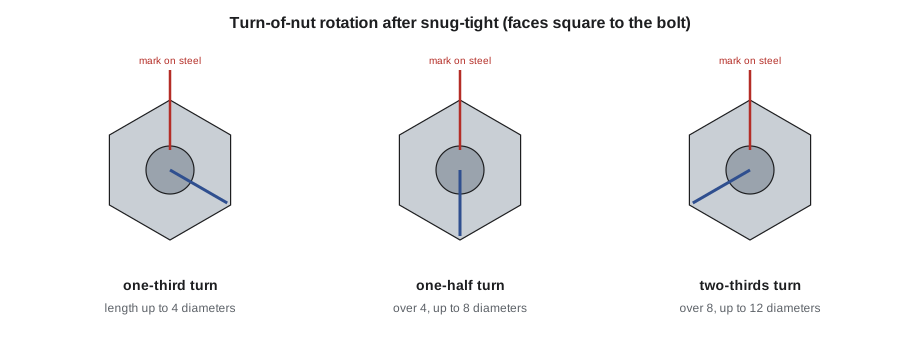
The turn-of-nut method relies on the fact that once a joint is snug, turning the nut a set amount stretches the bolt by a predictable amount and gives it at least the required pretension. After snugging, the crew often marks each nut, the end of its bolt and the steel with a single straight line, called match-marking. The nut is then turned the required rotation while a second wrench holds the bolt head, so that the bolt does not turn with the nut. The match marks show at a glance how far each nut has turned and whether the bolt turned with it.
The required rotation depends on the bolt's length compared with its diameter. For bolts with both faces of the joint square to the bolt, the RCSC Specification gives one-third of a turn for bolts up to four diameters long, one-half of a turn for bolts more than four and up to eight diameters, and two-thirds of a turn for bolts more than eight and up to twelve diameters. Longer bolts, and joints with sloped faces, need more rotation or testing to find the rotation, and the specification sets out how.
The rotation values come from the RCSC Specification, which the AISC specification and most project specifications adopt.
Worked problem
How far to turn
Three 3/4 in bolts are to be pretensioned by turn-of-nut in joints whose faces are square to the bolts. Their lengths are 2-1/2 in, 3-1/2 in and 6 in. How much rotation does each need after snug-tight?
Show solution
- Diameter = 0.75 in, so 4 diameters = 3 in, 8 diameters = 6 in and 12 diameters = 9 in.
- 2-1/2 in bolt: 2.5 ÷ 0.75 = 3.33 diameters, not more than 4, so one-third of a turn (120 degrees).
- 3-1/2 in bolt: 3.5 ÷ 0.75 = 4.67 diameters, more than 4 and not more than 8, so one-half of a turn (180 degrees).
- 6 in bolt: 6 ÷ 0.75 = 8.0 diameters, which is not more than 8, so one-half of a turn (180 degrees).
Answer: One-third, one-half and one-half of a turn. Bolt length is measured from under the head to the end of the bolt. The 6 in bolt sits exactly on the boundary and takes the shorter rotation; a 6-1/2 in bolt would take two-thirds.
Calibrated wrench
The calibrated wrench method uses a torque wrench or a powered wrench set to stop at a torque that has been shown, on that day and with those bolts, to give the required pretension. The calibration is done in a tension calibrator using bolts from the lot being installed, at least daily, and again whenever the lot, the wrench or the conditions change. Torque tables in catalogs are not used, because the torque needed varies widely with lubrication, rust and the condition of the threads. Hardened washers go under the element being turned, and the RCSC Specification does not allow the method where the bolt head, rather than the nut, is the part being turned. Of the four methods, it is the most sensitive to how bolts were stored and handled.
Twist-off bolts
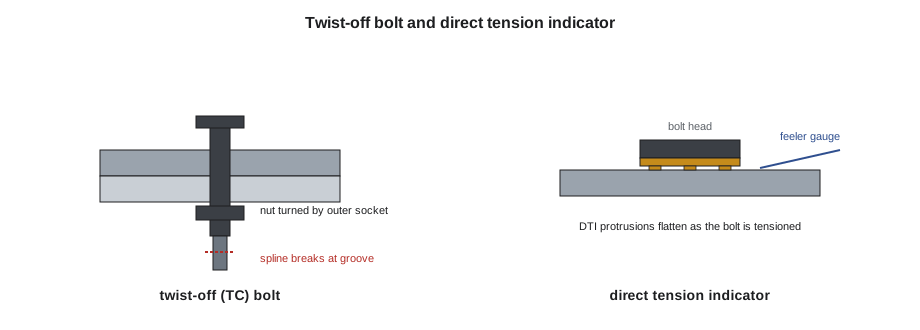
Twist-off bolts, also called tension-control or TC bolts, have a splined end beyond the threads. A special electric wrench holds the spline with an inner socket and turns the nut with an outer socket; when the torque reaches the value the bolt was made for, the spline twists off at a groove. The broken spline shows that the bolt reached that torque, which with properly stored bolts gives the required pretension.
The broken spline shows only that the torque was reached, not that the joint was snug first. A twist-off bolt installed in a joint that was not systematically snugged may break its spline while the plies are still apart, and when the neighboring bolts pull the plies together, it loses most of its tension. The method therefore requires the same systematic snugging as the others, usually with the spline wrench stopped before the spline breaks, followed by a second pass that breaks the splines in order. A twist-off bolt that has had its spline broken and is then loosened is replaced, never reinstalled.
Direct tension indicators
A direct tension indicator, or DTI, is a hardened washer made to ASTM F959 with small bumps, called protrusions, on one face. It goes under the bolt head or under the nut, as the maker's instructions say, with the protrusions against the head or nut. As the bolt is tightened, the protrusions flatten. The gaps between the DTI and the surface are checked with a feeler gauge of a stated thickness, and when the gauge is refused in the number of spaces the standard and the maker's instructions call for, the bolt has reached its pretension. Some DTIs squirt a colored silicone from the protrusions as they flatten, as a visual sign.
DTIs are sensitive to how they are installed. They must face the right way, and on the right side of the joint for the element being turned, and they must not be over-compressed: a DTI flattened completely may mean an overloaded bolt. Because they are hardened and deformed, they are used once only.
Pre-installation verification
Before any pretensioned or slip-critical bolting begins, and whenever the lot or the conditions change, the crew proves that the bolts, the method and the workers together produce the required pretension. For each combination of bolt diameter, length, grade and lot, at least three complete assemblies are tightened in a tension calibrator by the method that will be used on the job, and each must reach at least 1.05 times the specified minimum pretension. The test also confirms that snug-tight is being reached properly and that washers are in the right places. Bolts too short to fit the calibrator are tested by other methods the specification describes, such as in a steel plate with holes of the right size.
The minimum pretensions are listed in the RCSC Specification. For 3/4 in A325 bolts the minimum pretension is 28 kips, and for 7/8 in A325 bolts it is 39 kips.
Worked problem
Checking a calibrator reading
Nate tests three 3/4 in F1852 twist-off bolts from the Ashcroft lot, whose minimum pretension is the same as A325, 28 kips. The calibrator reads 31.2, 30.6 and 32.0 kips. Do they pass?
Show solution
- Required = 1.05 × 28 = 29.4 kips.
- Lowest reading = 30.6 kips.
- 30.6 is more than 29.4.
Answer: All three pass, so installation may begin with that lot, that wrench and that method. If one had read 28.8 kips, the reason would be found and fixed, often by replacing the lot or checking the storage, before any bolts were installed.
Reuse of bolts
A490 and F2280 bolts, and galvanized A325 bolts, are never reused once they have been pretensioned. Other A325 bolts may be retightened only if the engineer of record approves, and touching up a bolt that was loosened by the tightening of its neighbors is not reuse. When in doubt, the bolt is replaced. Used bolts are kept separate from new ones and do not go back into the keg.
A bolting procedure on the job
Nate's written procedure for the twist-off brace bolts at Ashcroft and Linwood ran to one page, and it followed the specification step by step. Bolts drawn from a closed keg, one lot at a time, with the lot number written on the area checklist. Pre-installation verification at the start of the job and whenever the lot changed. Each gusset assembled with all its bolts and washers, and the plies drawn together with the spline wrench stopped short of breaking the splines, working from the middle of the bolt group out. Ply contact checked with a feeler blade at the edges. Splines then broken in the same order, middle out. Broken splines collected in a bucket, not left on the steel. Any bolt whose spline broke before the joint was snug, or that was loosened afterwards, removed and replaced with a new assembly. The procedure was laminated and kept in the gang box, and every new hand on the bolt-up crew read it before touching a spline wrench.
The same discipline applies to the other methods. A turn-of-nut crew match-marks every bolt after snugging, turns the nuts the required amount while a partner holds the heads, and checks the marks before moving on. A DTI crew checks the orientation of every DTI before the bolt goes in, and checks the gaps with the gauge before calling the joint done. A calibrated wrench crew calibrates at the start of every shift and records it.
Tools and their care
Impact wrenches, spline wrenches and torque wrenches are precision tools as well as heavy ones. Spline wrenches need sockets that match the bolt size and are not worn, or they slip and damage the spline before it breaks. Torque wrenches for the calibrated wrench method are checked against the calibrator, not trusted from their dial. Tension calibrators themselves are calibrated at least once a year by a laboratory, and the calibration sticker is checked before each use. Batteries and air supplies matter too: a weak battery or a low air pressure can leave a wrench unable to reach the torque it needs, and the crew may not notice until the inspector does.
Common mistakes
MistakeLeaving bolt kegs open in the weather.
InsteadKeep bolts in closed containers and take out only a shift's worth.
MistakeUsing a catalog torque value for the calibrated wrench method.
InsteadCalibrate daily with bolts from the lot on the job.
MistakeBreaking twist-off splines one bolt at a time before the joint is snug.
InsteadSnug the whole joint systematically, then break the splines in order.
MistakeLetting the bolt turn with the nut during turn-of-nut.
InsteadHold the bolt head and watch the match marks.
MistakeReinstalling a loosened twist-off or A490 bolt.
InsteadReplace it with a new assembly.
Summary and key terms
- Most structural bolts are ASTM F3125 Grade A325 or A490, or the twist-off grades F1852 and F2280.
- Store bolts closed, dry and by lot; never clean or relubricate twist-off bolts.
- Every method starts with systematic snug-tightening from the most rigid part outward.
- Turn-of-nut: one-third, one-half or two-thirds of a turn by length in diameters, for square faces.
- Calibrated wrench, twist-off bolts and DTIs each have their own rules; the specification says which are allowed.
- Pre-installation verification: at least three assemblies per combination must reach 1.05 times the minimum pretension.
- ASTM F3125
- The standard covering A325, A490, F1852 and F2280 structural bolts.
- Twist-off bolt
- A bolt with a spline that breaks off when the installation torque is reached.
- Turn-of-nut method
- Pretensioning by turning the nut a set rotation from snug-tight.
- Match-marking
- Marking nut, bolt end and steel to show rotation.
- Calibrated wrench method
- Pretensioning with a wrench set by daily calibration.
- Direct tension indicator
- A washer with protrusions that flatten as the bolt is tensioned.
- Tension calibrator
- A device that reads the tension in a bolt installed in it.
- Pre-installation verification
- Testing bolts, method and workers before pretensioning begins.
Practice problems
Work each problem on paper first, then reveal the answer to check.
What rotation does a 7/8 in bolt 3 in long need by turn-of-nut, faces square?
Show answer
3 ÷ 0.875 = 3.4 diameters, so one-third of a turn.
What is 1.05 times 39 kips?
Show answer
40.95 kips, about 41 kips.
Why are bolts kept in closed containers?
Show answer
Rain and dirt remove the lubricant and change the tension reached.
A twist-off spline broke before the plies were together. What now?
Show answer
Replace the bolt after the joint is snug.
May a pretensioned A490 bolt be reused?
Show answer
No.
Lesson quiz · 5 questions
Score 60% or more to complete this lesson.
Create a free account to save your progress, take quizzes and earn a certificate.